Financial Consolidation for Retail Chains: How Multi-Entity Retail Businesses Get Clean Group Accounts
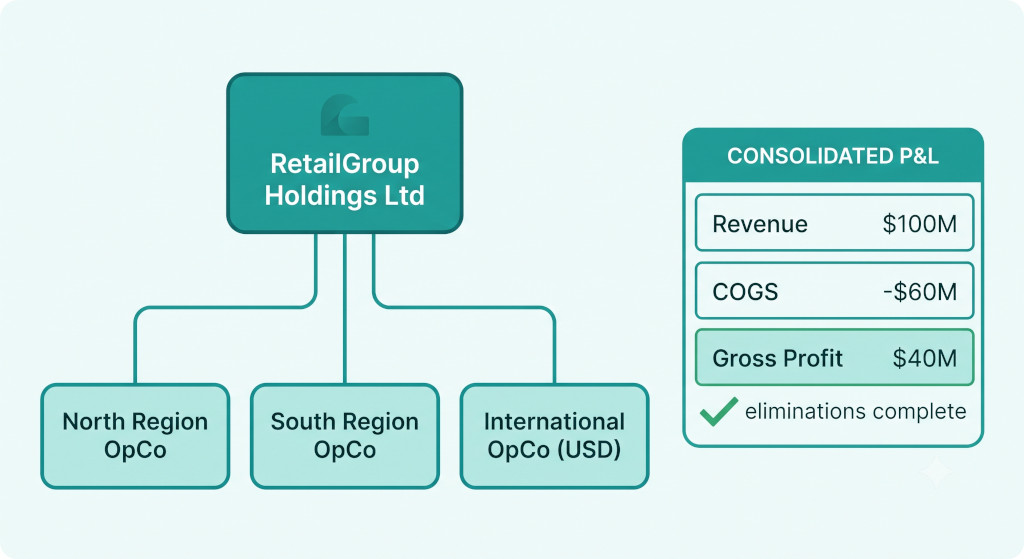
Emma is Group Finance Manager at a retail business that sells homewares through 28 stores across three countries. On paper, the group is straightforward: a UK holding company, two domestic operating companies split by region, and one overseas subsidiary trading in Australian dollars. In practice, the month-end close takes eleven working days. The holding company charges management fees to each OpCo. The buying entity purchases stock centrally and transfers it to the regional trading companies at a mark-up. And the Australian subsidiary needs its accounts translated before Emma can even begin building a group P&L.
By day eight, Emma is still reconciling intercompany balances in a spreadsheet that has twenty-three tabs. Financial consolidation for retail chains involves every complicating factor that makes group accounting difficult — intercompany inventory flows, management fee arrangements, multi-currency translation, and the need to strip out intra-group profit before showing results to the board.
This guide walks through how retail groups are structured, where the consolidation complexity comes from, and how a purpose-built platform replaces the spreadsheet with an automated, auditable process.
Automate NCI calculations across all your entities.
BrizoConsol handles non-controlling interest automatically — no manual adjustments required.
What Makes Retail Chain Consolidation Harder Than Most Sectors
| Challenge | Why it’s retail-specific |
|---|---|
| Intercompany stock transfers and unrealised profit | Central buying entities supply trading OpCos at a mark-up — the margin embedded in unsold closing stock must be recalculated and eliminated every period |
| Management fees and royalties | Holding entities charge multiple OpCos monthly — matching and eliminating intercompany balances across payers is error-prone without automation |
| Multi-currency translation | Overseas subsidiaries require three different exchange rates applied correctly — closing rate for the balance sheet, average rate for P&L, historical rate for equity — with the residual going to the CTA reserve |
| Inconsistent charts of accounts | Groups grown through acquisition or running different platforms across regions have divergent account naming — every entity must be mapped to a common group structure before consolidation can run |
How Retail Groups Are Typically Structured
Most retail chains that need to produce consolidated accounts share a recognisable architecture, even if the details vary:
- A holding company owns the subsidiaries, holds intellectual property (brand name, trademarks), and often employs senior management. It charges management fees or royalties downward to the trading entities.
- One or more domestic operating companies, often divided by region, channel (bricks-and-mortar vs. online), or brand. Each has its own set of accounts in the same ERP or accounting package.
- A central buying entity in some groups, which procures stock and on-sells it to the trading companies at a transfer price. This creates intercompany inventory transactions that must be eliminated at consolidation.
- International subsidiaries trading in local currencies, typically reporting under local GAAP before being translated into the group presentation currency at consolidation.
The legal structure rarely matches the management view. A group might have six legal entities but want to report P&L by brand, by channel, or by geography — requiring segment cuts that cross entity lines.
The Consolidation Challenges Unique to Retail Chains
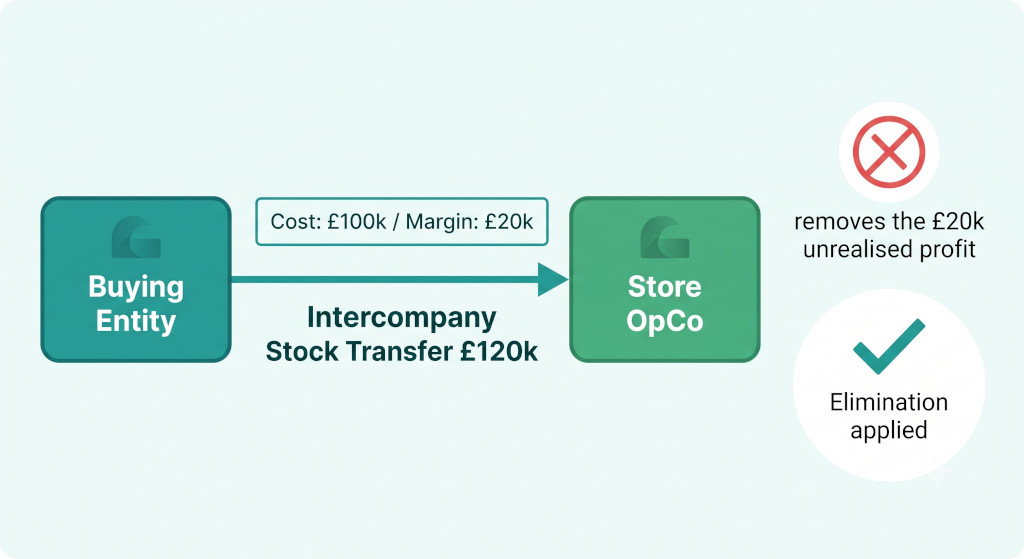
Retail groups face four consolidation challenges that do not arise (or arise less acutely) in service businesses.
1. Intercompany stock transfers and unrealised profit
When a buying entity purchases 1,000 units at £100 each and transfers them to a trading OpCo at £120 each, the group accounts must eliminate the £20 per unit margin. If any stock remains unsold at month-end — which in retail is almost always — that unrealised intra-group profit sits on the consolidated balance sheet. Identifying the closing stock quantity, calculating the unrealised margin, and posting the elimination journal is one of the most labour-intensive consolidation tasks in a retail group. The figure changes every period as inventory levels shift.
2. Management fees and royalty charges
The holding company’s management fee invoices to the trading companies appear as income in the holding entity and as an expense in the subsidiaries. At consolidation, both sides cancel. The same applies to royalties charged for use of the brand. These are straightforward to eliminate in principle, but when there are multiple payers and the amounts change month to month, matching the intercompany balances manually becomes error-prone.
3. Multi-currency translation
An overseas subsidiary typically reports in its local currency. Before it can be included in the consolidated group accounts, its P&L must be translated at the average exchange rate for the period, its balance sheet at the closing rate, and its equity at historical rates. The difference goes into the cumulative translation adjustment (CTA) reserve in equity — not through profit or loss. Getting this right requires applying three different rates consistently and reconciling any movement each period.
4. Different chart-of-accounts structures across entities
A group that has grown through acquisition, or that runs different accounting packages in different regions, typically has inconsistent account naming and numbering. “Cost of goods sold” might appear under different codes in each entity. Before consolidation, every entity’s accounts must be mapped to a common group chart of accounts — and that mapping must be maintained as entities add or change accounts.
A Practical Example: RetailGroup Holdings
RetailGroup Holdings Ltd owns three subsidiaries: North Region Ltd, South Region Ltd, and RetailGroup Australia Pty Ltd. The Australian entity reports in AUD; the group presentation currency is GBP. At the March year-end, the raw trial balance data looks like this before eliminations:
| Entity | Revenue (£) | Intercompany Income (£) | COGS (£) | Gross Profit (£) |
|---|---|---|---|---|
| Holdings Ltd (management fees) | — | 480,000 | — | 480,000 |
| North Region Ltd | 3,200,000 | — | 1,760,000 | 1,440,000 |
| South Region Ltd | 2,700,000 | — | 1,485,000 | 1,215,000 |
| RetailGroup Australia (translated) | 1,100,000 | — | 616,000 | 484,000 |
| Combined (pre-elimination) | 7,000,000 | 480,000 | 3,861,000 | 3,619,000 |
The combined revenue of £7,000,000 includes the £480,000 management fee charged by Holdings to the two domestic OpCos. That fee does not represent a sale to an external customer — it is income within the group. Similarly, COGS in the OpCos includes the mark-up on stock supplied by a central buying function within Holdings. Both must be eliminated before the consolidated P&L is meaningful.
After applying intercompany eliminations, the consolidated P&L looks very different:
| Line Item | Amount (£) |
|---|---|
| External Revenue | 7,000,000 |
| Less: Intercompany management fee elimination | (480,000) |
| Consolidated Revenue | 6,520,000 |
| COGS (post stock transfer elimination) | (3,601,000) |
| Consolidated Gross Profit | 2,919,000 |
| Consolidated Gross Margin | 44.8% |
The stock transfer elimination reduces COGS by £260,000, reflecting the unrealised profit on inventory still held by the trading entities at period end. In a spreadsheet, calculating that figure requires someone to know the closing stock units by entity, the transfer price, and the cost to the buying entity — and to update it every month.
The most common error in retail consolidations is forgetting that the unrealised profit elimination is not a fixed monthly journal. It must be recalculated each period based on actual closing inventory. A prior-year elimination reverses in the current period, and a new one is posted based on the new stock position.
The Intercompany Elimination Journal in Practice
For a retail group that uses a central buying entity, the key eliminations at consolidation are as follows. These should form part of any structured multi-entity month-end close checklist.
Elimination 1 — Management fee income and expense
| Dr £ | Cr £ | |
|---|---|---|
| Management Fee Income (Holdings) | 480,000 | |
| Management Fee Expense (OpCos) | 480,000 | |
| Total | 480,000 | 480,000 |
Eliminates the intra-group service charge. No net effect on consolidated equity.
Elimination 2 — Intercompany stock transfer mark-up (unrealised profit)
| Dr £ | Cr £ | |
|---|---|---|
| Cost of Sales | 260,000 | |
| Inventory (Consolidated Balance Sheet) | 260,000 | |
| Total | 260,000 | 260,000 |
Removes the intra-group profit margin embedded in closing inventory. Reduces both COGS and the carrying value of stock on the consolidated balance sheet. Reverses in the following period.
Elimination 3 — Intercompany balance on management fee payable/receivable
| Dr £ | Cr £ | |
|---|---|---|
| Intercompany Payable (OpCos) | 120,000 | |
| Intercompany Receivable (Holdings) | 120,000 | |
| Total | 120,000 | 120,000 |
Clears the balance sheet intercompany balance. Any difference indicates timing or reconciling items that must be investigated before the consolidated balance sheet can be finalised.
Currency Translation for International Retail Entities
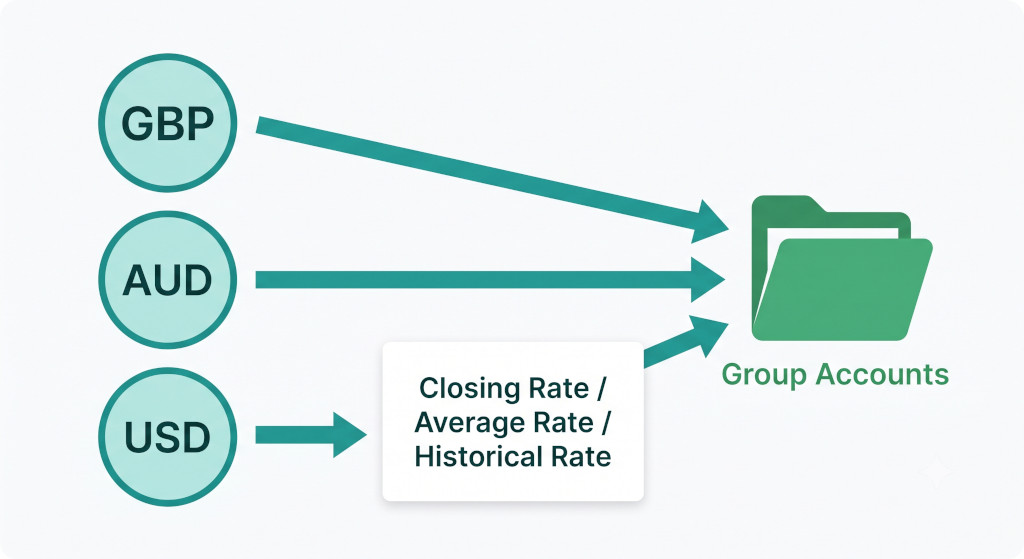
RetailGroup Australia Pty Ltd reports in AUD. Before its accounts can be included in the GBP consolidated group accounts, every line must be translated. The rules under IAS 21 (and equivalent standards) are consistent: income statement items translate at the average rate for the period; balance sheet assets and liabilities translate at the closing rate; equity translates at historical rates (the rates at which capital was contributed). The residual difference — arising because the balance sheet and P&L use different rates — goes into the cumulative translation adjustment (CTA) reserve in equity.
For retail groups with multiple international subsidiaries, tracking the CTA movement period by period is one of the most error-prone elements of the consolidation. Each subsidiary has its own CTA balance that compounds over time as exchange rates move. A manual spreadsheet approach requires the preparer to track opening CTA, add the current-period movement, and reconcile to the closing balance — for every overseas entity, every period.
Getting this right is not optional. Auditors will request a CTA roll-forward as standard. If the CTA cannot be reconciled, the consolidated balance sheet does not balance — which is often the trigger for those late-night close conversations that retail finance teams dread.
What Retail Group Consolidation Should Actually Look Like
A well-run retail chain consolidation process has four defining characteristics.
Intercompany transactions are matched and eliminated automatically. The system knows which accounts represent intra-group flows and posts the eliminations without manual intervention.
Unrealised profit on intercompany stock is calculated from live inventory data. Not estimated from last month’s figure — recalculated each period from the actual closing stock position.
Currency translation is applied consistently. All overseas entities use a centrally maintained exchange rate table, with the CTA tracked and reconciled automatically each period.
Consolidated reports are available within 24 to 48 hours of the last entity closing. Not at the end of the following week.
The gap between this standard and the reality at most growing retail groups is the reason financial consolidation software exists. The spreadsheet approach is not fundamentally wrong — it is just too fragile, too slow, and too dependent on the knowledge of one or two people who know where every formula is.
How BrizoConsol Handles Retail Group Consolidation
BrizoConsol connects directly to Xero, QuickBooks, MYOB, and Zoho Books — the accounting packages most commonly used by mid-market retail groups. Once connected, it pulls trial balance data from every entity each month without manual export or reformatting.
| Capability | What it does for retail groups |
|---|---|
| AI Auto-Map | Identifies how each entity’s account codes relate to the group chart of accounts and learns from corrections — eliminates the manual mapping burden for groups with inconsistent account naming |
| Automated intercompany eliminations | Management fees, intercompany loans, stock transfers, and dividends configured once and applied every period; unrealised profit calculated from the transfer price margin and closing inventory position |
| IAS 21 currency translation | Closing and average rates maintained in the platform; CTA calculated and tracked automatically for each overseas subsidiary; CTA roll-forward available as a standard report for audit |
| Consolidated statements on demand | P&L, balance sheet, and cash flow available immediately once eliminations and translation are applied — not at the end of a multi-day manual process |
| Virtual Groups for segment reporting | Cut the same data by brand, channel, or geography without additional legal entities — gives both a statutory consolidated view and a management reporting view from the same data set |
The close process that previously took eleven days compresses to two or three. The board receives its pack on the fourth working day of the month rather than the twelfth.
For retail groups running on Xero or QuickBooks across domestic and international entities, the biggest time saving is not the eliminations — it is the elimination of the export, reformat, and re-import cycle that precedes every manual consolidation. That alone typically saves three to four days per period.
Getting Started: What Retail Groups Need to Prepare
Before connecting entities to a consolidation platform, retail finance teams should complete three preparatory steps:
1. Agree the group chart of accounts
Define the common structure to which all entity accounts will be mapped. It does not need to be complex, but it must cover every account type present across the group — including intercompany accounts.
2. Document all intercompany arrangements
Record which entities charge management fees, at what rate, whether there is a transfer pricing policy for stock movements, and which balance sheet accounts carry intercompany balances. This is the foundation for configuring elimination rules.
3. Obtain historical exchange rates for overseas subsidiaries
Specifically, the rate at which the original equity in each subsidiary was contributed. This supports the CTA calculation from the outset and avoids a reconciliation gap in the first consolidated close.
With those three inputs in place, BrizoConsol can typically be set up and producing consolidated output within a single working day. The first period may take longer as mapping is refined, but by the second close most retail groups are running their full consolidation — eliminations, translation, and reports — in under two hours.
Conclusion: Retail Groups Need a Consolidation Process That Keeps Pace With the Business
A retail chain with four entities and three countries is already managing more consolidation complexity than a spreadsheet can handle reliably. Intercompany inventory margins that change every period, currency translation across multiple rates, management fees flowing in multiple directions, and charts of accounts that never quite align — each of these is manageable in isolation. Together, they make a manual close fragile, slow, and heavily dependent on institutional knowledge that walks out the door when a key person leaves.
The alternative is a consolidation process where the elimination rules are configured once, the translation runs automatically, and the consolidated P&L is available on the day the last entity closes — not eleven working days later. For Emma, that meant the board received its pack on day four instead of day twelve. For the group, it meant a finance function that could actually spend time on the numbers rather than just producing them.
Ready to close your retail group in days, not weeks?
BrizoConsol connects to Xero, QuickBooks, MYOB, and Zoho Books. Intercompany eliminations, currency translation, and consolidated reports — automated from day one. Start Free Trial