IFRS 11 Joint Arrangements in Group Consolidation: Joint Operations vs Joint Ventures and How to Account for Each
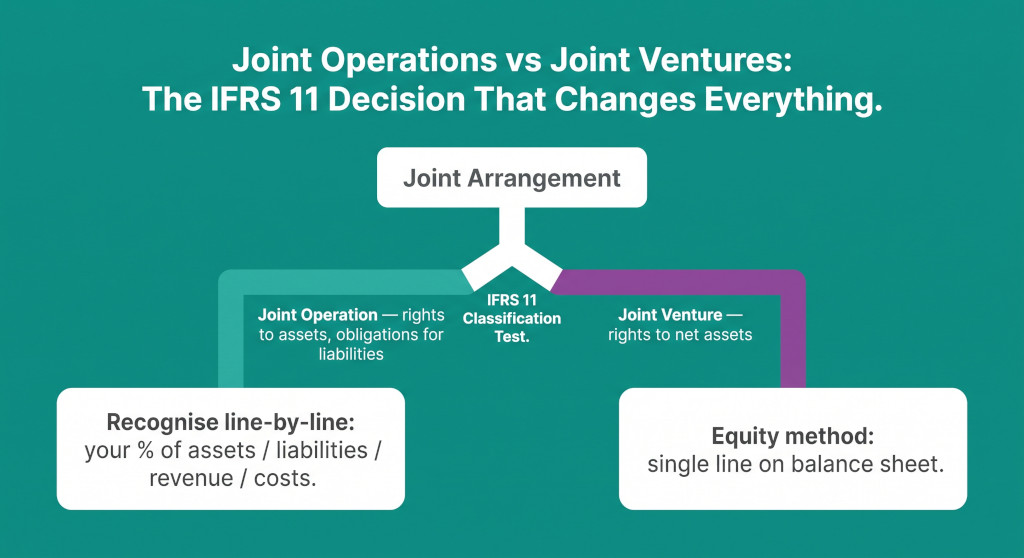
When a group enters a joint arrangement — two or more parties sharing control over an activity or entity — the first question is not how to account for it. The first question is what type of joint arrangement it is. Under IFRS 11, that classification determines everything that follows: a joint operation is recognised line-by-line in the consolidated accounts (the group’s share of assets, liabilities, revenues, and costs separately), while a joint venture is accounted for using the equity method (a single investment line on the balance sheet, a single share-of-profit line in the income statement).
The classification is not a matter of commercial convention or what the parties call the arrangement in their shareholder agreement. It is a technical assessment under IFRS 11 paragraphs 17 to 26, driven by whether the parties have rights to the assets and obligations for the liabilities of the arrangement, or merely rights to its net assets. Getting this wrong means the consolidated accounts show the wrong numbers — and since the two treatments produce fundamentally different balance sheet and income statement presentations, the error is material by definition.
What Is a Joint Arrangement?
IFRS 11 paragraph 4 defines a joint arrangement as an arrangement over which two or more parties have joint control. Joint control is the contractually agreed sharing of control of an arrangement, which exists only when decisions about the relevant activities (those that significantly affect the arrangement’s returns) require the unanimous consent of the parties sharing control. IFRS 11 para 7
Stop building consolidations in spreadsheets.
BrizoConsol automates multi-entity consolidation — setup in minutes, reports the same day.
Three elements must be present before IFRS 11 applies at all:
- A contractual arrangement: the parties’ rights and obligations must be established by a binding agreement — a shareholders’ agreement, a joint venture agreement, an unincorporated joint venture deed, or equivalent.
- Joint control: control must be shared. If one party can direct the relevant activities unilaterally, it controls the arrangement (IFRS 10 applies — subsidiary or not). If one party has significant influence but not joint control, IAS 28 applies (associate).
- Unanimous consent on relevant activities: the joint control criterion is met only if the relevant activities require unanimous consent of all controlling parties. Veto rights held for protective purposes (e.g., blocking extraordinary decisions) do not alone create joint control — the relevant activities must require agreement.
If there is any doubt about whether joint control exists — as distinct from one party having effective control despite a 50/50 ownership — assess whether the relevant activities require unanimous consent in practice, not just in the legal documents. Commercially, one party often drives decisions while the other acquiesces. If that is the pattern, the arrangement may not meet the joint control definition and a different standard applies.
Joint Operations vs Joint Ventures: The Core Distinction
Joint Operation IFRS 11 para 15
- Parties have rights to the assets of the arrangement
- Parties have obligations for the liabilities of the arrangement
- Each party’s economic interest is a direct share of assets and liabilities — not just a return on a net position
- Common structures: unincorporated joint ventures, jointly operated mines, oilfield working interests, shared infrastructure arrangements
Joint Venture IFRS 11 para 16
- Parties have rights to the net assets of the arrangement
- The arrangement is structured through a separate vehicle (company, partnership, trust)
- Parties’ economic interest is a return on their net investment — dividends, share of profits on winding up
- Common structures: 50/50 limited companies, jointly-owned holding companies, incorporated joint ventures
The distinction sounds clean on paper but can be difficult to apply in practice — particularly where the arrangement is structured through a separate legal entity (a company or partnership) but the contractual terms give the parties direct asset rights. IFRS 11 is explicit that the legal form of the separate vehicle is only one factor; substance prevails.
The IFRS 11 Classification Test
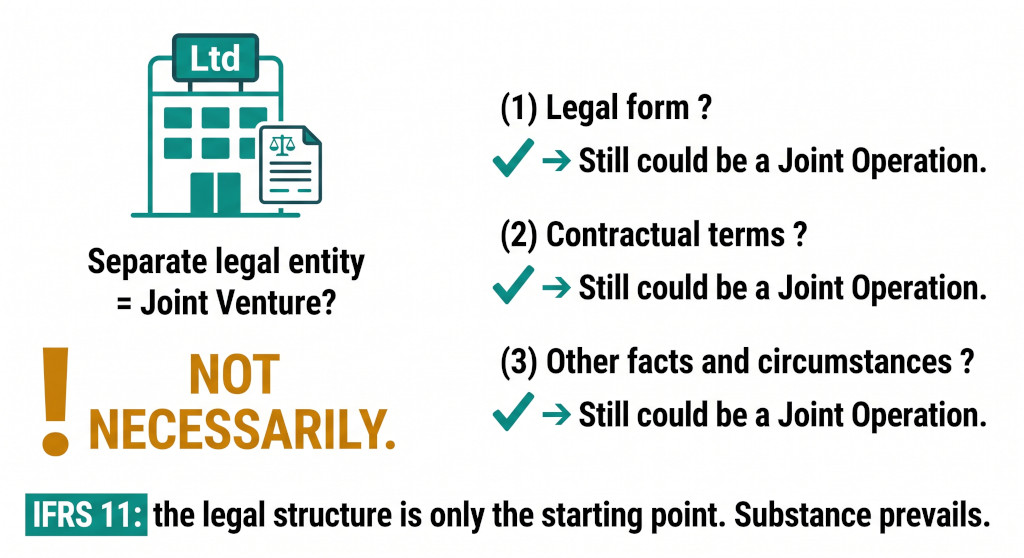
Do other facts and circumstances — primarily whether substantially all output is sold to the parties — indicate direct asset rights and liability obligations?
✓ Substantially all output is purchased by the parties at cost-plus or cost (so the arrangement relies on the parties’ purchase obligations to settle its liabilities) → Joint Operation indicator. IFRS 11 para 26
→ Arrangement sells output to third parties and distributes net profits to the parties → Joint Venture.
The “substantially all output” test catches arrangements that look like joint ventures legally but are economically equivalent to joint operations — the arrangement has no independent income stream and depends on the parties to absorb its costs and settle its liabilities through their purchase commitments.
The incorporated structure trap: Many groups operate joint arrangements through limited companies and assume the company structure means it is a joint venture. Under IFRS 11 this assumption is wrong if the contractual terms or other facts and circumstances override the legal form. A 50/50 Ltd company where each party is contractually required to purchase its 50% share of all output at cost, and where all liabilities are funded through those purchase obligations, will often be classified as a joint operation — despite the Ltd structure. Review the agreement, not just the company registration.
Accounting for Joint Operations
A joint operator recognises its share of the joint operation’s assets, liabilities, revenues, and expenses in its own financial statements — and therefore in the consolidated financial statements. IFRS 11 para 20 This is not a consolidation adjustment made in the group workbook; it is part of the joint operator’s own accounting. The recognition is done line by line — not as a single investment figure.
Bridge Project JO operates as an unincorporated joint venture to design and build a bridge. At 31 December 2026, the project’s total assets, liabilities, revenues, and costs are:
| Bridge Project JO — Total | £ Total | ConstructCo 40% |
|---|---|---|
| Assets | ||
| Plant and equipment | 2,000,000 | 800,000 |
| Receivables | 500,000 | 200,000 |
| Cash | 100,000 | 40,000 |
| Liabilities | ||
| Trade payables | (400,000) | (160,000) |
| Project bank loan | (800,000) | (320,000) |
| Income statement (year to 31 Dec 2026) | ||
| Revenue | 3,500,000 | 1,400,000 |
| Costs | (3,100,000) | (1,240,000) |
| Profit for year | 400,000 | 160,000 |
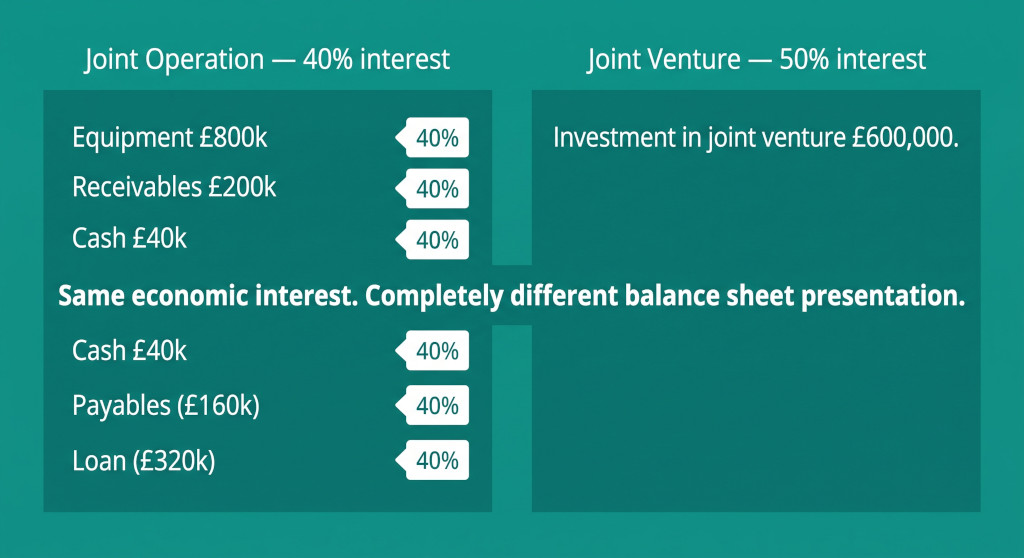
ConstructCo adds each of these line items directly to its own consolidated accounts. Plant and equipment increases by £800,000; the project bank loan increases by £320,000; revenue increases by £1,400,000; costs increase by £1,240,000. There is no “Investment in joint operation” line on the balance sheet — the constituent assets and liabilities appear in their normal categories.
Intercompany transactions with joint operations
When a joint operator sells assets or services to a joint operation in which it participates, it recognises a gain or loss only to the extent of the other parties’ interests in the joint operation. The portion of the gain attributable to its own interest is eliminated as an unrealised intercompany profit — consistent with the principle that a party cannot make a profit selling to itself. IFRS 11 para 22
Example: ConstructCo sells equipment to Bridge Project JO for £600,000 (book value £400,000, gain £200,000). ConstructCo’s interest is 40%. ConstructCo eliminates 40% of the gain (£80,000) — the portion attributable to its own share of the joint operation — and recognises the remaining 60% (£120,000) as income, representing the genuine sale to the other parties’ 60% interest.
Accounting for Joint Ventures
A joint venturer applies the equity method to its interest in a joint venture. IFRS 11 para 24 The equity method is the same method used for associates under IAS 28. The initial investment is recognised at cost; subsequently, the carrying amount is adjusted for the investor’s share of the joint venture’s profit or loss and OCI. The investment appears as a single line on the consolidated balance sheet; the share of profit appears as a single line in the consolidated income statement.
Equity method carrying amount — TechCo’s investment in InnovateCo Ltd
| Cost of investment at acquisition | 400,000 |
| TechCo’s share of post-acquisition retained earnings (50% × £400,000) | 200,000 |
| TechCo’s share of OCI (CTA on InnovateCo’s foreign operations) | 0 |
| Dividends received (reduce carrying amount) | 0 |
| Carrying amount — Investment in joint venture (balance sheet) | 600,000 |
In the current year, InnovateCo earns £150,000 PAT. TechCo’s consolidated income statement includes one line: “Share of profit of joint venture: £75,000.” The full balance sheet and income statement of InnovateCo — its revenue, costs, assets, and liabilities — do not appear anywhere in TechCo’s consolidated accounts. Only the net investment and the share of net profit are visible.
Embedded goodwill in joint ventures
Goodwill arising on the acquisition of a joint venture interest is included within the carrying amount of the investment — it is not separately disclosed or separately impairment-tested. If TechCo paid £400,000 for a 50% stake in InnovateCo when InnovateCo’s net assets were worth £700,000 (50% = £350,000), the implicit goodwill of £50,000 is subsumed in the £400,000 investment cost. The entire investment is impairment-tested as a single unit if there are indicators of impairment. For the embedded goodwill mechanics, see why your equity pickup is wrong after acquiring an associate: fair value adjustments and embedded goodwill.
Intercompany transactions with joint ventures
Transactions between a joint venturer and its joint venture are subject to the same unrealised profit elimination rules as transactions with associates: gains and losses on transactions are eliminated to the extent of the investor’s interest in the joint venture. IFRS 11 para 36 If TechCo sells goods to InnovateCo with a margin and InnovateCo still holds those goods in closing inventory, TechCo eliminates 50% of the unrealised margin — its proportionate share. For the full mechanics, see eliminating unrealised profits on associate transactions.
The Accounting Impact: A Direct Comparison
| Feature | Joint Operation | Joint Venture |
|---|---|---|
| Balance sheet presentation | Line-by-line: share of each asset and liability class | Single line: “Investment in joint venture” |
| Income statement presentation | Line-by-line: share of revenue, cost of sales, etc. | Single line: “Share of profit of joint venture” |
| Effect on key ratios | Higher revenue, higher assets, higher debt — gearing ratio worsens if the JO carries leverage | Net investment only — gearing ratio unaffected by the JV’s debt |
| Goodwill | Not applicable (no “investment” to allocate goodwill to) | Embedded in the investment carrying amount |
| Impairment testing | Assets recognised directly — tested per IAS 36 on the specific assets | Investment tested as a single unit under IAS 28 / IAS 36 |
| Effect if JO/JV makes a loss | Joint operator recognises its share of the loss directly in each line | Investment is written down; suspension rules apply below zero (IAS 28 para 38) |
| IC elimination | Eliminate gain to the extent of own interest only | Eliminate share of unrealised profit on transactions |
Gearing is the ratio that most often matters commercially. A joint operation that carries significant debt forces the joint operator to recognise its share of that debt line-by-line — increasing the consolidated balance sheet liabilities and worsening the gearing ratio that banks and lenders monitor. A joint venture with the same debt keeps it off the investor’s consolidated balance sheet entirely. Groups structuring new joint arrangements sometimes make the classification decision partly with this financial presentation consequence in mind — but IFRS 11 requires classification based on the substantive rights, not on the desired presentation outcome.
Common Misclassifications
Several patterns of misclassification recur across industries.
The most common is classifying an incorporated arrangement as a joint operation when it is a joint venture. This typically occurs in groups that applied proportionate consolidation under old IAS 31 (which permitted it for jointly controlled entities) and have not updated their accounting policy since IFRS 11 became effective in 2013. IAS 31’s “jointly controlled entities” category no longer exists — an incorporated arrangement is assessed under the IFRS 11 classification test, and if it is a joint venture, the equity method applies, not proportionate consolidation.
The reverse error also occurs: classifying a joint venture as a joint operation because the parties call it a “JV” commercially. Many construction and property groups refer to their project arrangements as “JVs” regardless of legal structure, and some account for them as joint operations (proportionate share) when they are actually joint ventures (equity method) — particularly when the arrangement is structured through a project company with a separate legal personality.
A third error is failing to assess an arrangement under IFRS 11 at all — treating a 50/50 holding as a subsidiary (if one party informally controls decisions) or as an associate (if the arrangement clearly requires unanimous consent but has not been assessed for joint control). Every arrangement with joint control must be classified under IFRS 11 before any accounting treatment is applied.
FRS 102 Position
FRS 102 Section 15 governs interests in joint ventures. FRS 102 distinguishes jointly controlled operations, jointly controlled assets, and jointly controlled entities. The treatment for jointly controlled operations and assets (the FRS 102 equivalent of IFRS 11 joint operations) is proportionate recognition — the entity recognises its share of assets, liabilities, revenues, and expenses line-by-line, consistent with IFRS 11 joint operations treatment. For jointly controlled entities (the FRS 102 equivalent of IFRS 11 joint ventures), FRS 102 paragraph 15.14 requires the equity method — the same as IFRS 11. The old proportionate consolidation option for jointly controlled entities that existed under SSAP 1 and FRS 9 has been removed.
The practical outcome for FRS 102 groups is broadly the same as for IFRS groups: unincorporated and asset-based joint arrangements → proportionate line-by-line recognition; incorporated joint ventures → equity method. The classification criteria differ in their precise articulation from IFRS 11, but the underlying substance test — direct rights to assets and obligations for liabilities versus rights to net assets — is consistent. For a broader comparison of IFRS and UK GAAP treatment across group accounting topics, see IFRS vs UK GAAP: key differences in financial reporting.
Checklist: IFRS 11 Classification and Accounting
- Confirm joint control exists. Relevant activities must require unanimous consent of all controlling parties. Protective veto rights alone do not create joint control.
- Identify whether a separate vehicle exists. If there is no separate vehicle, the arrangement is a joint operation — proceed directly to proportionate recognition.
- For incorporated arrangements, read the agreement carefully. Do not assume a limited company structure equals a joint venture. Assess the legal form, the contractual terms, and the “substantially all output” fact pattern under IFRS 11 paras 17–26.
- Document the classification assessment. The IFRS 11 classification is a judgement that auditors will scrutinise. The conclusion — joint operation or joint venture — and the reasoning should be recorded in the group’s accounting policies and updated whenever the arrangement changes.
- For joint operations: recognise the group’s share of each asset, liability, revenue, and expense line-by-line. Confirm which specific assets and liabilities the group has rights to and obligations for — in complex arrangements this may not be a simple percentage of every line.
- For joint ventures: apply the equity method from the acquisition date. Calculate embedded goodwill, track the investor’s share of profit and OCI, and apply the suspension rules if losses reduce the investment below zero.
- Eliminate intercompany profits correctly. Joint operations: eliminate gain to the extent of own interest only (not the full gain). Joint ventures: eliminate the investor’s proportionate share of unrealised profits on transactions.
- Reassess the classification when the arrangement changes. A change in contractual terms, the addition of a new party, or a restructuring of the separate vehicle can change the classification from joint operation to joint venture or vice versa. The change in classification is accounted for prospectively from the date the change takes effect.
For the equity method mechanics that apply to joint ventures — initial recognition, annual equity pickup, loss suspension, and disposal — see equity method accounting in group consolidation: associates, joint ventures, and significant influence. For the construction industry context, where joint arrangements are structurally common and the classification question arises frequently in project SPVs, see financial consolidation for construction groups.
Group consolidation that handles joint arrangements correctly
BrizoConsol supports groups with joint operations and joint ventures — recognising proportionate interests line-by-line for joint operations and applying the equity method for joint ventures, with the classification logic maintained across reporting periods. See how it works for your group structure. See It in Action