AASB 10 Consolidated Financial Statements: A Practical Guide for Australian Multi-Entity Groups
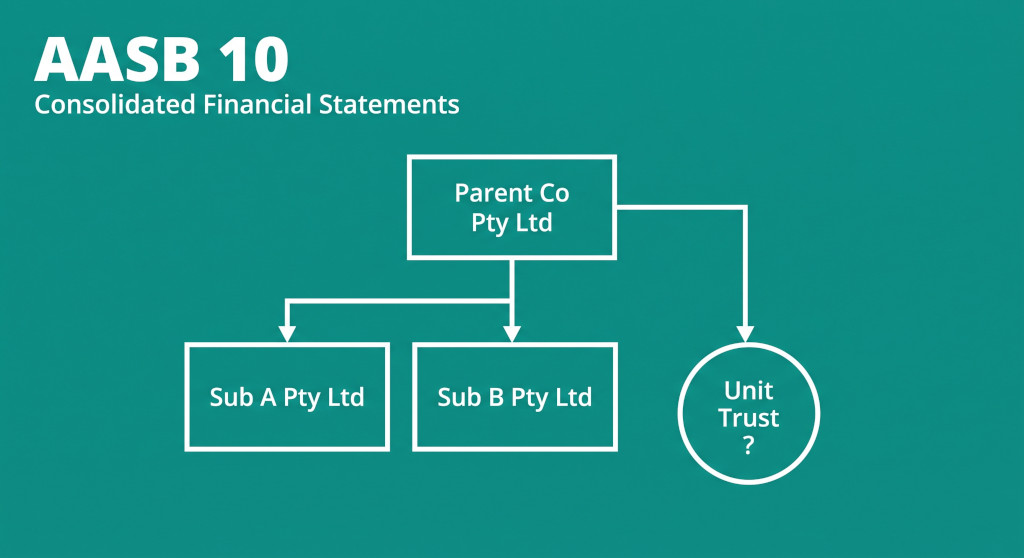
James had run his family group for fifteen years. What started as a single operations company had grown into six legal entities: a holding company, three operating subsidiaries, a discretionary trust that held the group’s commercial property, and a unit trust used to hold a joint venture interest with an unrelated third party. The structure had evolved organically — entities added when tax advice or a deal required it — without much thought given to what it looked like as a group.
Then the auditors arrived with a question: which of these six entities did James’s holding company actually control for the purposes of AASB 10? If it controlled them, it needed to prepare consolidated financial statements. If it didn’t, it might not. James knew what consolidated accounts looked like — he’d seen them at other companies — but he couldn’t articulate why the discretionary trust might or might not be a subsidiary, or what “control” actually meant technically. He also wasn’t sure whether the Corporations Act required consolidation at all, or whether he was below the threshold.
These questions — which entities to consolidate, how the control test works in practice, and what happens when you consolidate for the first time — are exactly what AASB 10 is designed to answer. This guide works through each of them.
Automate NCI calculations across all your entities.
BrizoConsol handles non-controlling interest automatically — no manual adjustments required.
What AASB 10 Requires
AASB 10 Consolidated Financial Statements establishes the principles for presenting a group’s financial position and results as if it were a single economic entity. An entity that controls one or more other entities must prepare consolidated financial statements that combine the parent and all its subsidiaries.
The standard applies to all Australian entities required to prepare general purpose financial statements — which includes large proprietary companies under the Corporations Act 2001, listed entities, and entities subject to ASIC class orders or APRA regulation. Smaller entities may prepare special purpose financial statements and apply a different reporting framework, but any entity that does prepare general purpose financial statements and controls subsidiaries must apply AASB 10.
AASB 10 is substantively identical to IFRS 10 as issued by the IASB. Australia adopted IFRS 10 into the AASB framework with minimal modification. The control model, consolidation procedures, and accounting requirements are the same. The differences are largely in scope paragraphs that reference Australian legislation and in the interaction with AASB 1053 (reduced disclosure requirements), which is discussed below.
The Control Test Under AASB 10: Three Elements, All Three Required
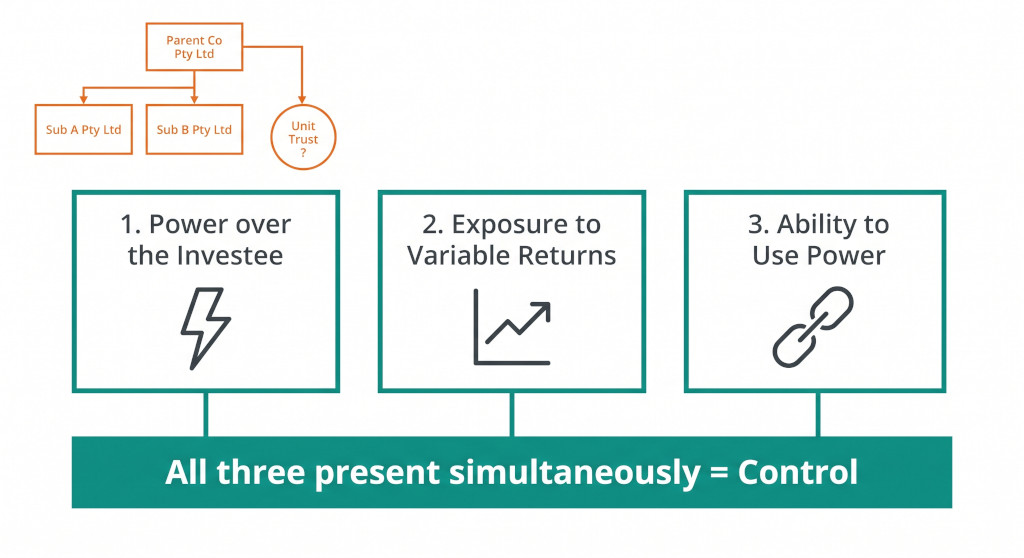
Under AASB 10, an investor controls an investee — and must therefore consolidate it — when all three of the following elements are present simultaneously:
1. Power over the investee. The investor has existing rights that give it the current ability to direct the relevant activities of the investee. Relevant activities are those that significantly affect the investee’s returns. Power most commonly arises from shareholding rights — owning more than 50% of the voting rights of an ordinary company gives clear power. But power can also arise from contractual rights, board appointment rights, or other rights that give the investor practical ability to direct decision-making even without a majority equity stake.
2. Exposure or rights to variable returns. The investor is exposed to, or has rights to, variable returns from its involvement with the investee. Returns can be positive (dividends, capital appreciation, fees) or negative (losses, guarantees called upon). The returns must be variable — they change depending on the investee’s performance — rather than fixed.
3. Ability to use power to affect returns. The investor has the ability to use its power over the investee to affect the amount of the investor’s returns. This element links the first two: it is not enough to have power and exposure to returns separately — the investor must be able to use its power to influence those returns.
All three elements must be present at the same time for control to exist. An investor with 60% of the shares in a company has power and likely has variable return exposure — but it still needs to confirm that it can use that shareholding to affect the company’s returns, which will normally be the case for an ordinary operating company but may not be in certain structured vehicles.
Applying the Test to Common Australian Structures
Ordinary corporate subsidiaries
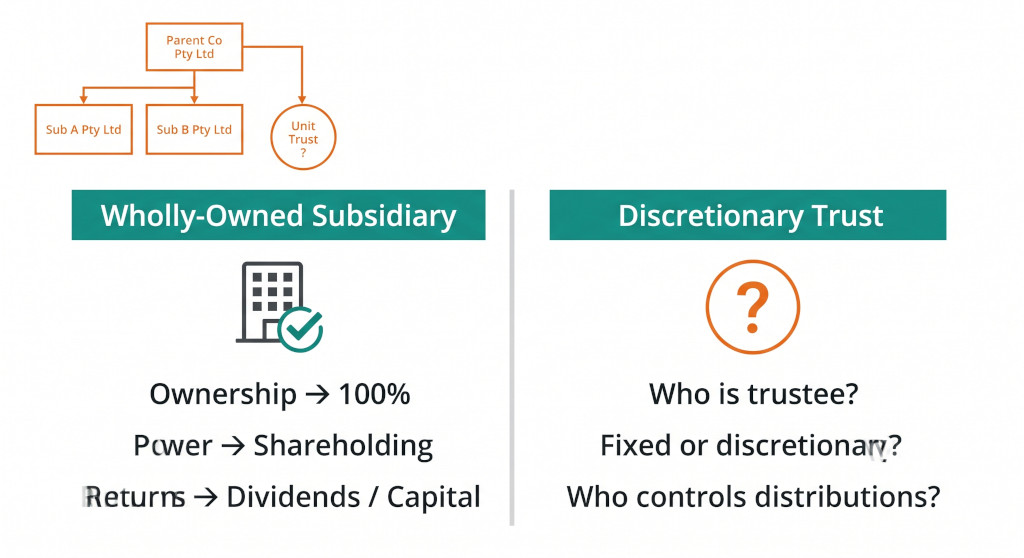
For a standard Pty Ltd company where the parent holds a majority of voting shares and appoints the board, control under AASB 10 is almost always straightforward. The shareholding gives power (majority vote), the parent is exposed to variable returns (dividends, capital), and it can use its shareholder rights to affect those returns. Wholly-owned subsidiaries and majority-owned subsidiaries with no blocking minority rights are consolidated without further analysis.
Discretionary trusts
Discretionary trusts are common in Australian group structures, particularly for property holding and wealth protection. They present a genuine challenge under AASB 10 because the beneficiaries of a discretionary trust do not hold ownership interests in the way shareholders do.
The critical question is: does the parent (or an entity within the group) act as trustee of the trust, or does it hold a power of appointment over the trustee? If the parent company is the trustee of a discretionary trust, it has power over the trust’s relevant activities (because it directs investment decisions and distributions as trustee). If the group is also the primary beneficiary — receiving the bulk of economic returns — then it has exposure to variable returns. If it can use its trustee power to direct distributions to itself, all three elements of control are present and the trust must be consolidated.
However, if the parent company is merely a discretionary beneficiary but has no trustee role and no power of appointment, it does not control the trust. It has exposure to returns (whatever distributions the trustee decides to make) but lacks power — and without power, there is no control.
Common mistake: Assuming that because a group company is listed as a beneficiary of a discretionary trust, the trust is a subsidiary. Beneficiary status alone does not confer control. The power element must be assessed independently — who directs the trust’s activities, and can that person use that power to affect the group’s returns?
Unit trusts
Unit trusts are more structured than discretionary trusts. If a group entity holds more than 50% of the units in a fixed unit trust and the unitholders collectively control the trustee, the majority unitholder has power over the trust’s relevant activities in proportion to its unit holding, and the three control elements are likely present. If the group holds a minority of units — as in James’s joint venture unit trust where a third party holds 50% — it does not control the trust, and the trust is treated as a joint venture or associate under AASB 128.
Special purpose vehicles and shelf companies
Australian property and project finance structures often use SPVs — companies or trusts created for a specific purpose with restricted activities. Under AASB 10, the fact that an SPV has been designed so that the investor receives the majority of benefits (even if it holds no equity) can still result in a control conclusion. The analysis focuses on substance and on who actually directs the vehicle’s activities and captures its returns.
When Does Australian Law Require Consolidated Financial Statements?
The obligation to prepare consolidated financial statements under Australian law arises primarily from the Corporations Act 2001. A company must prepare consolidated financial statements if it is a “reporting entity” that controls one or more entities. The key threshold tests are:
Large proprietary companies: A proprietary company is “large” if it satisfies at least two of these three criteria for a financial year: consolidated revenue of $50 million or more; consolidated gross assets of $25 million or more; 100 or more employees. Large proprietary companies must prepare and lodge financial reports under Chapter 2M of the Corporations Act, which requires consolidated financial statements prepared in accordance with Australian accounting standards — including AASB 10.
Small proprietary companies controlled by a foreign parent: Even a small proprietary company (one that does not meet the large thresholds) may need to prepare financial reports if it is controlled by a foreign entity and ASIC requires it.
Listed entities and APRA-regulated entities: These always prepare general purpose financial statements regardless of size.
Practical note: The “large” tests above apply at the consolidated group level, not at the individual entity level. A parent company that is individually small may still be part of a large group when its subsidiaries are aggregated. Finance teams often apply the test to the parent alone, which underestimates the group’s size and leads to incorrect conclusions about reporting obligations.
Determining the Consolidation Boundary: A Practical Method
Before preparing a single journal, the finance team needs a documented consolidation boundary — a clear list of which entities are in scope and which are not, with the control analysis recorded for each.
Work through the following steps:
First, list every legal entity that is directly or indirectly connected to the group, including dormant companies, shelf companies, trusts, and SPVs. The group structure diagram is the starting point but may not be complete — ask the directors whether any entity has been created that does not appear on the chart.
Second, for each entity, apply the three-part control test. Document: who has power, what are the variable returns, and can power be used to affect returns? For corporate subsidiaries this is usually a one-paragraph analysis. For trusts and structured vehicles it may require a review of the trust deed, shareholder agreements, or constitutional documents.
Third, identify any entities where control is uncertain — for example, a company where the group holds 45% of the shares but also has a casting vote or a contractual right to appoint the majority of directors. These need a deeper analysis and possibly professional advice.
Fourth, document the conclusion for each entity (consolidated, associate, joint venture, or investment) and record the basis. This documentation will be requested by auditors and is required to be reviewed annually, because control conclusions can change if the group’s rights or the investee’s governance structure changes.
Need to consolidate multiple Australian entities?
BrizoConsol pulls trial balances from Xero, MYOB, QuickBooks, and Zoho Books across all your subsidiaries and produces consolidated financial statements under AASB standards — without spreadsheets. See how it works for Australian groups. See It In Action
AASB 10 vs IFRS 10: What Is Actually Different?
For an Australian group finance team, the practical answer is: very little. AASB 10 was issued by the AASB as a near-verbatim adoption of IFRS 10. The control model is identical. The consolidation procedures are identical. The accounting for non-controlling interests, goodwill, and acquisition-date fair values follows the same principles as IFRS 3 (adopted in Australia as AASB 3).
The differences are procedural rather than substantive. AASB 10 includes additional scope paragraphs referencing Australian legislation. It cross-references AASB 127 (Separate Financial Statements) rather than IAS 27. And entities eligible to apply Tier 2 reporting under AASB 1053 may use Reduced Disclosure Requirements (RDR) — a simplified disclosure regime that reduces the volume of notes required without changing the recognition, measurement, or consolidation requirements themselves. The consolidated balance sheet, income statement, and SOCE under RDR look the same as under full AASB; it is only certain note disclosures that are condensed.
First-Time Consolidation Under AASB 10: The Journals You Need
When an Australian group prepares consolidated financial statements for the first time — or brings a new subsidiary into an existing consolidation — the same fundamental journal entries apply. The parent’s investment in each subsidiary is eliminated against the subsidiary’s equity at the acquisition date, goodwill (or a bargain purchase gain) is recognised, and non-controlling interests are recognised if the acquisition was partial.
Consider the following example. Apex Holdings Pty Ltd has two subsidiaries: Operations Pty Ltd (100% owned, acquired for $800k when its net assets were $650k) and Distribution Pty Ltd (80% owned, acquired for $560k when its net assets were $620k). All figures in A$’000.
Step 1: Goodwill and NCI calculation at acquisition
For Operations Pty Ltd (100% owned):
| Consideration transferred | $800k |
| Less: fair value of identifiable net assets acquired | ($650k) |
| Goodwill recognised | $150k |
For Distribution Pty Ltd (80% owned), using the partial goodwill method (NCI measured at proportionate share of net assets):
| Consideration transferred (80% stake) | $560k |
| NCI at acquisition (20% × $620k net assets) | $124k |
| Less: fair value of identifiable net assets acquired | ($620k) |
| Goodwill recognised | $64k |
Step 2: Elimination journal — Operations Pty Ltd
| Account | Dr | Cr |
|---|---|---|
| Share capital — Operations Pty Ltd | $400k | |
| Retained earnings — Operations Pty Ltd (at acquisition) | $250k | |
| Goodwill | $150k | |
| Investment in Operations Pty Ltd | $800k |
Eliminates Apex Holdings’ investment in Operations Pty Ltd against the subsidiary’s equity at the acquisition date and recognises goodwill. The subsidiary’s net assets of $650k (share capital $400k + retained earnings $250k) are replaced by its individual assets and liabilities line by line.
Step 3: Elimination journal — Distribution Pty Ltd (partial acquisition)
| Account | Dr | Cr |
|---|---|---|
| Share capital — Distribution Pty Ltd | $300k | |
| Retained earnings — Distribution Pty Ltd (at acquisition) | $320k | |
| Goodwill | $64k | |
| Investment in Distribution Pty Ltd | $560k | |
| Non-controlling interests | $124k |
Eliminates the investment against the subsidiary’s acquisition-date equity ($620k), recognises goodwill ($64k), and recognises the NCI at 20% of acquisition-date net assets ($124k). Post-acquisition profits and any adjustments are processed in subsequent periods through the NCI’s share of profit and the retained earnings column.
After these journals, the consolidated balance sheet combines all assets and liabilities of Apex Holdings, Operations Pty Ltd, and Distribution Pty Ltd line by line, with the investment balances replaced by the underlying net assets and goodwill. The complete consolidation worked example shows how the trial balances of multiple entities are combined from start to finish.
Post-Acquisition: The Ongoing Consolidation Adjustments
The acquisition-date eliminations are posted once and then carried forward each period. The ongoing consolidation workings each reporting period must also include:
Intercompany eliminations. All transactions between group entities — sales of goods, management fees, loans, rent — must be eliminated so that only transactions with external third parties appear in the consolidated accounts. The intercompany eliminations guide covers each type. Australian groups frequently have intercompany loans between the holding company and subsidiaries; these must be eliminated with both the loan asset and the loan liability removed, and any interest income and expense eliminated from the consolidated P&L.
NCI share of post-acquisition profits and equity. Each period, the NCI’s share of profits is calculated based on the consolidated profit of the partly-owned subsidiary after adjustments, and the NCI balance on the balance sheet is updated accordingly. If Distribution Pty Ltd earns $200k of consolidated profit in the year, the NCI’s 20% share ($40k) is attributed to the NCI balance on the balance sheet and shown as “profit attributable to non-controlling interests” in the consolidated income statement.
Goodwill impairment review. Goodwill recognised on acquisition does not amortise under AASB standards (unlike under FRS 102 in the UK). Instead, it is tested for impairment annually at the cash-generating unit level under AASB 136, the Australian equivalent of IAS 36. If the recoverable amount of the CGU falls below its carrying amount including allocated goodwill, an impairment loss is recognised in the consolidated income statement.
Deferred tax on consolidation adjustments. Some consolidation adjustments — particularly the elimination of unrealised profits in inventory or the recognition of fair value uplifts at acquisition — create temporary differences between the consolidated carrying value of assets and their tax base. These give rise to deferred tax assets or liabilities in the consolidated accounts that do not appear in any entity’s own financial statements.
Practical Checklist: AASB 10 Consolidation for Australian Groups
- Map every legal entity connected to the group, including dormant companies, shelf companies, trusts, and SPVs — not just operating entities.
- Apply the three-part control test to each entity: power, variable return exposure, ability to use power. Document the conclusion and the evidence supporting it.
- Pay particular attention to trusts. Assess who is trustee, whether beneficiary interests are fixed or discretionary, and whether any group entity has a power of appointment over the trustee. Do not assume that being a beneficiary equals control.
- Confirm whether the group meets the “large proprietary company” thresholds at the consolidated level, not just at the parent entity level.
- For each subsidiary, calculate goodwill at the acquisition date using consideration paid plus NCI recognised minus fair value of net assets acquired. See the goodwill calculation guide for the full method.
- Post the acquisition-date elimination journals for every subsidiary and bring forward the goodwill and NCI balances into the current period’s consolidation workings.
- Eliminate all intercompany transactions: revenue and cost of sales, management fees, interest, dividends, and loan balances. Reconcile intercompany balances before eliminating.
- Calculate and attribute the NCI’s share of consolidated profit and OCI for any partly-owned subsidiary. Use consolidated profit after adjustments, not entity profit.
- Test goodwill for impairment annually at the CGU level under AASB 136. Document the recoverable amount assessment.
- Review the consolidation boundary annually. Changes in rights, new entities, restructures, or acquisitions can change control conclusions. AASB 10 requires continuous assessment, not just a one-time determination.
- Consider RDR eligibility. If the group qualifies as a Tier 2 reporting entity under AASB 1053, reduced disclosure requirements apply to certain notes — but the consolidation itself is unchanged.
- When onboarding a new entity into the consolidation, document the acquisition date, collect the acquisition-date trial balance, and post the acquisition journals before the first period-end close that includes the new subsidiary.
Consolidate your Australian group without the spreadsheet pain
BrizoConsol connects to MYOB, Xero, QuickBooks, and Zoho Books to pull entity trial balances automatically — then handles intercompany eliminations, goodwill, NCI, and the full consolidated output. Start free today. Start Free Trial