IAS 36 Goodwill Impairment Testing: A Practical Guide for IFRS Multi-Entity Groups
When a UK-based manufacturing group acquired a German competitor in 2019, the purchase price allocation under IFRS 3 left €14 million of goodwill on the consolidated balance sheet — the premium paid over the fair value of the identifiable net assets. Three years later, with supply chain costs running higher than the acquisition model assumed and the acquired business missing its revenue targets for the second consecutive year, the group’s auditors raised a question during the year-end planning call that the finance director had been quietly hoping to avoid: where are the IAS 36 impairment workings?
Unlike FRS 102, which requires goodwill to be amortised and only mandates an impairment test when indicators of impairment are present, IFRS does not amortise goodwill. Under IFRS 3 and IAS 36, goodwill sits on the balance sheet indefinitely at cost less accumulated impairment — but in exchange for the absence of amortisation, IAS 36 requires an annual impairment test regardless of whether any indicators of impairment exist. The test must be performed at least once a year, at the same time each year, and whenever circumstances suggest that the carrying amount may no longer be supportable.
For a multi-entity IFRS group with goodwill arising from multiple acquisitions, the IAS 36 process involves a series of judgements that compound in complexity: allocating goodwill to cash-generating units, estimating future cash flows, determining an appropriate discount rate, and calculating recoverable amount using techniques that blend accounting standards with corporate finance. This guide works through the IAS 36 impairment model from the perspective of a group finance team preparing consolidated financial statements.
Stop building consolidations in spreadsheets.
BrizoConsol automates multi-entity consolidation — setup in minutes, reports the same day.
Goodwill and the Prohibition on Amortisation Under IFRS
IAS 36 paragraph 10 requires that goodwill acquired in a business combination and recognised on the consolidated balance sheet must be tested for impairment annually. The reason is mechanical: IFRS 3 prohibits the amortisation of goodwill. Without amortisation steadily reducing the carrying amount, the balance sheet figure could remain elevated indefinitely even as the underlying acquisition deteriorates — hence the mandatory annual impairment discipline.
This is one of the most consequential differences between IFRS and the other major frameworks covered in BrizoConsol’s technical standards series. Under FRS 102, goodwill is amortised over its useful economic life (with a maximum of ten years if the useful life cannot be estimated reliably) and an impairment test is only required when indicators are present. Under the ASC 350 private company alternative for US GAAP, private entities may elect to amortise goodwill over a useful life of up to ten years. The contrast matters practically: an IFRS group that paid a significant premium in an acquisition must defend that carrying amount against a formal VIU or FVLCD calculation every year, regardless of whether trading is going well. There is no amortisation buffer softening the balance sheet position as the years pass.
Step One: Allocating Goodwill to Cash-Generating Units
IAS 36 does not test goodwill at the entity level or the group level as a whole. It tests goodwill at the level of cash-generating units (CGUs) — the smallest identifiable groups of assets that generate cash inflows largely independent of the cash inflows from other assets or groups of assets.
At the date of acquisition, the goodwill arising from the business combination must be allocated to each CGU or group of CGUs expected to benefit from the synergies of the combination. The allocation must be completed by the end of the first annual reporting period after the acquisition. A CGU to which goodwill is allocated represents the lowest level within the entity at which the goodwill is monitored for internal management purposes, and cannot be larger than an operating segment as defined by IFRS 8.
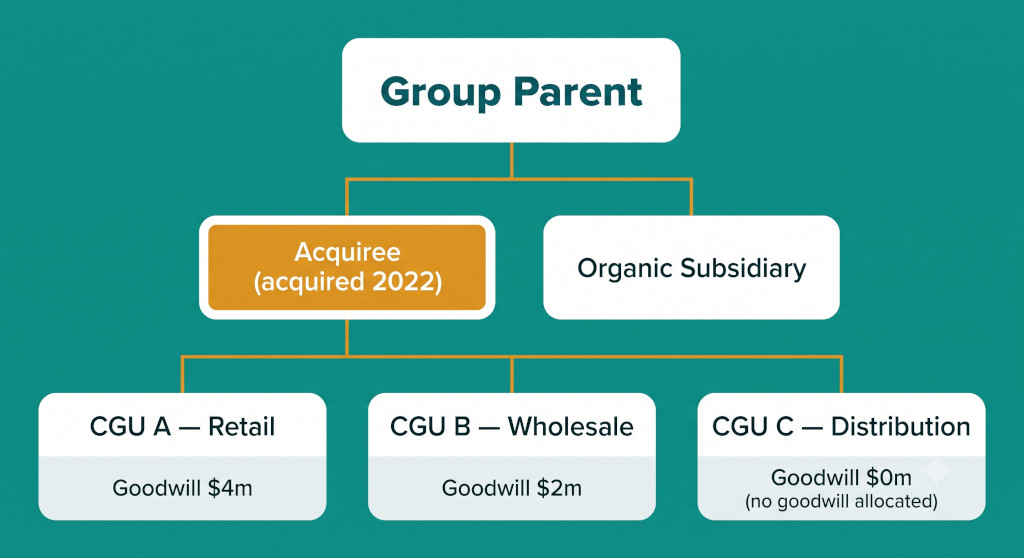
In practice, CGUs are typically determined by how the acquired business is managed and how its cash flows are tracked. A group that acquires a diversified competitor with three distinct trading divisions — retail, wholesale, and distribution — would normally identify three CGUs corresponding to those divisions, and allocate the acquisition goodwill across them in proportion to the synergies expected to flow to each. The distribution division might receive no allocation if the synergies from the acquisition were concentrated in the retail and wholesale operations.
The CGU allocation decision is not merely a technical accounting choice — it has real consequences for impairment risk. Allocating goodwill to larger CGUs (combining several divisions into one) dilutes the impairment risk across a broader pool of cash flows, making it less likely that any individual deteriorating unit will trigger an impairment. Allocating to smaller, more granular CGUs concentrates the risk. Auditors scrutinise CGU boundaries carefully for this reason, and the allocation must reflect genuine management monitoring practice rather than an outcome engineered to pass the impairment test.
For groups with foreign subsidiaries, each foreign operation or division may constitute its own CGU or form part of a larger CGU. Goodwill allocated to a CGU that operates in a foreign currency is itself a foreign currency asset — its carrying amount changes with the exchange rate as part of the IAS 21 closing rate translation process. The impairment test must be performed in the CGU’s functional currency; the resulting IAS 36 impairment (or confirmation of no impairment) is then translated at the closing rate into the group’s presentation currency. For full IAS 21 translation mechanics, see our IAS 21 guide for multi-entity groups.
Step Two: Determining Recoverable Amount
The IAS 36 impairment test compares the carrying amount of a CGU (including allocated goodwill) to its recoverable amount. Recoverable amount is defined as the higher of:
- Fair value less costs of disposal (FVLCD) — the price that would be received to sell the CGU in an orderly transaction between market participants at the measurement date, less the incremental costs directly attributable to the disposal (but not the costs of restructuring the business or reorganising it after disposal).
- Value in use (VIU) — the present value of the future cash flows expected to be derived from the CGU, calculated using a pre-tax discount rate that reflects current market assessments of the time value of money and the risks specific to the asset.
Because recoverable amount is the higher of the two, a CGU only needs to be impaired if both FVLCD and VIU fall below its carrying amount. In practice, groups typically calculate VIU first, as the data and assumptions are primarily internal. FVLCD requires market evidence — recent transaction multiples, external valuations, or observable prices — which is often harder to source and less reliable for a going-concern CGU that is not actively being marketed for sale. If VIU exceeds carrying amount, there is no impairment and the FVLCD calculation is not needed.
Step Three: Calculating Value in Use
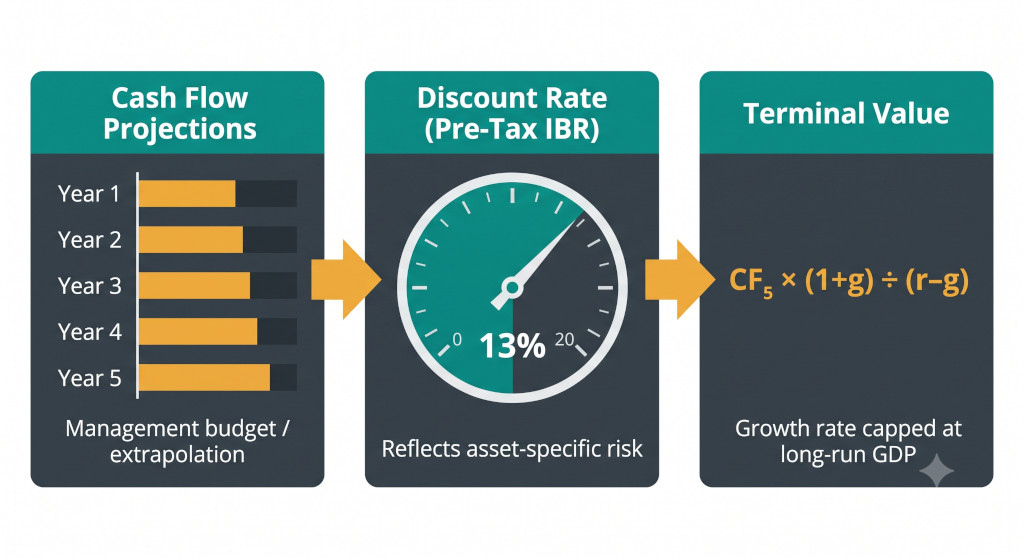
The value in use calculation is a discounted cash flow model applied to the CGU’s projected future cash flows. IAS 36 paragraphs 33–54 set out the requirements. The cash flow projections must be based on the most recent financial budgets approved by management, covering a maximum of five years. Projections beyond five years must use a steady-state growth rate that does not exceed the long-term average growth rate for the products, industries, or countries in which the CGU operates — in practice, this is typically aligned to long-run GDP growth or CPI for the relevant market.
The projections must reflect the asset in its current condition. They must not include cash flows from uncommitted restructurings, future capital expenditure that will enhance the asset beyond its current capacity, or cash flows from financing activities. The discount rate must be a pre-tax rate that reflects current market assessments of the time value of money and the risks specific to the CGU — not the group’s WACC unless it can be demonstrated to be appropriate for the specific asset.
Worked Example: VIU Calculation for a CGU
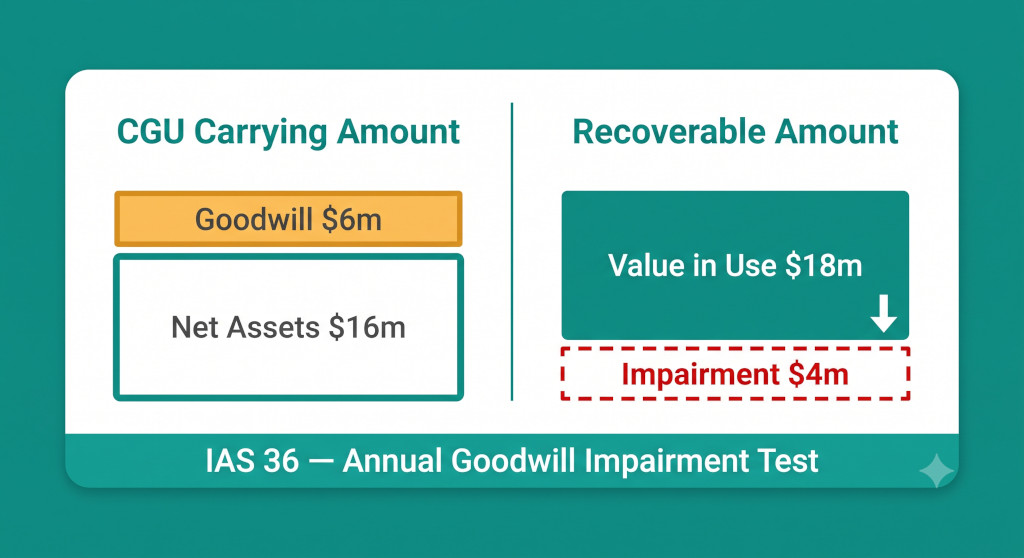
A CGU has a carrying amount of $22 million, comprising goodwill of $6 million and other net assets of $16 million. Management’s approved budget for Years 1–5 shows the following pre-tax cash flow projections. The terminal growth rate is 2% and the pre-tax discount rate is 13%, reflecting the risk profile of the specific CGU.
| Year | Projected Cash Flow ($m) | Discount Factor (13%) | Present Value ($m) |
|---|---|---|---|
| 1 | 1.80 | 0.885 | 1.593 |
| 2 | 1.90 | 0.783 | 1.488 |
| 3 | 2.00 | 0.693 | 1.386 |
| 4 | 2.10 | 0.613 | 1.287 |
| 5 | 2.20 | 0.543 | 1.195 |
| Sub-total: Years 1–5 | 6.949 | ||
| Terminal Value | 2.20 × 1.02 ÷ (0.13 − 0.02) = 20.40 | 0.543 | 11.077 |
| Value in Use (Recoverable Amount) | 18.026 | ||
Impairment assessment:
CGU carrying amount (goodwill $6m + net assets $16m) = $22.0m
Recoverable amount (VIU) = $18.0m
Impairment loss = $ 4.0m
An impairment of $4 million is indicated. Because the VIU ($18.0 million) is below the CGU’s carrying amount ($22.0 million), and assuming FVLCD does not exceed VIU, an impairment charge of $4 million must be recognised.
Step Four: Allocating the Impairment Loss
IAS 36 paragraph 104 sets out the sequence for allocating an impairment loss within a CGU. The loss is allocated in the following order:
- First to goodwill — reduce the carrying amount of goodwill allocated to the CGU to zero (or to the maximum extent of the impairment) before touching other assets.
- Then pro rata to other assets — any impairment that exceeds the goodwill balance is allocated pro rata across the other assets of the CGU, based on their carrying amounts.
In the worked example, the impairment loss of $4 million is fully absorbed by the goodwill balance of $6 million. Goodwill reduces from $6 million to $2 million; the other net assets of $16 million are untouched. The post-impairment carrying amount of the CGU is $18 million — equal to the recoverable amount.
Dr Impairment loss (P&L) $4,000,000
Cr Goodwill $4,000,000
Impairment of goodwill allocated to [CGU name] under IAS 36. Carrying amount $22.0m; recoverable amount (VIU) $18.0m. Impairment absorbed entirely by goodwill; no impairment of other CGU assets. Not reversible in future periods.
When allocating to other assets after goodwill is exhausted, IAS 36 paragraph 105 imposes a floor: the carrying amount of an individual asset cannot be reduced below the highest of its own FVLCD, its own VIU, and zero. Any amount that cannot be allocated because of this floor is allocated pro rata to the other assets in the CGU. This prevents a group from writing an individual asset down to nil simply because the CGU has failed its impairment test, when that individual asset could realistically be sold or used independently at a value above nil.
Maintain CGU carrying amounts automatically across your group
BrizoConsol tracks goodwill by CGU, applies translation for foreign operations, and keeps the carrying amounts current every period — so your impairment team starts from reliable numbers, not a spreadsheet archaeology project. See It in Action
The Irreversibility Rule
IAS 36 paragraph 124 contains one of the most important — and most consequential — rules in the standard: an impairment loss recognised for goodwill must not be reversed in a subsequent period. This is absolute. Even if the reasons for the original impairment subsequently disappear — the CGU’s trading recovers, the market improves, the acquisition synergies finally materialise — the goodwill write-down cannot be unwound.
The rationale is conceptual: goodwill is a residual arising from a business combination, not an independently identifiable asset. Any internally generated goodwill that arises after the impairment date cannot be recognised under IAS 38. So if the CGU’s recoverable amount subsequently rises above its carrying amount, the improvement reflects the creation of new internally generated goodwill — which is specifically prohibited from recognition under IFRS — not the recovery of the previously impaired purchased goodwill. Accordingly, the reversal is prohibited.
No reversal is permitted under any circumstances: IAS 36 paragraph 124 states this without qualification. Groups should be aware that a goodwill impairment is a permanent write-down — it reduces consolidated equity permanently and affects all future profitability metrics, leverage ratios, and return-on-assets calculations based on the carrying amount. Boards and audit committees should understand this consequence before approving an acquisition premium that results in material goodwill, and should build realistic impairment scenarios into acquisition modelling.
The no-reversal rule applies only to goodwill. For other assets impaired under IAS 36 — property, plant, and equipment, identifiable intangibles, investments in associates — impairment may be reversed if circumstances change. The reversal cannot exceed the carrying amount that would have applied had no impairment been recognised (the depreciated historical cost). This distinction between goodwill (no reversal) and other assets (reversal permitted) is a frequently tested point in group reporting contexts.
Disclosure Requirements Under IAS 36
IAS 36 paragraphs 130–137 require extensive disclosure in the notes to the consolidated financial statements, particularly for CGUs with significant allocated goodwill. For each CGU (or group of CGUs) to which a significant amount of goodwill or indefinite-life intangibles are allocated, the group must disclose:
- The carrying amount of goodwill allocated to the CGU.
- The basis on which recoverable amount has been determined (VIU or FVLCD).
- For VIU: the key assumptions, the period over which projections were made, the growth rates applied (including the long-term growth rate for the terminal value), and the discount rate.
- A sensitivity analysis showing what change in a key assumption would cause the carrying amount to equal the recoverable amount — or, if an impairment has been recognised, what further change would cause additional impairment.
The sensitivity disclosure is the most demanding in practice. It requires the finance team to re-run the VIU model with stressed assumptions — typically a reduction in growth rate, an increase in the discount rate, and a reduction in near-term cash flows — and to determine which single change (or combination) would bring recoverable amount down to carrying amount. For CGUs where headroom (recoverable amount minus carrying amount) is thin, this analysis requires iteration and appropriate documentation of the assumptions used.
For groups where the headroom above carrying amount is less than 10–15%, auditors will typically request sensitivity analysis covering at least two or three combinations of stressed assumptions, not just a single-variable sensitivity. Finance teams should build the VIU model with sensitivity inputs parameterised from the outset, rather than having to rebuild it under audit pressure. The sensitivity analysis also forms the basis of the IAS 36 disclosure note, which is read carefully by analysts and investors who use it to assess the vulnerability of the group’s goodwill balance to future impairment.
IAS 36 vs ASC 350 vs FRS 102 Section 27
| Area | IAS 36 (IFRS) | ASC 350 (US GAAP) | FRS 102 Section 27 (UK GAAP) |
|---|---|---|---|
| Goodwill amortisation | Prohibited — goodwill held at cost less impairment indefinitely | Prohibited for public companies. Private company alternative: amortise up to 10 years | Mandatory — amortised over useful life (max 10 years if uncertain) |
| Impairment test frequency | Annual — regardless of indicators — plus whenever indicators present | Annual — regardless of indicators — plus whenever indicators present. Qualitative assessment (“Step 0”) available first | Indicators only — no mandatory annual test |
| Unit of account | Cash-generating unit (CGU) — smallest group of assets with largely independent cash inflows | Reporting unit — operating segment or one level below (component) | CGU — same definition as IAS 36 |
| Recoverable amount basis | Higher of VIU (pre-tax DCF) and FVLCD | Fair value of reporting unit compared to carrying amount — single step since ASU 2017-04 | Higher of VIU and FVLCD — same methodology as IAS 36 |
| Discount rate for VIU | Pre-tax rate specific to the asset/CGU | No separate VIU concept — fair value uses market participant assumptions (typically post-tax WACC) | Pre-tax rate — same as IAS 36 |
| Impairment recognition | Charged to P&L; reduces goodwill to zero then other assets pro rata | Charged to P&L; measured as excess of carrying over fair value of reporting unit | Charged to P&L; same allocation sequence as IAS 36 |
| Reversal of goodwill impairment | Prohibited | Prohibited | Prohibited |
| Sensitivity disclosure | Required for CGUs with significant goodwill; must quantify change in assumption that eliminates headroom | Required if reasonably possible that goodwill could fail the test — less prescriptive than IAS 36 | Required if management reasonably believes headroom is sensitive to assumption changes |
The most operationally significant difference is the frequency of the test. Under IAS 36 and ASC 350, the annual test is mandatory — groups must run the full impairment process every year regardless of performance. Under FRS 102, the test is only triggered when indicators of impairment are present, and since goodwill is being amortised concurrently, the carrying amount reduces automatically over time, narrowing the potential impairment exposure without requiring a formal VIU calculation. For an IFRS group that paid a significant premium — particularly in a high-multiple acquisition in sectors like technology or healthcare — the annual IAS 36 test is a meaningful annual discipline, not just a compliance exercise.
For a full treatment of the IFRS 3 purchase price allocation process that generates the goodwill balance being tested, including the acquisition method, NCI measurement options, and contingent consideration, see our IFRS 3 guide for multi-entity groups. For FRS 102 goodwill — which is amortised rather than tested annually — the Section 19 acquisition accounting and Section 27 impairment rules were covered in our FRS 102 consolidation guide.
IAS 36 in the Annual Close: A Practical Checklist
- Confirm CGU structure and goodwill allocations. Review whether the CGU boundaries remain appropriate — significant changes in how management monitors operations (new divisions, disposals, restructurings) may require re-allocation. Document any changes and update the goodwill allocation schedule.
- Identify indicators of impairment early. Even though the annual test is mandatory, indicators — significant adverse changes in the market, loss of key customers, sustained trading losses — should trigger a test outside the annual cycle if they arise. Build an indicator review into the quarterly reporting process, not just the year-end.
- Prepare the VIU model using approved budgets. Use management’s most recent approved budget for Year 1; extrapolate for Years 2–5 using supportable, documented assumptions. Challenge growth rates that exceed the long-term average for the CGU’s market.
- Set the pre-tax discount rate correctly. Do not simply use the group’s after-tax WACC. The IAS 36 discount rate should be pre-tax and CGU-specific, reflecting the risks of the assets being tested. If the group derives a post-tax discount rate from market data, gross it up to a pre-tax equivalent.
- Calculate terminal value conservatively. The terminal growth rate should not exceed the long-run average for the relevant market. For most developed-market CGUs, a rate in the range of 1–2.5% is supportable and unlikely to attract auditor challenge.
- Run sensitivity analysis before the audit. Identify the two or three assumptions where a reasonable change would most quickly eliminate headroom. Document the change required to bring recoverable amount to carrying amount for each. This is both a disclosure requirement and an audit expectation.
- For foreign-operation CGUs, perform the test in functional currency. Translate the resulting carrying amount and recoverable amount into the group’s presentation currency at the closing rate for the consolidated balance sheet. Any resulting impairment is translated at the rate prevailing when the impairment is recognised.
- For partial disposals and NCI, reassess CGU boundaries. Where the group disposes of part of a CGU, goodwill must be allocated to the disposed portion on a relative value basis and included in the gain or loss on disposal. Confirm that the remaining goodwill balance is correctly reallocated to the retained CGU.
BrizoConsol maintains the consolidated goodwill balance by CGU across all reporting periods, applies the IAS 21 closing rate to foreign-operation CGUs automatically, and tracks the carrying amounts that feed the annual IAS 36 impairment workings — ensuring the input data is reliable and current rather than reconstructed from memory each year-end. For the broader year-end close process, our month-end close checklist covers where impairment testing fits within the annual consolidation timeline.
Reliable goodwill balances by CGU — every reporting period
BrizoConsol maintains your consolidated balance sheet entity by entity, so when IAS 36 season arrives, your carrying amounts are already right. Start free, no credit card required. Start Free Trial