How to Consolidate an IFRS Subsidiary into a UK GAAP (FRS 102) Parent: Journals, Fiscal Periods, and Currency Translation
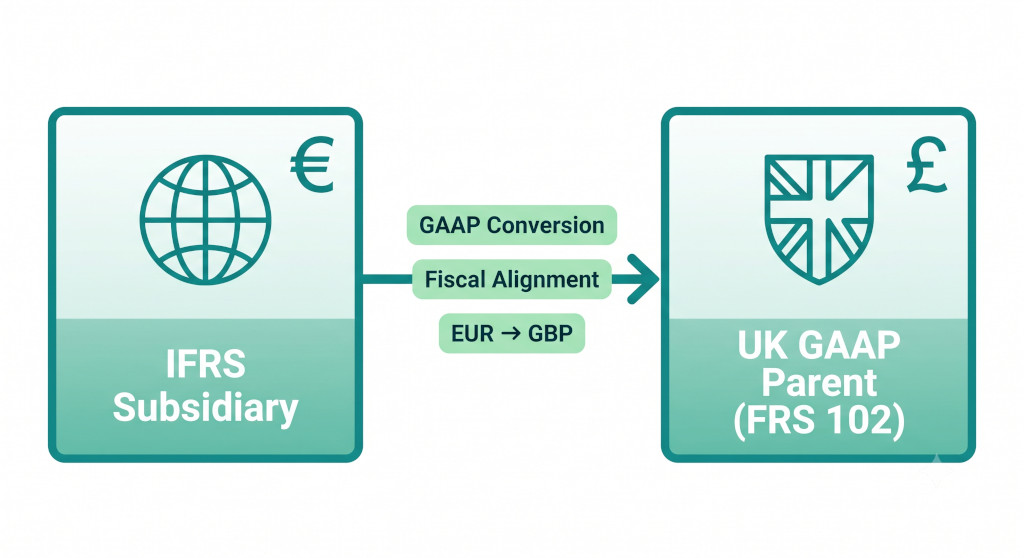
UK groups that have grown through acquisition — particularly those with European or international subsidiaries — often find themselves in a position where the parent company applies FRS 102 while one or more subsidiaries prepare their statutory accounts under full IFRS. The subsidiary reports to its local regulator under IFRS; the group consolidates under FRS 102. Every reporting period, the two sets of accounts must be reconciled.
The good news is that IFRS and FRS 102 share more common ground than IFRS and US GAAP. Both are principles-based, both permit development cost capitalisation, both allow revaluation of PP&E, and both permit impairment reversals. The conversion journal list is shorter. But where they differ — particularly on lease accounting and goodwill — the differences are material and cannot be overlooked.
This guide walks through the GAAP conversion journals required to bring an IFRS subsidiary into a FRS 102 group consolidation, how to handle fiscal year differences, and how to translate the subsidiary’s local currency into sterling. For background on the conceptual differences between the two frameworks, see our IFRS vs UK GAAP comparison guide.
Foreign currency consolidation, handled automatically.
BrizoConsol applies the correct CTA/FCTR treatment across all entities — no spreadsheets needed.
The Group Structure Used in This Guide
- BrizoUK Ltd — UK parent, applies FRS 102, reports in GBP, fiscal year 1 January to 31 December
- BrizoEU GmbH — German subsidiary, 100% owned, applies IFRS, reports in EUR, fiscal year 1 January to 31 December
- Exchange rates (illustrative): closing rate EUR/GBP 0.855; average rate EUR/GBP 0.848; historical rate at date of acquisition EUR/GBP 0.880
BrizoEU GmbH has office and warehouse leases accounted for under IFRS 16, goodwill arising from a prior acquisition, and a deferred tax position that will require adjustment following the conversion journals.
Step 1 — GAAP Conversion Journals
Step 1
All conversion journals are prepared in EUR — BrizoEU GmbH’s functional currency — and translated into GBP in Step 3. The objective is to produce a FRS 102-compliant trial balance for BrizoEU in EUR before any currency translation takes place.
Adjustment 1: Leases — Remove IFRS 16 Treatment, Reinstate Operating Lease Expense
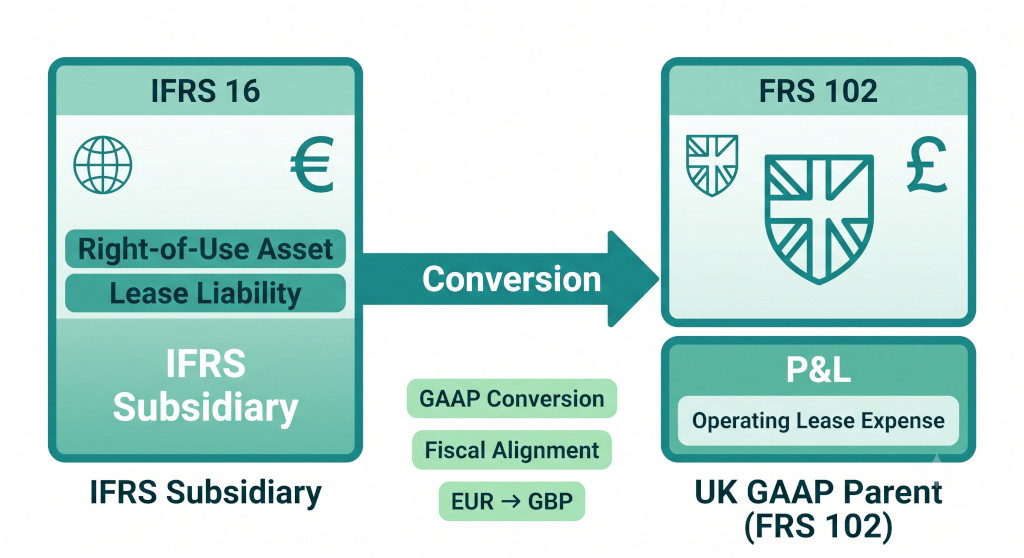
This is the most significant and most common conversion adjustment for IFRS-to-FRS 102 consolidations. Under IFRS 16, BrizoEU GmbH has recognised its office and warehouse leases on the balance sheet. Under FRS 102 Section 20, these are operating leases and remain off balance sheet — only finance leases (those that substantially transfer risks and rewards of ownership) appear on the FRS 102 balance sheet.
IFRS 16 Treatment
Right-of-Use Asset: EUR 780,000 (net)
Lease Liability: EUR 810,000
P&L: Depreciation EUR 130,000 + Interest EUR 22,000
FRS 102 Section 20 Treatment
No balance sheet entries for operating leases
P&L: Straight-line lease expense EUR 148,000
(total undiscounted lease payments ÷ lease term)
Journal 1A — Remove ROU asset and lease liability (opening balances)
DR Lease Liability EUR 810,000
CR Right-of-Use Asset (gross) EUR 910,000
DR Accumulated Depreciation — ROU EUR 130,000
CR Retained Earnings EUR 30,000
Removes the ROU asset (net EUR 780,000) and lease liability from the balance sheet. Retained earnings is the net difference — cumulative effect of prior periods where lease expense under FRS 102 would have differed from IFRS 16 depreciation + interest treatment.
Journal 1B — Reverse current-year IFRS 16 charges; reinstate straight-line lease expense
DR Depreciation — ROU Asset EUR 130,000
DR Interest Expense — Lease Liability EUR 22,000
CR Operating Lease Expense EUR 148,000
CR Retained Earnings EUR 4,000
Removes the IFRS 16 income statement charges (depreciation + interest = EUR 152,000) and replaces them with the straight-line operating lease expense of EUR 148,000. The EUR 4,000 credit to retained earnings reflects the net income difference for the period — IFRS 16 front-loads cost, so in early lease years the combined depreciation + interest typically exceeds the straight-line expense.
The IFRS 16 reversal is the most impactful GAAP journal for most IFRS-to-FRS 102 conversions. It reduces total assets, reduces total liabilities, and changes the P&L presentation — moving charges from depreciation and finance costs to operating expenses. EBITDA will decrease; net profit may be marginally different depending on lease age and the straight-line vs front-loaded cost profile.
Adjustment 2: Goodwill — Introduce Amortisation
BrizoEU GmbH was acquired three years ago. Goodwill on acquisition was EUR 600,000. Under IFRS (IFRS 3 / IAS 36), goodwill is not amortised — it sits on the balance sheet at EUR 600,000, subject only to annual impairment testing (assumed nil impairment to date). Under FRS 102 Section 19, goodwill must be amortised over its useful economic life. If the useful life cannot be estimated reliably, FRS 102 requires a maximum period of ten years.
BrizoUK’s group accounting policy under FRS 102 is to amortise goodwill over ten years. Annual amortisation charge: EUR 60,000 per year. After three years of ownership: cumulative amortisation EUR 180,000.
Journal 2A — Introduce prior-year cumulative goodwill amortisation
DR Retained Earnings EUR 120,000
CR Goodwill EUR 120,000
Recognises two prior years of goodwill amortisation (EUR 60,000 × 2 = EUR 120,000) that would have been charged under FRS 102 but were not charged under IFRS. Reduces retained earnings and reduces the goodwill carrying value.
Journal 2B — Charge current-year goodwill amortisation
DR Goodwill Amortisation Expense EUR 60,000
CR Goodwill EUR 60,000
Current-year amortisation charge under FRS 102 — hits the income statement directly. After this journal, goodwill is EUR 420,000 (EUR 600,000 − EUR 180,000 cumulative amortisation) versus EUR 600,000 under IFRS. This difference widens by EUR 60,000 every year.
Note on impairment: FRS 102 also requires goodwill to be reviewed for impairment when there are indicators that the carrying value may not be recoverable. If BrizoUK has conducted an impairment review under IFRS and found no impairment, that review should be revisited on a FRS 102 basis — the recoverable amount methodology is broadly similar, but the lower FRS 102 carrying value (post-amortisation) means impairment is less likely to arise than under IFRS.
Adjustment 3: Deferred Tax on Conversion Adjustments
The lease and goodwill conversion journals above change the carrying values of assets and liabilities on the FRS 102 balance sheet relative to IFRS. Where there are differences between the FRS 102 carrying value and the tax base of those assets and liabilities, deferred tax adjustments are required.
For the lease conversion: removing the ROU asset and lease liability from the balance sheet under FRS 102 eliminates the associated deferred tax position that existed under IFRS (a deferred tax asset on the lease liability exceeding the deferred tax liability on the ROU asset in early lease years). The net deferred tax impact depends on the applicable tax rate and whether lease payments are deductible in the relevant jurisdiction.
For goodwill amortisation: in most jurisdictions, goodwill amortisation for accounting purposes is not deductible for tax. If so, the FRS 102 goodwill amortisation creates a temporary difference — the accounting carrying value falls faster than the tax base — generating a deferred tax liability. The deferred tax liability on the cumulative goodwill amortisation of EUR 180,000, at a 25% tax rate, would be EUR 45,000.
Journal 3 — Deferred tax on goodwill amortisation (if non-deductible)
DR Retained Earnings EUR 30,000
DR Deferred Tax Expense EUR 15,000
CR Deferred Tax Liability EUR 45,000
Prior-year deferred tax on cumulative goodwill amortisation (EUR 120,000 × 25%) goes to retained earnings. Current-year deferred tax (EUR 60,000 × 25%) hits the income statement as deferred tax expense. Confirm the tax deductibility position in BrizoEU’s jurisdiction before applying.
Step 2 — Fiscal Year Differences
Step 2
In this example, BrizoEU GmbH and BrizoUK Ltd share the same 31 December year-end — no adjustment is needed. Unlike US GAAP (which has an explicit three-month rule under ASC 810), FRS 102 does not prescribe a specific maximum gap between subsidiary and parent year-ends. However, UK company law and best practice strongly favour aligned reporting dates, and FRS 102 paragraph 9.16 requires that where a subsidiary’s reporting date differs from the parent’s, adjustments must be made for significant events occurring between the two dates.
Where fiscal year-ends do not align, BrizoUK should identify any material transactions — acquisitions, disposals, large financing events, significant one-off items — that occurred in the gap period and include them as adjustments in the group consolidation, or disclose them as post-balance-sheet events in the group accounts. For subsidiaries with year-ends differing by more than a quarter, preparing a special set of accounts as of the group reporting date is advisable.
Step 3 — Currency Translation: EUR to GBP (FCTR)
Step 3
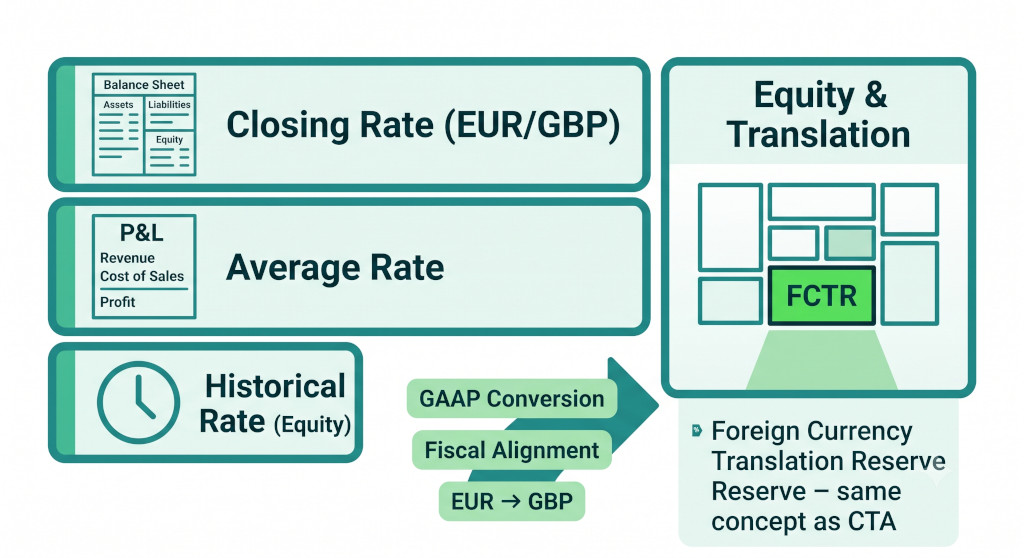
FRS 102 Section 30 follows the same functional currency approach as IAS 21 for translating foreign operations into the presentation currency. The mechanics are identical — what FRS 102 calls the Foreign Currency Translation Reserve (FCTR) is the same concept as the Cumulative Translation Adjustment (CTA) under IFRS and US GAAP. The term differs; the accounting does not.
| Item | Translation Rate | Note |
|---|---|---|
| Balance sheet assets and liabilities | Closing rate (EUR/GBP 0.855) | All balance sheet items translated at the year-end spot rate |
| Income statement revenues and expenses | Average rate (EUR/GBP 0.848) | Approximates the rate in effect at the time of each transaction |
| Share capital and share premium | Historical rate (EUR/GBP 0.880) | Rate at the date BrizoUK acquired / invested in BrizoEU |
| Opening retained earnings | Carried forward from prior year translation | Consistent with cumulative prior-period translation |
| FCTR (Foreign Currency Translation Reserve) | Balancing figure | Absorbs all differences from using different rates; recognised in equity (other comprehensive income) |
Worked Translation Example
Using BrizoEU GmbH’s FRS 102-restated figures in EUR (after conversion journals above) and the exchange rates from our example:
| Item | EUR (FRS 102 restated) | Rate | GBP |
|---|---|---|---|
| Income Statement | |||
| Revenue | 9,500,000 | Avg 0.848 | 8,056,000 |
| Operating Expenses (incl. lease expense, goodwill amortisation) | (7,800,000) | Avg 0.848 | (6,614,400) |
| Net Profit | 1,700,000 | 1,441,600 | |
| Balance Sheet | |||
| Total Assets | 14,200,000 | Close 0.855 | 12,141,000 |
| Total Liabilities | (7,400,000) | Close 0.855 | (6,327,000) |
| Net Assets | 6,800,000 | 5,814,000 | |
| Equity Reconciliation | |||
| Share Capital (historical rate 0.880) | 2,500,000 | Hist 0.880 | 2,200,000 |
| Opening Retained Earnings (carried forward) | 2,600,000 | Prior year | 2,183,600 |
| Current Year Net Profit | 1,700,000 | Avg 0.848 | 1,441,600 |
| FCTR (balancing figure) | — | Plug | (11,200) |
| Total Equity | 6,800,000 | 5,814,000 | |
The negative FCTR of GBP (11,200) reflects a slight weakening of the EUR against GBP over the period — the closing rate of 0.855 is lower than the average rate of 0.848 applied to income, and both are lower than the historical rate of 0.880 applied to equity. This negative FCTR sits in equity (other comprehensive income) in BrizoUK’s consolidated accounts and accumulates until BrizoEU GmbH is disposed of, at which point it is recycled to the income statement.
The FCTR under FRS 102 and the CTA under IFRS and US GAAP are the same economic concept — a translation reserve that captures the cumulative effect of exchange rate movements on the reported value of the foreign subsidiary. Groups with several foreign-currency subsidiaries should monitor FCTR movements carefully: a significant EUR/GBP shift can create a material swing in consolidated equity even when the underlying trading performance is unchanged.
Step 4 — Intercompany Eliminations
Step 4
With BrizoEU GmbH’s FRS 102-restated, GBP-translated figures loaded into the group consolidation, intercompany eliminations follow exactly the same logic as any consolidation. All balances between BrizoEU and BrizoUK — intercompany receivables, payables, loans, management fees, dividends — are eliminated in full.
Cross-currency intercompany balances require particular attention. A EUR-denominated loan from BrizoUK to BrizoEU will appear on BrizoEU’s books in EUR at the closing rate; BrizoUK may have recorded it in GBP at the rate prevailing on the drawdown date. The resulting translation difference at elimination is treated as an FX difference at group level. Where the loan is part of the net investment in BrizoEU — in substance quasi-equity, with no expectation of repayment — the exchange difference goes to the FCTR in equity rather than to the income statement, in line with FRS 102 Section 30.13.
Practical Checklist: IFRS to FRS 102 Consolidation
✅ Period-End Consolidation Checklist
- Obtain BrizoEU GmbH’s trial balance in EUR under IFRS
- Identify applicable GAAP differences: confirm which IFRS 16 leases are operating in nature (no FRS 102 balance sheet entry); note goodwill carrying value and calculate FRS 102 amortisation charge
- Prepare lease conversion journals in EUR: remove ROU asset and lease liability; reinstate straight-line operating lease expense
- Prepare goodwill amortisation journals: prior-year cumulative charge to retained earnings; current-year charge to P&L
- Prepare deferred tax adjustment on goodwill amortisation if non-tax-deductible
- Review for any other IFRS vs FRS 102 differences relevant to BrizoEU’s specific accounting policies
- Confirm year-ends align; if not, identify and adjust for significant gap-period events
- Apply closing EUR/GBP rate to all balance sheet items
- Apply average EUR/GBP rate to all income statement items
- Apply historical EUR/GBP rate to share capital and share premium
- Calculate FCTR as the equity balancing figure; record in other comprehensive income
- Load GBP-translated FRS 102 figures into group consolidation model
- Eliminate all intercompany balances and transactions
- Classify net investment loans — route exchange differences on these to FCTR, not P&L
- Review FCTR movement for reasonableness against EUR/GBP rate movement in the period
Note: This guide covers the most common GAAP conversion adjustments for IFRS-to-FRS 102 consolidations. The specific journals required will depend on BrizoEU GmbH’s accounting policies and the materiality of individual differences. Always involve your external auditors when establishing the conversion framework for the first time, particularly around lease classification, goodwill useful life assessment, and deferred tax treatment in the relevant jurisdiction.
Consolidating a multi-currency, multi-framework group?
BrizoConsol connects to Xero, QuickBooks, MYOB, and Zoho Books — automating intercompany eliminations, currency translation, and consolidated reporting across all your entities and standards. Start Free Trial