Goodwill on a Foreign Subsidiary: Why It Must Be Retranslated Every Period — and the CTA You Are Probably Not Recording
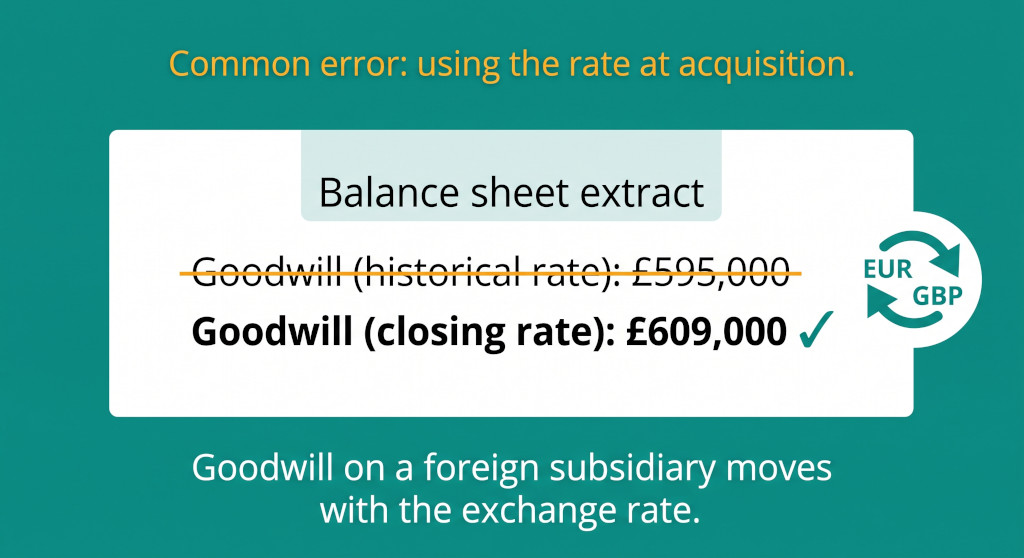
Rachel is the group financial controller of Nexus Group, a UK-based business that acquired a German subsidiary, Nexus GmbH, eighteen months ago. The acquisition was straightforward: goodwill of €700,000 (£595,000 at the acquisition date rate) was recognised at closing and has not been impaired since. In Rachel’s consolidation model, the goodwill balance sits at £595,000 every month, unchanged.
At the next audit committee meeting, the external auditor raises a question about goodwill. Why does the consolidated balance sheet show goodwill of £595,000 when the current EUR/GBP rate would translate €700,000 at £581,000? The goodwill should have been retranslated at every period-end closing rate, with the exchange difference recorded in OCI as part of the group’s cumulative translation adjustment. Rachel’s model has been using the rate at acquisition throughout — a mistake that understates OCI by the cumulative translation difference on goodwill, and that, when Nexus GmbH is eventually sold, will produce a disposal gain that is overstated.
The error is more common than it might appear. Many consolidation models treat goodwill as a fixed number in the parent’s functional currency — set at acquisition and never moved again unless there is an impairment. The logic seems reasonable: goodwill was calculated in the parent’s currency, so why would it change? The answer is in IAS 21, which is unambiguous on the point, and the consequence runs through to the disposal mechanics in a way that cannot easily be unwound.
Foreign currency consolidation, handled automatically.
BrizoConsol applies the correct CTA/FCTR treatment across all entities — no spreadsheets needed.
What IAS 21 Actually Says About Goodwill on a Foreign Operation
IAS 21 paragraph 47 states that goodwill arising on the acquisition of a foreign operation “shall be treated as an asset and liability of the foreign operation and shall be expressed in the functional currency of the foreign operation.” In Nexus Group’s case, Nexus GmbH has a EUR functional currency. Goodwill arising on the acquisition of Nexus GmbH is therefore an asset denominated in EUR — €700,000. It exists in euros, lives in euros, and must be translated into the group’s GBP presentation currency at each period-end using the closing rate, exactly as any other EUR-denominated asset of Nexus GmbH would be translated.
The exchange difference that arises from retranslating goodwill — between its value at the previous closing rate and its value at the current closing rate — is recognised directly in OCI as part of the foreign currency translation reserve (FCTR), alongside the exchange differences on the rest of Nexus GmbH’s net assets. It does not go through the consolidated P&L. It accumulates in OCI until the subsidiary is disposed of, at which point the entire FCTR balance relating to the subsidiary — including the accumulated translation differences on goodwill — is recycled through P&L as part of the disposal gain or loss calculation.
Goodwill on a foreign subsidiary is denominated in the subsidiary’s functional currency, not the parent’s. It is an asset of the foreign operation, translated at the closing rate at every period-end. Using the rate at acquisition is incorrect under IAS 21 and understates the cumulative translation adjustment in OCI.
The Two Methods Compared
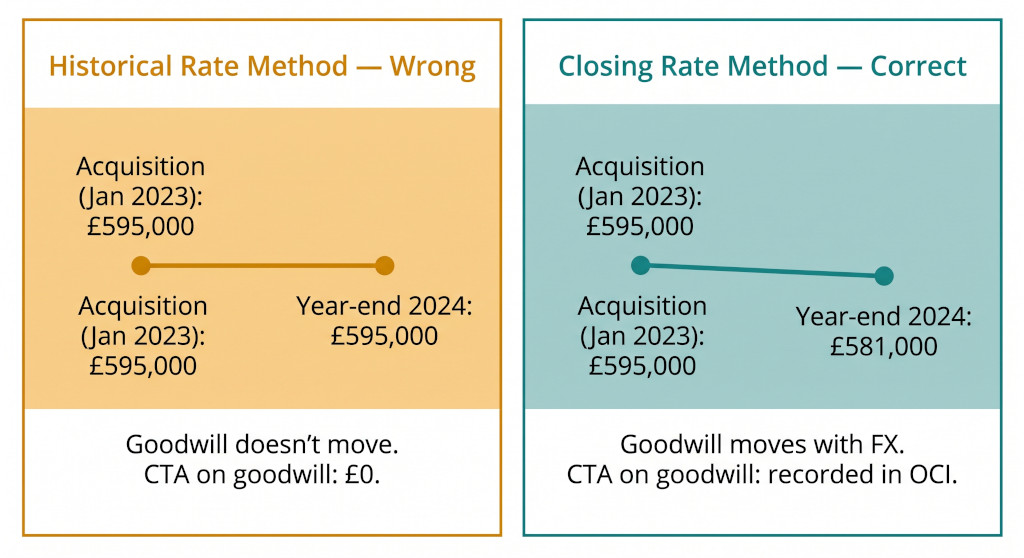
The practical difference between the correct and incorrect approach can be seen clearly in Nexus Group’s numbers over a two-year period:
| Period | EUR/GBP Rate | Goodwill in EUR | Historical Rate (wrong) | Closing Rate (correct) | Difference |
|---|---|---|---|---|---|
| Acquisition: 1 Jan 2023 | 0.8500 | €700,000 | £595,000 | £595,000 | — |
| 31 Dec 2023 | 0.8700 | €700,000 | £595,000 | £609,000 | £14,000 |
| 31 Dec 2024 | 0.8300 | €700,000 | £595,000 | £581,000 | (£14,000) |
Using the correct method, goodwill rises from £595,000 to £609,000 during 2023 (as EUR strengthened against GBP) and falls back to £581,000 in 2024 (as EUR weakened). The £14,000 increase during 2023 is a positive exchange difference, credited to OCI as part of the FCTR. The £28,000 decrease during 2024 (from £609,000 back to £581,000) is a negative exchange difference, debited to OCI. The net cumulative CTA on goodwill over the two years is a debit of £14,000 — EUR/GBP ended lower than it started.
Using the incorrect method, goodwill stays at £595,000 throughout. No exchange difference is ever recorded. The FCTR in OCI is understated by the amount that should have been recorded on goodwill. This understatement accumulates silently and only becomes visible — and financially significant — when the subsidiary is eventually sold.
Common mistake: Treating goodwill as a fixed sterling amount set on the date of acquisition and never retranslated. This is the most widespread goodwill translation error in practice, often because consolidation models are built with goodwill as a hardcoded input rather than a foreign-currency asset that translates each period. The model looks correct because goodwill doesn’t move — but that is exactly the problem.
Recording the CTA on Goodwill — The Annual Journals
For each period, the retranslation of goodwill produces an exchange difference that must be posted to OCI. Using Nexus Group’s numbers:
Year ended 31 December 2023 (EUR strengthened — positive CTA):
| Account | Dr | Cr |
|---|---|---|
| Goodwill — Nexus GmbH (balance sheet) | £14,000 | |
| Foreign currency translation reserve — FCTR (OCI / equity) | £14,000 |
Goodwill retranslated from £595,000 (opening, at 0.8500) to £609,000 (closing, at 0.8700). Exchange difference of £14,000 credited to the FCTR in OCI — not to P&L. This is a consolidation-level journal, not posted in any entity’s books.
Year ended 31 December 2024 (EUR weakened — negative CTA):
| Account | Dr | Cr |
|---|---|---|
| Foreign currency translation reserve — FCTR (OCI / equity) | £28,000 | |
| Goodwill — Nexus GmbH (balance sheet) | £28,000 |
Goodwill retranslated from £609,000 (opening, at 0.8700) to £581,000 (closing, at 0.8300). Exchange difference of £28,000 debited to the FCTR in OCI. Net cumulative CTA on goodwill after two years: (£14,000) — a net debit to OCI reflecting the net weakening of EUR against GBP since acquisition.
These journals are consolidation-level adjustments. They do not appear in Nexus GmbH’s own accounts (which are in EUR and have no translation to perform) or in the UK parent’s own accounts (which don’t carry the subsidiary’s goodwill — that only exists in the consolidated accounts). They exist solely in the consolidation workbook or tool, as part of the process of translating the foreign subsidiary’s results and position into the group’s GBP presentation currency.
What Happens to the Goodwill CTA at Disposal
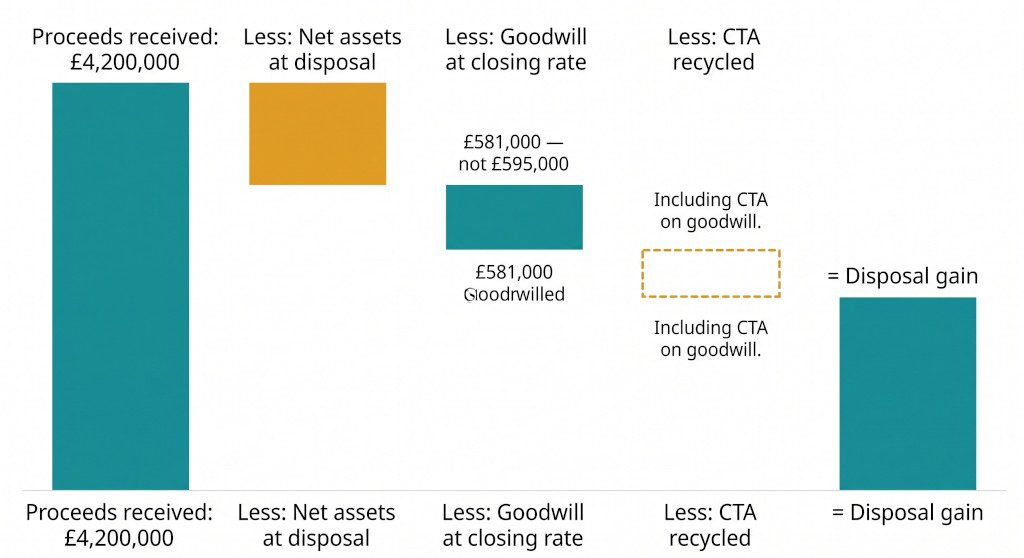
The critical downstream consequence of getting the goodwill translation right — or wrong — becomes apparent when the subsidiary is sold. Under IFRS 10 and IAS 21, when a group disposes of a foreign subsidiary and loses control, the cumulative exchange differences relating to that subsidiary that are held in OCI must be recycled into P&L as part of the disposal gain or loss calculation. This includes the cumulative exchange differences on goodwill.
Suppose Nexus Group sells Nexus GmbH at the end of 2024 for proceeds of £4,200,000. The disposal gain is calculated as follows under the correct method:
| Disposal proceeds | £4,200,000 |
| Less: Net identifiable assets of Nexus GmbH at disposal date (translated at closing rate) | (£3,450,000) |
| Less: Goodwill at disposal date (closing rate: €700,000 × 0.8300) | (£581,000) |
| Less: NCI at disposal date | — |
| Add: Cumulative FCTR recycled from OCI (including CTA on goodwill) | £14,000 |
| Disposal gain — correct | £183,000 |
Now compare what the disposal gain would have looked like if Rachel had continued using the historical rate throughout:
| Disposal proceeds | £4,200,000 |
| Less: Net identifiable assets (same — translated at closing rate) | (£3,450,000) |
| Less: Goodwill at historical rate (£595,000 — never moved) | (£595,000) |
| Add: Cumulative FCTR recycled (excluding CTA on goodwill — never recorded) | £28,000 |
| Disposal gain — wrong | £183,000 |
In this specific example, the disposal gain is the same either way — £183,000. This might seem to suggest the error doesn’t matter. But that conclusion is wrong for two reasons.
First, the components of the gain are different. Using the wrong method, goodwill is higher (£595,000 vs £581,000) and the FCTR recycled is different (£28,000 vs £14,000 net). The individual line items in the disclosure are misstated even if the total happens to agree. In practice, the total will only agree in specific exchange rate scenarios; for most rate paths, the totals will diverge.
Second, the FCTR recycled through P&L is wrong in the historical-rate approach. The group has £28,000 sitting in OCI as the FCTR on Nexus GmbH’s net assets (excluding goodwill), but if the goodwill CTA was never recorded, the total FCTR in OCI attributable to Nexus GmbH is not what the group thinks it is. When the disposal forces a reclassification of the accumulated FCTR from OCI to P&L, the group either over- or under-recycles — depending on the direction of exchange rate movement since acquisition. The amounts can be material for large acquisitions over long holding periods.
The goodwill CTA is part of the FCTR that must be recycled on disposal. If the goodwill CTA was never recorded in OCI, the recycling at disposal will be incomplete — and the disposal gain will be misstated. The error is self-concealing until the disposal occurs, at which point it is too late to correct cleanly.
Goodwill, CTA, and the Full Foreign Subsidiary Translation
To understand why goodwill follows the closing rate, it helps to think through the complete translation of a foreign subsidiary at consolidation. Nexus GmbH’s EUR balance sheet — all assets and liabilities — is translated into GBP at the period-end closing rate. This produces GBP-equivalent amounts for every line on the balance sheet. The difference between the translated net assets and the GBP net assets at the start of the period (adjusted for profits earned and dividends paid during the year) is the currency translation adjustment — a number that goes to OCI, not P&L.
Goodwill is part of the Nexus GmbH “balance sheet” in this translation framework, even though it does not appear in Nexus GmbH’s own statutory accounts. In the consolidated accounts, goodwill is recognised as part of the consolidated balance sheet of the group attributable to Nexus GmbH. For IAS 21 purposes, it is treated as an asset of the foreign operation — held in EUR, translated at closing rate — exactly as if it appeared on Nexus GmbH’s own books in EUR.
The full calculation of the CTA for Nexus GmbH therefore has two components: the CTA on the net identifiable assets (the standard translation of the subsidiary’s own balance sheet) and the CTA on goodwill (the translation of the additional consolidation-level asset). Both belong in the FCTR in OCI. Both must be recycled at disposal. The detailed mechanics of how to calculate the full CTA on a foreign subsidiary, including the reconciliation of the FCTR from period to period, are covered in How to Calculate the Cumulative Translation Adjustment (CTA) in Group Consolidation.
Goodwill Impairment and the Closing Rate Interaction
One complication arises when goodwill has been partially impaired before the balance sheet date. The impairment is tested in the foreign subsidiary’s functional currency (EUR), reduces the goodwill balance in EUR, and the reduced EUR balance is then translated at the closing rate. The impairment loss itself is translated at the rate on the date of impairment (typically the average rate for the period in which the impairment was recognised) and flows through the consolidated P&L.
For example, if Nexus GmbH’s goodwill of €700,000 was impaired by €100,000 during 2024 (at an average rate of, say, 0.8450), the impairment loss in GBP would be £84,500. The remaining goodwill is €600,000, which at the year-end closing rate of 0.8300 translates to £498,000. The CTA for the year reflects the exchange difference on the post-impairment goodwill balance, not the original balance. Groups that calculate the CTA on goodwill as “opening goodwill × rate movement” without adjusting for any impairment taken during the year will calculate the wrong CTA figure.
What to Do If You Have Been Using the Wrong Rate
If goodwill on a foreign subsidiary has been carried at the historical rate and never retranslated, the correction involves two steps.
First, calculate the cumulative CTA on goodwill from the acquisition date to the current period-end. This is the difference between goodwill at the historical rate and goodwill at the current closing rate, adjusted for any impairment taken in the interim. This cumulative difference should be recorded in OCI — as a credit to the FCTR if the foreign currency has strengthened, or a debit if it has weakened.
Second, review every prior period’s FCTR balance and reconciliation to determine whether the omission of the goodwill CTA was material. If the group has filed accounts that included an incorrect FCTR balance, the materiality assessment will determine whether a restatement is required. In many cases, the amounts are below materiality — particularly for subsidiaries with moderate goodwill balances and stable exchange rates. Where the amounts are material, the correction should be reflected in the opening balance of the earliest comparative period presented, with a note to the accounts.
Going forward, the correct approach is to maintain goodwill as a foreign-currency balance in the consolidation model, retranslated at each period-end closing rate. The exchange difference for each period flows to the FCTR. The mechanics of FCTR recycling on disposal cover the treatment when the subsidiary is eventually sold.
Goodwill Translation Checklist
- Confirm goodwill is denominated in the foreign subsidiary’s functional currency. For each foreign subsidiary where goodwill exists in the consolidated accounts, determine the goodwill amount in the subsidiary’s functional currency (calculated at acquisition using the rate at that date). This is the EUR balance that must be carried forward and retranslated each period.
- Retranslate goodwill at the period-end closing rate in every consolidation. Do not carry forward the GBP goodwill amount from the prior period without updating for the current closing rate. The opening GBP goodwill (prior period closing rate) becomes the starting point; the closing GBP goodwill (current period closing rate) is the ending point.
- Record the exchange difference on goodwill in OCI — not P&L. The difference between opening and closing goodwill (in GBP) due to exchange rate movement is a translation difference, not an impairment. It belongs in the FCTR within OCI, alongside the exchange differences on the rest of the subsidiary’s net assets.
- Adjust the goodwill CTA calculation for any impairment taken in the period. If goodwill was impaired during the year, reduce the EUR goodwill balance before applying the closing rate. The impairment loss itself is translated at the rate on the impairment date (or average rate for the period), and flows through P&L — not OCI.
- Include the cumulative goodwill CTA in the FCTR attributable to the subsidiary. The total FCTR to be recycled on disposal of a foreign subsidiary includes the CTA on net identifiable assets plus the CTA on goodwill. Maintain these as separate components in the FCTR reconciliation to ensure the full amount is recycled on disposal.
- When computing a disposal gain, use goodwill at the closing rate on the disposal date. The goodwill to be included in the “net assets disposed of” calculation is the GBP amount at the closing rate on the date of disposal — not the historical rate amount or the original acquisition amount.
- Recycle the full FCTR — including the goodwill component — on disposal. When reclassifying the FCTR from OCI to P&L on disposal of a foreign subsidiary, confirm the FCTR balance includes all cumulative goodwill translation differences. Any component excluded from the recycling will produce an error in the disposal gain.
- Review any prior-period consolidations where goodwill may have been carried at the historical rate. If the error has been in place for multiple periods, calculate the cumulative omitted FCTR on goodwill and assess materiality. Post a prior-period correction in OCI if material, or an opening balance adjustment if multiple years are affected.
Get foreign subsidiary goodwill translation right every period
BrizoConsol handles multi-currency consolidation — including closing-rate translation of goodwill, CTA tracking by subsidiary, and FCTR recycling on disposal — so your group accounts are correct from day one. Start Free Trial