How to Onboard a New Entity Into Your Group Consolidation: The Finance Controller’s Checklist
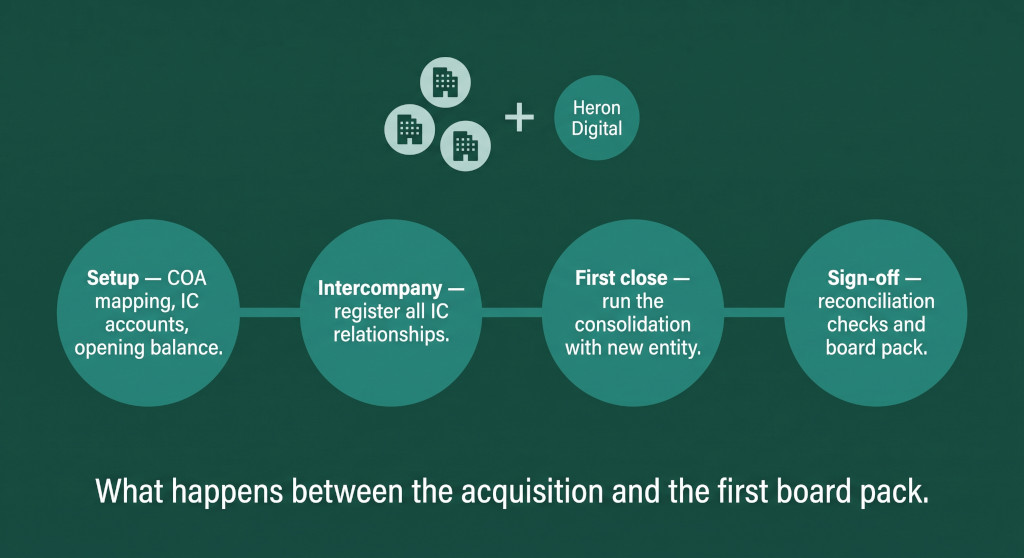
Sam is group financial controller at Heron Group. On 1 March, the group completed the acquisition of Heron Digital Ltd — a digital marketing agency — for a consideration of £1,850,000. The existing group comprises Heron Holdings (the parent) and Heron Trading Ltd. The March board pack is due in three weeks.
The legal team has confirmed the completion. The deal team has moved on to the next transaction. The question now sitting with Sam is operational: what, exactly, needs to happen before Heron Digital’s numbers can appear in the consolidated group accounts?
This is the onboarding problem — and it is entirely a group-level process. Heron Digital’s own accounts are fine; it has been running its own Xero for three years. The challenge is integrating Heron Digital’s data, structure, and intercompany relationships into a consolidation workflow that was designed for two entities and must now accommodate three. Every step in the checklist below exists because there is a group consolidation, and that consolidation has requirements that no individual entity’s accounting system imposes.
Stop building consolidations in spreadsheets.
BrizoConsol automates multi-entity consolidation — setup in minutes, reports the same day.
The Four Phases of Entity Onboarding
Onboarding a new entity into a group consolidation involves four phases, each of which must be substantially complete before the entity’s data can be included in a consolidated close. Missing any phase does not just create extra work at month-end — it creates errors in the consolidated accounts that are harder to find and fix after the close than before it.
Phase 1: Setup — Before the First Close
-
☐Confirm the acquisition date and ownership percentage The consolidation includes Heron Digital from 1 March only. Months before that date are excluded from the consolidated P&L. Confirm the exact date of control transfer — this is the date from the share purchase agreement, not the date the deal was announced.
-
☐Obtain the trial balance as at the acquisition date Heron Digital’s balance sheet at 1 March is the starting point for everything. This is the trial balance at which the PPA adjustments are applied and from which the first consolidated balance sheet is built. Obtain it from Heron Digital’s finance team or directly from their Xero.
-
☐Complete the purchase price allocation (PPA) Identify and measure all identifiable assets and liabilities at fair value as at 1 March. Calculate goodwill as consideration (£1,850,000) minus fair value of net assets. For Heron Digital: net assets at FV £420,000; goodwill £1,430,000. If any intangibles should be separately identified (customer lists, brand), do this now — not after the first close.
-
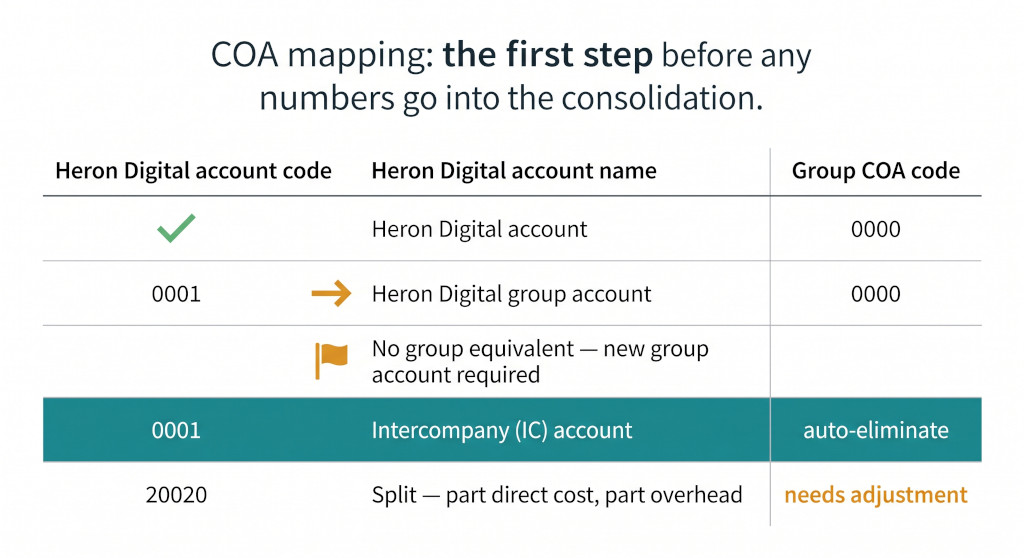
☐Map Heron Digital’s COA to the group COA Every account in Heron Digital’s Xero must be assigned a group COA code. Look for: accounts with no group equivalent (create new group accounts or assign to nearest equivalent); accounts coded above the GP line that the group codes below it (reclassification needed); and any existing accounts that should become dedicated IC accounts.
-
☐Add dedicated intercompany accounts to Heron Digital’s Xero Heron Digital needs IC accounts for every type of transaction it will have with the group: IC payable to Heron Holdings (management fee), IC loan payable to Heron Holdings (working capital facility). Add these accounts now, before any IC transactions are posted.
-
☐Set the functional currency Heron Digital trades in GBP — no FX setup required. For a foreign-currency entity, this step also involves configuring the closing rate, average rate, and historical rate for equity translation, and establishing the CTA account in the group COA.
The COA Mapping in Practice
Sam’s COA mapping exercise for Heron Digital reveals 142 accounts in their Xero. Most map cleanly to existing group COA codes. But three issues require resolution before the first close:
| Issue | Heron Digital account | Resolution |
|---|---|---|
| Reclassification needed | “Freelancer Costs” coded as direct cost — group codes all contractor costs below GP line | Map to group operating expense account; reclassify in mapping layer |
| No group equivalent | “Platform Licence Fees” — not in group COA | Create new group account G-7510 “Software & Platform Licences” and add to COA |
| IC accounts missing | No dedicated IC accounts exist in Heron Digital’s Xero | Add IC-7100 (management fee expense), IC-2100 (IC payable — Holdings), IC-2500 (IC loan payable — Holdings) |
The reclassification is the most consequential. Heron Digital codes £18,000 per month of freelancer costs as direct costs, which reduces its reported gross profit. The group convention is to treat all contractor and freelancer costs as operating expenses. If Sam maps Heron Digital’s account to a group operating expense account, the consolidated gross margin will be stated on a consistent basis with the existing entities. If she does not, Heron Digital’s contribution will appear to have a lower gross margin than a like-for-like comparison would show — and every entity-to-entity margin comparison will be distorted from the first month.
Phase 2: Intercompany Relationship Registration
-
☐Register all IC relationships between Heron Digital and the existing group entities Every type of intercompany flow must be documented and configured before the first close: who charges whom, what account it goes to in each entity, and which group elimination pair it maps to.
-
☐Confirm management fee terms and set up the recurring IC invoice Heron Holdings charges Heron Digital £8,000 per month from 1 March. Holdings codes to IC-4100 (IC Revenue — Management Fees); Heron Digital codes to IC-7100 (IC Expense — Management Fees). First invoice covers March only.
-
☐Record the intercompany working capital loan Heron Holdings advanced £250,000 to Heron Digital on the acquisition date. Holdings codes to IC-1500 (IC Loan Receivable — Digital); Digital codes to IC-2500 (IC Loan Payable — Holdings). Confirm the interest rate and document in the IC loan agreement.
-
☐Set up the IC loan interest calculation from acquisition date If the IC loan bears interest, the first interest accrual runs from 1 March. Holdings accrues IC interest income (IC-4300); Digital accrues IC interest expense (IC-7300). Configure this before the March close.
-
☐Check whether Heron Digital will trade with Heron Trading (existing entity) If Digital will refer work to Trading, or Trading will provide services to Digital, both entities need matched IC accounts for those flows. Set up now — a post-close IC registration creates an elimination gap in the first period.
The IC relationship map for Heron Group after the acquisition looks like this:
Heron Holdings (lender / fee charger)
Heron Digital (borrower / fee payer)
The IC loan is the most commonly missed item in the first-period consolidation of a new entity. The working capital facility advanced at acquisition sits in Holdings’ trial balance as a debtor and in Digital’s trial balance as a creditor — and if neither entity has set up the dedicated IC loan accounts yet, both amounts will appear in the consolidated balance sheet as external debtors and creditors, inflating both. Set up the IC loan accounts before the first close, post the loan to them, and confirm the elimination before the board pack goes out.
Phase 3: The First Close
-
☐Obtain Heron Digital’s trial balance at 31 March This is the first period-end TB since the acquisition date. Confirm it has been prepared on the same basis as the prior month-ends — no extraordinary items or catch-up adjustments that should have been in pre-acquisition periods.
-
☐Input the opening balance sheet at the acquisition date The consolidated balance sheet needs Heron Digital’s FV-adjusted net assets at 1 March, plus goodwill of £1,430,000, as the opening position. This is distinct from Heron Digital’s own 1 March TB — the PPA adjustments exist only in the group accounts.
-
☐Include only post-acquisition P&L (1–31 March) The consolidated P&L includes Heron Digital’s revenue and costs for March only. Pre-acquisition periods are excluded. Confirm that the trial balance extracts only the March period and does not include January or February activity.
-
☐Post and verify the goodwill journal Goodwill of £1,430,000 is recognised in the group accounts only. The journal: Dr Goodwill £1,430,000 / Dr Net assets at FV £420,000 / Cr Investment in subsidiary £1,850,000. The investment in subsidiary account in Holdings must be eliminated against the subsidiary’s equity.
-
☐Run the IC reconciliation for all pairs involving Heron Digital Confirm that IC-4100 in Holdings (management fee income, £8,000) matches IC-7100 in Digital (management fee expense, £8,000). Confirm IC loan balances match. Any difference is an elimination gap that must be resolved before the board pack.
-
☐Eliminate the investment in subsidiary against Heron Digital’s equity Holdings’ investment in Heron Digital (£1,850,000) is eliminated against Digital’s share capital and reserves at acquisition date. The difference is absorbed by the goodwill recognised in step 4. Confirm the elimination nets to zero.
-
☐Apply COA mapping reclassifications The freelancer cost reclassification (£18,000 from cost of sales to operating expenses) must be applied in the March consolidated close. Confirm the group P&L reflects the reclassified position and document the adjustment for future months.
The Opening Balance Sheet at Acquisition Date
The opening balance sheet is the most common source of errors in the first consolidation of a new entity. Three positions need to be correct simultaneously:
| Position | Entity accounts (£) | PPA adjustment (£) | Group accounts (£) |
|---|---|---|---|
| Heron Digital — opening balance at 1 March | |||
| Tangible fixed assets (FV) | 180,000 | — | 180,000 |
| Trade debtors | 95,000 | — | 95,000 |
| Cash | 60,000 | — | 60,000 |
| Trade creditors | (85,000) | — | (85,000) |
| Deferred tax on PPA (if applicable) | — | (170,000) | (170,000) |
| Net assets at fair value | 250,000 | (170,000) | 420,000 |
| Goodwill (residual) | — | 1,430,000 | 1,430,000 |
| Total carrying value recognised in group | 250,000 | 1,260,000 | 1,850,000 |
The PPA adjustments exist only in the group accounts. Heron Digital’s own accounts carry net assets of £250,000 at book value. The group carries £420,000 net assets (at fair value) plus £1,430,000 of goodwill. Neither number appears in Heron Digital’s own Xero. The group finance function must maintain the PPA schedule separately and ensure the goodwill is correctly carried forward at each subsequent balance sheet date.
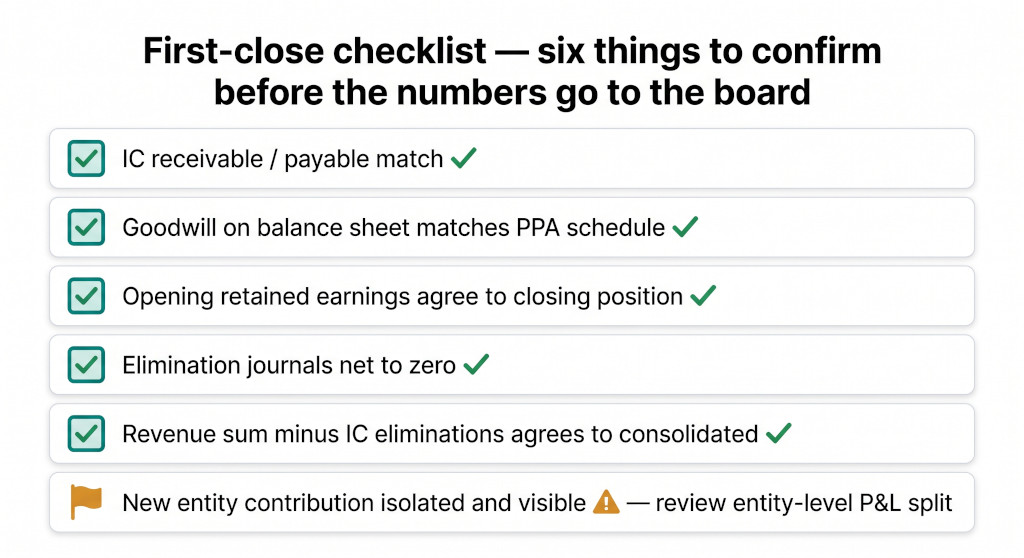
Phase 4: Sign-Off — First-Close Reconciliation Checks
-
☐IC receivable / payable match across all pairs Holdings IC-4100 (£8k) = Digital IC-7100 (£8k). Holdings IC-1500 (£250k) = Digital IC-2500 (£250k). Any difference must be resolved — do not carry an unreconciled IC difference into the board pack.
-
☐Goodwill balance agrees to the PPA schedule £1,430,000 on the consolidated balance sheet. If goodwill is being amortised (FRS 102), the first month’s charge must be included. Confirm the amortisation basis and useful life are documented.
-
☐Consolidated revenue = sum of entity revenues minus IC eliminations Holdings revenue (external + IC fee income £8k) minus IC elimination (£8k) = external revenue only. Digital’s March revenue should appear in full — it is external client revenue, not intercompany. Confirm the arithmetic reconciles.
-
☐All elimination journals net to zero in the consolidated trial balance The investment elimination, IC balance eliminations, and IC P&L eliminations must each net to zero. A non-zero elimination is either a mis-posted journal or an unreconciled IC difference.
-
☐Heron Digital’s contribution is visible as a separate entity in the board pack The first board pack including Digital should show Digital’s contribution clearly — revenue, gross profit, EBITDA — so the board can see what the new entity is adding to the group. This is both an accountability requirement and a board pack best practice.
-
☐Comparative period presentation reviewed and labelled Prior year / prior month comparatives do not include Heron Digital (it was not in the group). Label columns clearly: “Current period” includes Digital; “Prior year” does not. Present a like-for-like analysis if the board needs to assess underlying performance trends.
The most common first-close error: including pre-acquisition revenue. When the entity’s full-year or full-period trial balance is imported rather than the post-acquisition period only, the consolidated revenue and costs include months in which the group did not own the entity. This inflates the consolidated P&L, overstates growth, and is technically incorrect under IFRS 3 and FRS 102. Always confirm that the TB extract covers only the period from the acquisition date to the period end — not the entity’s full accounting year.
The Ongoing Monthly Process After Onboarding
Once Heron Digital has been onboarded and the first close is complete, the monthly process for subsequent periods is lighter. The setup work — COA mapping, IC account configuration, PPA schedule, elimination pairs — is done once and carries forward. The monthly close for Heron Digital is then:
- Obtain trial balance from Heron Digital’s Xero
- Apply COA mapping (automatic once the mapping table is configured)
- Confirm IC account balances match between Holdings and Digital
- Run standard IC eliminations (management fee, IC loan, IC interest)
- Carry forward goodwill (and deduct monthly amortisation if applicable under FRS 102)
- Include Digital’s contribution in the board pack entity breakdown
The ongoing process takes minutes per entity once the onboarding is correctly completed. The investment is front-loaded in the setup phase — getting the COA mapping right, the IC accounts in place, and the opening balance sheet correct. Shortcuts taken in setup become recurring errors in every subsequent close.
For the accounting mechanics behind the goodwill and purchase price allocation at the acquisition date, see How to Consolidate a New Subsidiary Acquired During the Year. For the intercompany account design that makes the IC elimination automatic, see Group Reporting for Multi-Entity Businesses: What It Is and How to Get It Right.
New entity in the group — ready for the next close
BrizoConsol’s onboarding workflow maps the new entity’s COA, configures IC elimination pairs, and sets up the opening balance sheet — so your first consolidated close after an acquisition runs on the same process as every other month.Start Free — Add Your First Entity