How to Automate the Monthly Intercompany Elimination Journal: A Step-by-Step Guide for Multi-Entity Groups
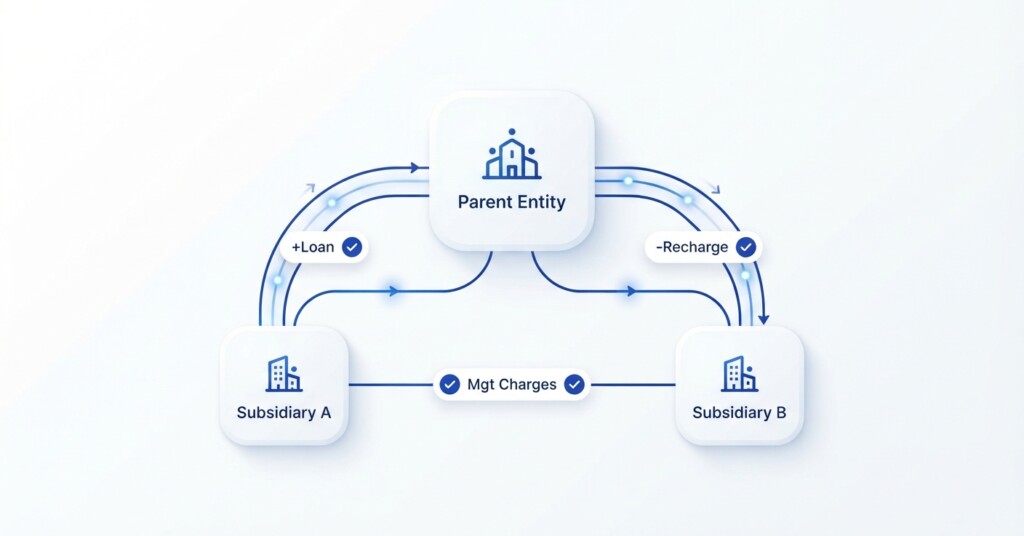
If your group operates through two or more legal entities, intercompany eliminations are almost certainly one of the most time-consuming parts of your monthly financial close. Loans, management charges, recharges, shared service fees, intercompany sales — each of these creates a balance in one entity that needs to be cancelled against a corresponding balance in another before you can produce meaningful consolidated accounts. Do it manually in Excel and you are reconciling ledger exports, chasing subsidiary controllers for confirmations, and fixing mismatches until well after your close deadline. This guide walks through the mechanics of intercompany elimination, explains why automation is the logical next step for growing groups, and gives you a practical framework to implement it.
Why Intercompany Eliminations Exist — and Why They Go Wrong
Consolidated financial statements are supposed to show a group as if it were a single economic entity. When Company A sells services to Company B and both sit inside the same group, neither the revenue in A nor the corresponding expense in B should appear in the consolidated income statement — they cancel each other out from the group’s perspective. The same logic applies to intercompany loans (eliminate the receivable against the payable), intercompany dividends, and unrealised profit on inventory transferred between entities. The accounting standard requirement exists in IFRS 10, FRS 102, and US GAAP ASC 810, but the practical mechanics of executing those eliminations accurately every month is where most SME finance teams struggle.
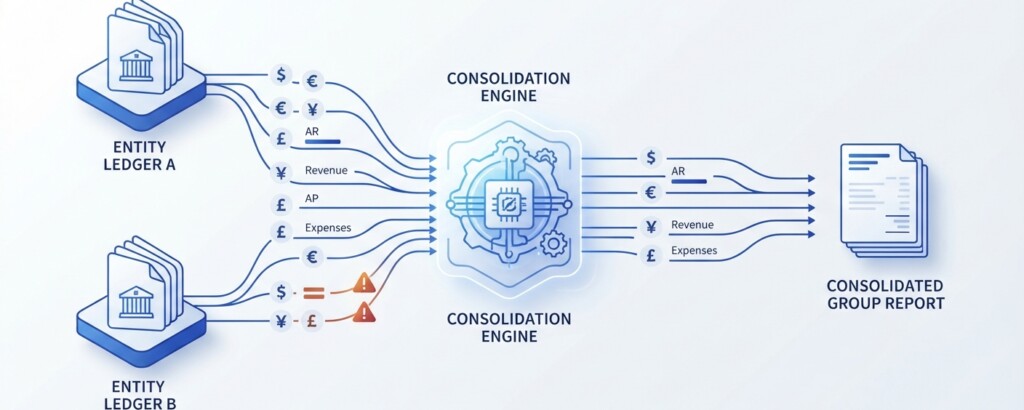
The most common failure mode is an intercompany mismatch — where Company A has posted a charge of £50,000 to Company B but Company B has only recognised £48,500 of the corresponding cost. The £1,500 gap might be a timing difference, an FX movement, or simply a posting error. Either way, if you eliminate without resolving it, you leave a residual balance in the consolidated accounts that does not belong there. In a manual process, finding these mismatches requires exporting AR and AP subledgers from every entity, building a reconciliation matrix, and manually emailing subsidiary controllers. In a group with five or more entities transacting in multiple currencies, this can consume several days of your close.
Intercompany eliminations without the manual work.
BrizoConsol identifies and eliminates intercompany balances automatically at consolidation.
The Four Categories of Intercompany Eliminations You Need to Handle
Before building any automation, it helps to map the types of intercompany activity your group generates. Most groups fall into four broad categories, each requiring a slightly different elimination approach.
| Category | Typical Transaction | Elimination Required | Common Complexity |
|---|---|---|---|
| Intercompany Trading | Management fees, recharges, shared services | Eliminate revenue vs expense | Timing mismatches, VAT differences |
| Intercompany Loans | Loans between group entities | Eliminate loan receivable vs payable | Accrued interest needs separate elimination |
| Intercompany Dividends | Upstream dividend from sub to parent | Eliminate dividend income vs equity distribution | Retained earnings impact in consolidation |
| Unrealised Profit in Inventory | Stock transferred between entities at a margin | Eliminate unrealised profit from group inventory | Requires tracking sell-through rates |
Intercompany interest on intra-group loans is one of the most frequently missed eliminations. If Entity A charges Entity B 5% interest on a £200,000 loan, the £10,000 interest income in A and the £10,000 interest expense in B both need to be eliminated — not just the loan principal itself. Missing this creates a distortion in the consolidated finance cost line.
Step One: Build a Central Intercompany Transaction Register
Automation cannot work without clean, structured data. The first step is to create a single source of truth that captures every intercompany transaction across all entities before the elimination journals are posted. This is your intercompany transaction register, and it needs to record the posting entity, the counterparty entity, the transaction type, the amount in both functional and group reporting currency, and the accounting period.
In a manual process, you are pulling this data from multiple ERP exports or accounting systems and merging it in Excel. In an automated process, the consolidation system pulls directly from each entity’s general ledger via API or standardised data import, matches transactions by intercompany counterparty code, and flags mismatches automatically. The discipline of assigning intercompany counterparty codes to every relevant transaction in each entity’s ledger is the necessary foundation — without it, no automation can correctly identify which transactions need eliminating.
Step Two: Reconcile Intercompany Balances Before Posting Eliminations
Once you have the register, the next step is the reconciliation — matching each amount in Entity A against the corresponding amount in Entity B. A practical rule is that no elimination journal should be posted until the balances have been agreed by both entities. Where there is a mismatch, you need to determine the root cause: is it a timing difference (one entity has not yet processed the invoice), a foreign currency translation difference (the same transaction translated at different rates), or a genuine posting error?
Never net off a mismatch simply to get the elimination to balance. Posting an elimination journal to a suspense account or forcing it to balance without resolving the underlying difference will cause errors to compound over subsequent months. Auditors will also look for evidence that intercompany balances were formally agreed — an unreconciled elimination is a significant audit risk.
Step Three: FX Translation Before Elimination
For multi-currency groups, FX translation adds a layer of complexity to every intercompany elimination. If Company A (functional currency GBP) holds an intercompany balance with Company B (functional currency EUR), both entities record the transaction in their respective functional ledgers. At period-end, foreign-currency monetary items are retranslated at the closing rate under IAS 21, and the subsidiary’s balance sheet is translated into the group presentation currency at the closing rate. Because both the receivable and payable are translated at the closing rate, the balance sheet balances eliminate against each other in full.
However, the exchange difference recognised in entity-level profit or loss cannot simply be eliminated. Under IAS 21 (paragraph 45), because an intragroup monetary balance represents an exposure to currency fluctuations, the resulting exchange difference must remain in consolidated profit or loss. An exception applies only if the loan qualifies under IAS 21 as part of the reporting entity’s net investment in a foreign operation (settlement is neither planned nor likely to occur in the foreseeable future), in which case the exchange difference is recognised in other comprehensive income and accumulated in the foreign currency translation reserve (FCTR) in equity.
| Intercompany loan receivable in Company A (historical cost in GBP) | £100,000 |
| Intercompany balance retranslated at closing rate (EUR 115,000 at 1.10) | £104,545 |
| Exchange difference (reclassified to FCTR only if qualifying as net investment) | £4,545 |
Step Four: Post the Elimination Journals
Once balances are reconciled and FX differences are understood, you can post the elimination journals. These journals exist only in the consolidation layer — they are not posted back into the individual entity ledgers. Below are the standard elimination journals for the most common intercompany scenarios.
| Account | Dr | Cr |
|---|---|---|
| Intercompany Revenue (Group P&L elimination) | 50,000 | |
| Intercompany Cost of Sales (Group P&L elimination) | 50,000 |
Elimination of intercompany management fee: Company A charged Company B £50,000. Revenue in A and expense in B are both eliminated from the consolidated P&L.
| Account | Dr | Cr |
|---|---|---|
| Intercompany Loan Payable (Company B) | 200,000 | |
| Intercompany Loan Receivable (Company A) | 200,000 |
Elimination of intra-group loan principal: the receivable in Company A and the payable in Company B cancel on consolidation.
| Account | Dr | Cr |
|---|---|---|
| Intercompany Interest Income (Company A) | 10,000 | |
| Intercompany Interest Expense (Company B) | 10,000 |
Elimination of interest on intra-group loan: both the income recognised in Company A and the expense recognised in Company B are removed from the consolidated income statement.
| Account | Dr | Cr |
|---|---|---|
| Foreign Currency Translation Reserve (Equity) | 4,545 | |
| Intercompany FX Difference (P&L reclassification) | 4,545 |
Reclassification of FX difference on an intra-group monetary item from consolidated P&L to the foreign currency translation reserve in equity under IAS 21 (applicable only where the balance forms part of a net investment in a foreign operation; standard trading balances and loans remain in consolidated profit or loss).
Step Five: Non-Controlling Interests and the Elimination Interaction
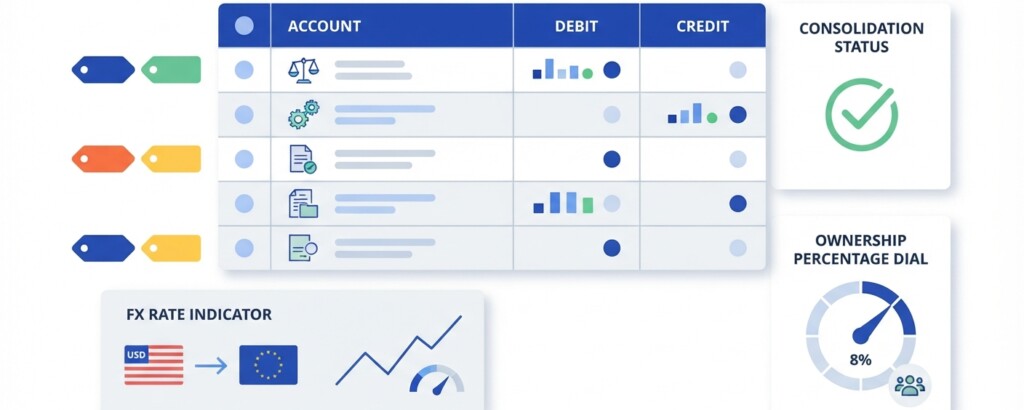
If your group includes partially owned subsidiaries, non-controlling interests (NCI) interact with your intercompany eliminations in a way that is easy to overlook. When you eliminate intercompany profit, the treatment depends on the direction of the transaction. Under IFRS 10, in an upstream sale (where the partially owned subsidiary is the seller), the unrealised profit is eliminated in full and the reduction is allocated between the parent and NCI in proportion to their ownership interests. Conversely, in a downstream sale (where the parent is the seller), the profit is eliminated entirely against the parent’s equity, leaving NCI unaffected.
In practice, this means your elimination journals need to be aware of the transaction direction and the ownership structure of each entity involved. In an upstream sale by a subsidiary that is 75% owned, a £20,000 unrealised profit elimination reduces group retained earnings by £15,000 and NCI by £5,000. Getting this right in a manual spreadsheet model requires careful formula construction and is a common source of consolidation errors.
Building Automation: What the Ideal Workflow Looks Like
Automating the intercompany elimination process means systematically removing the manual steps: the ledger exports, the email confirmations, the Excel matching formulas, and the manual journal entry. An effective automated workflow connects directly to each entity’s accounting system, pulls the relevant account balances tagged with intercompany counterparty codes, matches them automatically, reports mismatches for human review, translates amounts to the group presentation currency using consistent exchange rates, and generates the elimination journals ready for review and approval.
- Connect each entity’s accounting system to the consolidation platform via API or standardised import
- Assign intercompany counterparty codes to all relevant accounts in every entity ledger
- Configure account mapping so equivalent accounts across different chart-of-accounts structures are treated as the same line
- Set exchange rate sourcing — typically closing rate for balance sheet items, average rate for P&L items
- Define the elimination rules: which account pairs are eliminated, and in which consolidation journal
- Run automated matching at month-end and review the mismatch report before approving journals
- Approve or override elimination journals within the consolidation platform, maintaining a full audit trail
- Produce consolidated trial balance and financial statements from the post-elimination data
The Real Cost of Keeping This Manual
Finance teams sometimes underestimate the compounding cost of a manual intercompany elimination process. Beyond the hours spent each month, the real risks are: mismatches going undetected until audit, restatements caused by cumulative errors in elimination journals, and management accounts that cannot be trusted because the intercompany lines have not been properly eliminated. As a group grows — adding entities, currencies, or transaction volumes — the manual approach scales poorly. A process that took two days with three entities can easily take five or six days with eight.
Automation does not eliminate the need for finance professionals to understand and review the eliminations — it eliminates the mechanical work of producing them, allowing controllers and CFOs to focus on analysis and exception management rather than ledger reconciliation. The result is a faster close, cleaner consolidated accounts, and a more defensible audit trail.
Getting Started: A Practical Checklist
- Map all intercompany relationships and transaction types across your group
- Ensure every entity uses consistent intercompany counterparty coding in their accounting system
- Document your current elimination journal process, including who posts, who approves, and where mismatches are resolved
- Identify the exchange rate sources used by each entity and agree a group policy for translation
- Review your NCI ownership percentages and ensure elimination allocation rules distinguish between upstream and downstream transactions
- Evaluate consolidation tools that connect to your existing accounting software and can automate the matching and journal generation steps
- Pilot the automated process in parallel with your manual process for one close cycle before cutting over
The most important single investment you can make before automating is clean intercompany coding discipline. If transactions are not consistently tagged with the correct counterparty entity code at the point of posting, no consolidation tool can reliably identify what needs to be eliminated. This is a people and process fix, not a technology fix — and it needs to happen first.
Intercompany eliminations are not the most glamorous part of group reporting, but they are foundational. Get them wrong and your consolidated accounts are unreliable. Get them right — and ideally automate them — and you gain a faster close, fewer audit queries, and management accounts your CFO can actually use to make decisions. The investment in process improvement and the right tools pays back quickly in reduced close effort and greater confidence in reported numbers.
See How Automated Consolidation Handles Intercompany Eliminations
BrizoConsol is built for multi-entity groups that need accurate, auditable consolidated accounts without the monthly Excel marathon. Explore how automated intercompany matching, FX translation, and elimination journals work in practice.