How to Consolidate a UK GAAP (FRS 102) Subsidiary into an IFRS Parent: Lease Recognition, Goodwill Reversal, and GBP Translation
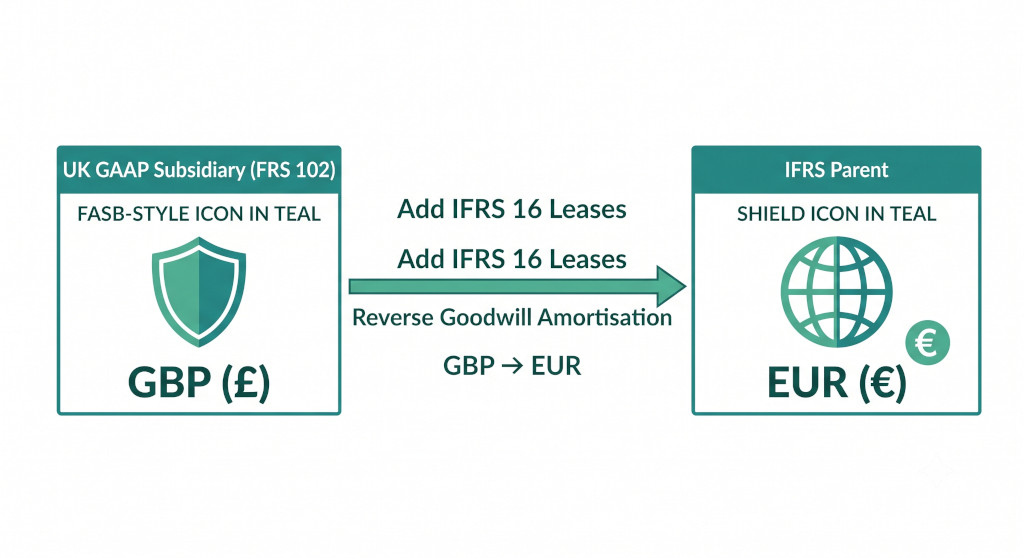
European and international IFRS groups that have acquired UK businesses face a consolidation path that is often underestimated in its simplicity. Unlike consolidating a US GAAP subsidiary — which requires four or more substantive conversion journals — bringing a UK FRS 102 subsidiary into an IFRS group typically requires just two: adding the IFRS 16 lease recognition that FRS 102 omits, and reversing the goodwill amortisation that FRS 102 requires but IFRS does not. Beyond that, the two frameworks largely agree.
This guide walks through both conversion journals in full, covers the deferred tax treatment for each, and provides a worked GBP-to-EUR currency translation example under IAS 21. The reverse direction — consolidating an IFRS subsidiary into an FRS 102 parent — is covered in the IFRS to UK GAAP consolidation guide.
The Group Structure Used in This Guide
- BrizoGroup SA — IFRS parent (European listed company), presents in EUR, fiscal year 1 January to 31 December
- BrizoUK Ltd — UK subsidiary, 100% owned, applies FRS 102, reports in GBP, fiscal year 1 January to 31 December
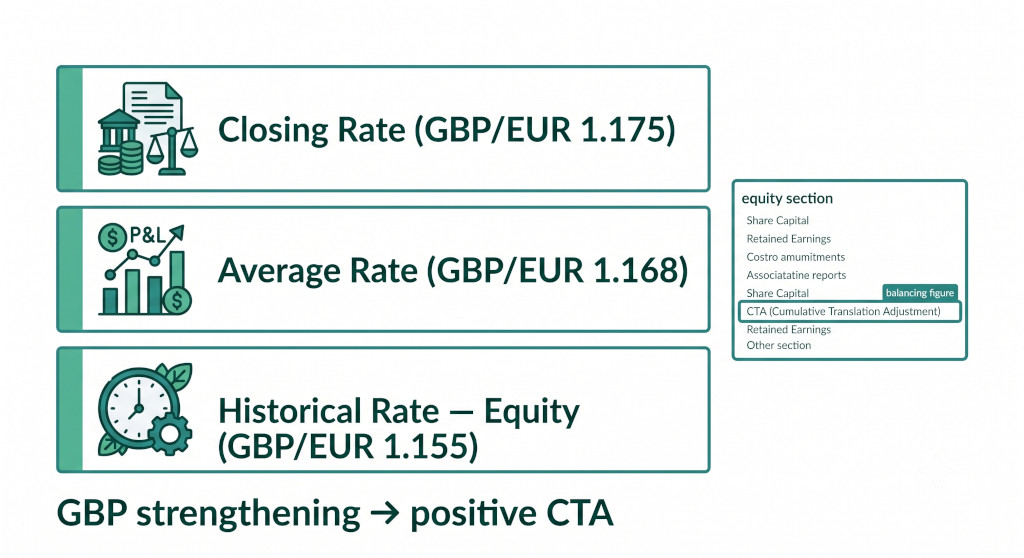
- Exchange rates (illustrative): closing GBP/EUR 1.175; average GBP/EUR 1.168; historical rate at acquisition GBP/EUR 1.155
BrizoUK Ltd holds office and warehouse leases accounted for as operating leases under FRS 102 Section 20 (off balance sheet) and goodwill arising from a prior acquisition that it has been amortising over ten years under FRS 102 Section 19. These two items are the entire GAAP conversion agenda.
Stop building consolidations in spreadsheets.
BrizoConsol automates multi-entity consolidation — setup in minutes, reports the same day.
Step 1 — The FRS 102 to IFRS Gap: Narrower Than You Might Expect
Step 1
FRS 102 was developed from the IFRS for SMEs standard and shares much of its conceptual framework with full IFRS. Many areas that require conversion journals in other cross-standard combinations — development costs, impairment reversals, PP&E revaluation, inventory costing — produce no material difference when moving between FRS 102 and full IFRS. The gap concentrates in two areas where the FRC made a deliberate simplification relative to full IFRS:
FRS 102 — BrizoUK Ltd’s basis
Leases: Section 20 — operating leases off balance sheet; straight-line rent expense in P&L only. Finance leases (substantially all risks and rewards) capitalised.
Goodwill: Section 19 — systematic amortisation over useful economic life; maximum ten years if that life cannot be reliably estimated. Annual impairment review only where indicators exist.
Financial instruments: Sections 11 & 12 — simplified basic/other classification; reduced fair value requirements for most instruments.
IFRS — BrizoGroup’s group basis
Leases: IFRS 16 — all leases (except short-term and low-value) recognised on balance sheet as ROU asset and lease liability; separate depreciation and interest in P&L.
Goodwill: IFRS 3 / IAS 36 — no amortisation; annual impairment test required regardless of indicators. Goodwill carried at acquisition cost less any impairment.
Financial instruments: IFRS 9 — three-category classification (amortised cost, FVOCI, FVTPL); ECL impairment model; hedge accounting rules more complex.
Financial instruments merit a brief review each period — particularly if BrizoUK holds investments, derivatives, or non-basic financial assets that IFRS 9 would classify differently from FRS 102 Sections 11 and 12. For most trading subsidiaries, however, the instruments in play are trade receivables, trade payables, and bank debt — all of which are “basic” under both frameworks and produce no conversion journal. Leases and goodwill are where the work sits.
Step 2 — GAAP Conversion Journals
Step 2
All conversion journals are prepared in GBP — BrizoUK Ltd’s functional currency — and translated into EUR in Step 5.
Adjustment 1: Leases — Recognise IFRS 16 Right-of-Use Asset and Lease Liability
BrizoUK’s office and warehouse leases are operating leases under FRS 102 Section 20. They are off the FRS 102 balance sheet entirely, with lease payments charged to the income statement on a straight-line basis. IFRS 16 requires these to be recognised on the balance sheet as a Right-of-Use (ROU) asset and a lease liability at the present value of future lease payments, discounted at BrizoUK’s incremental borrowing rate.
BrizoUK’s operating lease portfolio — measured as if IFRS 16 had always applied:
- ROU asset (gross, at commencement): GBP 960,000
- Accumulated IFRS 16 depreciation (2 years into a 7-year lease): GBP 274,000
- Net ROU asset: GBP 686,000
- Lease liability (present value of remaining 5 years’ payments at 4% IBR): GBP 712,000
- Current-year IFRS 16 depreciation: GBP 137,000
- Current-year IFRS 16 interest on lease liability: GBP 30,000
- Equivalent FRS 102 straight-line rent expense: GBP 160,000
Journal 1A — Recognise IFRS 16 lease on the balance sheet (opening position)
DR Right-of-Use Asset (gross) GBP 960,000
CR Accumulated Depreciation — ROU Asset GBP 274,000
CR Lease Liability GBP 712,000
DR / (CR) Retained Earnings (net difference) GBP (26,000)
Introduces the ROU asset (net GBP 686,000) and lease liability (GBP 712,000) that IFRS 16 requires but FRS 102 Section 20 does not recognise. The GBP 26,000 debit to retained earnings (reduction) is the cumulative prior-period income difference: in early lease years, IFRS 16 front-loads total lease cost (depreciation + interest) relative to straight-line rent, so the two years already elapsed have produced a slightly higher cumulative charge under IFRS 16 than under FRS 102. This reverses in later lease years as the interest charge falls.
Journal 1B — Replace straight-line rent with IFRS 16 depreciation and interest
DR Operating Lease Expense (reversal) GBP 160,000
DR Depreciation — ROU Asset GBP 137,000
DR Finance Costs — Lease Interest GBP 30,000
CR Operating Lease Expense GBP 160,000
CR Depreciation — ROU (reclassify to depreciation line) GBP 137,000
CR Finance Costs (reclassify to finance line) GBP 30,000
More simply: remove the GBP 160,000 straight-line lease expense from operating costs; recognise GBP 137,000 depreciation within operating expenses and GBP 30,000 lease interest within finance costs. Net P&L impact in this year: GBP 7,000 additional charge under IFRS 16 (GBP 167,000 total vs GBP 160,000 straight-line). EBITDA increases under IFRS 16 as lease costs shift below the EBITDA line into depreciation and finance costs.
For IFRS groups reporting EBITDA as a key performance metric, the IFRS 16 conversion journal increases BrizoUK’s reported EBITDA — lease costs that sat within operating expenses under FRS 102 are reclassified to depreciation (below EBITDA) and finance costs (below EBIT). Finance teams should flag this presentational difference when reporting segment or subsidiary KPIs to the group.
Adjustment 2: Goodwill — Reverse FRS 102 Amortisation
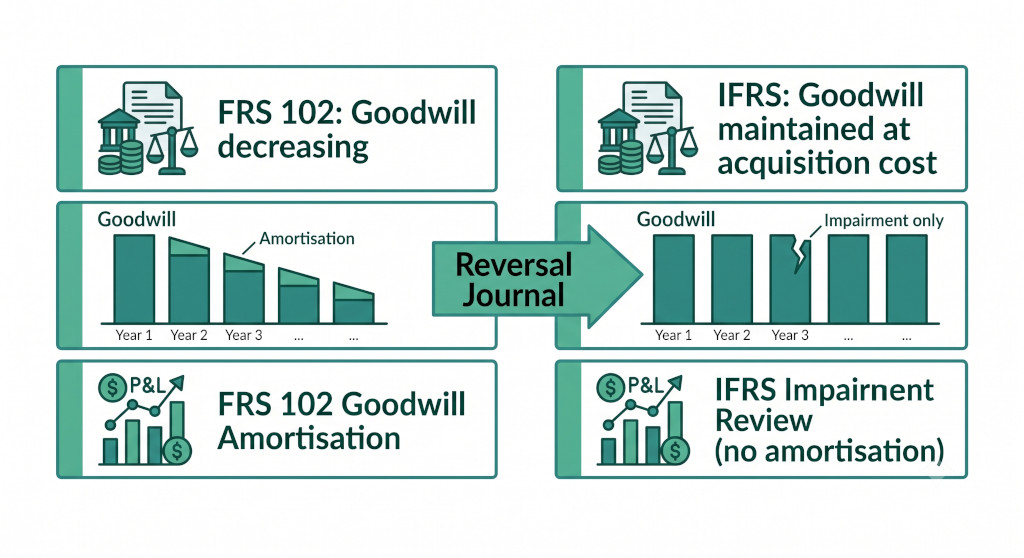
BrizoUK acquired a competitor four years ago. Goodwill at acquisition: GBP 800,000. Under FRS 102 Section 19, BrizoUK has amortised goodwill over ten years at GBP 80,000 per year. Cumulative amortisation: GBP 320,000 (four years). FRS 102 goodwill carrying value: GBP 480,000.
Under IFRS (IFRS 3 / IAS 36), goodwill is not amortised. The IFRS carrying value, assuming no impairment has been identified through the annual IAS 36 impairment test, remains at GBP 800,000. The conversion journal reverses the FRS 102 amortisation and restores goodwill to its IFRS value.
Journal 2A — Reverse prior-year cumulative goodwill amortisation
DR Goodwill GBP 240,000
CR Retained Earnings GBP 240,000
Reverses three prior years of goodwill amortisation (GBP 80,000 × 3 = GBP 240,000) through opening retained earnings. Goodwill rises from GBP 480,000 to GBP 720,000 on the opening IFRS balance sheet.
Journal 2B — Reverse current-year goodwill amortisation charge
DR Goodwill GBP 80,000
CR Goodwill Amortisation Expense GBP 80,000
Reverses the current-year amortisation charge from the income statement. After this journal, goodwill is GBP 800,000 — its acquisition cost — consistent with the IFRS impairment-only approach. The income statement effect is a GBP 80,000 reduction in operating expenses (improving IFRS consolidated profit relative to what FRS 102 would show).
Impairment review required: Restoring goodwill to GBP 800,000 under IFRS does not mean the asset is necessarily worth that amount. IAS 36 requires an annual impairment test — comparing the carrying value of the cash-generating unit to which goodwill is allocated against its recoverable amount (the higher of fair value less costs to sell and value in use). If the recoverable amount is below GBP 800,000, an impairment charge is required. Importantly, IFRS impairment losses on goodwill cannot be reversed in subsequent periods. The IAS 36 impairment review must be completed before the IFRS-restated goodwill figure is finalised.
Adjustment 3: Deferred Tax on Conversion Journals
Each conversion journal creates a temporary difference between the IFRS carrying value and the UK tax base of the affected assets and liabilities.
IFRS 16 leases: The ROU asset (net GBP 686,000) has a tax base of nil — lease payments are deductible for UK corporation tax when paid, not when the IFRS 16 asset is recognised. This creates a GBP 686,000 taxable temporary difference and a deferred tax liability of GBP 171,500 at the UK corporation tax rate of 25%. The lease liability (GBP 712,000) has a tax base equal to itself (future deductible lease payments). This creates a GBP 712,000 deductible temporary difference and a deferred tax asset of GBP 178,000. The two largely offset: net deferred tax asset of approximately GBP 6,500.
Goodwill reversal: For goodwill arising from share purchases (the most common UK acquisition structure), goodwill amortisation is not deductible for UK corporation tax under the intangibles regime. The tax base of goodwill is therefore nil regardless of whether FRS 102 amortisation has been charged or not. Reversing the FRS 102 amortisation increases the IFRS carrying value of goodwill from GBP 480,000 to GBP 800,000, but since the tax base is nil in both cases, reversing the amortisation does not change the taxable temporary difference. No deferred tax adjustment is required for the goodwill reversal in this common scenario.
Where goodwill has a tax base: Some UK acquisitions are structured as asset purchases, or the acquired entity’s intangibles qualify for amortisation relief under Part 8 of CTA 2009. In those cases, goodwill may have a positive tax base. If so, the reversal of FRS 102 amortisation changes the temporary difference between accounting carrying value and tax base — and a deferred tax adjustment is required. Confirm the tax base of BrizoUK’s goodwill with UK tax advisers before concluding that no deferred tax adjustment is needed.
Step 3 — Financial Instruments: Brief Review
Step 3
For BrizoUK as a trading subsidiary, financial instruments are predominantly trade receivables (basic under both FRS 102 Section 11 and IFRS 9 amortised cost), trade payables (basic under both), and bank borrowings (basic under both). No conversion journal is expected for these. Two areas warrant specific review each period:
- Expected credit losses (ECL): IFRS 9 requires an ECL impairment model for receivables — recognising credit losses earlier than the incurred loss model that FRS 102 uses. For a diversified customer base with low historical bad debt, the practical difference is small but should be quantified. If material, a provision uplift journal may be required.
- Non-basic financial instruments: If BrizoUK holds equity investments, interest rate swaps, or other instruments classified as “other financial instruments” under FRS 102 Section 12, review whether IFRS 9’s classification criteria produce a different measurement basis. Reclassify to FVTPL or FVOCI as required.
Step 4 — Fiscal Year Alignment
Step 4
BrizoUK Ltd and BrizoGroup SA share a 31 December year-end — no adjustment is needed. Under IFRS 10 paragraph B93, a gap of up to three months between subsidiary and parent year-ends is permissible if stub-period accounts are impracticable to prepare, provided the gap length is consistent from period to period and significant events in the gap are adjusted. UK companies can choose any year-end; if BrizoUK uses a non-December year-end, assess whether the gap exceeds three months and plan accordingly. For full guidance, see our fiscal year alignment guide.
Step 5 — Currency Translation: GBP to EUR
[ Section image — GBP/EUR closing, average, and historical rates with CTA as positive balancing figure ]
Step 5
BrizoUK Ltd’s functional currency is GBP; BrizoGroup SA presents its consolidated accounts in EUR. The translation from GBP to EUR follows IAS 21 — closing rate for the balance sheet, average rate for the income statement, historical rate for equity components, and the Cumulative Translation Adjustment (CTA) as the balancing equity item in other comprehensive income.
| Item | Rate | Note |
|---|---|---|
| Balance sheet — all assets and liabilities | Closing rate (GBP/EUR 1.175) | Year-end spot rate; GBP 1 converts to EUR 1.175 |
| Income statement — revenues and expenses | Average rate (GBP/EUR 1.168) | Annual average; approximates transaction-date rates |
| Share capital and share premium | Historical rate (GBP/EUR 1.155) | Rate on the date BrizoGroup SA acquired BrizoUK Ltd; fixed for the life of the investment |
| Opening retained earnings | Brought forward from prior year | Cumulative prior-period translation; consistent with prior year |
| CTA (Cumulative Translation Adjustment) | Balancing figure | Deferred in equity under IAS 21; recycled to P&L on disposal of BrizoUK |
Worked Translation Example
Using BrizoUK Ltd’s IFRS-restated figures in GBP (after conversion journals above) and translating to EUR:
| Item | GBP (IFRS restated) | Rate | EUR |
|---|---|---|---|
| Income Statement | |||
| Revenue | 7,000,000 | Avg 1.168 | 8,176,000 |
| Cost of Sales | (3,800,000) | Avg 1.168 | (4,438,400) |
| Operating Expenses (incl. ROU depreciation; excl. goodwill amortisation reversed) | (1,400,000) | Avg 1.168 | (1,635,200) |
| Finance Costs — Lease Interest | (30,000) | Avg 1.168 | (35,040) |
| Net Profit | 1,770,000 | 2,067,360 | |
| Balance Sheet | |||
| Total Assets (incl. ROU asset GBP 686k; goodwill restored to GBP 800k) | 14,000,000 | Close 1.175 | 16,450,000 |
| Total Liabilities (incl. lease liability GBP 712k) | (7,500,000) | Close 1.175 | (8,812,500) |
| Net Assets | 6,500,000 | 7,637,500 | |
| Equity Reconciliation | |||
| Share Capital (historical rate 1.155) | 2,000,000 | Hist 1.155 | 2,310,000 |
| Opening Retained Earnings (brought forward) | 2,730,000 | Prior year | 3,169,500 |
| Current Year Net Profit | 1,770,000 | Avg 1.168 | 2,067,360 |
| CTA (balancing figure) | — | Plug | 90,640 |
| Total Equity | 6,500,000 | 7,637,500 | |
The positive CTA of EUR 90,640 reflects sterling strengthening against the euro over the period — the closing rate of 1.175 exceeds the average rate of 1.168 used for the income statement, which in turn exceeds the historical rate of 1.155 applied to equity. When GBP strengthens, the euro value of BrizoUK’s net assets increases, and this translation gain sits in the CTA reserve in equity rather than flowing through the consolidated income statement. It will be released to P&L only when BrizoUK is sold or wound up.
📚 Cross-Standard Consolidation SeriesIFRS Subsidiary → UK GAAP ParentUS GAAP Subsidiary → UK GAAP ParentSFRS Subsidiary → UK GAAP ParentUS GAAP Subsidiary → IFRS ParentSFRS Subsidiary → IFRS Parent
Practical Checklist: FRS 102 Subsidiary into an IFRS Group
✅ Period-End Consolidation Checklist
- Obtain BrizoUK Ltd’s trial balance in GBP under FRS 102
- List all operating leases held by BrizoUK — confirm none meet the IFRS 16 short-term (12 months or less) or low-value (underlying asset value below USD 5,000 equivalent) exemptions
- For each qualifying lease: calculate the IFRS 16 ROU asset (gross and net of accumulated depreciation) and lease liability (present value of future payments at IBR) as if IFRS 16 had been applied from lease commencement
- Prepare Journal 1A to recognise the opening ROU asset and lease liability; credit / debit retained earnings for the cumulative income difference
- Prepare Journal 1B to reclassify straight-line lease expense to IFRS 16 depreciation (operating) and interest (finance costs)
- Calculate cumulative FRS 102 goodwill amortisation from acquisition date; prepare Journal 2A to reverse prior years’ amortisation to retained earnings
- Prepare Journal 2B to reverse current-year goodwill amortisation charge from the income statement
- Complete an IAS 36 impairment review on the restored goodwill balance — confirm the recoverable amount of the cash-generating unit exceeds the IFRS carrying value; document the assessment for auditors
- Review the tax base of BrizoUK’s goodwill (share purchase vs asset purchase structure; Part 8 CTA 2009 elections) — prepare deferred tax adjustment on goodwill only if the tax base is not nil
- Prepare deferred tax on IFRS 16 lease: DTL on ROU asset (carrying value × 25% UK rate); DTA on lease liability (lease liability × 25%); net these if the criteria for netting are met
- Review BrizoUK’s financial instruments: check trade receivables for ECL model uplift under IFRS 9; identify any non-basic instruments under FRS 102 Section 12 that require IFRS 9 reclassification
- Confirm 31 December year-end alignment; if BrizoUK uses a different year-end, assess the gap against the three-month rule
- Source and document GBP/EUR closing rate, average rate, and historical rate
- Translate all balance sheet items at closing rate; all income statement items at average rate
- Apply historical rate to share capital; carry forward prior-year translated retained earnings
- Calculate CTA as the equity balancing figure; record in other comprehensive income — note positive CTA when GBP strengthens vs EUR
- Load EUR-translated IFRS figures into the group consolidation model
- Eliminate all intercompany balances and transactions; classify GBP/EUR intercompany loan differences as net investment (→ CTA) or working capital (→ P&L) per IAS 21 paragraph 32
IFRS group with a UK FRS 102 subsidiary?
BrizoConsol connects Xero, QuickBooks, MYOB, and Zoho Books across all your entities — automating GAAP conversion journals, GBP currency translation, intercompany eliminations, and IFRS consolidated reporting. Start Free Trial