IFRS 3 Business Combinations: A Practical Guide for Multi-Entity Groups
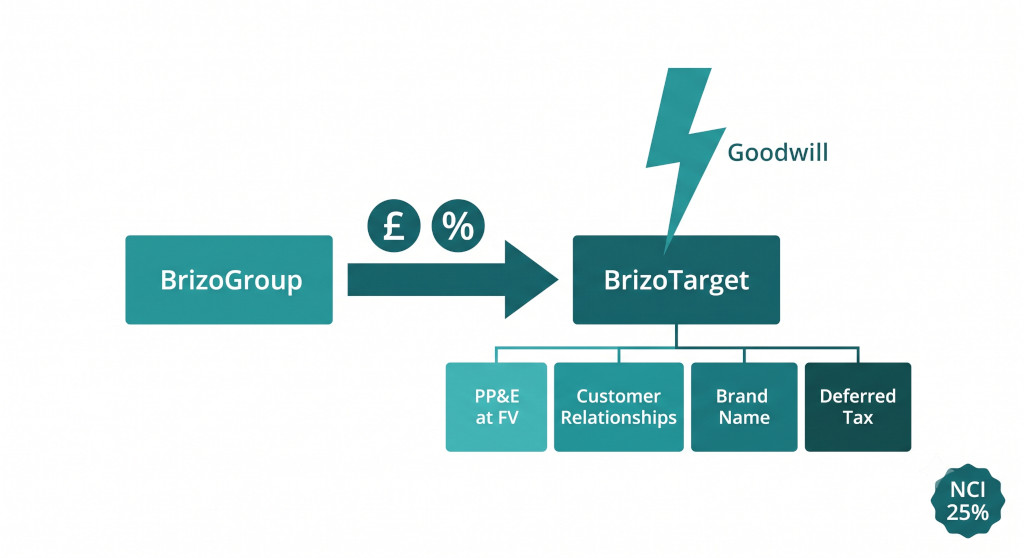
Every consolidation begins with an acquisition. And every acquisition governed by IFRS starts with IFRS 3 Business Combinations — the standard that prescribes how to recognise the assets you have acquired, the liabilities you have assumed, and the goodwill (or bargain purchase gain) that bridges the gap between what you paid and what you got.
IFRS 3 applies to the date of acquisition accounting. But the choices made on that date — how to measure non-controlling interests, how to present contingent consideration, how to identify and value acquired intangibles — flow through every subsequent period of consolidation. Getting the acquisition accounting right is not just an audit requirement; it is the foundation on which accurate group accounts are built for years.
This guide works through each stage of the acquisition method in sequence, using a consistent worked example, and closes with the consolidation consequences that group finance teams need to manage after the deal is done.
Stop building consolidations in spreadsheets.
BrizoConsol automates multi-entity consolidation — setup in minutes, reports the same day.
What Counts as a Business Combination?
IFRS 3 applies when an acquirer obtains control of a business — defined in IFRS 10 as a set of integrated activities and assets that are capable of being conducted and managed to provide a return to investors. Not every asset purchase is a business combination. An acquisition of a single property, a portfolio of financial assets, or an early-stage entity with no outputs may be an asset acquisition (accounted for at cost, allocated across identifiable assets) rather than a business combination. The distinction matters because goodwill only arises in a business combination — never in an asset acquisition.
The IFRS 3 optional concentration test (issued as an amendment in 2018) provides a simplified screen: if substantially all of the fair value of the gross assets acquired is concentrated in a single identifiable asset or group of similar identifiable assets, the set is not a business. If the concentration test is not met, a full assessment of whether the acquired set constitutes a business is required.
Step 1 — Identify the Acquirer
Step 1
In most acquisitions the acquirer is obvious — the entity that transfers cash or issues equity to obtain control. In reverse acquisitions (where the legal acquiree is the accounting acquirer), mergers of equals, or acquisitions settled entirely with equity instruments, identification requires judgement. IFRS 3 provides indicators: which entity initiated the combination; which entity’s former management team leads the combined entity; whether one entity is significantly larger; and whether one entity paid a premium over pre-combination fair value. The acquirer must always be identified, as it determines the direction of the purchase price allocation and where goodwill is recognised.
Step 2 — Determine the Acquisition Date
Step 2
The acquisition date is the date on which the acquirer obtains control — typically the date the consideration is transferred and the acquiree’s assets and liabilities are legally received. This date, not the announcement date or the signing date, is the reference point for all IFRS 3 measurements: fair values of assets and liabilities, exchange rates, purchase price allocation, and the start of post-acquisition consolidation.
For the worked example in this guide, BrizoGroup plc acquires a 75% stake in BrizoTarget Ltd, gaining control on 1 July 2026. BrizoGroup’s year-end is 31 December. BrizoTarget will be consolidated for six months in BrizoGroup’s 2026 consolidated accounts — from 1 July to 31 December only. For fiscal year alignment considerations, see the fiscal year alignment guide.
Step 3 — Purchase Price Allocation (PPA): Fair-Valuing What You Bought
Step 3
At the acquisition date, every identifiable asset acquired and liability assumed must be measured at fair value — regardless of what BrizoTarget’s own balance sheet showed. This process, known as Purchase Price Allocation or PPA, is where the most work (and the most judgement) in IFRS 3 sits.
“Identifiable” means either separable (can be sold, transferred, licensed, or rented apart from the business) or arising from contractual or other legal rights. IFRS 3 requires the acquirer to recognise intangible assets that BrizoTarget never recognised on its own balance sheet — because many intangibles are internally generated and therefore excluded from recognition under IAS 38 in individual entity accounts. In a business combination, this rule does not apply; if an intangible meets the identifiability criteria, it must be recognised and measured at fair value at the acquisition date even if it was never capitalised by the target.
Common fair-value step-ups and newly recognised intangibles in practice:
- PP&E: If the target’s properties or equipment are carried below market value (as they often are under the cost model), a fair value step-up is required. This increases both the asset and — via the deferred tax liability — the net identifiable assets.
- Customer relationships: The value attributed to existing customer contracts and relationships, typically valued using an excess earnings or relief-from-royalty method. Almost always present in service and technology businesses.
- Brand names and trade names: Valued using a relief-from-royalty method — the royalty the acquiree would pay to licence the brand if it did not own it, discounted to present value.
- Favourable contracts: If the target has contracts priced above or below current market rates, the favourable / unfavourable element is recognised as an intangible asset or liability.
- Deferred tax on fair value adjustments: Each fair value step-up creates a taxable temporary difference — the IFRS carrying value exceeds the tax base (which does not change). A deferred tax liability must be recognised at the local tax rate on every fair value uplift. This reduces net identifiable assets and therefore increases goodwill.
BrizoTarget Ltd’s PPA at 1 July 2026:
| Item | Book Value (GBP) | Fair Value Adjustment (GBP) | Fair Value (GBP) |
|---|---|---|---|
| Property, plant & equipment | 6,000,000 | +2,500,000 | 8,500,000 |
| Customer relationships (new) | — | +3,000,000 | 3,000,000 |
| Brand name (new) | — | +1,500,000 | 1,500,000 |
| Other net assets (book value = FV) | 5,000,000 | — | 5,000,000 |
| Deferred tax liability on FV step-ups (25% × GBP 7,000,000) | — | (1,750,000) | (1,750,000) |
| Net identifiable assets at fair value | 11,000,000 | +5,250,000 | 16,250,000 |
The deferred tax trap: Every GBP 1 of fair value step-up creates a DTL of GBP 0.25 (at 25% UK rate), which reduces net identifiable assets by GBP 0.25 and therefore increases goodwill by GBP 0.25. Groups sometimes underestimate goodwill on acquisition because they omit or understate the DTL on intangible step-ups. Equally, some acquirers inadvertently recognise a DTL on goodwill itself — IFRS 3 paragraph 15 explicitly prohibits recognising a deferred tax liability arising from initial goodwill recognition.
Step 4 — Calculate Goodwill
Step 4
IFRS 3 Goodwill FormulaGoodwill = Consideration transferred
+ Fair value of non-controlling interest (NCI)
+ Fair value of previously held equity interest (step acquisitions)
− Net identifiable assets at fair value
BrizoGroup pays GBP 15,000,000 cash for 75% of BrizoTarget. Net identifiable assets at fair value: GBP 16,250,000 (from the PPA above). Goodwill depends on how NCI is measured — covered in Step 5 below.
If the PPA results in net identifiable assets exceeding the total consideration plus NCI, the difference is a bargain purchase gain — recognised immediately in profit or loss. Before recognising a bargain purchase, IFRS 3 requires a reassessment of all fair values and the identification of all identifiable assets, to confirm that the gain is genuine and not a measurement error.
Step 5 — Non-Controlling Interests: Full Goodwill vs Proportionate Method
Step 5
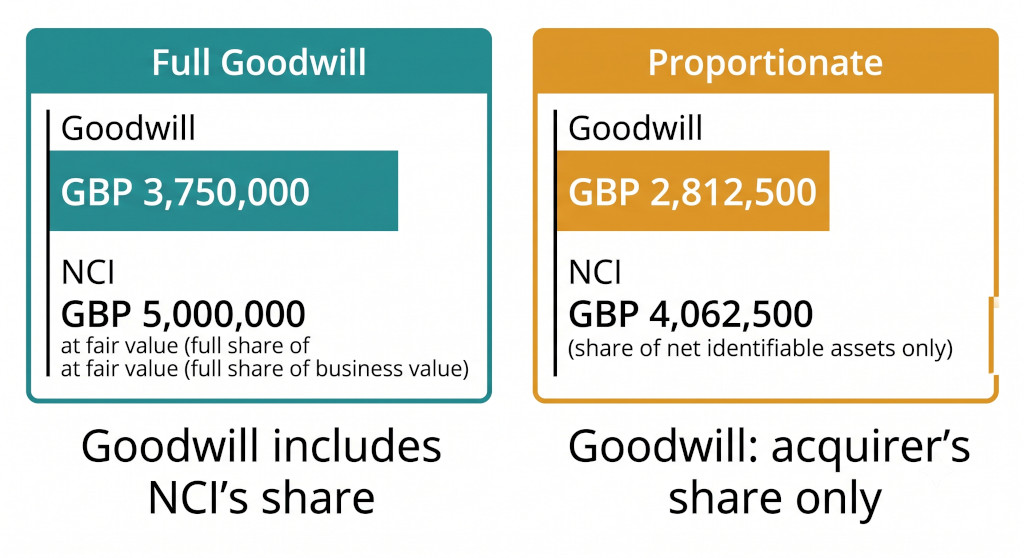
IFRS 3 allows a policy choice — made on a transaction-by-transaction basis — for how to measure non-controlling interests at the acquisition date. The choice between the two methods determines both the goodwill recognised and the NCI balance on the consolidated balance sheet:
Full Goodwill Method — NCI at Fair Value
NCI is measured at its fair value at the acquisition date — typically calculated as the implied value of the whole business (derived from the consideration paid for the acquirer’s stake) multiplied by the NCI percentage.
NCI fair value:
Implied 100% FV = GBP 15,000,000 ÷ 75% = GBP 20,000,000
NCI (25%) = GBP 20,000,000 × 25% = GBP 5,000,000
Goodwill:
15,000,000 + 5,000,000 − 16,250,000 = GBP 3,750,000
Goodwill includes both BrizoGroup’s and NCI’s share. On a subsequent impairment, the full GBP 3,750,000 is tested and impaired.
Proportionate Method — NCI at Share of Net Assets
NCI is measured as the NCI’s proportionate share of the acquiree’s identifiable net assets at fair value. No goodwill is attributed to the NCI.
NCI:
25% × GBP 16,250,000 = GBP 4,062,500
Goodwill:
15,000,000 + 4,062,500 − 16,250,000 = GBP 2,812,500
Goodwill reflects BrizoGroup’s share only. On impairment, only GBP 2,812,500 is tested and potentially impaired.
The proportionate method produces lower goodwill and a lower NCI balance — it is often preferred where the cost of obtaining a fair value for the NCI stake is significant and where the group’s policy is to minimise balance sheet gross-up from acquisition. The full goodwill method is preferred where the group wants to show the full economic resource controlled (including NCI’s share) on the face of the balance sheet.
Step 6 — The Acquisition Journal
Step 6
Using the full goodwill method, the acquisition journal in BrizoGroup’s consolidated accounts at 1 July 2026:
Acquisition Journal — BrizoGroup plc acquires 75% of BrizoTarget Ltd
DR Property, Plant & Equipment GBP 8,500,000
DR Customer Relationships — Intangible GBP 3,000,000
DR Brand Name — Intangible GBP 1,500,000
DR Other Net Assets GBP 5,000,000
DR Goodwill GBP 3,750,000
CR Deferred Tax Liability (on FV step-ups) GBP 1,750,000
CR Cash (consideration) GBP 15,000,000
CR Non-Controlling Interests GBP 5,000,000
Check: DR total = 8,500 + 3,000 + 1,500 + 5,000 + 3,750 = 21,750,000. CR total = 1,750 + 15,000 + 5,000 = 21,750,000. ✓ This journal replaces BrizoGroup’s “Investment in BrizoTarget” carrying value (eliminated in the consolidation) with the underlying assets, liabilities, goodwill, and NCI.
Acquisition costs — expensed, not capitalised: Under IFRS 3, transaction costs (legal fees, due diligence fees, investment bank advisory costs) are not part of the consideration and must be expensed as incurred. If BrizoGroup incurred GBP 350,000 in deal fees, these are charged to profit or loss in the period incurred — DR Acquisition Costs (P&L) GBP 350,000 / CR Cash GBP 350,000. This differs from US GAAP (ASC 805), which also expenses acquisition costs but handled them differently under the old pooling-of-interests rules.
Step 7 — Contingent Consideration
Step 7
Many acquisitions include an earn-out or contingent consideration — additional amounts payable to the seller if the acquired business hits revenue, EBITDA, or other performance targets in the years following completion. IFRS 3 requires contingent consideration to be measured at fair value at the acquisition date and included in the total consideration transferred. It is not deferred until the condition is met.
If the contingent consideration is classified as a financial liability (because the acquirer may be required to pay cash), subsequent changes in fair value flow through profit or loss in each period. If it is classified as equity (because settlement will be in the acquirer’s own shares and the number of shares is fixed), it is not remeasured after the acquisition date.
Suppose BrizoGroup agrees to pay an additional GBP 2,000,000 if BrizoTarget’s revenue exceeds GBP 10,000,000 in the 12 months post-acquisition. At 1 July 2026, the probability-weighted fair value of this obligation is assessed at GBP 1,200,000:
- Total consideration in the acquisition journal: GBP 15,000,000 + GBP 1,200,000 = GBP 16,200,000
- Goodwill (full goodwill): GBP 16,200,000 + GBP 5,000,000 NCI − GBP 16,250,000 = GBP 4,950,000
- If the fair value of the contingent consideration rises to GBP 1,800,000 at 31 December 2026: DR Finance Costs GBP 600,000 / CR Contingent Consideration Liability GBP 600,000 (through P&L, as it is a financial liability)
Step 8 — The Measurement Period (12 Months)
Step 8
The PPA at acquisition date often includes provisional amounts — particularly for complex intangibles, environmental liabilities, or tax positions that cannot be fully measured within the accounting close cycle. IFRS 3 allows a measurement period of up to 12 months from the acquisition date during which provisional amounts can be revised retrospectively. Adjustments within the measurement period are made as if the corrected amounts had been recognised at acquisition — goodwill is restated, not P&L.
Once the 12-month measurement period closes, any further changes are recognised in profit or loss as post-acquisition events, not as IFRS 3 adjustments. This distinction is significant: a measurement period adjustment restates goodwill; a post-measurement-period adjustment goes through the income statement. For BrizoGroup, the measurement period for the 1 July 2026 acquisition closes on 30 June 2027.
Step 9 — Step Acquisitions: Gaining Control from Associate Status
[ Section image — ownership timeline from 30% associate to 75% subsidiary, with FV remeasurement and FCTR recycling at control date ]
Step 9
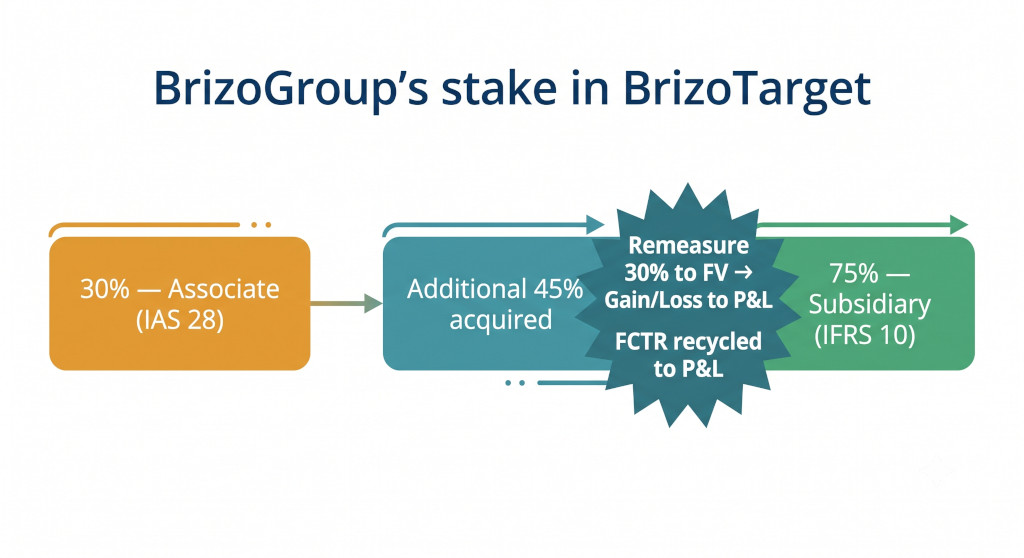
If BrizoGroup had held 30% of BrizoTarget as an associate (equity-accounted under IAS 28) before acquiring the additional 45% to reach 75% and gain control, the accounting is more complex.
On the date control is obtained, IFRS 3 requires BrizoGroup to:
- Remeasure the previously held 30% interest to fair value at the acquisition date. The gain or loss between the carrying value of the associate investment and its fair value is recognised in profit or loss. This is a mandatory step — it cannot be deferred or included in goodwill.
- Recycle any OCI balances related to the previously held interest. If BrizoTarget is a foreign operation and BrizoGroup has been recognising foreign currency translation differences on its 30% stake through OCI, those FCTR amounts must be reclassified from OCI to profit or loss at the date control is obtained — the same treatment as if BrizoGroup had disposed of the associate.
- Include the fair value of the previously held interest in the goodwill calculation alongside the new consideration: Goodwill = New consideration + NCI + FV of previously held interest − Net identifiable assets at FV.
Importantly, once control is established, any subsequent increase in ownership (buying additional shares from the NCI) is treated as an equity transaction, not another business combination. No new goodwill is recognised; the difference between the consideration paid and the reduction in NCI is adjusted directly in equity (typically retained earnings or a separate component of equity). This is one of the most frequently misapplied rules in group accounting.
What Happens Post-Acquisition in Your Consolidation Model
Once the acquisition journal is posted and the measurement period is open, five ongoing consolidation tasks flow from the IFRS 3 accounting:
1. Amortise the acquired intangibles. Unlike goodwill (impairment-only under IFRS 3 / IAS 36), customer relationships and brand names acquired in a business combination are finite-life intangibles that must be amortised over their estimated useful lives. BrizoGroup must set amortisation periods for the GBP 3,000,000 customer relationships and GBP 1,500,000 brand name — typically 5–15 years, supported by the valuations prepared at acquisition. These charges run through the consolidated income statement from the acquisition date.
2. Depreciate the PP&E fair value step-up. The GBP 2,500,000 uplift on BrizoTarget’s property and equipment must be depreciated over the remaining useful life of the assets from the acquisition date. This additional depreciation charge appears only in the consolidated accounts — not in BrizoTarget’s own FRS or IFRS entity accounts. It is a consolidation-only adjustment, prepared as part of the GAAP conversion or consolidation journal package. See GAAP journals vs consolidation journals for how these are structured.
3. Unwind the deferred tax liability. As the PP&E step-up and intangibles are depreciated and amortised, the DTL unwinds — releasing a deferred tax credit to the income statement each period. The DTL on PP&E unwinds over the same period as the depreciation; the DTL on finite-life intangibles unwinds over the amortisation period.
4. Test goodwill for impairment annually. Under IAS 36, goodwill must be tested for impairment at least annually (or more frequently if indicators exist), at the level of the cash-generating unit (CGU) to which it has been allocated. The carrying value of the CGU (including goodwill) is compared to its recoverable amount. Any shortfall is recognised as an impairment loss — first reducing goodwill, then other assets of the CGU pro rata. Goodwill impairment cannot be reversed.
5. Eliminate intercompany transactions from the acquisition date only. Prior to the acquisition date, transactions between BrizoGroup and BrizoTarget were arm’s-length third-party transactions — they are not eliminated. Only intercompany transactions occurring from 1 July 2026 onwards are subject to consolidation eliminations. For full guidance on elimination types, see intercompany elimination types and treatments.
Practical Checklist: IFRS 3 Acquisition Accounting
✅ Acquisition Accounting Checklist
- Confirm the transaction constitutes a business combination under IFRS 3 (not an asset acquisition) — apply the optional concentration test if applicable
- Identify the acquirer in all cases — including reverse acquisitions and mergers of equals
- Confirm the acquisition date: the date on which control is transferred, not the announcement or signing date
- Commission an independent PPA valuation for material acquisitions; identify all recognisable intangibles (customer relationships, brands, technology, favourable contracts, order backlogs)
- Agree fair values of PP&E, inventory, and financial instruments; document valuation methodology for each item
- Calculate the deferred tax liability on all fair value step-ups (at the local tax rate of the acquired entity); do NOT recognise a DTL on initial goodwill
- Choose NCI measurement method (full goodwill or proportionate) — document the policy and apply consistently for this transaction
- Identify and fair-value all contingent consideration; classify each element as financial liability (remeasure through P&L) or equity (not remeasured)
- Expense all acquisition transaction costs in the period incurred — do not capitalise
- If a step acquisition, remeasure the previously held interest to fair value at acquisition date; recycle any FCTR or other OCI to P&L
- Post the acquisition journal in the consolidation model at acquisition date
- Set up amortisation schedules for all finite-life acquired intangibles in the consolidation model
- Set up the fair value step-up depreciation schedule for PP&E
- Track the DTL unwind schedule, tied to intangible amortisation and PP&E depreciation
- Allocate goodwill to CGUs; schedule annual IAS 36 impairment test and document recoverable amount assessment
- Flag the measurement period end date (12 months from acquisition date); review provisional amounts before period close
- Begin eliminating intercompany transactions from the acquisition date only — not prior-period transactions
- For subsequent share purchases from NCI (post-control): treat as equity transactions, not new business combinations
📚 Related Reading
Intercompany Eliminations — Types and Treatments
Fiscal Year Alignment in Group Consolidation
GAAP Journals vs Consolidation Journals: The Difference
Just completed an acquisition?
BrizoConsol handles the post-IFRS 3 consolidation automatically — intangible amortisation schedules, PP&E step-up depreciation, DTL unwind, goodwill tracking, and intercompany eliminations from the acquisition date. Connect Xero, QuickBooks, MYOB, or Zoho Books and consolidate from day one.Start Free Trial