How to Present Net Debt and Covenant Headroom in a Multi-Entity Group Board Pack
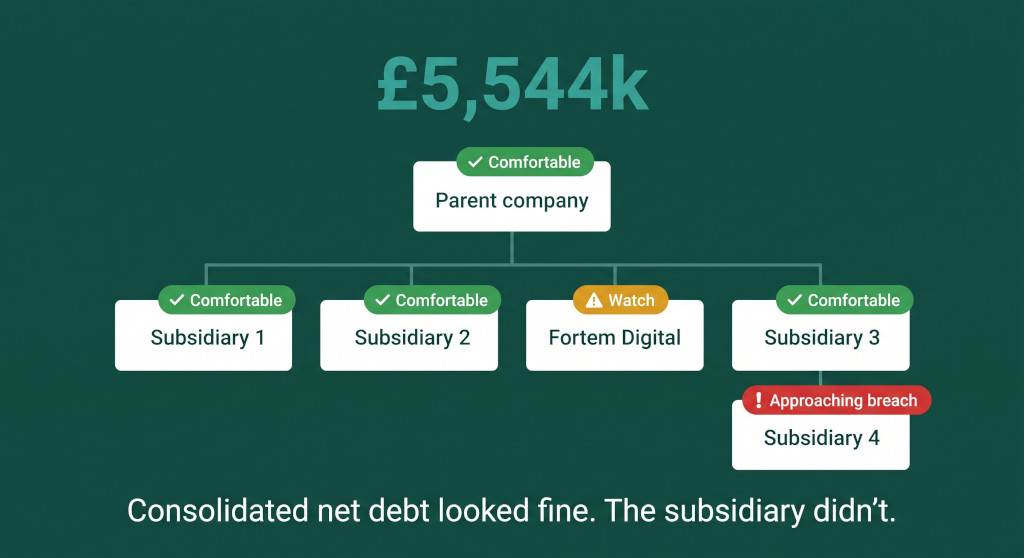
At the March board meeting, David — group CFO of Fortem Group — presented a single consolidated net debt figure of £5,544,000. The group’s EBITDA for the year was £3,200,000, giving a net leverage ratio of 1.73x. The board noted the position with satisfaction and moved on.
Twelve days later, Fortem’s relationship manager at the bank called. The interest cover covenant on Fortem Digital’s term loan — tested at entity level, not group level — had been breached. The entity’s interest cover had fallen to 2.4x against a covenant minimum of 3.0x. The bank was requesting a management meeting and a remediation plan.
The board had not been told. The consolidated net debt figure gave no indication. The entity-level covenant breach had developed quietly inside a subsidiary whose external borrowing was one of three facilities spread across the group — and the board pack had never been designed to surface it.
Stop building consolidations in spreadsheets.
BrizoConsol automates multi-entity consolidation — setup in minutes, reports the same day.
This is the core problem with presenting debt in a multi-entity group board pack: consolidated net debt, on its own, is not sufficient. It tells the board what the group owes in aggregate. It does not tell the board which entities owe it, on what terms, with what covenants, and how close each facility is to its limits. For a group where debt sits across multiple subsidiaries and is tested at entity level by lenders — which is most groups — the consolidated number is a starting point, not the answer.
Why Consolidated Net Debt Alone Misleads
In a single-entity business, net debt is straightforward: gross borrowings minus cash. The facility, the covenants, and the entity are all the same thing. In a multi-entity group, they are not. Debt facilities typically sit in specific subsidiaries — the entity that the lender has lent to, against the security of that entity’s assets and income. The covenant is tested at that entity’s level, using that entity’s financial statements, not the group’s.
A group with five entities and three external facilities may have one entity approaching covenant breach while the consolidated leverage looks comfortable, because the other entities are unlevered and their cash and EBITDA offset the stressed entity in the consolidated number. The board sees 1.73x consolidated leverage and assumes the group is within limits. The bank sees 2.4x interest cover in a specific entity and calls a meeting.
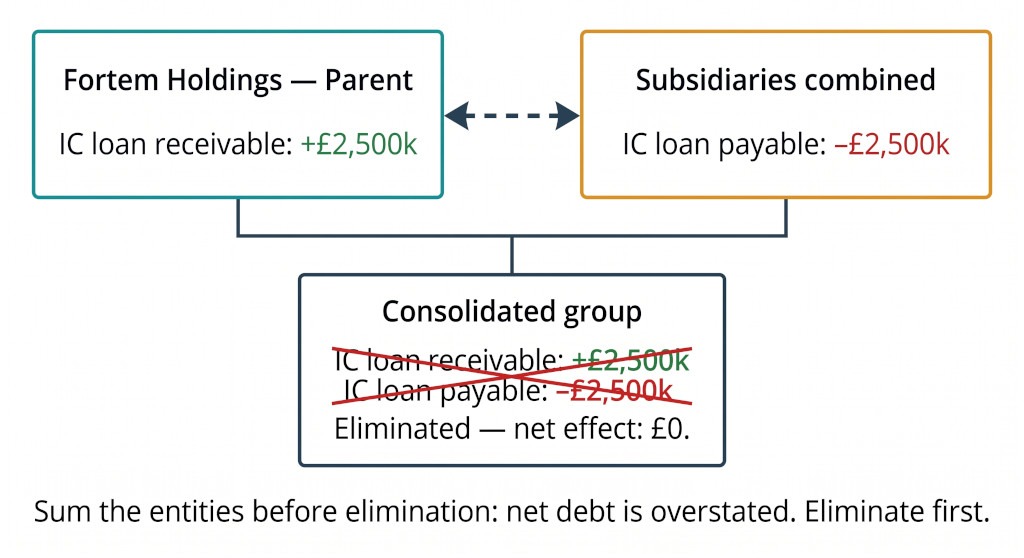
A second problem is intercompany loans. Groups routinely lend funds between entities — the parent lends to a subsidiary to fund working capital, or one subsidiary lends to another as part of a cash pooling arrangement. These intercompany loans are assets in one entity and liabilities in another. If a board pack presents entity-by-entity net debt figures without eliminating the intercompany loans, the presentation double-counts them: the parent shows a net asset (IC receivable) and the subsidiary shows a net liability (IC payable), and both are included in the entity totals. The consolidated net debt figure, however, correctly eliminates them — which means the sum of entity net debt positions will not equal the consolidated figure, and the board will not understand why.
Fortem Group: The Debt Structure
Fortem Group has five entities: the parent holding company, two UK operating subsidiaries (Trading and Digital), a European subsidiary (Fortem Europe, functional currency EUR), and a property SPV. External borrowings are spread across three of the five entities. The parent carries no external debt but has advanced intercompany loans to its subsidiaries. The full debt position, before elimination, is:
| Entity | Cash (£k) | External debt (£k) | IC loan payable (£k) | IC loan receivable (£k) | Entity net debt (£k) |
|---|---|---|---|---|---|
| Fortem Holdings (parent) | 400 | — | — | (2,500) | (2,100) |
| Fortem Trading Ltd | 600 | 1,200 | 800 | — | 1,400 |
| Fortem Digital Ltd | 150 | 3,500 | 700 | — | 4,050 |
| Fortem Europe (EUR sub) | 240 | 514 | 1,000 | — | 1,274 |
| Fortem Property SPV | 80 | 1,800 | — | — | 1,720 |
| Sum of entities (pre-elimination) | 1,470 | 7,014 | 2,500 | (2,500) | 6,344 |
| Eliminate: intercompany loans | — | — | (2,500) | 2,500 | (800) |
| Consolidated net debt | 1,470 | 7,014 | — | — | 5,544 |
Without the IC loan elimination, the sum of entity net debt positions is £6,344,000 — overstated by £800,000 relative to the consolidated figure of £5,544,000. The discrepancy is not an error; it is the consequence of including IC loans in entity positions before netting them out. A board seeing £6,344,000 as the “sum of entities” alongside £5,544,000 consolidated would reasonably ask why the numbers differ. The board pack should anticipate and explain this before they do.
How to Present the Elimination in the Board Pack
The board pack net debt table should show entity positions, an explicit elimination row, and the consolidated total — in that sequence. The entity positions make visible which subsidiary carries the most debt. The elimination row explains the reconciliation to the consolidated figure. The consolidated total gives the group-level position that governs external reporting.
The IC loan elimination row should be labelled clearly — “Eliminate: intercompany loans (parent receivable / subsidiary payables)” — rather than appearing as an unexplained plug between the entity subtotal and the consolidated figure. A board that understands the elimination is a consolidation adjustment, not an actual cash movement, will not be confused by the reconciliation. A board that does not understand it will ask the question at the wrong moment.
The intercompany loan elimination affects the net debt figure but not the external debt figure. External borrowings of £7,014,000 are the same before and after elimination — IC loans are intra-group, not bank debt. The elimination only affects the net debt calculation because IC receivables and payables offset one another within the group. This is worth stating explicitly in the board narrative so that directors do not confuse the elimination with a reduction in what is owed to banks.
The Entity-Level Covenant Problem
Consolidated net debt answers one question: what does the group owe, in aggregate? It does not answer the question that matters most for financial risk: are any of the group’s debt facilities at risk of breach?
Debt facilities in multi-entity groups are almost always structured at entity level. The lender lends to Fortem Digital, not to Fortem Group. The covenant is tested on Fortem Digital’s financial statements — Fortem Digital’s EBITDA, Fortem Digital’s interest charge, Fortem Digital’s asset values — not the group’s consolidated position. Group EBITDA and group interest cover are irrelevant to the lender’s covenant test. What matters is the entity.
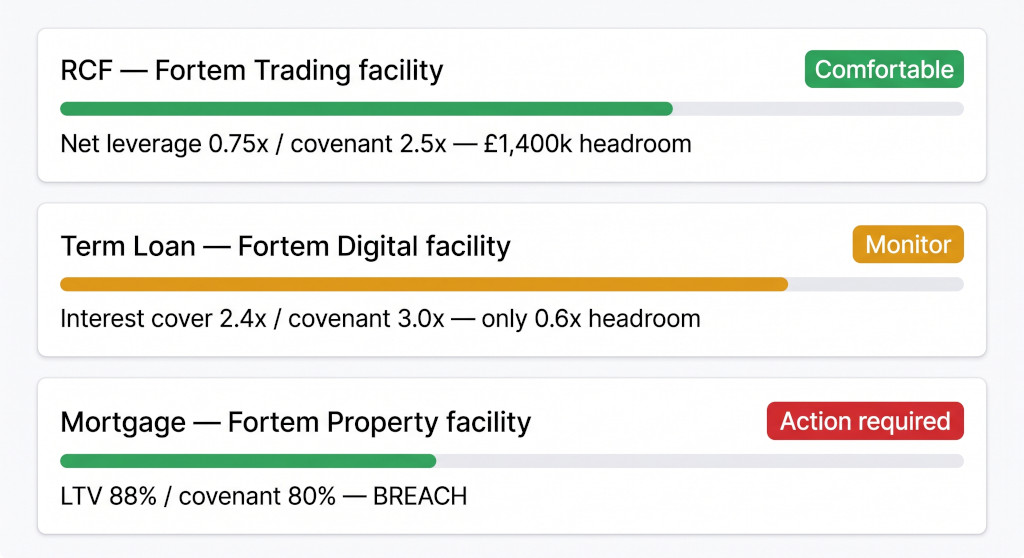
Fortem Group’s three external facilities sit in three different entities, with three different covenant structures:
Revolving Credit Facility — Fortem Trading Ltd
Term Loan — Fortem Digital Ltd
Mortgage — Fortem Property SPV
The consolidated interest cover for Fortem Group as a whole is comfortable — group EBIT across all five entities is sufficient to cover group interest multiple times over. But the interest cover covenant on Fortem Digital’s term loan is tested at Fortem Digital’s level only. The other entities’ EBIT does not count. At 2.4x against a covenant minimum of 3.0x, Fortem Digital is in breach.
Similarly, the LTV covenant on Fortem Property’s mortgage is tested against the SPV’s property valuation. The group’s other assets are irrelevant. If the property has been revalued downward — perhaps in a commercial property market correction — the LTV covenant tightens even if the group’s overall financial position is unchanged.
The Board Pack Covenant Table
The covenant headroom section of the board pack should present each facility in a single table with sufficient detail for the board to understand the risk position without requiring them to read the facility agreements. The essential columns are: entity, facility type, lender, covenant metric, covenant threshold, current actual, headroom or shortfall, and a RAG status:
| Entity | Facility | Covenant | Threshold | Actual | Headroom / (Shortfall) | Status |
|---|---|---|---|---|---|---|
| Fortem Trading | RCF £2m | Net leverage < 2.5x | < 2.5x | 0.75x | 1.75x headroom | ✓ OK |
| Fortem Digital | Term loan £3.5m | Interest cover > 3.0x | > 3.0x | 2.4x | (0.6x) breach | ✗ Breach |
| Fortem Property | Mortgage £1.8m | LTV < 80% | < 80% | 88% | (8pp) breach | ⚠ Breach |
This table takes less than half a page of the board pack. It tells the board everything they need to know: one facility is comfortably within covenant, two are in breach, and the specific metrics and entities are identified. A board looking at this table in March would have known about the Fortem Digital situation before the bank called. The board pack that showed only consolidated net debt gave them no such warning.
What to Include in the CFO Narrative
The narrative accompanying the net debt and covenant section should cover three things: the consolidated position, the entity-level position, and the action plan for any breach or near-breach situation.
For Fortem Digital, the narrative should explain what caused the interest cover deterioration — whether EBIT fell, interest costs rose, or both — and what the remediation plan is. Is the group seeking a covenant waiver? Is it planning to make a capital injection into Digital to reduce the external debt? Is it in discussions with the lender about a covenant reset? The board cannot govern a covenant breach situation without knowing the plan, and the plan should be on the face of the board pack, not surfaced only when the board asks.
For Fortem Property, the narrative should explain whether the LTV breach reflects a market-wide valuation movement or a property-specific issue, and whether the breach triggers any penalty clauses or margin step-up provisions in the facility. A technical LTV breach on a commercial mortgage in a falling market may be addressable through a covenant waiver or a partial repayment; the board needs to know which path the CFO is pursuing.
Presenting the Intercompany Loan Structure
A separate element of the board pack — typically a footnote or supplementary table — should document the intercompany loan structure: which entity has advanced funds to which, on what terms (interest rate, repayment schedule, subordination), and whether any of the IC loans are subject to subordination agreements with external lenders. Subordination clauses — common in leveraged finance structures — prevent the parent from repaying IC loans from a subsidiary until the external lender is repaid. They are a form of cash trap that affects the parent’s ability to access subsidiary cash and should be visible to the board.
For groups where the IC loan structure is straightforward, this can be a single sentence in the narrative. For groups with complex inter-entity lending — a common situation when the group has grown through acquisition and used the parent’s balance sheet to fund subsidiary working capital — a simple table showing lender entity, borrower entity, balance, interest rate, and subordination status is appropriate.
What Consolidated Net Debt Is and Is Not For
Consolidated net debt has an important role: it is the metric used for external reporting, for group-level leverage calculations, and for comparing the group’s financial position over time. It is the correct number to present alongside consolidated EBITDA in the group-level leverage analysis. It is not the correct number to use for covenant monitoring, because covenants are tested at entity level.
The board pack should present both: the consolidated position, for external reporting context and group-level trending; and the entity-level positions, with covenant calculations, for risk monitoring. The two serve different purposes and neither replaces the other. A board pack that presents only the consolidated figure is missing the risk monitoring function. A board pack that presents only entity positions without a consolidated summary is missing the group-level context.
For how to present cash accessibility across the group — which of the group’s cash balances can the parent actually use, and which are trapped — see What Should a Group Board Pack Include? and Board Reporting for Multi-Entity Groups: How Group CFOs Build a Consolidated Board Pack That Directors Can Use. For how to investigate consolidated variances that arise from entity-level movements, see Group Variance Dashboard: How Multi-Entity Finance Teams Investigate Consolidated Results That Miss Budget.
Covenant headroom across every entity — in one view
BrizoConsol tracks external facilities and intercompany loan balances at entity level, so your board pack net debt table builds automatically — with IC eliminations applied and covenant calculations current.See It in Action