Non-Controlling Interest Formula: How NCI Is Calculated at Each Reporting Date
Non-controlling interest is not a static figure. It is set on the day the parent acquires control of the subsidiary, then it moves — every reporting period, in every period where the subsidiary earns a profit, declares a dividend, or generates any item of other comprehensive income. Finance teams who treat the NCI balance as something that gets calculated once at acquisition and then carried forward unchanged will find that their consolidated balance sheet becomes progressively less accurate as the years pass.
The formula that drives NCI at each reporting date is straightforward once its components are understood. This guide sets out the formula, explains where each component comes from, and works through a complete numerical example — including the journal entries that post each movement into the consolidation. It covers the case where a subsidiary is profitable, the case where a subsidiary makes a loss (including how NCI can go negative under current standards), and the OCI allocation that most groups get wrong when the subsidiary is a foreign operation.
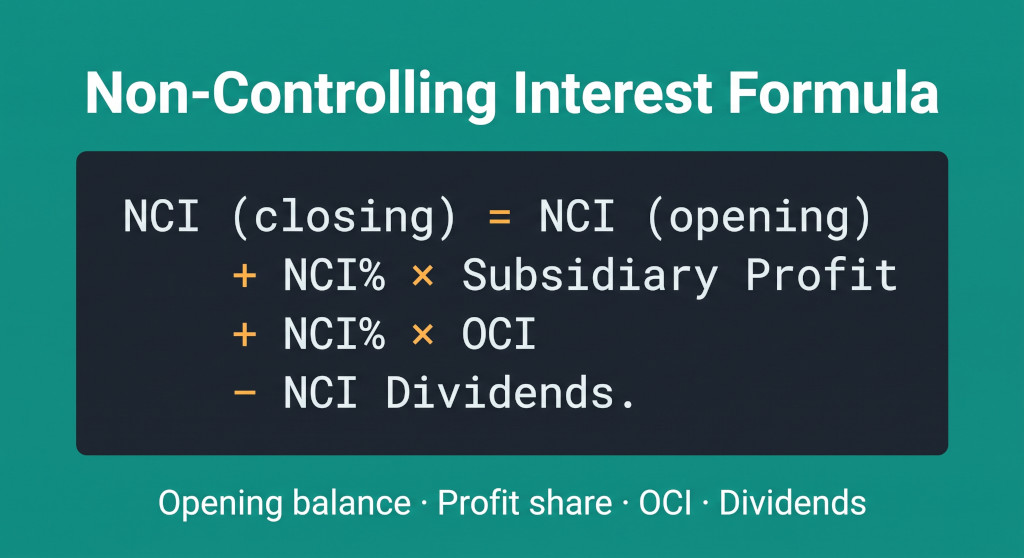
The NCI Formula
NCI (closing)
= NCI (opening)
+ NCI% × Subsidiary profit for the period
+ NCI% × Subsidiary OCI for the period
− NCI dividends paid or declaredNCI% = minority shareholders' percentage of ownership in the subsidiary
Each element of the formula corresponds to a specific movement in the NCI equity balance during the period. The opening balance is where the subsidiary’s minority shareholders started the period; the closing balance is where they end it. The formula is a rollforward — it connects the opening and closing NCI balances through the four types of movement that can affect them.
Automate NCI calculations across all your entities.
BrizoConsol handles non-controlling interest automatically — no manual adjustments required.
This formula applies from the second reporting period onwards. The opening NCI for any period is the closing NCI from the prior period — except in the very first period of consolidation, where the opening NCI is the amount recognised at the acquisition date. For how that acquisition-date figure is determined — including the choice between the fair value method and the proportionate share method — see the companion guide on NCI at acquisition: how to calculate non-controlling interest on the date of purchase.
Component 1: Opening NCI
The opening NCI is simply the NCI balance at the start of the reporting period — the closing balance from the prior period’s consolidation. In the first reporting period after acquisition, it is the amount recognised in the acquisition journal (either at fair value or at NCI% × net assets, depending on the measurement method chosen).
The opening NCI balance is an equity figure in the consolidated balance sheet. It represents the minority shareholders’ cumulative stake in the subsidiary’s net assets — their share of everything the subsidiary has earned, less everything it has paid out and less the intercompany adjustments that have reduced the net assets attributable to them.
Component 2: NCI Share of Subsidiary Profit
Each period, the NCI receives its proportionate share of the subsidiary’s profit for the period. The formula is:
NCI share of profit
| Subsidiary profit after tax for the period | £X |
| Less: intercompany adjustments applicable to the subsidiary | (£Y) |
| Adjusted subsidiary profit | £Z |
| × NCI% | × % |
| NCI share of profit | £ |
The most important detail here is the word “adjusted.” The NCI does not receive a share of the subsidiary’s standalone profit before consolidation adjustments. It receives a share of the subsidiary’s profit after any intercompany adjustments that affect the subsidiary’s reported results — specifically, the elimination of unrealised intercompany profits on transactions between the subsidiary and other group entities. If the subsidiary has sold goods to the parent with a margin, and some of those goods are still in the parent’s closing inventory, the unrealised profit element must be eliminated from the subsidiary’s profit before the NCI percentage is applied.
For upstream sales (subsidiary sells to parent), the unrealised profit elimination reduces the subsidiary’s profit. Because the NCI is calculated on the subsidiary’s adjusted profit, the NCI’s share of that profit is also reduced. For downstream sales (parent sells to subsidiary), the unrealised profit sits in the parent’s books and does not affect the subsidiary’s reported profit — so the NCI calculation is unaffected. For lateral sales (between two subsidiaries), the treatment depends on which subsidiary holds the unrealised profit. For the full mechanics, see intercompany eliminations when there is a non-controlling interest.
Common error: Applying NCI% to the group’s consolidated profit rather than the subsidiary’s individual profit. NCI is calculated on the subsidiary’s profit — not the group total. The parent company’s profits, and the profits of other subsidiaries, are entirely attributable to the group and do not affect the NCI calculation for a given subsidiary.
Component 3: NCI Share of Other Comprehensive Income
Not all movements in equity flow through profit or loss. Items of other comprehensive income (OCI) — including currency translation adjustments, revaluation gains and losses on property, movements in FVOCI financial instruments, and remeasurements of defined benefit pension liabilities — affect the subsidiary’s equity without passing through profit for the period. The NCI’s share of these items must be separately allocated to NCI equity.
The OCI allocation uses the same NCI percentage as the profit allocation:
NCI share of OCI
| Subsidiary OCI for the period (e.g. currency translation adjustment) | £X |
| × NCI% | × % |
| NCI share of OCI | £ |
The OCI component is the one most commonly omitted in practice. Groups that have a foreign subsidiary — where a currency translation adjustment arises every period from translating the subsidiary’s accounts into the group’s presentation currency — must allocate the NCI’s share of the CTA to NCI equity in OCI, not to the group’s CTA reserve. Failing to split the CTA between the group and the NCI produces an overstated group CTA reserve and an understated NCI balance. For the precise mechanics of splitting the CTA in a partly-owned foreign subsidiary, see NCI and currency translation adjustments.
Component 4: NCI Dividends
When a subsidiary declares or pays a dividend, the NCI receives its proportionate share. That share reduces the NCI equity balance — the minority shareholders have taken cash out of the subsidiary, so their equity stake in it is correspondingly reduced.
NCI dividends
| Subsidiary dividends declared or paid in the period | £X |
| × NCI% | × % |
| NCI share of dividends (deducted from NCI equity) | £ |
The timing question — declared versus paid — depends on the applicable accounting standard and whether the dividend has been accrued by the subsidiary at the period end. Under IFRS, dividends reduce equity when declared, not when paid, if they are declared before the balance sheet date. Dividends declared after the balance sheet date are disclosed as non-adjusting events but do not reduce NCI equity in the current period.
At the group level, the intercompany dividend flow (parent receives its share from the subsidiary) is eliminated entirely in the consolidation. Only the NCI share of the dividend is visible in the consolidated accounts — as a reduction in NCI equity and a cash outflow (or liability) in the consolidated balance sheet.
Full Worked Example
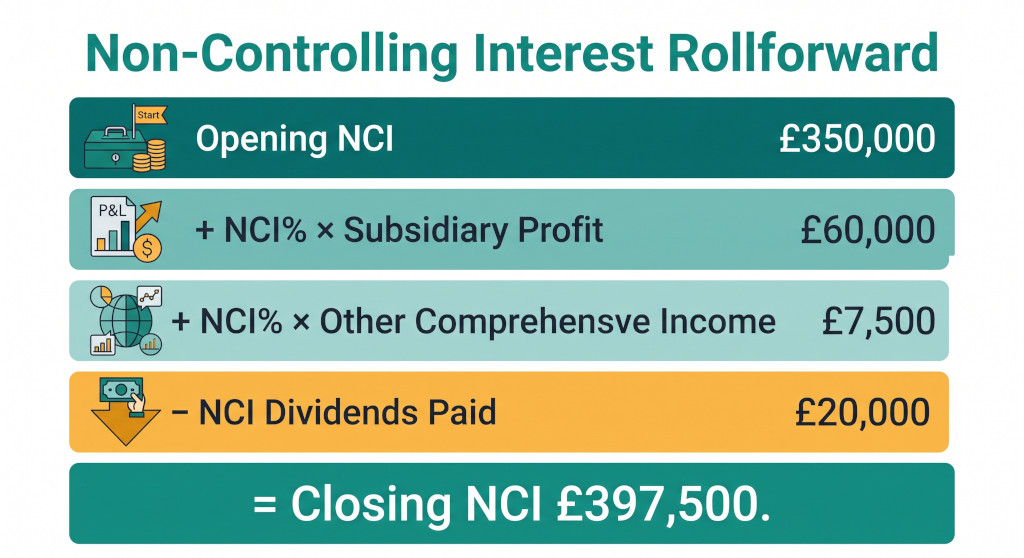
ParentCo owns 75% of SubCo, acquired on 31 December 2025. The NCI (25%) at acquisition was measured at £350,000 using the proportionate share method (Method B — NCI% × SubCo’s identifiable net assets at fair value). For the year ended 31 December 2026, the following information is available:
| Item | Amount (£) |
|---|---|
| SubCo profit after tax for the year | 240,000 |
| Unrealised intercompany profit elimination (upstream — SubCo sold goods to ParentCo) | (20,000) |
| SubCo adjusted profit after intercompany elimination | 220,000 |
| SubCo OCI — currency translation adjustment (SubCo functional currency: AUD, group presentation: GBP) | 30,000 |
| SubCo dividend declared and paid in the year | 80,000 |
Step 1: Calculate each NCI component
NCI share of profit
| SubCo adjusted profit | 220,000 |
| × NCI% (25%) | × 25% |
| NCI share of profit | 55,000 |
NCI share of OCI (CTA)
| SubCo CTA for the year | 30,000 |
| × NCI% (25%) | × 25% |
| NCI share of CTA | 7,500 |
NCI dividends
| SubCo total dividend | 80,000 |
| × NCI% (25%) | × 25% |
| NCI dividend (deducted from NCI equity) | 20,000 |
Step 2: The NCI rollforward
NCI equity rollforward — year ended 31 December 2026
| NCI at 1 January 2026 (acquisition date balance) | 350,000 |
| + NCI share of SubCo profit (25% × £220,000) | 55,000 |
| + NCI share of OCI — CTA (25% × £30,000) | 7,500 |
| − NCI dividends paid (25% × £80,000) | (20,000) |
| NCI at 31 December 2026 | 392,500 |
Step 3: Journal entries for each movement
Three separate journals post the NCI movements into the consolidation:
Journal 1 — Allocate NCI share of profit (P&L → Equity)
| Account | Dr (£) | Cr (£) |
|---|---|---|
| Profit attributable to NCI (P&L — below the line) | 55,000 | |
| NCI equity (Balance Sheet) | 55,000 |
This entry moves SubCo’s adjusted profit attributable to minority shareholders from the P&L (reducing the profit allocated to the parent’s shareholders) into NCI equity on the balance sheet. The debit appears in the consolidated P&L as “Profit attributable to non-controlling interests.”
Journal 2 — Allocate NCI share of OCI (CTA)
| Account | Dr (£) | Cr (£) |
|---|---|---|
| Group CTA reserve (OCI — reduces group share of CTA) | 7,500 | |
| NCI equity (Balance Sheet) | 7,500 |
This entry reclassifies the NCI’s share of the currency translation adjustment from the group’s OCI into NCI equity. Without this journal, the full CTA (£30,000) would sit in the group’s CTA reserve and the NCI balance would be understated by £7,500.
Journal 3 — NCI dividend
| Account | Dr (£) | Cr (£) |
|---|---|---|
| NCI equity (Balance Sheet) | 20,000 | |
| Cash / Intercompany payable (Balance Sheet) | 20,000 |
The NCI’s share of SubCo’s dividend (£20,000) is paid out in cash to minority shareholders. This reduces NCI equity and the group’s cash. The parent’s 75% share of the dividend (£60,000) is an intercompany flow eliminated in the consolidation and does not appear in the consolidated cash balance.
Where NCI Sits in the Consolidated Financial Statements
After posting these three journals, the NCI balance of £392,500 appears in three places in the consolidated financial statements:
On the consolidated balance sheet, NCI is presented as a separate component of equity — distinct from the equity attributable to the parent’s shareholders. It sits within the equity section but is clearly identified as belonging to the minority. Under IFRS 10, NCI is always equity, never a liability, regardless of the NCI’s size or the terms of the minority arrangement.
In the consolidated income statement, the profit for the period is split at the bottom between “attributable to owners of the parent” (£165,000 — the parent’s 75% of the adjusted £220,000 profit) and “attributable to non-controlling interests” (£55,000 — the NCI’s 25% share). The total profit line above this split shows the full £220,000 as the consolidated profit for the period.
In the consolidated statement of changes in equity, the NCI column shows the opening balance (£350,000), the profit allocation (+£55,000), the OCI allocation (+£7,500), and the dividend payment (−£20,000), arriving at the closing balance (£392,500). For how to construct this column correctly, see NCI in the consolidated statement of changes in equity.
When NCI Goes Negative: Absorbing Subsidiary Losses
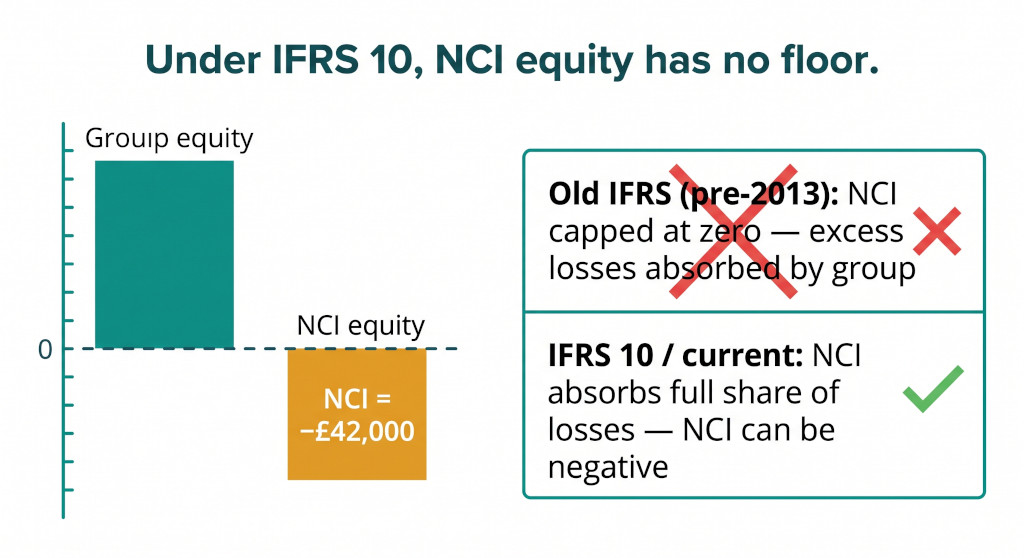
The NCI formula works symmetrically: if the subsidiary makes a loss, the NCI share of that loss reduces the NCI equity balance. Under current standards (IFRS 10, ASC 810, and FRS 102), there is no floor. If the NCI’s accumulated losses exceed its opening equity balance, the NCI equity balance becomes negative. The minority shareholders effectively owe the group, in an accounting sense, more than their stake is worth.
This is a significant change from the approach under the old IAS 27 (replaced in 2013), which capped the NCI’s loss allocation at zero. Under old IAS 27, any excess losses beyond the NCI’s equity stake were absorbed by the parent — a treatment that often produced a misleading picture of where the losses actually sat. Under IFRS 10, the NCI absorbs its full share of losses even if this produces a negative NCI balance. The group’s equity is not affected by the portion allocated to NCI; only the NCI column goes negative.
A negative NCI balance does not mean the minority shareholders must make a cash contribution to the group. It is an accounting balance, not a legal obligation. The practical implication is usually that the subsidiary is loss-making and the minority shareholders’ stake has been eroded. If the subsidiary later returns to profitability, the NCI balance rebuilds from the negative position through the same formula — NCI share of profits adding back to the NCI equity column.
Changes in NCI Percentage During the Period
The formula above assumes a constant NCI percentage throughout the period. Where the parent acquires additional shares in the subsidiary (increasing its stake and reducing the NCI%), or disposes of shares (decreasing its stake and increasing the NCI%), the NCI percentage changes at the transaction date. The formula must then be applied in two segments: the period before the transaction using the original NCI%, and the period after the transaction using the revised NCI%.
Importantly, under IFRS 10, a change in ownership that does not result in a loss of control — for example, the parent increases its stake from 75% to 85% while still controlling the subsidiary — is treated as an equity transaction, not a business combination. No new goodwill is recognised. The NCI balance is restated to reflect the new percentage, with the difference between the amount paid and the NCI’s book value recognised in equity (not profit or loss). This is one of the more complex areas of consolidation accounting and is worth separate treatment in the group’s accounting policies.
For a broader treatment of how ownership changes affect the consolidation, see how to consolidate a subsidiary after a change in ownership.
Checklist: NCI Formula at Each Reporting Date
- Confirm the opening NCI balance — this is the closing NCI from the prior period, as signed off in the prior period’s consolidation workpapers.
- Obtain SubCo’s profit after tax from its individual trial balance.
- Apply intercompany adjustments — deduct the NCI’s share of unrealised intercompany profit eliminations that relate to the subsidiary’s sales. For upstream sales, the full unrealised profit comes out of SubCo’s profit before the NCI% is applied.
- Calculate NCI share of adjusted profit — NCI% × adjusted profit. Post Journal 1 (debit P&L attributable to NCI, credit NCI equity).
- Obtain SubCo’s OCI items — CTA from foreign currency translation, revaluation movements, pension remeasurements. Calculate NCI% × each OCI item. Post Journal 2 for each OCI category (debit relevant OCI reserve, credit NCI equity).
- Confirm dividend amounts — total dividends declared by SubCo in the period. Calculate NCI% × total dividend. Post Journal 3 (debit NCI equity, credit cash or liability). Do not include dividends declared after the balance sheet date.
- Prepare the NCI rollforward — opening + profit share + OCI share − dividends = closing. Agree the closing figure to the NCI equity balance in the consolidated balance sheet.
- Reconcile to the SoCE — the NCI column in the consolidated statement of changes in equity should reflect exactly the same movements as the rollforward. Any difference indicates a journal is missing or was posted to the wrong column.
- Check for ownership changes — if the NCI% changed during the period, segment the rollforward calculation and treat the change in ownership as an equity transaction (not a business combination) if control is retained.
NCI calculated automatically at every close
BrizoConsol calculates NCI profit share, OCI allocation, and dividend movements automatically from your subsidiary trial balances and posts the consolidation journals — so the NCI rollforward is always accurate and always reconciles to your SoCE. See It in Action
Further Reading
This post covers NCI measurement at each subsequent reporting date. For the complete NCI lifecycle:
- Day 1 — how NCI is measured when the subsidiary is first acquired, including the fair value method (Method A) vs. the proportionate share method (Method B): NCI at acquisition: how to calculate non-controlling interest on the date of purchase
- Presentation — how to build the NCI column in the consolidated statement of changes in equity: NCI in the consolidated statement of changes in equity
- FX complication — how to split the CTA between the group and the NCI when the subsidiary is a foreign operation: NCI and currency translation adjustments
- Elimination complication — how unrealised intercompany profits are split when there is a non-controlling interest: intercompany eliminations when there is a non-controlling interest
- Complete example — NCI in the context of a full consolidation from trial balances: a complete consolidation worked example
- Broader overview — NCI in group consolidation including goodwill and the consolidated balance sheet: how to calculate non-controlling interest (NCI) in financial consolidation
Consolidation software for partly-owned groups
BrizoConsol handles all the complexity of consolidating partly-owned subsidiaries — NCI profit and OCI allocation, intercompany eliminations adjusted for the NCI, CTA splitting, and the full statement of changes in equity. Start with a free trial. Start Free Trial