How to Reconcile Consolidated Equity
The audit senior’s email arrived on a Tuesday morning, two weeks before year-end sign-off. Claudia, group financial controller at Veritas Capital Group, had been expecting the standard list — reconcile cash, reconcile borrowings, confirm intercompany balances. But item 11 was different: “Please provide a component-level reconciliation of the consolidated equity section to the entity-level equity of each entity within the consolidation scope, showing how each equity line on the consolidated balance sheet derives from the underlying entities.”
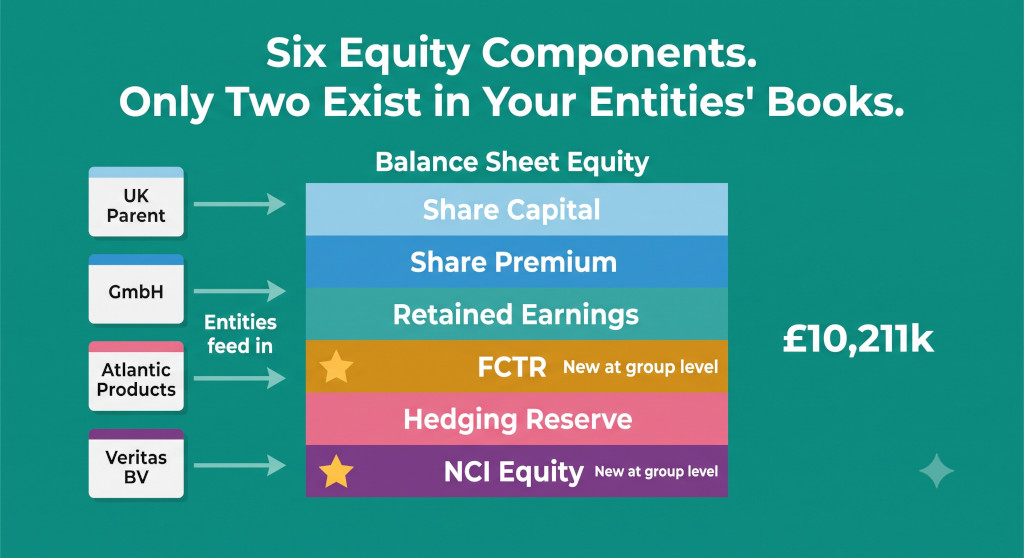
Claudia looked at the consolidated balance sheet. The equity section showed six lines: share capital £1,000k, share premium £2,500k, retained earnings £6,445k, FCTR (£268k), hedging reserve (£65k), and non-controlling interest £599k — a total of £10,211k. The sum of all four entities’ equity was £14,291k. The £4,080k gap needed to be explained, line by line, for each of the six equity components.
The consolidated equity section is the part of the balance sheet that looks most alien to someone approaching it for the first time, and most familiar to someone who has done the work for years. Two of its six components — the FCTR and the NCI equity — exist nowhere in any entity’s books; they emerge entirely from the consolidation process. Two others — share capital and share premium — appear in every entity’s books but only the parent’s survive into the consolidated accounts. The remaining two — retained earnings and OCI reserves — pass through with significant adjustments. Understanding what happens to each component and why is the key to producing a reconciliation that a senior auditor or external reviewer can follow without further questions.
Automate NCI calculations across all your entities.
BrizoConsol handles non-controlling interest automatically — no manual adjustments required.
Four Fates for Subsidiary Equity
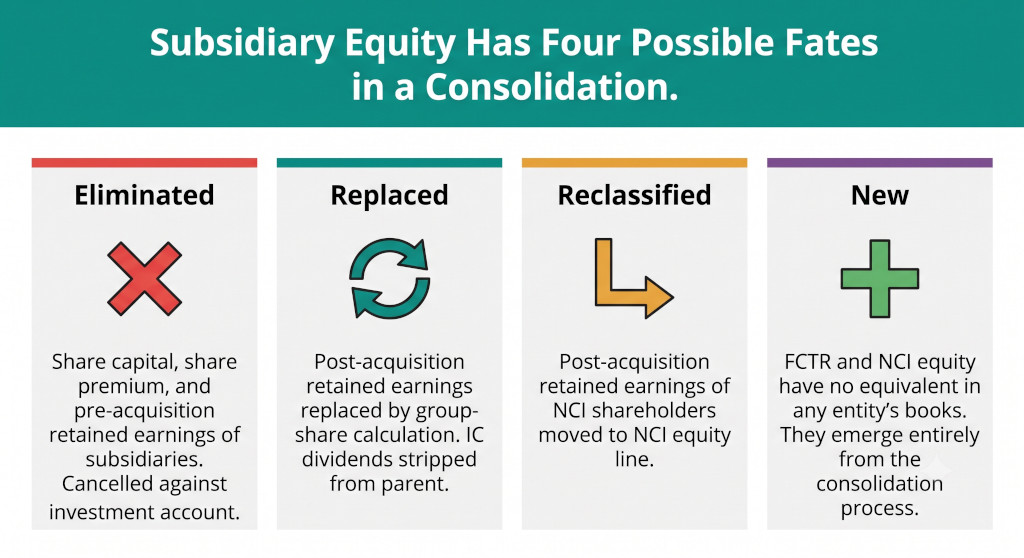
Before working through the components individually, it helps to understand the four things that can happen to any item of subsidiary equity in the consolidation process. Every component of every subsidiary’s equity follows one of these four paths.
The first path is elimination. Share capital, share premium, and retained earnings at the acquisition date are eliminated in the investment elimination journal — they cancel against the parent’s investment account in that subsidiary, with goodwill emerging as the residual difference. These items disappear from the consolidated equity section entirely.
The second path is replacement. The post-acquisition retained earnings of subsidiaries do not pass through directly — they are replaced in the consolidated retained earnings by the group’s proportionate share, calculated using the methodology described in How to Reconcile Consolidated Retained Earnings. The entity’s retained earnings figure is not what appears in the consolidated balance sheet; a group-share calculation, adjusted for intercompany dividends and consolidation adjustments, replaces it.
The third path is reclassification. For partially-owned subsidiaries, the NCI’s share of equity moves across — from within the subsidiary’s equity totals — into the NCI equity line on the consolidated balance sheet. The NCI equity is not new money; it is the NCI’s portion of the subsidiary’s net assets, reclassified from the sub’s equity into a separate consolidated equity component.
The fourth path is creation. The FCTR emerges from the retranslation of foreign subsidiaries’ net assets; it has no counterpart in any entity’s books because no entity prepares accounts in a currency different from its own functional currency. The NCI equity also, in part, involves a presentation that does not exist at entity level — because no entity’s balance sheet separately shows “what the minority shareholders own.”
Component-by-Component: What Happens at Each Equity Line
Veritas Capital Group has four entities: the UK parent (Veritas Holdings), Veritas GmbH (Germany, EUR functional, 100% owned, acquired four years ago), Atlantic Products (UK, GBP, 70% owned, acquired three years ago), and Veritas BV (Netherlands, EUR functional, 100% owned, acquired two years ago). The equity of each entity, translated to GBP at the closing rate for foreign entities, is:
| Component | Veritas Holdings £k | Veritas GmbH £k | Atlantic Products £k | Veritas BV £k | Sum of Entities £k | Consolidated £k |
|---|---|---|---|---|---|---|
| Share capital | 1,000 | 420 | 500 | 252 | 2,172 | 1,000 |
| Share premium | 2,500 | 168 | 300 | 84 | 3,052 | 2,500 |
| Retained earnings | 4,620 | 2,394 | 1,480 | 638 | 9,132 | 6,445 |
| FCTR | — | — | — | — | — | (268) |
| Hedging reserve | (65) | — | — | — | (65) | (65) |
| NCI equity | — | — | — | — | — | 599 |
| Total equity | 8,055 | 2,982 | 2,280 | 974 | 14,291 | 10,211 |
The table makes visible what the reconciliation must explain: two components that exist in the sum but are smaller in the consolidated (share capital, share premium), one component that is significantly smaller (retained earnings), two components that appear from nothing in the consolidated (FCTR and NCI equity), and one that passes through unchanged (hedging reserve).
Share Capital and Share Premium
The simplest components in the reconciliation. Share capital and share premium in the consolidated accounts represent only the parent’s issued capital — they are constant at £1,000k and £2,500k regardless of the number of subsidiaries in the group. Every subsidiary’s share capital and share premium is eliminated in the investment elimination journal, where it cancels against the parent’s investment in that subsidiary (with goodwill as the residual).
For partially-owned subsidiaries, the NCI’s proportionate share of share capital and share premium does not go to the consolidated share capital line — it goes to the NCI equity line as part of the NCI’s opening position (NCI’s share of net assets at acquisition).
| Share Capital Reconciliation | |
|---|---|
| Sum of all entities’ share capital | £2,172k |
| Less: Veritas GmbH share capital eliminated (100% owned) | (£420k) |
| Less: Atlantic Products share capital — parent’s share eliminated (70%) | (£350k) |
| Less: Atlantic Products share capital — reclassified to NCI equity (30%) | (£150k) |
| Less: Veritas BV share capital eliminated (100% owned) | (£252k) |
| Consolidated share capital | £1,000k |
The same logic applies to share premium — the sum (£3,052k) reduces to the parent’s £2,500k through identical eliminations. The share premium reconciliation follows exactly the same structure and is not repeated here.
Retained Earnings
The retained earnings reconciliation — from the sum of entities’ £9,132k to the consolidated £6,445k — follows the methodology covered in detail in How to Reconcile Consolidated Retained Earnings. In brief: the parent’s retained earnings (£4,620k) include £380k of intercompany dividend income from subsidiaries, which is eliminated and replaced by the group’s proportionate share of each subsidiary’s post-acquisition retained earnings. Cumulative PPA amortisation of £340k and unrealised profit of £95k are then deducted. The summary reconciling items are:
Retained Earnings — Summary Reconciliation
Sum of all entities’ retained earnings£9,132k
Less: Pre-acquisition RE of subsidiaries (GmbH £792k, Atlantic 70%×£540k, BV £258k)(£1,428k)
Less: NCI share of post-acq RE — reclassified to NCI equity (Atlantic 30%×£940k)(£282k)
Less: Intercompany dividend income in parent RE — eliminated(£380k)
Less: Unrealised profit eliminations (group share)(£95k)
Less: Cumulative PPA amortisation (GmbH, Atlantic, BV)(£340k)
Less: Goodwill impairment charges (nil in this period)—
Consolidated retained earnings£6,445k
FCTR — The Currency Translation Reserve
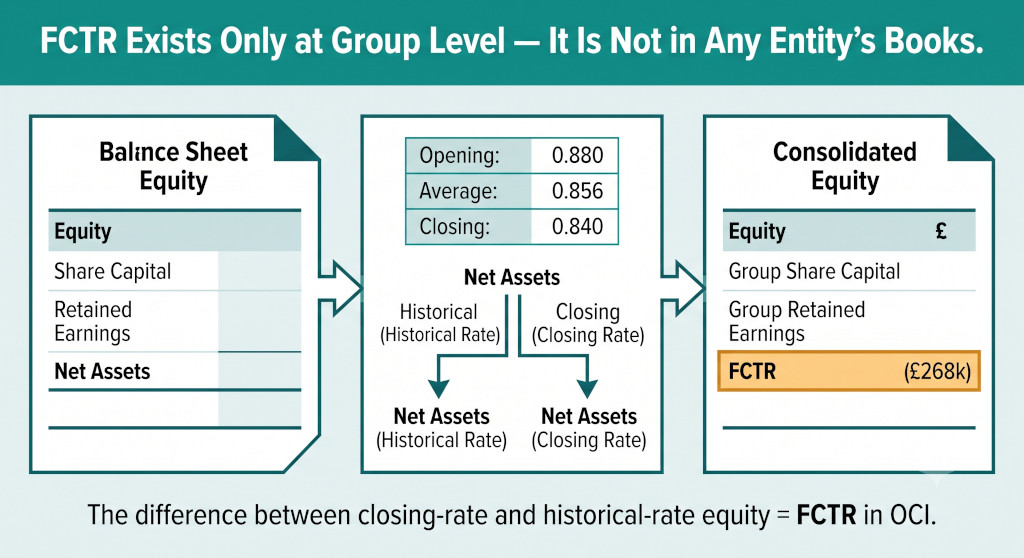
The FCTR — Foreign Currency Translation Reserve, also called the Currency Translation Adjustment or CTA — is the equity component that appears in consolidated accounts but in none of the entities’ books. It arises because the group includes subsidiaries with a functional currency different from the group’s presentation currency (GBP). When those subsidiaries’ net assets are translated at the closing exchange rate for the consolidated balance sheet, but their post-acquisition earnings have been translated at average rates (and their acquisition-date net assets at the historical rate at acquisition), a translation difference arises. That difference sits in OCI as the FCTR.
The FCTR for Veritas Group comprises two components — the translation differences on Veritas GmbH (EUR/GBP) and Veritas BV (EUR/GBP). Neither appears in GmbH’s or BV’s own books, because those entities prepare accounts in EUR. The FCTR only appears when their EUR-denominated net assets are translated into GBP for the group presentation.
| FCTR Component | Subsidiary | £k | Key Driver |
|---|---|---|---|
| GmbH net asset retranslation (EUR/GBP move) | Veritas GmbH | (220) | EUR weakened against GBP post-acquisition; closing rate lower than historical rate |
| GmbH goodwill retranslation | Veritas GmbH | (16) | Goodwill is a EUR-denominated asset under IAS 21; retranslated at closing rate |
| BV net asset retranslation | Veritas BV | (32) | EUR/GBP movement since BV acquisition two years ago |
| Total FCTR — consolidated balance sheet | (268) | ||
Because the FCTR has no equivalent in the sum of entities’ equity, it represents a difference of (£268k) in the reconciliation — a component that appears in consolidated equity but has a zero balance in the sum. A preparer reconciling from the sum of entities to the consolidated total must include the FCTR as a line item that reduces the sum (it is a debit balance — a loss in translation terms, representing a weakening of the EUR against GBP since acquisition).
The goodwill retranslation component of the FCTR (£16k in Veritas Group’s case) is the item most frequently omitted from CTA calculations. Under IAS 21, goodwill arising on the acquisition of a foreign subsidiary is treated as a foreign-currency asset of the group — denominated in the subsidiary’s functional currency — and must be retranslated at the closing rate each period, with the movement going to the FCTR. For a group that has held a subsidiary with significant goodwill for several years, the cumulative goodwill retranslation CTA can be material. For the detailed mechanics, see Why Does My CTA Not Reconcile?
Other OCI Reserves: Hedging and Revaluation
Other OCI reserves — hedging reserves from designated cash flow hedges, revaluation reserves from property or financial assets measured at fair value through OCI — behave differently depending on whether the hedge relationship or revaluation is at the parent level or within a subsidiary.
For Veritas Group, the hedging reserve of (£65k) arises entirely from the parent’s designated cash flow hedges (EUR/GBP forward contracts hedging future subsidiary cash flows). Because it is a parent-level item, it passes through unchanged to the consolidated equity — the consolidated hedging reserve equals the parent’s hedging reserve of (£65k), and the reconciliation from sum to consolidated shows no adjustment for this line.
If a subsidiary had its own hedging reserve or revaluation reserve, the consolidation treatment would depend on the ownership percentage and whether intercompany hedges need to be eliminated. For a 100%-owned subsidiary, the subsidiary’s OCI reserves pass through fully to consolidated equity. For a partially-owned subsidiary, the OCI reserves are split between consolidated equity (at the group percentage) and NCI equity (at the NCI percentage), in the same way that retained earnings are split.
NCI Equity
The NCI equity line represents the non-controlling interest’s cumulative ownership stake in the group’s partially-owned subsidiary — in this case, 30% of Atlantic Products Ltd. It appears only in the consolidated equity section; no individual entity’s balance sheet carries an NCI equity figure.
The NCI equity balance is built up as follows: the NCI’s share of Atlantic’s net assets at the date of acquisition, plus the NCI’s share of Atlantic’s post-acquisition earnings, less dividends paid to the NCI shareholders, adjusted for any NCI share of OCI (which is nil here because Atlantic is a GBP entity with no hedging or revaluation reserves).
NCI Equity — Atlantic Products Ltd (30%)
Opening Position — Acquisition Date (3 Years Ago)
NCI share of share capital at acquisition: 30% × £500k£150k
NCI share of share premium at acquisition: 30% × £300k£90k
NCI share of retained earnings at acquisition: 30% × £540k£162k
NCI at acquisition date£402k
Post-Acquisition Movements
NCI share of Atlantic’s post-acquisition earnings: 30% × £940k£282k
Dividends paid to NCI shareholders (cumulative, 3 years)(£85k)
NCI share of PPA amortisation: 30% × £115k cumulative(£35k)
NCI share of unrealised profit elimination (upstream): 30% × £45k(£14k)
NCI share of goodwill impairment (nil — partial goodwill method applied)—
NCI equity per consolidated balance sheet£550k
Two points in the NCI build-up require careful attention. First, PPA amortisation is shared between the parent’s retained earnings and the NCI equity — the NCI absorbs its proportionate share of the amortisation of fair value uplifts recognised at acquisition. If the PPA amortisation is deducted only from the parent’s consolidated retained earnings and not from NCI equity, the NCI will be overstated. Second, for upstream intercompany eliminations (subsidiary sells to parent), the unrealised profit elimination is shared between the parent and the NCI in proportion to ownership. The NCI absorbs its 30% share — it does not benefit from profits it helped generate that have not yet been realised in third-party sales. For downstream eliminations (parent sells to subsidiary), 100% of the unrealised profit reduces the parent’s consolidated retained earnings, and the NCI equity is unaffected.
Note on partial vs. full goodwill method: Veritas Group uses the partial goodwill method for Atlantic Products, meaning goodwill is recognised only on the parent’s share (70%) of the excess of consideration over net assets. Under the full goodwill method, goodwill would also include the NCI’s notional share, and the NCI at acquisition would be stated at fair value (a higher opening figure). The choice of method affects the NCI equity balance and the goodwill amount but does not affect total group equity — the two effects are equal and opposite. The partial goodwill method is the default under IFRS 3 (with the full goodwill method as an election); it is the only method available under FRS 102. If your group uses the full goodwill method, the NCI at acquisition will be higher, and any goodwill impairment will need to be split between parent equity and NCI equity in the ownership ratio.
Full Equity Section Reconciliation
Combining the component reconciliations, Claudia can now produce the complete equity reconciliation — from the sum of entities’ £14,291k total equity to the consolidated £10,211k, with every difference identified and explained by component.
| Reconciling Item | Share Capital £k | Share Premium £k | Retained Earnings £k | FCTR £k | Hedging £k | NCI £k | Total £k |
|---|---|---|---|---|---|---|---|
| Sum of all entities’ equity | |||||||
| Per entity aggregation | 2,172 | 3,052 | 9,132 | — | (65) | — | 14,291 |
| Investment elimination — subsidiary capital and pre-acquisition reserves | |||||||
| GmbH share capital / premium (100% eliminated) | (420) | (168) | — | — | — | — | (588) |
| GmbH pre-acquisition retained earnings (100%) | — | — | (792) | — | — | — | (792) |
| Atlantic share capital / premium — parent 70% | (350) | (210) | — | — | — | — | (560) |
| Atlantic share capital / premium — NCI 30% → reclassified to NCI | (150) | (90) | — | — | — | 240 | — |
| Atlantic pre-acquisition RE — parent 70% | — | — | (378) | — | — | — | (378) |
| Atlantic pre-acquisition RE — NCI 30% → reclassified to NCI | — | — | (162) | — | — | 162 | — |
| BV share capital / premium (100% eliminated) | (252) | (84) | — | — | — | — | (336) |
| BV pre-acquisition retained earnings (100%) | — | — | (258) | — | — | — | (258) |
| Post-acquisition adjustments to retained earnings | |||||||
| IC dividend income in parent RE — eliminated | — | — | (380) | — | — | — | (380) |
| NCI post-acq RE (Atlantic 30% × £940k) → reclassified to NCI | — | — | (282) | — | — | 282 | — |
| Unrealised profit eliminations (group share) | — | — | (95) | — | — | (14) | (109) |
| Cumulative PPA amortisation (group share) | — | — | (340) | — | — | (35) | (375) |
| NCI dividends paid to NCI shareholders (cumulative) | — | — | — | — | — | (85) | (85) |
| New consolidated-only components | |||||||
| FCTR — GmbH and BV net asset retranslation (incl. goodwill) | — | — | — | (268) | — | — | (268) |
| Consolidated equity per balance sheet | 1,000 | 2,500 | 6,445 | (268) | (65) | 550 | 10,162 |
The NCI equity total of £550k in the reconciliation matches the NCI build-up from the preceding section (£402k at acquisition + £282k post-acq earnings − £85k NCI dividends − £35k NCI PPA − £14k NCI unrealised profit = £550k). The slight difference from the £599k figure used in the opening scenario reflects the PPA and unrealised profit adjustments — a reminder that the NCI equity on the balance sheet is not simply “NCI% × subsidiary’s book equity” but requires the same consolidation adjustments that apply to the parent’s retained earnings.
Common Errors in the Full Equity Reconciliation
The most common error in the full equity reconciliation is treating NCI equity as a residual — calculating everything else and letting NCI be whatever is needed to make the total agree. NCI equity should be built up from the acquisition-date position, post-acquisition earnings, dividends, and OCI movements, and verified independently before the reconciliation is finalised. An NCI equity balance that can only be justified as a plug is an error waiting to be discovered by the auditors or the NCI shareholders themselves.
The second most common error is omitting the NCI’s share of consolidation adjustments. PPA amortisation that runs through consolidated retained earnings must also reduce NCI equity at the NCI percentage. Similarly, upstream unrealised profit eliminations reduce NCI equity at the NCI percentage. Preparers who focus on the parent’s retained earnings reconciliation in isolation frequently produce a NCI equity balance that is too high, because it has not been reduced by the NCI’s share of post-acquisition consolidation charges.
For groups with foreign subsidiaries, the FCTR is the component most commonly calculated incorrectly — particularly the goodwill retranslation component, which many models omit. Since goodwill on a foreign subsidiary is a foreign-currency asset under IAS 21, it must be retranslated at the closing rate each period, with the movement going to the FCTR. Omitting this produces an FCTR balance that understates the true translation difference, and a goodwill balance on the balance sheet that is translated at the historical acquisition rate rather than the current closing rate — producing an error in both assets and OCI simultaneously.
Practical Checklist: Reconciling Consolidated Equity
- List every equity component that appears on the consolidated balance sheet. For most groups this will be: share capital, share premium, retained earnings, FCTR (if foreign subsidiaries), other OCI reserves (hedging, revaluation — as applicable), and NCI equity. Map each component to its treatment: parent-only (share capital, share premium), adjusted (retained earnings), new group component (FCTR, NCI equity), or pass-through (hedging/revaluation from parent).
- Reconcile share capital and share premium first. These are the simplest lines — confirm that the consolidated balance equals the parent’s issued capital only, and that the difference equals the subsidiary share capital and premium eliminated (grossed up across 100%-owned entities and split between parent-share elimination and NCI reclassification for partially-owned entities).
- Reconcile retained earnings using the companion methodology. The six reconciling items (pre-acquisition RE, NCI share, IC dividends, unrealised profit, PPA amortisation, goodwill impairment) are explained in full in How to Reconcile Consolidated Retained Earnings. Do not start the full equity reconciliation without first closing the retained earnings reconciliation.
- Build the FCTR from the CTA calculation for each foreign subsidiary. For each foreign entity: calculate net assets at closing rate minus net assets at historical rates (acquisition rate for opening position, average rates for post-acquisition earnings). Include the goodwill retranslation component. Sum to the total FCTR and agree to the consolidated balance sheet OCI line.
- Build NCI equity from the acquisition-date position upward. NCI at acquisition = NCI% × subsidiary net assets at acquisition date (under partial goodwill method). Then add NCI share of post-acquisition earnings, deduct NCI dividends paid, deduct NCI share of PPA amortisation, deduct NCI share of upstream unrealised profit, add NCI share of OCI movements (CTA if foreign sub, hedging if applicable). Never calculate NCI as a plug.
- Verify NCI equity against two cross-checks. First: NCI% × subsidiary’s closing net assets (before consolidation adjustments) should approximate NCI equity, with the difference explained by PPA amortisation and unrealised profit at NCI%. Second: the NCI charge in the income statement (NCI% × subsidiary PAT, less PPA amortisation at NCI%) should equal the movement in NCI equity between opening and closing, net of NCI dividends.
- Check that OCI components from subsidiaries are correctly split between parent equity and NCI equity. For partially-owned subsidiaries, any OCI reserve — hedging, revaluation — is split in the ownership ratio. A 70% owned subsidiary’s hedging reserve splits 70% to consolidated reserves and 30% to NCI equity. Do not consolidate the full OCI reserve into consolidated reserves and leave NCI equity unadjusted.
- Confirm that the FCTR is only for foreign-functional-currency subsidiaries. UK subsidiaries with a GBP functional currency contribute zero to the FCTR. Including a FCTR line for a GBP subsidiary is a structural error — it indicates the consolidation model is translating an entity that does not require translation.
- Cross-check total equity against the statement of changes in equity. Opening consolidated equity plus total comprehensive income plus share issues less dividends to parent’s shareholders less dividends to NCI shareholders should equal closing consolidated equity. A discrepancy between the SOCE and the balance sheet equity is a sign of an unrecorded movement or a misclassified OCI item.
- Document each reconciling item with a reference to its source. Each line in the equity reconciliation should be traceable to a specific working paper: the investment elimination schedule for pre-acquisition equity, the retained earnings reconciliation for the RE adjustments, the CTA calculation for the FCTR, and the NCI roll-forward for NCI equity movements. An equity reconciliation with untraced figures will not survive an audit review; one with complete cross-references typically passes with minimal queries.
Claudia submitted the component-level reconciliation on Thursday, two days after receiving the request. The NCI equity build-up was what took the longest — she discovered in preparing it that the prior year’s NCI had not been reduced by the NCI’s share of PPA amortisation for three consecutive years, producing a £105k overstatement in NCI equity that had been sitting unnoticed in the consolidated balance sheet. Correcting it required a prior-year adjustment. The equity reconciliation had not just answered the audit question — it had found an error that would otherwise have remained in the accounts indefinitely.
Equity reconciliation built in to every close
BrizoConsol tracks each equity component — share capital, retained earnings, FCTR, and NCI equity — as standing outputs from the consolidation, updated every period. When the auditors ask for the equity reconciliation, it already exists as a live working paper, not a quarterly rebuilding exercise. See It In Action
Stop rebuilding the equity section from scratch at year-end
BrizoConsol maintains a live equity roll-forward for every component — NCI, FCTR, retained earnings — updated automatically with each close. Start free today. Start Free Trial