How to Consolidate a US GAAP Subsidiary into an IFRS Parent: Conversion Journals, Fiscal Periods, and Currency Translation
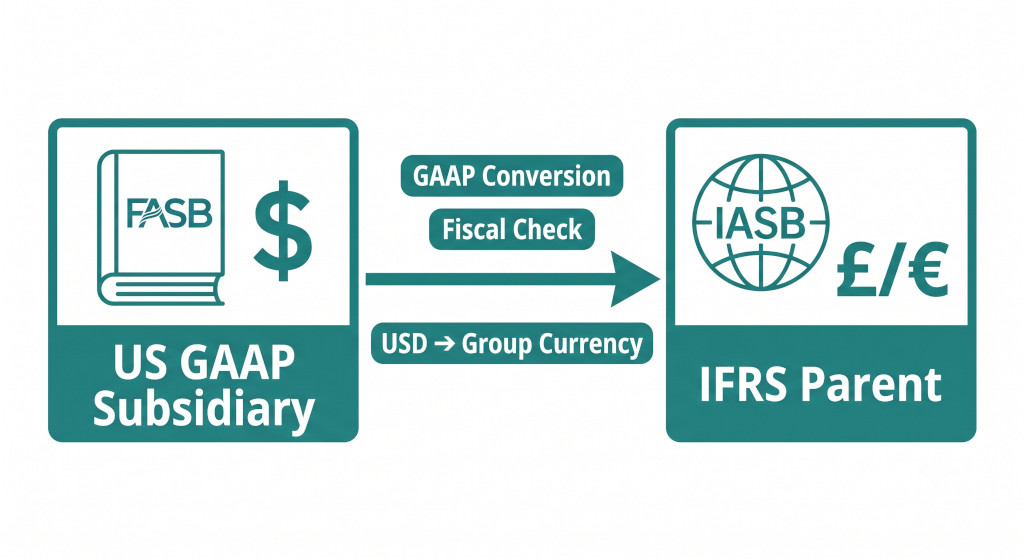
International groups that have grown through acquisition in the United States frequently find themselves consolidating a US GAAP subsidiary into an IFRS group. The dynamics of this conversion are subtly different from the more widely discussed IFRS-to-US GAAP direction. Where IFRS-to-US GAAP typically involves removing items (expensing capitalised development costs, stripping out PP&E revaluations, reclassifying leases), US GAAP-to-IFRS often involves adding items — capitalising development costs that US GAAP required to be expensed, reversing a LIFO reserve that IFRS prohibits, and recognising impairment reversals that US GAAP does not permit.
This guide walks through the principal GAAP conversion journals needed to bring a US GAAP subsidiary into an IFRS group consolidation, the fiscal year considerations specific to US entities, and the USD-to-GBP currency translation process. For the reverse direction, see our companion guide on consolidating an IFRS subsidiary into a US GAAP parent.
The Group Structure Used in This Guide
- BrizoGroup plc — IFRS parent (UK-listed), presents in GBP, fiscal year 1 January to 31 December
- BrizoUS Inc — US subsidiary, 100% owned, applies US GAAP, reports in USD, fiscal year 1 January to 31 December
- Exchange rates (illustrative): closing USD/GBP 0.787; average USD/GBP 0.800; historical rate at acquisition USD/GBP 0.820
BrizoUS Inc is a manufacturing and distribution business. It uses LIFO inventory costing, has qualifying development activities expensed in full under ASC 730, and holds operating leases accounted for under ASC 842. These three areas drive the main conversion adjustments.
Foreign currency consolidation, handled automatically.
BrizoConsol applies the correct CTA/FCTR treatment across all entities — no spreadsheets needed.
Step 1 — Key US GAAP to IFRS Differences
Step 1
The table below summarises the areas most likely to require conversion journals when bringing a US GAAP subsidiary into an IFRS group consolidation. Several major topics from the IFRS-to-US GAAP conversion list do not appear here — goodwill, for example, is impairment-only under both frameworks since IFRS 3 (2004) and ASC 350, so no goodwill amortisation reversal is needed in this direction.
US GAAP — BrizoUS Inc’s basis
Inventory: LIFO permitted — BrizoUS uses LIFO; inventory carried at historical cost, LIFO reserve of USD 2,400,000
Development costs: ASC 730 — all R&D expensed as incurred; no intangible asset for development
Leases: ASC 842 — both operating and finance leases on balance sheet; operating leases show a single straight-line “lease cost” in P&L
Impairment: ASC 360 — no reversal of previously recognised impairment losses on long-lived assets
Goodwill: ASC 350 — impairment-only, no amortisation
IFRS — BrizoGroup’s group basis
Inventory: IAS 2 — LIFO prohibited; must use FIFO or weighted average; inventory carried at lower of cost and net realisable value
Development costs: IAS 38 — qualifying development costs must be capitalised; research costs expensed
Leases: IFRS 16 — all leases on balance sheet; P&L shows separate depreciation on ROU asset and interest on lease liability
Impairment: IAS 36 — reversal of impairment permitted (except goodwill) if recoverable amount increases
Goodwill: IFRS 3 — impairment-only, no amortisation (same as US GAAP)
Revenue recognition (IFRS 15 vs ASC 606) and lease recognition (IFRS 16 vs ASC 842) are largely converged; differences in those areas are typically presentational rather than recognition-based. The three areas requiring substantive conversion journals for BrizoUS are LIFO inventory, development costs, and — where applicable — impairment reversals.
Step 2 — GAAP Conversion Journals
Step 2
All conversion journals are prepared in USD — BrizoUS Inc’s functional currency — and translated into GBP in Step 4. The objective is to produce an IFRS-compliant trial balance for BrizoUS in USD before currency translation takes place.
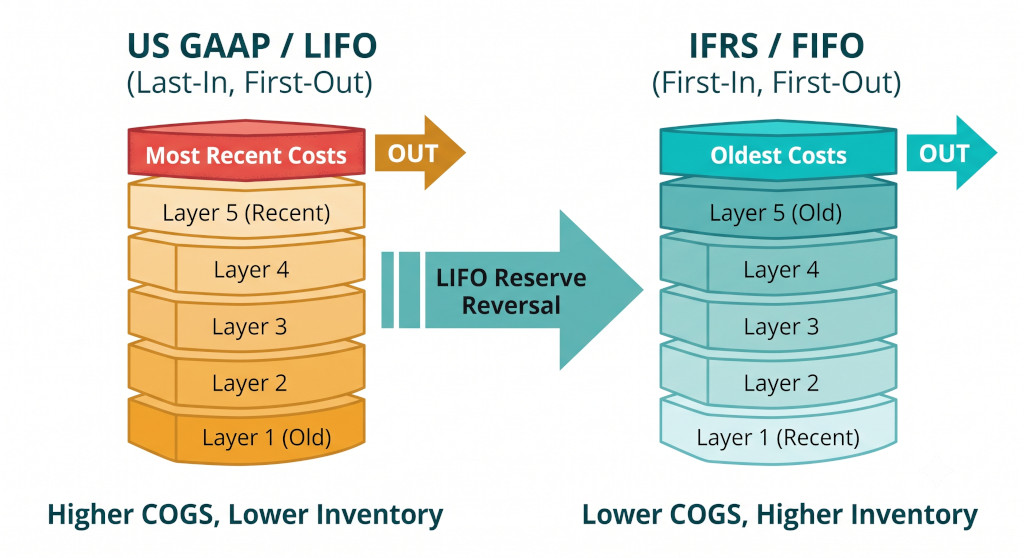
Adjustment 1: LIFO to FIFO — Reverse the LIFO Reserve
BrizoUS Inc uses the Last-In First-Out (LIFO) method for inventory valuation, which is common among US manufacturers and distributors. IAS 2 prohibits LIFO. For consolidation purposes, BrizoUS’s inventory must be restated to FIFO (the group’s IFRS policy). The LIFO reserve — the cumulative difference between inventory at LIFO cost and at FIFO cost — must be reversed.
BrizoUS’s LIFO position:
- Opening LIFO reserve: USD 2,100,000
- Closing LIFO reserve: USD 2,400,000
- Movement in the year (additional LIFO charge): USD 300,000
Journal 1A — Reverse opening LIFO reserve (prior-year cumulative adjustment)
DR Inventory USD 2,100,000
CR Deferred Tax Liability (21% US rate) USD 441,000
CR Retained Earnings USD 1,659,000
Reverses the cumulative LIFO reserve as at the start of the current period. Inventory increases by the opening LIFO reserve amount (USD 2,100,000), reflecting the higher FIFO cost. A deferred tax liability arises because LIFO is also used for US tax purposes (the LIFO conformity rule means tax must follow the accounting method) — reversing LIFO for IFRS creates a temporary difference. Retained earnings is credited net of deferred tax. US federal corporate tax rate used: 21%.
Journal 1B — Reverse current-year LIFO movement
DR Inventory USD 300,000
CR Cost of Sales USD 300,000
Reverses the current-year LIFO charge of USD 300,000 from Cost of Sales and restores the inventory value on the balance sheet. In a rising-price environment, LIFO produces higher COGS than FIFO — reversing it reduces COGS and increases gross profit on the IFRS-restated P&L. The related deferred tax movement on the current-year USD 300,000 (USD 63,000 at 21%) is processed in Journal 4.
The LIFO conformity rule in the US means that if a company uses LIFO for tax, it must also use LIFO for its primary financial statements. This does not prevent an IFRS parent from applying a GAAP conversion journal for consolidation purposes — the subsidiary continues to file its US statutory accounts and tax returns under LIFO; only the group consolidation figures are restated to FIFO. Ensure this distinction is clearly documented in the group accounting policy and communicated to auditors.
Adjustment 2: Development Costs — Capitalise Qualifying Expenditure
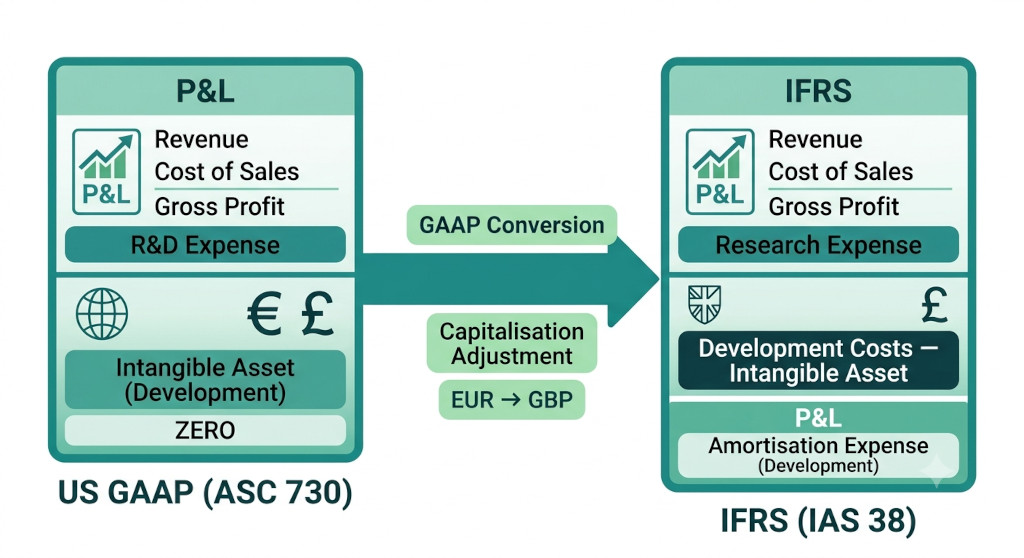
Under ASC 730, BrizoUS Inc expenses all research and development costs as incurred — no intangible asset is recognised for development activities. Under IAS 38, the group’s IFRS policy is to capitalise development costs when technical and commercial feasibility has been established, the intention and ability to complete the asset exist, and the expenditure can be reliably measured. Research costs continue to be expensed.
BrizoUS has been developing a new manufacturing process over two years. Prior-year qualifying development expenditure: USD 900,000. Current-year qualifying development expenditure: USD 750,000. The group amortises development costs over four years (straight-line) from the date of completion. The process was completed at the start of the prior year, so prior-year accumulated amortisation is one year (USD 225,000); current-year amortisation is one year (USD 225,000).
Journal 2A — Capitalise prior-year development costs (opening position)
DR Development Costs — Intangible Asset (gross) USD 900,000
CR Accumulated Amortisation — Dev Costs USD 225,000
CR Retained Earnings USD 675,000
Recognises the prior-year development expenditure as an intangible asset under IAS 38. The net carrying value of USD 675,000 (gross USD 900,000 less one year’s amortisation USD 225,000) increases retained earnings, reversing the prior-year expensing of these costs. Deferred tax on this temporary difference is processed in Journal 4.
Journal 2B — Reverse current-year R&D expense; capitalise development spend
DR Development Costs — Intangible Asset (gross) USD 750,000
CR Research & Development Expense USD 750,000
Reverses the current-year development expenditure that was expensed under ASC 730 and recognises it as an intangible asset under IAS 38. The income statement effect is a reduction in R&D expense of USD 750,000 — increasing IFRS operating profit relative to US GAAP. Note: only qualifying development costs are capitalised; research costs remain expensed. The classification of activities as research vs development requires judgement and should be documented.
Journal 2C — Charge current-year amortisation on development costs
DR Amortisation — Development Costs USD 225,000
CR Accumulated Amortisation — Dev Costs USD 225,000
Charges the current-year amortisation on the prior-year capitalised development costs (USD 900,000 ÷ 4 years = USD 225,000). This partially offsets the income benefit from Journal 2B. The current-year capitalised spend (USD 750,000) has no amortisation charge yet — it begins amortising when the asset is available for use, which is assumed to be at the start of the next period for this example.
Adjustment 3: Lease P&L Reclassification
ASC 842 and IFRS 16 are broadly converged on lease recognition — both require operating leases to be recognised on the balance sheet as a Right-of-Use asset and lease liability. The balance sheet amounts are therefore similar (though minor measurement differences may arise from differing discount rate approaches). The significant difference is in P&L presentation:
- ASC 842 (operating lease): A single “operating lease cost” is recognised on a straight-line basis — presented within operating expenses. Depreciation and interest are not separately disclosed.
- IFRS 16: Depreciation on the ROU asset and interest on the lease liability are recognised separately — depreciation in operating expenses, interest in finance costs. The total charge is front-loaded (higher in early years).
BrizoUS’s ASC 842 operating lease position: operating lease cost USD 420,000 (straight-line). IFRS 16 equivalent: depreciation on ROU asset USD 380,000, interest on lease liability USD 52,000 — total USD 432,000. The USD 12,000 difference reflects the IFRS 16 front-loading effect in early-to-mid lease years.
Journal 3 — Reclassify operating lease cost to IFRS 16 presentation
DR Operating Lease Cost (reversal) USD 420,000
DR Finance Costs — Lease Interest USD 52,000
CR Depreciation — ROU Asset USD 380,000
CR Retained Earnings / P&L Difference USD 92,000
Reclassifies the ASC 842 operating lease cost into IFRS 16 presentation — depreciation above EBIT and interest below EBIT. The USD 12,000 net P&L impact (USD 432,000 IFRS 16 total vs USD 420,000 ASC 842 cost) is a timing difference that reverses over the lease term. EBITDA will increase under IFRS 16 (lease costs move below EBITDA); net profit differs by USD 12,000 in this year. Minor balance sheet differences from differing discount rate applications should be reviewed separately.
Adjustment 4: Deferred Tax on All Conversion Journals
The LIFO reversal, development cost capitalisation, and lease reclassification all create temporary differences between the IFRS-restated carrying values and the US tax bases of the affected assets and liabilities. Deferred tax is calculated at the applicable US tax rate (federal 21%; add applicable state rates for a blended effective rate). The principal deferred tax adjustments are:
- LIFO reserve reversal (Journal 1B current year): DR Cost of Sales USD 300,000 creates a taxable temporary difference; deferred tax liability increases by USD 63,000 (USD 300,000 × 21%).
- Development cost capitalisation (Journal 2A/2B): Capitalised development costs are deductible for US tax when expensed — the IAS 38 intangible asset has a carrying value that exceeds its nil tax base. Deferred tax liability on net development cost carrying value of USD 1,200,000 (USD 675,000 prior + USD 750,000 current − USD 225,000 amortisation): USD 252,000 at 21%.
- Lease reclassification (Journal 3): The balance sheet effect is minimal if ROU asset and lease liability amounts are similar under both standards; any difference generates a small deferred tax adjustment.
Step 3 — Fiscal Year Considerations
Step 3
BrizoUS Inc and BrizoGroup plc both use 31 December year-ends — no adjustment is required. Where a US subsidiary uses a non-December year-end, IFRS 10 paragraphs B92–B93 apply: the gap must not exceed three months, and stub-period accounts or gap-period adjustments are required. For a detailed treatment of the three-month rule and how to manage misaligned year-ends, see our fiscal year alignment guide.
One US-specific consideration: US companies sometimes operate on a 52/53-week fiscal year (ending on the nearest Friday or Saturday to 31 December, rather than on 31 December itself). The year-end date shifts slightly each year. For an IFRS parent, this creates a nominal gap that is always less than a week — well within the three-month rule — and requires only a trivial review for gap-period events. Document the position each year and confirm with auditors that it is not treated as a reportable difference.
Step 4 — Currency Translation: USD to GBP
Step 4
With BrizoUS Inc’s IFRS-restated trial balance in USD, currency translation follows IAS 21 — the same methodology used in every guide in this series. Closing rate for the balance sheet, average rate for the income statement, historical rate for equity, and the Cumulative Translation Adjustment (CTA) as the equity balancing figure in other comprehensive income.
| Item | Rate | Note |
|---|---|---|
| Balance sheet — all assets and liabilities | Closing rate (USD/GBP 0.787) | GBP/USD 1.270 at year-end spot rate |
| Income statement — revenues and expenses | Average rate (USD/GBP 0.800) | GBP/USD 1.250 annual average |
| Share capital and share premium | Historical rate (USD/GBP 0.820) | Rate at the date BrizoGroup plc acquired BrizoUS Inc; locked for life of investment |
| Opening retained earnings | Brought forward from prior year | Cumulative prior-period translation applied consistently |
| CTA (Cumulative Translation Adjustment) | Balancing figure | Deferred in equity (OCI) under IAS 21 until BrizoUS is sold or wound up |
Worked Translation Example
Using BrizoUS Inc’s IFRS-restated figures in USD after all conversion journals above:
| Item | USD (IFRS restated) | Rate | GBP |
|---|---|---|---|
| Income Statement | |||
| Revenue | 15,000,000 | Avg 0.800 | 12,000,000 |
| Cost of Sales (FIFO-restated) | (7,200,000) | Avg 0.800 | (5,760,000) |
| Operating Expenses (incl. dev cost amortisation, net R&D reversal) | (3,600,000) | Avg 0.800 | (2,880,000) |
| Net Profit | 4,200,000 | 3,360,000 | |
| Balance Sheet | |||
| Total Assets (incl. FIFO inventory uplift, dev cost intangible) | 28,000,000 | Close 0.787 | 22,036,000 |
| Total Liabilities (incl. deferred tax on conversion journals) | (14,500,000) | Close 0.787 | (11,411,500) |
| Net Assets | 13,500,000 | 10,624,500 | |
| Equity Reconciliation | |||
| Share Capital (historical rate 0.820) | 4,000,000 | Hist 0.820 | 3,280,000 |
| Opening Retained Earnings (brought forward) | 5,300,000 | Prior year | 4,100,000 |
| Current Year Net Profit | 4,200,000 | Avg 0.800 | 3,360,000 |
| CTA (balancing figure) | — | Plug | (115,500) |
| Total Equity | 13,500,000 | 10,624,500 | |
The negative CTA of GBP (115,500) reflects a slight strengthening of sterling against the dollar over the period — the closing rate of 0.787 is lower than the average rate of 0.800 used for the income statement, meaning balance sheet items translate at fewer pence per dollar than the income statement items. For a USD-functional subsidiary, a strengthening GBP erodes the sterling value of the US net assets. Groups with material US subsidiaries often monitor GBP/USD rate movements as a key sensitivity in their group equity position.
📚 Cross-Standard Consolidation SeriesIFRS Subsidiary → US GAAP ParentIFRS Subsidiary → UK GAAP ParentSFRS Subsidiary → US GAAP ParentSFRS Subsidiary → UK GAAP ParentSFRS Subsidiary → IFRS Parent
Practical Checklist: US GAAP Subsidiary into an IFRS Group
✅ Period-End Consolidation Checklist
- Obtain BrizoUS Inc’s trial balance in USD under US GAAP
- Confirm inventory costing method: if LIFO, calculate the opening and closing LIFO reserve and prepare Journal 1A (opening) and Journal 1B (current-year movement)
- Note the US LIFO conformity rule — confirm the conversion is being made for consolidation purposes only, not for statutory filing
- Review R&D expenditure for the period: classify activities into research (expense) and development (potentially capitalise under IAS 38)
- For qualifying development activities: prepare Journal 2A to capitalise prior-year balances and Journal 2B to capitalise current-year spend; prepare Journal 2C for current-year amortisation on the prior-year asset
- Review lease schedule: confirm ROU asset and lease liability amounts are consistent between ASC 842 and IFRS 16; prepare Journal 3 to reclassify operating lease cost to depreciation plus interest in the income statement
- Review any assets impaired under US GAAP in prior periods — assess whether the recoverable amount (IAS 36 basis) now exceeds the impaired carrying value; if so, prepare an impairment reversal journal
- Prepare Journal 4 for all deferred tax adjustments arising from the conversion journals: LIFO reversal, development cost capitalisation, and any lease balance sheet differences — at the applicable US blended tax rate
- Review for any VIE entities consolidated by BrizoUS under ASC 810 that would not meet the IFRS 10 control criteria — remove from scope if applicable; assess any IFRS 10 entities not in BrizoUS’s US GAAP scope
- Confirm 31 December year-end alignment; if BrizoUS uses a 52/53-week fiscal year, document the nominal year-end date and confirm it is within three months of the group date
- Source and document USD/GBP closing rate, average rate, and historical rate
- Translate all balance sheet items at closing rate; all income statement items at average rate
- Apply historical rate to share capital; carry forward prior-year translated retained earnings
- Calculate CTA as the equity balancing figure; record in other comprehensive income
- Load GBP-translated IFRS figures into the group consolidation model
- Eliminate all intercompany balances and transactions; classify USD/GBP loan FX differences as net investment (→ CTA) or working capital (→ P&L)
- Review CTA movement for reasonableness against USD/GBP rate movement in the period
IFRS group with a US subsidiary?
BrizoConsol connects Xero, QuickBooks, MYOB, and Zoho Books across all your entities — automating GAAP conversion journals, USD currency translation, intercompany eliminations, and IFRS consolidated reporting. Start Free Trial