How to Reconcile Consolidated Retained Earnings
The audit PBC request landed in Priya’s inbox on the first Friday of January. She had been group financial controller at Aldgate Manufacturing Group for eighteen months, and this was her second year-end audit — but the first where the audit senior had asked for something she hadn’t produced before. Item 14 on the list read: “Please provide a reconciliation of consolidated retained earnings per the audited balance sheet to the sum of retained earnings of each entity within the consolidation scope, with each reconciling item identified and supported.”
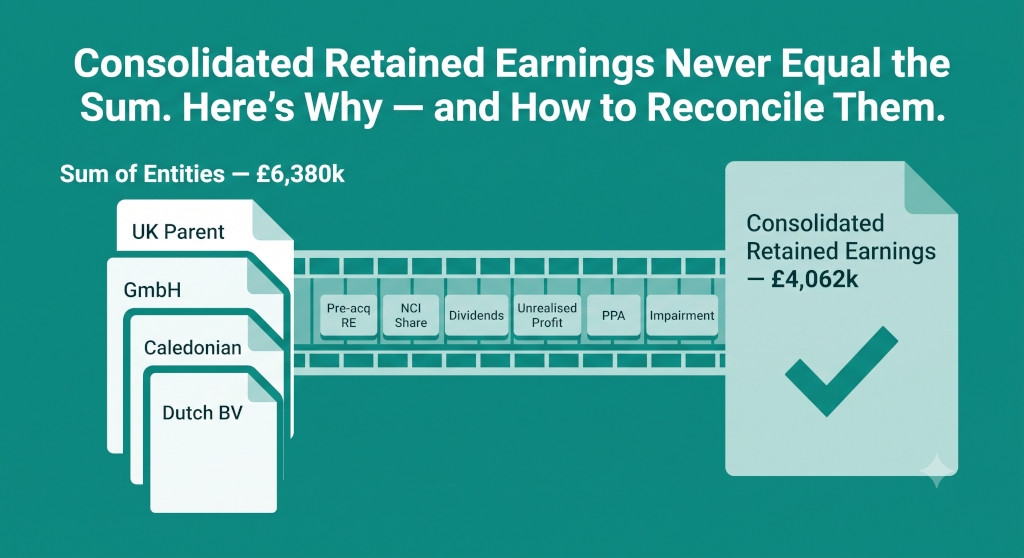
Priya looked at her consolidation model. She could see that consolidated retained earnings were £4,062k. She could see that the sum of all four entities’ retained earnings was £6,380k — a gap of £2,318k. But the number had simply come out of the model; the model eliminated things, applied adjustments, and produced a result. She had never had to explain the gap as a reconciliation.
What the auditor was asking for is one of the most revealing diagnostics in group accounting: a complete explanation of why consolidated retained earnings differ from the simple sum of what each entity is carrying on its books. Understanding it requires understanding every major consolidation treatment simultaneously — investment elimination, NCI attribution, intercompany eliminations, unrealised profit, PPA amortisation, and goodwill impairment. Produce it correctly and it proves that every one of those treatments has been applied consistently. Produce it with a residual that doesn’t reconcile, and it tells you there’s an error somewhere in the consolidation.
Automate NCI calculations across all your entities.
BrizoConsol handles non-controlling interest automatically — no manual adjustments required.
Why Consolidated Retained Earnings Never Equal the Sum of Entities’ Retained Earnings
When you add up the retained earnings of every entity in the group, you get a number that reflects the cumulative profits each entity has earned since its incorporation — net of dividends paid, adjusted for losses. That number has four fundamental differences from consolidated retained earnings:
First, the sum of entities includes the retained earnings each subsidiary had already accumulated before the parent acquired it. Those pre-acquisition retained earnings belong, economically, to the sellers — they are part of what the parent paid for. In consolidation, they are absorbed into the investment elimination journal and form part of the cost-less-net-assets calculation that generates goodwill. They do not belong to the group’s own earnings.
Second, the sum of entities includes the full post-acquisition earnings of partially owned subsidiaries. If Caledonian Manufacturing is 75% owned by the group, the sum of entities includes 100% of Caledonian’s post-acquisition earnings. Consolidated retained earnings include only 75% — the remaining 25% belongs to the non-controlling interest and appears in the NCI equity line, not in retained earnings.
Third, the parent’s standalone retained earnings include dividend income received from its subsidiaries. Under the cost method of accounting for subsidiaries (the standard approach in a parent’s separate financial statements), each dividend received from a subsidiary is recognised as income in the parent’s profit and loss. In consolidation, that income is eliminated because it represents a transfer between entities within the group, not earnings generated by trading with third parties. The subsidiary’s retained earnings have already been reduced by the dividend it paid, so the dividend appears in the sum of entities as a deduction from the sub — but it also appears as income in the parent. In consolidation, the income side is removed.
Fourth, the sum of entities does not reflect the consolidation adjustments that are applied at group level: the unrealised profit in closing inventory or fixed assets from intercompany sales, the cumulative PPA amortisation for fair value uplifts recognised on acquisition, and any goodwill impairment charges taken since acquisition. These adjustments exist only in the consolidated accounts; they are not in any entity’s standalone books.
The Six Reconciling Items
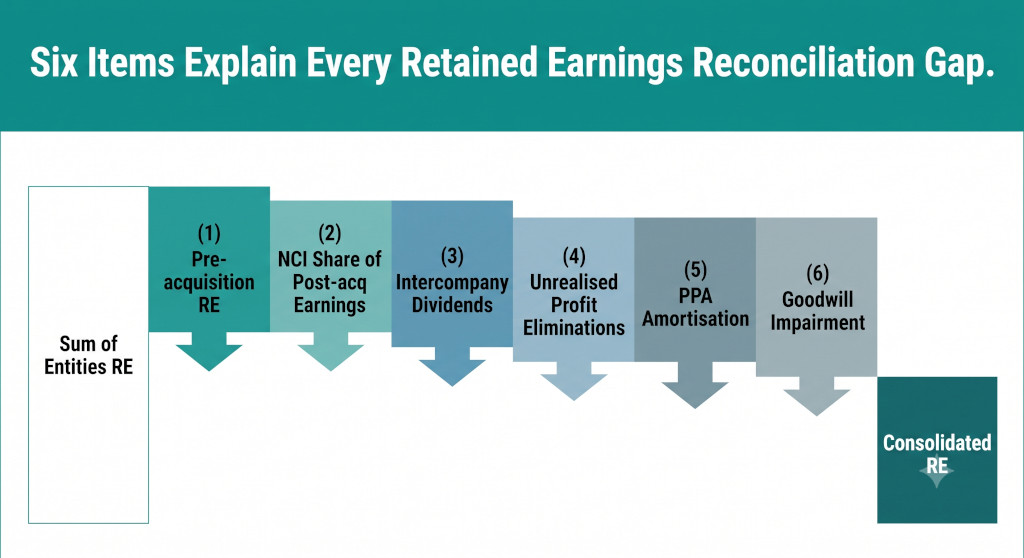
Every consolidated retained earnings reconciliation can be explained by some combination of six reconciling items. A group’s specific reconciliation will contain only the items that are relevant to its structure — a single-entity, single-currency group with no acquisitions will have none of them. A multi-entity group with partial ownership, foreign subsidiaries, and recent acquisitions will have all of them.
1. Pre-Acquisition Retained Earnings
Each subsidiary’s retained earnings at the date the parent acquired it. Eliminated in the investment elimination journal. Always negative in the reconciliation (reduces sum → consolidated).
2. NCI Share of Post-Acquisition Earnings
For partially-owned subsidiaries: the non-controlling interest’s percentage of cumulative post-acquisition retained earnings. Goes to NCI equity, not consolidated retained earnings.
3. Intercompany Dividend Income
Dividend income recognised in the parent’s standalone profit and loss from dividends received from subsidiaries. Eliminated in consolidation. Parent’s cost-method RE includes it; consolidated RE does not.
4. Unrealised Profit Eliminations
Cumulative unrealised profit in closing inventory or fixed assets from intercompany sales. Downstream (parent→sub): 100% eliminated from consolidated RE. Upstream (sub→parent): group share eliminated from consolidated RE, NCI absorbs its share.
5. Cumulative PPA Amortisation
Cumulative amortisation of fair value uplifts recognised on acquisition (customer relationships, brands, technology, order backlogs). Reduces consolidated RE only — not in any entity’s books.
6. Goodwill Impairment
Cumulative goodwill impairment recognised since each subsidiary was acquired. Reduces consolidated RE (and NCI equity if full goodwill method is applied). Not in any entity’s books.
The Intercompany Dividend Problem in Detail
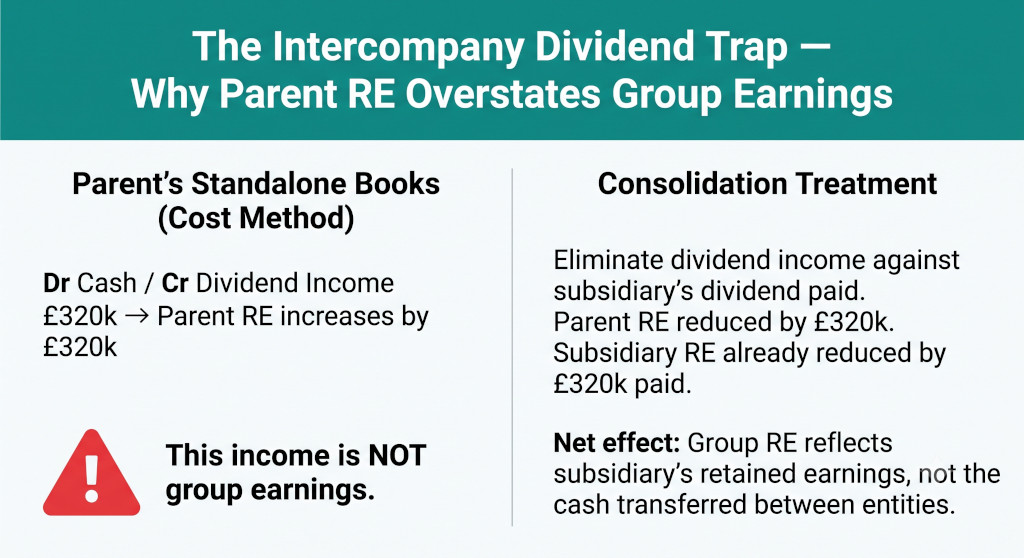
The intercompany dividend item catches more preparers than any other reconciling item, because it requires understanding what the parent’s retained earnings actually contain under the cost method — something that becomes invisible once the model runs.
When a parent accounts for its investment in a subsidiary using the cost method (as is standard in separate financial statements under both IFRS and FRS 102), dividends received from the subsidiary are recognised as income in the parent’s profit and loss account. Dr Cash, Cr Dividend Income. That income flows into the parent’s retained earnings. The subsidiary’s books show the other side: Dr Retained Earnings, Cr Cash — a reduction in the subsidiary’s retained earnings when the dividend was paid.
In the sum of entities’ retained earnings, both effects are present: parent RE includes the dividend income, and the subsidiary’s RE has been reduced by the dividend paid. These two cancel out in the sum — the net effect on the total is zero. But in the consolidated accounts, the parent’s dividend income is eliminated because it is an intercompany transaction. That elimination reduces consolidated RE relative to the sum by exactly the amount of the cumulative intercompany dividends received by the parent.
The practically important point: in the reconciliation, you must identify and strip out all dividend income the parent has recognised from subsidiaries, in all periods since acquisition. A parent that has owned a profitable subsidiary for five years and received dividends annually may have a substantial accumulated dividend income balance sitting in its retained earnings — and every pound of it creates a difference between parent-based RE and consolidated RE.
Under the equity method (which some parents use in their separate financial statements under the IFRS option), dividend income is not recognised — instead, the carrying value of the investment moves with the subsidiary’s earnings. If your parent uses the equity method in its separate accounts, the intercompany dividend reconciling item disappears, but the “add group share of post-acquisition earnings” item also disappears, and you start from a parent RE that is already approximately equivalent to the equity-accounted basis. The reconciliation structure changes, but the same underlying economics apply.
Worked Example: Aldgate Manufacturing Group
Priya’s group has four entities: the UK parent company (Aldgate Holdings), Aldgate GmbH (100% owned, acquired three years ago), Caledonian Manufacturing (75% owned, acquired two years ago), and Aldgate BV (100% owned, acquired one year ago). Caledonian has a minority shareholder holding the remaining 25%.
The retained earnings position across the four entities at the current period end is:
| Entity | Ownership | Current RE £k | RE at Acquisition £k | Post-Acq RE £k |
|---|---|---|---|---|
| Aldgate Holdings (parent) | N/A | 3,240 | — | — |
| Aldgate GmbH | 100% | 1,840 | 620 | 1,220 |
| Caledonian Mfg | 75% | 960 | 280 | 680 |
| Aldgate BV | 100% | 340 | 90 | 250 |
| Sum of all entities’ retained earnings | 6,380 | |||
Additional information needed for the reconciliation:
| Item | Detail | Amount £k |
|---|---|---|
| Cumulative dividends received by parent from GmbH | Recognised as dividend income in parent’s P&L over 3 years | 320 |
| Cumulative dividends received from Caledonian (75% × £240k paid) | Recognised as dividend income in parent’s P&L over 2 years | 180 |
| Cumulative dividends received from Aldgate BV | Recognised as dividend income in parent’s P&L — year 1 | 90 |
| Unrealised profit in closing inventory — downstream (UK→GmbH) | GmbH holds goods purchased from UK parent; £85k markup not yet realised | 85 |
| Unrealised profit in closing inventory — upstream (Caledonian→UK) | UK parent holds goods from Caledonian; £60k markup — group share 75% | 45 |
| Cumulative PPA amortisation — GmbH customer relationships (£40k/yr × 3) | Customer relationships fair-valued on acquisition, 10-year life | 120 |
| Cumulative PPA amortisation — Caledonian brand (£36k/yr × 2) | Brand name fair-valued on acquisition, 15-year life | 72 |
| Cumulative PPA amortisation — Aldgate BV technology (£68k × 1 yr) | Technology fair-valued on acquisition, 7-year life | 68 |
| Goodwill impairment — Caledonian Mfg (Year 2) | Impairment test triggered by market downturn; charged in year 2 | 178 |
Priya builds the reconciliation in two directions: starting from the parent’s standalone retained earnings, and starting from the sum of all entities, both arriving at the same consolidated figure.
Method A: Starting from Parent’s Standalone Retained Earnings
This is the approach most commonly requested by auditors — it starts from an audited number (the parent’s statutory retained earnings) and bridges to the consolidated position.
Reconciliation of Consolidated Retained Earnings — Method A
Parent’s standalone retained earnings (cost method)£3,240k
Remove: Intercompany Dividend Income in Parent RE
Dividends received from Aldgate GmbH (cumulative)(£320k)
Dividends received from Caledonian Mfg (75% × £240k cumulative)(£180k)
Dividends received from Aldgate BV (cumulative)(£90k)
Parent RE adjusted (ex-intercompany dividends)£2,650k
Add: Group Share of Post-Acquisition Retained Earnings of Subsidiaries
Aldgate GmbH: (£1,840k − £620k) × 100%£1,220k
Caledonian Mfg: (£960k − £280k) × 75%£510k
Aldgate BV: (£340k − £90k) × 100%£250k
Subtotal before consolidation adjustments£4,630k
Less: Consolidation Adjustments (Cumulative)
Unrealised profit — downstream inventory (UK parent → GmbH)(£85k)
Unrealised profit — upstream inventory (Caledonian → UK), group share 75%(£45k)
PPA amortisation — GmbH customer relationships (£40k × 3 years)(£120k)
PPA amortisation — Caledonian brand (£36k × 2 years)(£72k)
PPA amortisation — Aldgate BV technology (£68k × 1 year)(£68k)
Goodwill impairment — Caledonian Mfg (Year 2)(£178k)
Consolidated retained earnings per balance sheet£4,062k
Method B: Starting from the Sum of All Entities’ Retained Earnings
This approach reconciles from the gross sum to the consolidated position by removing all components of the sum that are not part of the group’s own retained earnings.
Reconciliation of Consolidated Retained Earnings — Method B
Sum of all entities’ retained earnings£6,380k
Remove: Pre-Acquisition Retained Earnings of Subsidiaries
Aldgate GmbH — RE at acquisition date(£620k)
Caledonian Mfg — RE at acquisition date(£280k)
Aldgate BV — RE at acquisition date(£90k)
Remove: NCI Share of Post-Acquisition Retained Earnings
Caledonian Mfg: £680k post-acq RE × 25% NCI(£170k)
Remove: Dividend Income Recognised in Parent RE (Intercompany Elimination)
Cumulative dividends from GmbH, Caledonian, and BV received by parent(£590k)
Less: Consolidation Adjustments (Cumulative)
Unrealised profit eliminations (downstream + upstream group share)(£130k)
Cumulative PPA amortisation (GmbH, Caledonian, BV)(£260k)
Goodwill impairment — Caledonian Mfg(£178k)
Consolidated retained earnings per balance sheet£4,062k
Both methods arrive at £4,062k. Method A is preferable for audit purposes because it starts from an audited, entity-level number (the parent’s statutory retained earnings) and builds upward through identifiable adjustments. Method B is useful as a cross-check and is often easier to prepare quickly because it does not require the parent’s dividend income to be extracted from its retained earnings balance separately.
Common Errors in Producing the Reconciliation
The reconciliation fails to close — leaving an unexplained residual — for a predictable set of reasons. The most common is forgetting to extract intercompany dividend income from the parent’s retained earnings in Method A. A preparer who has not consciously thought about how the parent accounts for its subsidiaries will start from the parent’s total retained earnings, add group share of subsidiary post-acquisition earnings, and find a residual equal to the cumulative dividends received — which represents the income the parent recognised without realising it needs to come out of the starting number.
The most common reconciliation residual: If your Method A reconciliation has an unexplained gap roughly equal to a round number that seems too large to be a calculation error, check whether you have extracted cumulative intercompany dividend income from the parent’s opening retained earnings. For many groups that have owned subsidiaries for several years, this accumulated dividend income balance is the single largest reconciling item — and it is the one most often missed by preparers who have not explicitly traced what the parent’s retained earnings contain.
The second most common error is using the wrong acquisition-date retained earnings figure for the pre-acquisition RE deduction. Some groups use the management accounts figure at acquisition rather than the completion accounts or the formally agreed locked-box figures. If the acquisition was several years ago and the retained earnings at acquisition were not formally captured in the consolidation workings, the figure used may be an approximation that has drifted from the actual number, leaving a residual in the reconciliation that no one can explain.
For partially-owned subsidiaries, the NCI share of post-acquisition retained earnings must use the cumulative post-acquisition figure, not the current year’s NCI attribution. The NCI equity balance on the balance sheet represents cumulative NCI — opening balance plus current year NCI share of PAT less NCI dividends paid. The retained earnings reconciliation uses the retained earnings component only (not the NCI on the balance sheet gross, which may include NCI share of goodwill under the full goodwill method). For groups that have taken a step acquisition during the year, the post-acquisition period must be split at the step date for the NCI calculation — the same split-year methodology that applies to the NCI charge in the income statement applies to the retained earnings reconciliation.
Goodwill impairment is frequently omitted entirely because preparers think of it as a goodwill movement rather than a retained earnings item. But goodwill impairment reduces consolidated retained earnings — it appears in the consolidated income statement as an expense in the period of impairment, and cumulates in retained earnings thereafter. If a subsidiary was impaired in a prior year, the impairment charge from that year must be included in the reconciliation regardless of whether there is any further impairment in the current period.
Residual after everything else reconciles: If your reconciliation still has an unexplained gap after accounting for all six item types, the most likely cause is a consolidation adjustment that exists in the model but has not been captured in the reconciliation — a hardcoded adjustment, a manually entered figure with no reference, or an entry from a prior period that was never cleared. Cross-reference the reconciliation total against the master adjustment register, if one exists. See How to Prepare a Consolidation Adjustment Schedule for the format that makes this cross-reference straightforward.
When Retained Earnings Move in Translation
For groups with foreign subsidiaries, there is one additional complexity: the currency translation of retained earnings. A foreign subsidiary’s retained earnings, translated at the closing rate for balance sheet purposes, will differ from the same earnings translated cumulatively at historical rates. The difference sits in the Currency Translation Reserve (FCTR) within other comprehensive income — not in retained earnings. The retained earnings reconciliation should use the retained earnings balance as reported in the consolidated balance sheet, which is the accumulated post-acquisition earnings translated at historical rates (effectively the average rate for each period’s earnings, compounded). If your subsidiary’s functional currency has moved significantly relative to the group’s presentation currency since acquisition, the retained earnings figure you use in the reconciliation will differ from the subsidiary’s local-currency retained earnings translated at the current closing rate — and that difference is correct. The closing-rate balance sheet figure would be inflated or deflated by the translation gain or loss, which belongs in OCI, not in retained earnings.
Practical Checklist: Reconciling Consolidated Retained Earnings
- Establish your starting position. Decide whether you are reconciling from the sum of entities or from the parent’s standalone retained earnings. For audit purposes, Method A (from parent RE) is preferred. For diagnostic purposes, Method B (from sum of entities) is often faster to prepare. Ideally, prepare both and cross-check that they arrive at the same figure.
- Identify retained earnings at acquisition for every subsidiary. Pull these from the acquisition date working papers or the completion accounts. For older acquisitions, check that the figure used in the consolidation model matches the formally agreed figure — not a management account approximation.
- Extract intercompany dividend income from the parent’s retained earnings. If the parent uses the cost method, its retained earnings include all dividend income received from subsidiaries since acquisition. Calculate the cumulative total by entity and remove it from the starting figure in Method A. This is the most commonly missed step.
- Calculate group share of each subsidiary’s post-acquisition retained earnings. Post-acquisition RE = current period RE minus RE at acquisition date. Multiply by the group’s effective ownership percentage. For step acquisitions, calculate separately for each ownership period and aggregate.
- Calculate NCI share of each partially-owned subsidiary’s post-acquisition retained earnings. This is the complement of the group share — NCI% × post-acquisition RE. Check it against the NCI equity balance on the consolidated balance sheet (noting that the NCI balance may also include NCI share of goodwill under the full goodwill method, which is not part of the retained earnings reconciliation).
- Identify and sum all unrealised profit eliminations. Downstream eliminations (parent sells to subsidiary) are 100% deducted from consolidated RE. Upstream eliminations (subsidiary sells to parent) are deducted at the group percentage — the NCI absorbs its share. Ensure you are using the cumulative unrealised profit in closing inventory, not the current-year movement.
- Sum cumulative PPA amortisation by intangible class and by subsidiary. Check that each amortisation line is being translated at the correct rate if the subsidiary has a different functional currency. A EUR-denominated intangible should be amortised in EUR and translated at the average rate for each year of amortisation.
- Include cumulative goodwill impairment from all prior periods. Impairment charges reduce retained earnings in the period taken and remain in retained earnings thereafter. Do not limit the reconciliation to current-year impairment.
- Reconcile the result to the consolidated balance sheet retained earnings. The closing figure should agree exactly. If it does not, the residual is the diagnostic — use the amount, sign, and entity association to identify whether the gap is in pre-acquisition RE, NCI, dividends, or a consolidation adjustment. For the diagnostic framework, see How to Find the Source of a Consolidation Difference.
- Verify the NCI balance as a cross-check. The NCI equity balance on the consolidated balance sheet equals the NCI share of net assets at acquisition plus cumulative NCI post-acquisition earnings less cumulative NCI dividends received. If your retained earnings reconciliation is correct, the NCI roll-forward should also close. A mismatch between the two is evidence of an error in one or both. For the NCI roll-forward methodology, see Why Does My NCI Calculation Not Match?
Priya submitted the reconciliation to the audit senior on Monday morning — Method A running from the parent’s £3,240k of standalone retained earnings, through the dividend income stripping, through the group share of subsidiary post-acquisition earnings, through the five consolidation adjustments, to consolidated retained earnings of £4,062k. The senior reviewed it, traced three of the larger items back to the acquisition date workings, and signed off the working paper the same afternoon. The reconciliation had taken Priya four hours to produce for the first time. The following year, with the template built and the acquisition-date RE captured in a standing schedule, it took forty minutes.
Your retained earnings reconciliation, built automatically
BrizoConsol tracks pre-acquisition retained earnings, intercompany dividend flows, PPA amortisation, and goodwill impairment as standing data — so when the auditors ask for a retained earnings reconciliation, it already exists as a live output from the consolidation, not a manual exercise you have to build from scratch. See It In Action
Stop rebuilding the same reconciliation every year
BrizoConsol maintains the retained earnings reconciliation as a standing output from the consolidation — updated every close, with every reconciling item traced to its source. Start free today. Start Free Trial