Intercompany Eliminations: Organised by Type, With Full Difference Treatment Control
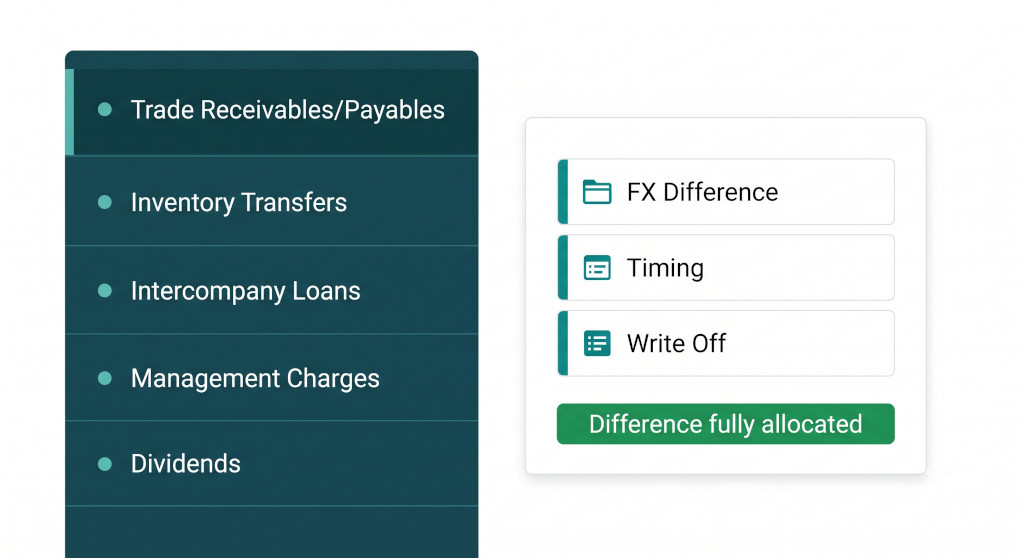
Intercompany eliminations are rarely straightforward. When balances between entities do not match perfectly — because of timing, exchange rate movements, or accounting treatment differences — the finance team needs to decide how to handle the gap. Until now, BrizoConsol recorded these as FX differences by default. That worked for many cases, but not all.
This update introduces two significant changes to how intercompany eliminations work in BrizoConsol: a reorganised sidebar that separates eliminations by type, and a flexible difference treatment workflow that gives you full control over how any outstanding balance is handled and documented.
Eliminations Organised by Type

The Intercompany section of the navigation sidebar now organises elimination entries by category, so you can work through each type of intercompany balance systematically rather than managing everything from a single list. The categories are:
Intercompany eliminations without the manual work.
BrizoConsol identifies and eliminates intercompany balances automatically at consolidation.
- Trade Receivables / Payables — intercompany debtors and creditors
- Inventory Transfers — stock movements between entities
- Unrealised Profit — internal margin on inventory not yet sold externally
- Intercompany Loans — balances on intercompany lending arrangements
- Management Charges — fees charged between group entities
- Dividends — intercompany dividend flows
- Fixed Assets — asset transfers between entities
- Other Income / Expenses — any other intercompany income or cost flows
- Other Balances — catch-all for balance sheet items not covered above
Each category opens its own elimination view, showing only the entries relevant to that type. This makes it much easier to divide the month-end intercompany work between team members, audit a specific category of eliminations, or focus on the areas where differences are most likely to arise.
Working through eliminations category by category — rather than as one undifferentiated list — also makes it easier to spot patterns. If your Management Charges category consistently has timing differences, that is a signal worth investigating at the entity level.
Flexible Difference Treatments — Three Options, Not One
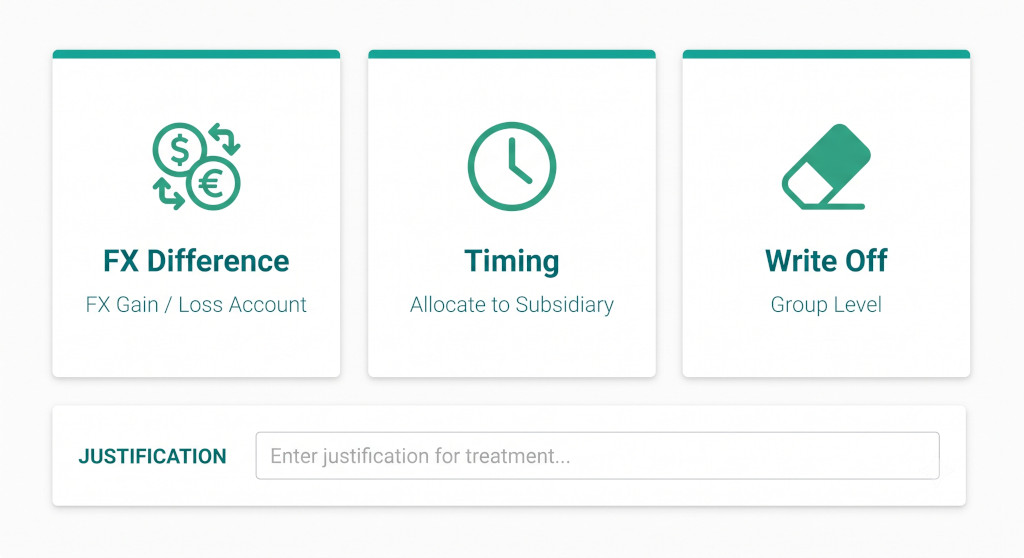
When an intercompany elimination has a difference between the debit and credit sides, BrizoConsol now asks you how you want to treat it — and gives you three options. You can add as many treatment lines as needed to fully allocate the difference, mixing types where appropriate.
Treatment 1 – FX Difference
The difference is a currency translation variance. It is posted to an FX gain or loss account at group level — the standard treatment for exchange rate movements between entities transacting in different currencies.
Treatment 2 – Timing
The difference exists because one entity has recorded the transaction in a different period. The variance is allocated to a subsidiary, leaving it to be resolved when the matching entry is posted in the correct period.
Treatment 3 – Write Off
The difference is immaterial or irrecoverable and is written off at group level. This closes the elimination without requiring a corresponding entry in either entity’s books.
Once all treatment lines are entered, the panel shows a live running total of what has been Allocated and what is Remaining. When Remaining reaches zero, the status updates to Difference fully allocated and you can confirm the elimination entry.
Note: BrizoConsol will warn you if a currency difference is above materiality and has been treated as an FX difference. Review these warnings carefully — a large FX treatment may warrant a conversation with the relevant entity’s finance team before confirmation.
Justification Field
Each treatment line now includes a Justification field. Use this to document why a particular treatment was chosen — for example, “timing difference: invoice raised in July, received by counter-party in August” or “FX variance on USD/SGD settlement, below materiality threshold”. This creates an audit trail directly within the elimination entry, without needing to maintain a separate working paper.
The justification is visible in the elimination record after confirmation, making it straightforward to review decisions during audit or when revisiting prior-period entries.
BrizoElim: Same Treatment Options, Same Control
BrizoElim — BrizoConsol’s suggested elimination engine — scans your intercompany accounts, detects uneliminated balances, and proposes elimination entries for your review. This update extends the same difference treatment workflow to BrizoElim suggestions.
When BrizoElim detects a difference on a suggested elimination, it will automatically propose an FX treatment where applicable. You can accept that suggestion, change the treatment type, or add additional treatment lines before confirming. You also choose the elimination type for each BrizoElim entry, ensuring it is categorised correctly in the relevant sidebar section.
This means the manual and automated elimination workflows now behave consistently — the same options, the same flexibility, the same audit trail.
For groups with foreign-currency subsidiaries, BrizoElim’s ability to detect and pre-populate FX difference treatments on intercompany receivable/payable mismatches saves significant time at month-end. Review the suggested amount, confirm the account, add a justification, and move on.
Where to Find These Features
Navigate to Intercompany in the left sidebar and select the relevant elimination category. For BrizoElim suggestions, use the BrizoElim button at the bottom of any elimination list page to scan for missing eliminations and review the proposed entries.
The difference treatment panel appears automatically whenever an elimination entry has an unallocated difference — you do not need to enable it separately.
New to BrizoConsol?
Automate your intercompany eliminations across all entity types, handle FX differences correctly, and close your consolidated accounts faster every month. Start Free Trial