Intragroup Restructuring: How to Account for Common Control Transactions When IFRS 3 Doesn’t Apply
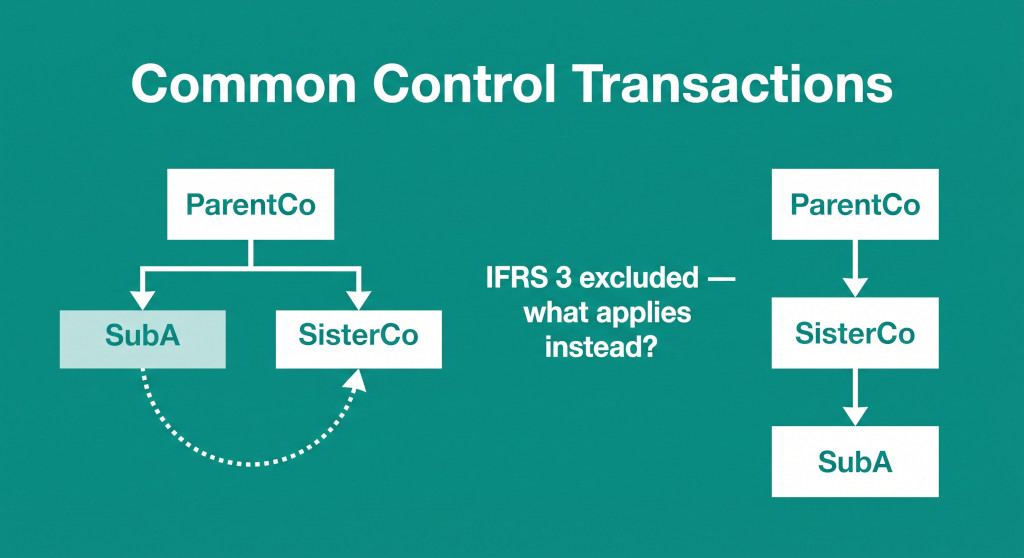
David had been CFO of the retail group for four years when the board approved a restructuring. For commercial and tax reasons, the group wanted to move its property subsidiaries under a new intermediate holding company, separate from its trading subsidiaries. A new HoldCo would be incorporated, and the three property subsidiaries — all currently owned directly by the parent — would be transferred to HoldCo. Nothing was changing economically: the same assets, the same operations, the same ultimate ownership. Only the legal structure was being altered.
David knew that IFRS 3 applied to business combinations. He assumed he would need to do purchase price allocations, identify fair values, and potentially recognise goodwill on the property subsidiaries. His advisers told him otherwise. This was not an IFRS 3 transaction. All entities were under common control before and after the restructuring — the ultimate parent owned them all throughout. IFRS 3.2(c) explicitly excludes business combinations under common control from its scope.
The problem David then faced was harder in a different way. IFRS excludes these transactions from IFRS 3. But it provides no alternative standard to apply instead. The IASB has been working on a standard for business combinations under common control for years, but has not yet issued one. In the absence of specific guidance, David’s group had to develop and apply an accounting policy under IAS 8.10-12 — choosing between a book value approach and a fair value approach, applying it consistently, and documenting why the chosen method provided reliable and relevant information. Most groups, and most auditors, default to book value for purely intragroup restructuring.
Stop building consolidations in spreadsheets.
BrizoConsol automates multi-entity consolidation — setup in minutes, reports the same day.
What Makes a Transaction “Under Common Control”
A business combination is under common control when all of the combining entities or businesses are ultimately controlled by the same party or parties, both before and after the combination, and that control is not transitory. In David’s case, the ultimate parent owned all entities throughout. Inserting HoldCo between the parent and the property subsidiaries does not change who is ultimately in control. The restructuring is entirely within the group.
Common control transactions include: inserting a new holding company above existing subsidiaries, transferring a subsidiary from one group entity to another, merging two subsidiaries within the same group, and hiving up or hiving down operations between related entities. All of these share the same feature: from the perspective of the ultimate parent’s group, the assets and operations in question remain within the consolidated boundary throughout. Nobody acquires anything from outside the group.
The exclusion from IFRS 3 applies when control is held by the same party — including individuals and their families — both before and after the combination, and that control is not transitory. Temporary changes in structure that are part of a transaction leading to an external sale may not qualify as common control for this purpose.
The Two Methods and When Each Is Used
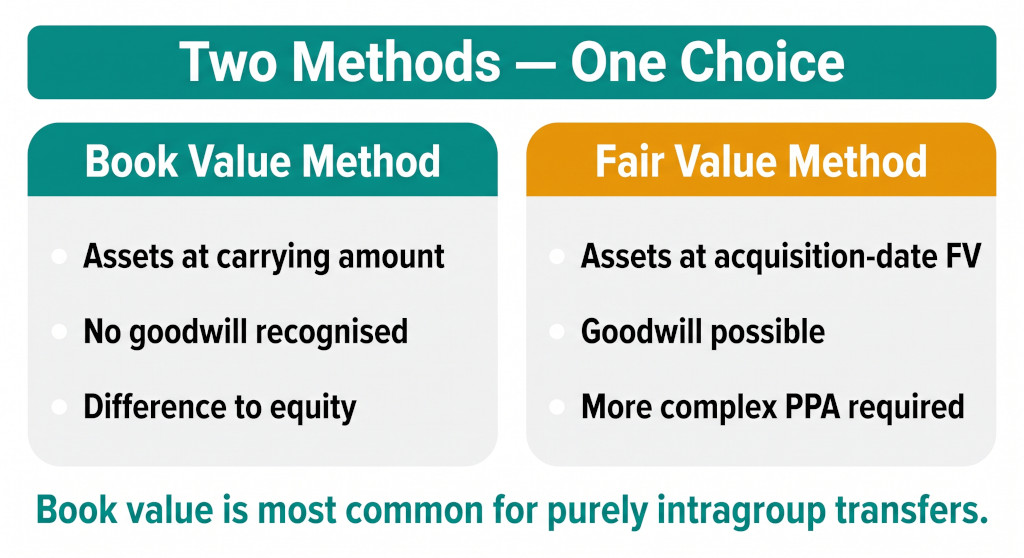
Because IFRS provides no specific standard for these transactions, groups look to IAS 8.10-12, which requires the application of an accounting policy that results in information that is relevant and reliable. In practice, two approaches dominate.
The book value method (sometimes called the predecessor method or the pooling-of-interests method) recognises the transferred entity’s assets and liabilities at their carrying amounts in the consolidated accounts at the date of transfer. No fair value adjustment is performed. No goodwill is recognised. If there is a difference between the consideration paid and the carrying amount of the net assets transferred, that difference goes to equity — typically a common control reserve — rather than to the income statement.
The fair value method applies the acquisition method as if IFRS 3 were applicable: assets and liabilities are recognised at fair value on the transfer date, and any excess of consideration over net assets is recognised as goodwill. This method is more burdensome and more controversial for purely intragroup transactions, but some groups prefer it when the restructuring involves significant non-controlling interests and they want the accounts to reflect fair values for the benefit of minority shareholders.
For the vast majority of intragroup restructurings — particularly in wholly-owned groups — the book value method is the appropriate and defensible choice. Auditors generally accept it. It avoids the creation of “artificial” goodwill (goodwill arising from an internal transfer between entities that were already in the same group), and it produces consolidated accounts that are consistent with the economic reality that nothing has changed.
The IASB’s current project: The IASB is developing a standard on business combinations under common control. Its tentative decisions lean towards book value for transactions that do not affect non-controlling interests, and acquisition method for transactions that do affect NCI. Until a final standard is issued, IAS 8 applies and the book value method remains the dominant practice for wholly-owned group restructurings.
Scenario One: Moving a Subsidiary Sideways
ParentCo owns SubA and SisterCo directly (both 100%). The group decides to move SubA under SisterCo. SisterCo “acquires” SubA from ParentCo for a consideration of £2,000,000 — the carrying value of SubA’s net assets in the consolidated accounts. SisterCo settles by creating an intercompany payable to ParentCo.
| Item | Before restructuring | After restructuring |
|---|---|---|
| ParentCo owns | SubA (directly) + SisterCo | SisterCo only (directly) |
| SisterCo owns | Nothing | SubA |
| SubA’s net assets (consolidated carrying value) | £2,000,000 | £2,000,000 |
| Intercompany payable (SisterCo → ParentCo) | £0 | £2,000,000 |
Under the book value method, SisterCo records the investment in SubA at the consideration paid — £2,000,000, which equals SubA’s carrying value. No goodwill arises. At consolidated level, the investment in SubA is eliminated against SubA’s net assets in the usual way. The intercompany payable (SisterCo to ParentCo) is eliminated against ParentCo’s intercompany receivable. The consolidated balance sheet is identical to what it showed before the restructuring — same assets, same liabilities, same equity.
SisterCo’s entity-level journal (book value method)
| Account | Dr | Cr |
|---|---|---|
| Investment in SubA | £2,000,000 | |
| Intercompany payable to ParentCo | £2,000,000 |
SisterCo records the investment at the book value consideration. No goodwill or purchase price allocation is performed. The payable will be settled in cash or converted to a loan on agreed terms.
ParentCo’s entity-level journal
| Account | Dr | Cr |
|---|---|---|
| Intercompany receivable from SisterCo | £2,000,000 | |
| Investment in SubA (at cost in ParentCo’s books) | £2,000,000 |
ParentCo derecognises its investment in SubA. If the cost of the investment in ParentCo’s books differs from the consideration received, the difference is credited (or debited) to a common control reserve in equity — NOT to the income statement. No disposal gain or loss is recognised.
At consolidation, two eliminations clear the restructuring entirely:
| Account | Dr | Cr |
|---|---|---|
| SubA’s equity (net assets) | £2,000,000 | |
| Investment in SubA (SisterCo) | £2,000,000 |
Standard elimination of investment against SubA’s equity — identical in form to any other subsidiary elimination.
| Account | Dr | Cr |
|---|---|---|
| Intercompany payable (SisterCo) | £2,000,000 | |
| Intercompany receivable (ParentCo) | £2,000,000 |
Eliminates the intercompany consideration, per the standard intercompany loan elimination. The consolidated balance sheet is unchanged.
Scenario Two: Inserting a New Holding Company
The second common scenario is inserting a new intermediate holding company above existing subsidiaries. ParentCo currently owns SubA, SubB, and SubC directly. The group incorporates a new NewHoldCo, which ParentCo capitalises with cash of £5,000,000. NewHoldCo uses that cash to acquire SubA, SubB, and SubC from ParentCo at their respective book values.
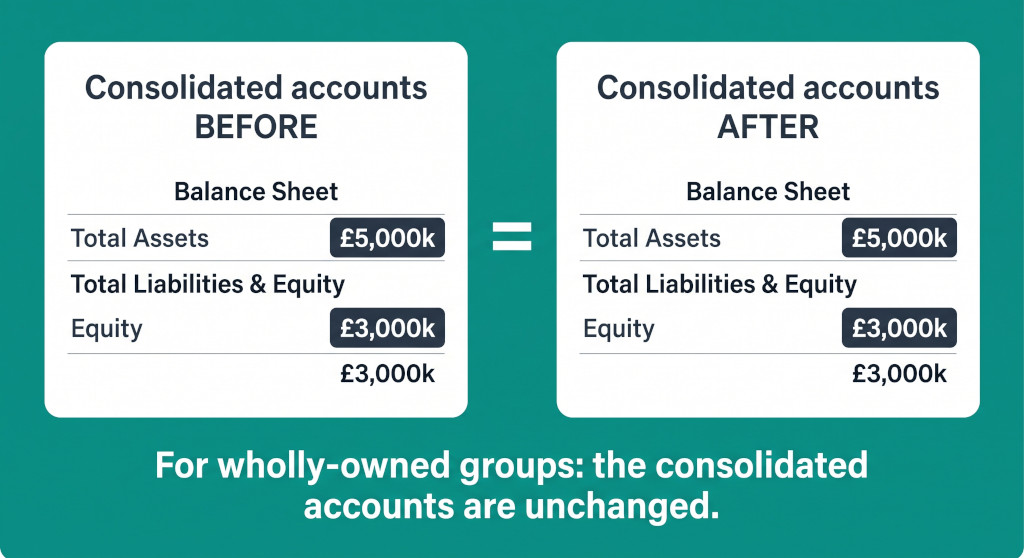
The mechanics at entity level involve NewHoldCo recording investments in each subsidiary (at book value), and ParentCo replacing its direct investments in three subsidiaries with a single investment in NewHoldCo plus an intercompany receivable. At consolidated level, NewHoldCo is simply a new entity in the group that consolidates in the normal way. SubA, SubB, and SubC continue to be consolidated line by line. The consolidated balance sheet before and after is identical in substance — only the legal ownership chain has changed.
The one addition is that NewHoldCo’s investment in each subsidiary eliminates against each subsidiary’s equity, as with any other subsidiary elimination. NewHoldCo’s own equity (the £5,000,000 capitalisation from ParentCo) eliminates against ParentCo’s investment in NewHoldCo. All intercompany cash flows from the capitalisation and subsidiary acquisitions eliminate. Nothing survives into the consolidated accounts except the underlying assets, liabilities, income, and expenses of SubA, SubB, and SubC — exactly as before.
When It Does Affect the Consolidated Accounts
For wholly-owned groups, common control restructurings typically leave the consolidated accounts unchanged. The complexity increases significantly when non-controlling interests are involved.
If SubA has a 20% NCI and is transferred from ParentCo to SisterCo (which is 100% owned), the NCI’s interest in SubA is unchanged — they still hold 20% of SubA. But the NCI now holds its 20% through a different legal structure (via SisterCo rather than directly via ParentCo). The consolidated accounts must still show the NCI balance correctly, and the SOCE NCI column must reflect any consideration attributable to the NCI’s stake.
If the consideration paid for the transfer includes an element attributable to the NCI (for example, if SisterCo pays full fair value for SubA, which includes the value attributable to the minority shareholders), the transaction can affect how NCI is measured at consolidated level. This is one area where the book value vs fair value method choice has a direct consolidated impact, and where specialist advice is worth taking before the restructuring proceeds.
Common control transactions can also affect consolidated accounts when:
An entity records a gain on disposal at entity level that needs to be eliminated at consolidation. If ParentCo sells SubA to SisterCo at fair value (£3,000,000) rather than book value (£2,000,000), ParentCo records a £1,000,000 gain. At consolidated level, that gain must be eliminated — it is an intercompany transaction, and the additional £1,000,000 paid by SisterCo (now shown in its investment in SubA) must also be eliminated to avoid inflating consolidated assets. For groups using the book value method, pricing the intercompany transfer at book value avoids this complication entirely.
Entity-level gains on common control disposals are eliminated at consolidation. If the transfer price differs from the book value of the net assets being transferred, the entity recording the gain or loss is correct in its own accounts. At consolidated level, the transaction must still be eliminated in full. The consolidated accounts should show no gain, no additional assets, and no additional goodwill from a common control restructuring using the book value method.
Restructuring your group? Keep the consolidation current
BrizoConsol updates your consolidation structure as entities are added, removed, or re-parented — without losing historical data. See how it handles group restructuring for your specific setup. See It In Action
Developing and Documenting Your Accounting Policy
Because there is no specific IFRS standard for common control transactions, the group must formally select and document its accounting policy under IAS 8.10-12. The policy should state: which method is applied (book value or fair value), how “common control” is defined for the group’s purposes, how differences between consideration and book value are treated in entity and consolidated accounts, and how the policy will be applied consistently to future transactions of the same type.
The documentation matters. Auditors and regulators will look for evidence that the policy was chosen deliberately, applied consistently, and produces information that is reliable and relevant. A policy that was applied one way in Year 1 and a different way in Year 3 without good reason is harder to defend than a consistently applied book value approach from the outset.
The policy should also address comparatives. Under the book value method, some groups restate prior period comparative information as if the restructured group structure had always existed — presenting a “pooled” view that makes year-on-year comparisons consistent. Others present only the post-restructuring period under the new structure, with a note explaining the change. Either approach can be supportable; what matters is consistency and disclosure.
How This Interacts With the Group’s Existing Consolidation
After a common control restructuring, the group’s consolidation working papers need to be updated to reflect the new legal structure. The investment eliminations change — SubA is now eliminated against SisterCo’s investment, not ParentCo’s. Any pre-existing goodwill, PPA adjustments, or intercompany eliminations relating to SubA need to be reviewed in the context of its new position in the group. For consolidating a subsidiary after a change in ownership, the key question is always whether the change in ownership is within the group (common control — no economic change) or involves an external party (acquisition or disposal — economic change requiring full IFRS 3 or disposal accounting).
The group’s consolidated retained earnings reconciliation should be updated immediately after the restructuring. The common control reserve — used to absorb any difference between consideration and book value at entity level — is a component of group equity that must be tracked and reconciled. If the group later brings in an external investor or lists, this reserve will need to be clearly understood and explained.
Checklist: Common Control Transaction Accounting
- Confirm the transaction qualifies as common control. The same ultimate party must control all entities before and after the combination, and control must not be transitory. Document the ownership chain on both dates.
- Select and document your accounting policy under IAS 8. State whether you are using the book value (predecessor) method or the fair value (acquisition) method, and why that method produces reliable and relevant information for your group.
- Price intercompany transfers at book value if using the book value method. Pricing at fair value introduces entity-level gains that must be eliminated at consolidation and complicates the working papers unnecessarily for a purely intragroup restructuring.
- Record any difference between consideration and book value in a common control reserve — not in the income statement. Neither a gain nor a loss should be recognised in P&L for a common control transaction under the book value method.
- Update the consolidation structure immediately. Change the investment elimination entries to reflect the new ownership chain. Check that all pre-existing PPA adjustments, goodwill balances, and intercompany eliminations have been correctly reassigned.
- Eliminate all intercompany consideration. The payment or loan created by the transfer is an intercompany balance and must eliminate in the consolidated accounts. Treat it as a standard intercompany loan elimination.
- Eliminate any entity-level gains at consolidation. If a transfer price other than book value was used and an entity recorded a gain, eliminate it fully in the consolidation working papers. No gain should appear in the consolidated income statement.
- Address NCI carefully if non-controlling interests exist in any entity involved. The restructuring should not change what the NCI is economically entitled to. If it does, seek specialist advice before proceeding.
- Consider comparative presentation. Decide whether prior period comparatives will be restated under the pooled structure or presented as originally reported, and disclose the approach clearly in the notes.
Group structure changed? Update your consolidation without starting from scratch
BrizoConsol lets you re-parent entities, add new holding companies, and update the consolidation structure mid-year — preserving all historical data and eliminations. Start a free trial today. Start Free Trial