Management Consolidation vs. Statutory Consolidation: Why They’re Different and Which One Your Group Needs
At a recent board meeting, a director of a four-entity Australian property group asked the CFO whether the consolidated accounts were ready for the bank’s annual review. The CFO said yes — she had been producing a consolidated P&L and balance sheet every month for the past two years. The bank’s representative reviewed the documents, then asked a question that caught everyone off guard: “Has this been prepared in accordance with AASB 10 and AASB 3? Is goodwill recognised? Has the minority shareholder’s interest been separately disclosed?”
The CFO’s monthly consolidation was accurate, internally consistent, and genuinely useful for management. It included all four entities, eliminated most intercompany transactions, and gave the board a reliable view of group revenue, cost structure, and net debt. But it was not a statutory consolidated financial statement. It had not recognised the goodwill from the original acquisition of two subsidiaries, had not calculated the non-controlling interest on the 75%-owned entity, and had not applied AASB 121 to the NZ property entity. It was — without anyone intending this — a management consolidation masquerading as statutory accounts.
This distinction matters more than most finance teams realise, and it matters in both directions. Some groups overestimate what their management consolidation is — assuming it satisfies audit, regulatory, or banking requirements when it does not. Others underestimate it — assuming a statutory consolidation is required when internal management accounts would be sufficient for their actual reporting obligation. This guide explains the difference and how to determine which one your group needs.
Stop building consolidations in spreadsheets.
BrizoConsol automates multi-entity consolidation — setup in minutes, reports the same day.
What a Management Consolidation Is
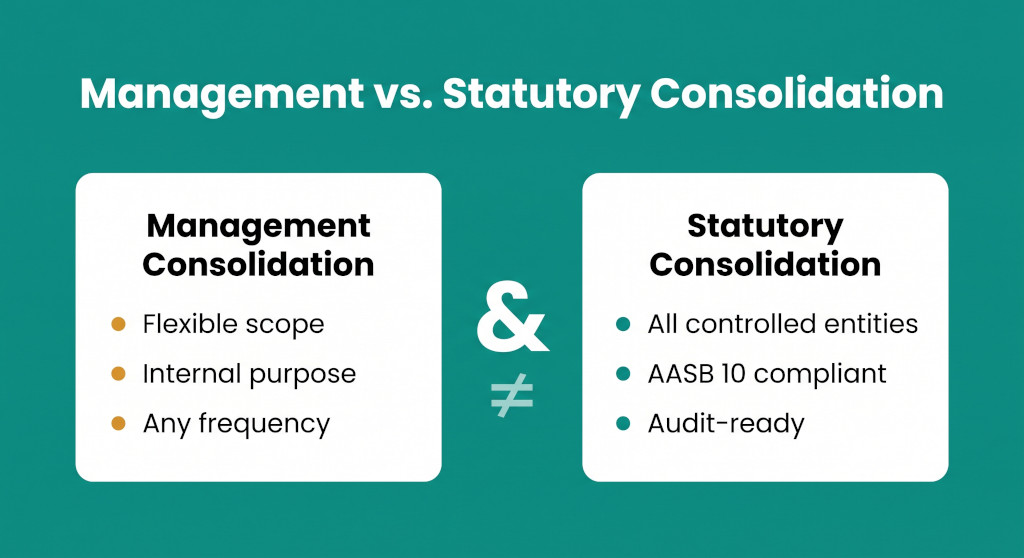
A management consolidation is a financial summary prepared for internal purposes that combines the accounts of two or more entities in a group. It typically includes a combined P&L and balance sheet, intercompany eliminations where material, and a reporting period aligned to the group’s internal calendar — often monthly or quarterly. The people who receive it are usually the board, senior management, and sometimes lenders or investors who have a close enough relationship with the group to accept internal accounts as sufficient.
The defining characteristics of a management consolidation are flexibility and purpose. The preparer decides which entities to include. They decide which intercompany transactions to eliminate and at what level of rigour. They decide what accounting bases to apply — some management consolidations use cash accounting for simplicity; others use accrual but skip formal deferred tax calculations. The format can be whatever is most useful to the audience. There is no mandatory standard that governs what a management consolidation must contain or how it must be presented.
This flexibility is a feature, not a flaw. A well-designed management consolidation can be produced quickly, gives management a reliable view of the group’s operational performance, and can be tailored to the specific questions a board is trying to answer — without the disclosure overhead of a statutory report. The problem arises when a management consolidation is treated as if it were something it is not.
What a Statutory Consolidation Is
A statutory consolidated financial statement is a set of accounts prepared in accordance with accounting standards and, where applicable, the requirements of the Corporations Act 2001 or equivalent regulation. For Australian entities, the relevant standard is AASB 10 Consolidated Financial Statements, which defines which entities must be consolidated (all entities under the control of the parent), how control is assessed, and the general framework for the consolidation. The specific accounting for business combinations (AASB 3), income taxes (AASB 112), foreign currency translation (AASB 121), and other areas must also be applied.
A statutory consolidation has no flexibility on scope: if the parent controls an entity under AASB 10, that entity must be consolidated — regardless of its size, whether it is profitable, whether it has been dormant all year, or whether its inclusion would complicate the presentation. The eliminations must be complete and correct. Goodwill must be recognised, calculated, and tested for impairment annually. Non-controlling interests must be measured and separately presented. Deferred tax on consolidation adjustments must be calculated. The disclosures — related party transactions, commitments, contingent liabilities, significant accounting policies — must comply with the applicable standards.
Statutory consolidated accounts are typically prepared annually and subject to audit. They are the version of the group’s accounts that is filed with ASIC where required, provided to lenders under covenant obligations, and reviewed by auditors. They are the authoritative statement of the group’s financial position and performance under Australian law and accounting standards.
A management consolidation can be excellent, accurate, and genuinely informative — and still not be a statutory consolidated financial statement. The question is not whether the management consolidation is good. The question is whether the purpose it is being used for requires a statutory consolidation instead.
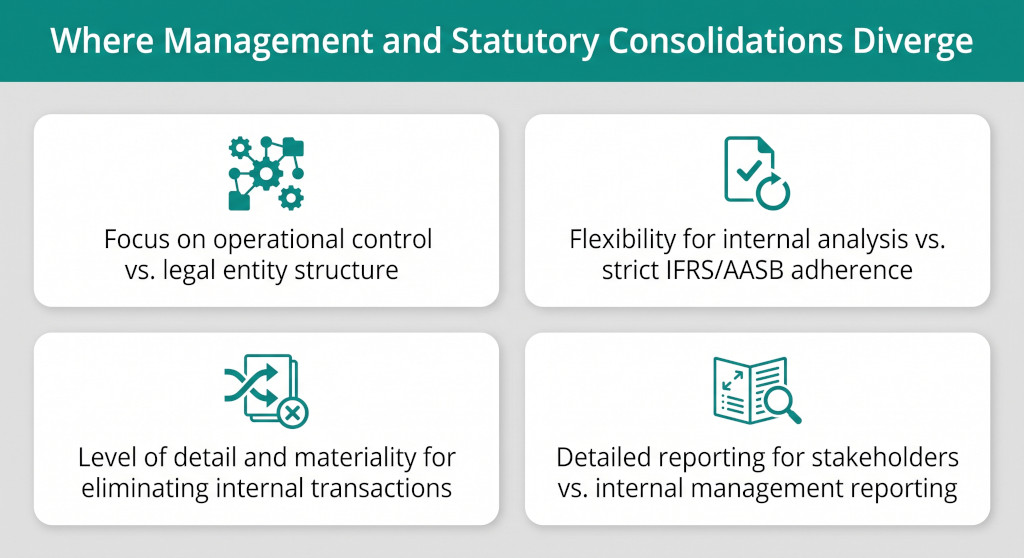
The Four Points Where Management and Statutory Consolidations Diverge
1. Scope of Entities Included
A management consolidation might exclude entities for practical reasons — a dormant holding company with no activity, an early-stage startup whose results are immaterial, a foreign subsidiary that is difficult to roll up on a monthly basis. A statutory consolidation cannot do this. AASB 10 requires that all controlled entities are consolidated. The materiality principle applies to disclosures, not to whether an entity is included in the consolidation scope.
A management consolidation might also include entities that would not be consolidated for statutory purposes. Some groups proportionally consolidate a joint venture — including 50% of its revenue and costs — for management reporting purposes, because that reflects the economic reality of the arrangement for the management audience. For statutory purposes, a joint venture is equity-accounted (not consolidated), meaning only one line on the P&L (share of profit) and the investment balance on the balance sheet. The two presentations tell very different stories about the group’s revenue scale and asset base.
2. Accounting Standard Compliance
A management consolidation can use simplified or adapted accounting. Depreciation might be estimated rather than calculated on a granular asset register. Accruals might be rough estimates rather than formally computed. Deferred tax might be excluded entirely. Revenue might be recognised on a cash basis rather than under AASB 15.
A statutory consolidation must apply the full suite of relevant accounting standards consistently and correctly. Every acquisition must be accounted for under AASB 3 — with a formal purchase price allocation, goodwill calculation, and fair value assessment of identifiable assets and liabilities acquired. Deferred tax on acquisition-date adjustments must be recognised under AASB 112. Foreign currency subsidiaries must be translated under AASB 121 using the correct rates for balance sheet, P&L, and equity items respectively. None of these are optional.
3. Intercompany Elimination Rigour
A management consolidation often eliminates the most visible intercompany flows — management fees, intercompany loans, large intercompany sales — while leaving smaller or more complex eliminations incomplete. This is a reasonable prioritisation for internal reporting where the audience understands the limitations.
A statutory consolidation requires complete elimination of all intercompany transactions and balances. Every intercompany revenue and cost. Every intercompany asset and liability. Every intercompany dividend. The unrealised profit on any intercompany asset transfer. The deferred tax on every elimination. Any incomplete elimination will result in an audit qualification or adjustment. For the sequencing framework that applies to both types of consolidation, see Why You Should Never Start Intercompany Eliminations Before Reconciling Balances.
4. Disclosure Requirements
A management consolidation has no mandatory disclosure requirements. It can be as brief or as detailed as the preparer chooses. A statutory consolidation must include the disclosures required by each applicable standard — AASB 10 disclosures about the basis of consolidation and significant judgements in assessing control, AASB 3 disclosures about business combinations during the period, AASB 112 disclosures about deferred tax, AASB 121 disclosures about foreign currency translation, related party disclosures under AASB 124, and more. The disclosure burden of a statutory consolidation is substantially higher than most management consolidations carry.
Ready to Upgrade From Management Consolidation to Statutory Accounts?
BrizoConsol produces AASB 10-compliant consolidations with full intercompany eliminations, goodwill tracking, NCI calculations, and multi-currency translation — giving you statutory-quality consolidated accounts from the same process that produces your monthly management pack. See It In Action
Which One Does Your Group Actually Need?
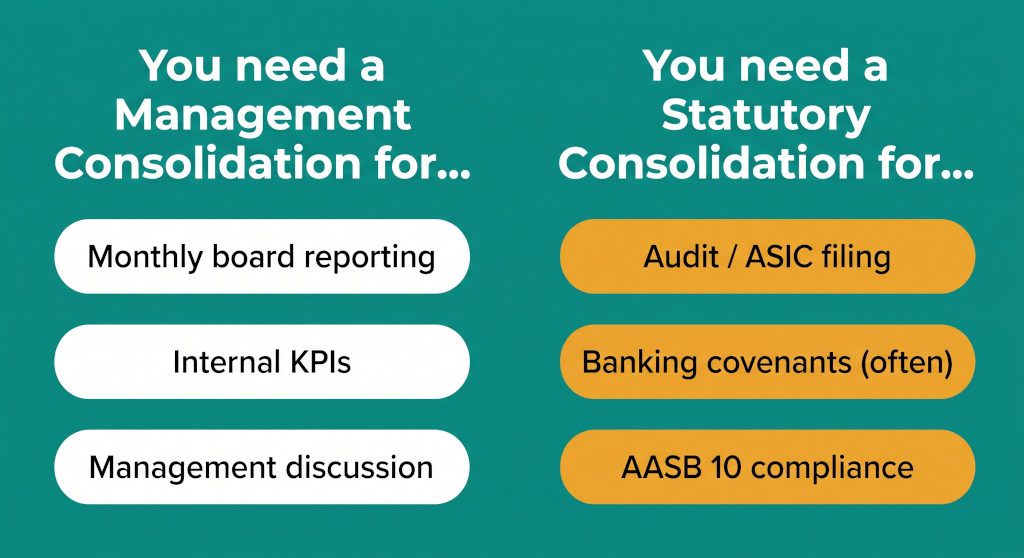
The answer depends on what the consolidated accounts are being used for. Many groups need both: a management consolidation for internal reporting purposes, and a statutory consolidation for audit, regulatory, and lender purposes. The key is knowing which version is required for each use case and not allowing the management consolidation to substitute for the statutory one where the latter is required.
A management consolidation is typically sufficient for: monthly or quarterly board reporting, internal KPIs and performance monitoring, management discussion and analysis, and informal investor updates where the audience understands they are receiving internal accounts.
A statutory consolidation is required for: annual accounts that will be audited, ASIC filing where required under the Corporations Act, banking covenant compliance (most covenant packages specify that ratios must be tested against accounts prepared in accordance with applicable accounting standards), investor reporting under subscription agreements or shareholders’ deeds that specify IFRS or AASB compliance, and any reporting obligation where a third party has specified that the accounts must comply with a particular standard.
| Dimension | Management Consolidation | Statutory Consolidation |
|---|---|---|
| Entity scope | Finance team’s discretion — can include or exclude entities | All controlled entities under AASB 10 — no exceptions |
| Accounting basis | Flexible — simplified, cash, or management-adjusted | Full AASB standards (AASB 3, 10, 112, 121, etc.) |
| Goodwill | Optional — often omitted | Mandatory — must be calculated, recognised, tested annually |
| Non-controlling interest | Optional — often presented as “minority” or omitted | Mandatory — presented separately in equity and P&L |
| Deferred tax | Often excluded or simplified | Full AASB 112 application required |
| Foreign currency translation | Often simplified — one rate applied | AASB 121 — closing rate (B/S), average rate (P&L), historical (equity), with CTA in OCI |
| Intercompany eliminations | Major items — may be incomplete | Complete — all intercompany transactions and balances |
| Disclosures | Preparer’s choice | Full standard disclosures required |
| Frequency | Monthly or quarterly | Typically annual |
| Audit | Not required | Required for many groups |
How Groups Get This Wrong — In Both Directions
Overestimating the management consolidation is the more common mistake. Groups invest significant effort in their monthly management consolidation, the numbers are stable and reliable, and over time there is a tendency to assume this process satisfies all reporting obligations. It often does not. The exclusion of goodwill, the simplified deferred tax, the incomplete eliminations, and the non-standard entity scope mean the management consolidation will differ from the statutory accounts — sometimes materially. Discovering this at audit, or when a banker asks a pointed question, is a poor time to find out.
Underestimating the management consolidation is less common but also happens. Some groups produce a full statutory-quality consolidation every month when their reporting obligations would be satisfied by a simpler, faster management pack. The overhead of maintaining goodwill impairment models, deferred tax schedules, and full AASB 121 translations on a monthly basis adds cost and time that may not be necessary for internal management purposes. Knowing which level of rigour each output requires allows the finance team to apply appropriate effort to each.
Banking covenants require careful reading. Many loan agreements specify that financial covenants (leverage ratios, interest cover tests, net asset tests) must be tested using accounts prepared in accordance with “generally accepted accounting principles” or “Australian Accounting Standards.” If your covenant package uses this language, your management consolidation — even if accurate and detailed — may not satisfy the test if it omits goodwill, excludes entities, or uses non-standard accounting bases. Review the covenant definition with your legal team before relying on management accounts for compliance testing.
Building a Process That Serves Both Purposes
The most efficient approach for groups that need both types is to build a consolidation process that produces the statutory-quality output as its primary deliverable, and then derives the management accounts from it — rather than running two separate processes. If the underlying data, eliminations, and accounting are correct at the statutory level, the management pack can be extracted from the same working papers with adjustments for format and frequency. The reverse — upgrading a management consolidation to statutory quality at year end — typically requires significant rework and is a common source of delay in audit-ready account preparation.
For groups that currently have only a management consolidation process and are facing a first statutory audit or a new banking requirement, the starting point is identifying the gaps: which entities are currently excluded, what goodwill has not been recognised, whether deferred tax is missing, and whether the foreign currency translation is correct. Each of those gaps must be addressed before the accounts will satisfy a statutory audit. The earlier this assessment is done, the less disruptive the catch-up process is. For a guide to building the right consolidation process from the beginning, see How to Review Consolidated Financial Statements Before Board Reporting.
Need Consolidated Accounts That Satisfy Both Your Board and Your Auditor?
BrizoConsol produces AASB 10-compliant consolidated financial statements with full intercompany eliminations, goodwill and NCI tracking, multi-currency translation, and deferred tax — every period, from your existing accounting software. One process, both outputs. Start Free Trial