MYOB Intercompany Loans: Why the Balances Don’t Match Between MYOB Companies — and How to Reconcile Before You Eliminate
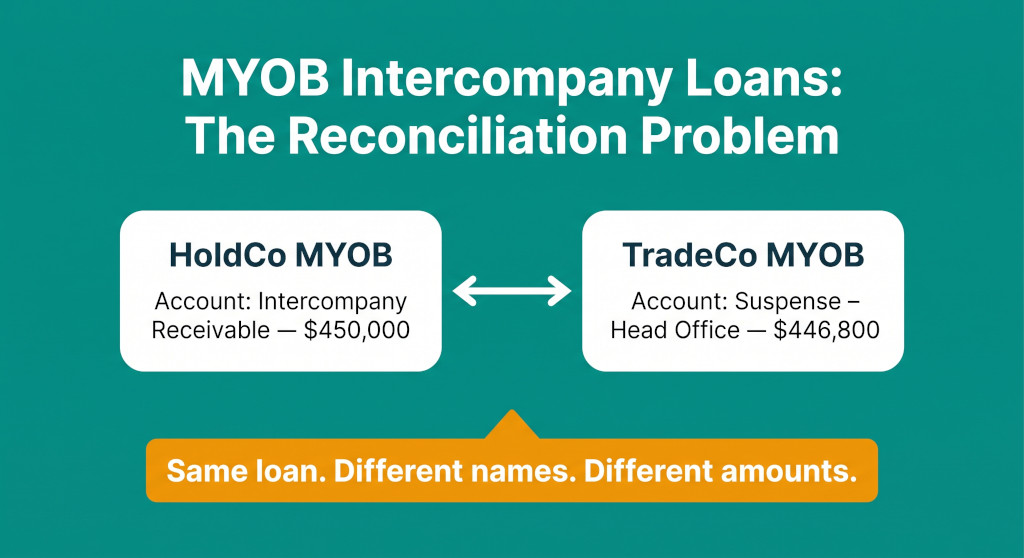
Rachel is the finance manager for a Brisbane-based construction group. The group operates three entities: a HoldCo and two trading subsidiaries, all running on MYOB Business. Last financial year, HoldCo advanced $450,000 to TradeCo 1 to fund a large contract. HoldCo recorded this in MYOB as “Intercompany Receivable — TradeCo 1.” TradeCo 1 recorded the same amount in its MYOB file as “Suspense — Head Office.”
Ten months later, Rachel sits down to prepare the annual consolidated accounts. She opens both MYOB files to locate the intercompany loan for elimination. HoldCo’s MYOB shows a receivable of $450,000. TradeCo 1’s MYOB shows a payable of $446,800. There is a $3,200 difference and the accounts don’t share the same name, so Rachel can’t even start the elimination until she has worked out what each side actually represents and why they’re different.
This problem — mismatched account names, inconsistent classifications, and amounts that don’t reconcile — is the most common intercompany loan problem in MYOB groups. It’s not a software glitch. It’s the predictable result of each MYOB file being set up independently by different people at different times, with no coordination on how intercompany balances should be labelled or maintained. And because MYOB Business and MYOB AccountRight don’t have any built-in intercompany synchronisation, the two sides of every loan grow further apart with every transaction unless someone actively maintains a reconciliation register.
Consolidate your MYOB entities in minutes.
BrizoConsol connects to MYOB and automates your group financial statements.
The Three Sources of MYOB Intercompany Loan Mismatches
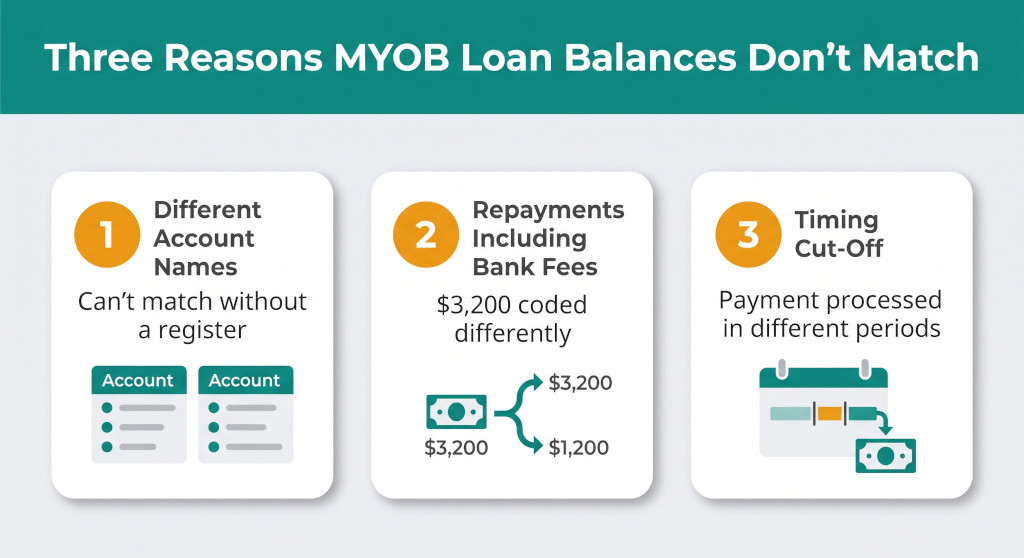
Before attempting to post the elimination entry, Rachel needs to understand why the two balances differ. In MYOB groups, there are three distinct sources of intercompany loan mismatches, and each requires a different fix.
Source 1: Different Account Names and Classifications
MYOB Business allows each organisation to build its own chart of accounts from scratch. The result, in groups that grew organically rather than being set up centrally, is that the same intercompany loan is often recorded under completely different account names — and sometimes in completely different balance sheet classifications. HoldCo uses “Intercompany Receivable” (a current asset). TradeCo 1 uses “Suspense — Head Office” (which may be classified as a current liability, a non-current liability, or even a current asset depending on how the bookkeeper set it up).
This naming mismatch doesn’t cause an accounting error within either MYOB file — both entities have recorded a real transaction correctly in their own context. But it makes the intercompany reconciliation invisible unless someone manually maintains a register that links the two accounts. Without a register, the junior accountant preparing the consolidation has no systematic way to confirm that “Intercompany Receivable — TradeCo 1” in HoldCo’s MYOB is the same loan as “Suspense — Head Office” in TradeCo 1’s MYOB. They might even eliminate the wrong accounts.
Source 2: Repayments Coded With Bank Fees Included
In Rachel’s case, TradeCo 1 repaid $150,000 of the loan during the year. When processing the repayment in MYOB, the bookkeeper saw the bank transaction of $149,800 hit the account — the bank had deducted $200 in transfer fees. Rather than splitting the entry ($149,800 to the intercompany loan account, $200 to bank charges), the bookkeeper posted the entire $149,800 against “Suspense — Head Office.” The result: TradeCo 1’s MYOB records a $200 underpayment on the loan that HoldCo didn’t know about and has not recorded. This pattern — small amounts absorbed into repayments — repeats across the year, which is why TradeCo 1’s balance is $446,800 rather than $450,000.
The fix here is a correction entry in TradeCo 1’s MYOB file before any consolidation adjustment is posted:
Correction entry — TradeCo 1 MYOB (post before consolidation)
| Account | Dr | Cr |
|---|---|---|
| Bank Charges / Finance Costs | $3,200 | |
| Suspense — Head Office (Intercompany Loan Payable) | $3,200 |
This corrects TradeCo 1’s MYOB file so the loan payable reflects the full $450,000 outstanding. Bank fees of $3,200 absorbed into prior repayments are reclassified to Finance Costs. After this entry, both MYOB files show $450,000 and the elimination can proceed.
Source 3: Timing Cut-Off
The third source is familiar to any multi-entity group: one entity processes a transaction before the period end, the other processes it after. HoldCo sends a loan repayment request on 28 June. TradeCo 1 processes the payment on 30 June. HoldCo receives the funds and records the repayment on 3 July — after year end. At 30 June, HoldCo’s MYOB shows a receivable $X higher than TradeCo 1’s payable. This is a pure timing difference: both entities are correct in their own accounts, but they’re recording the same transaction in different periods.
The fix for timing differences is to adjust one entity’s MYOB file to bring both sides to the same cut-off date. If HoldCo’s treatment is correct (the money had not yet been received at 30 June), TradeCo 1 must reverse the 30 June repayment entry and reinstate the payable. Alternatively, if TradeCo 1 paid before 30 June and HoldCo simply processed late, HoldCo records the receipt within the period. The right answer depends on which entity’s books accurately reflect the economic reality at the reporting date.
Step 1: Build the Intercompany Loan Reconciliation Register
With all three sources identified, Rachel’s first task is to build a per-loan reconciliation register. This is a simple schedule that shows both sides of each loan, transaction by transaction, until she can confirm the balances agree. The register lives outside MYOB — it’s typically a spreadsheet that is updated each period and retained as audit evidence.
| Date | Description | HoldCo Receivable (Dr/(Cr)) | TradeCo 1 Payable (Dr/(Cr)) | Running Difference |
|---|---|---|---|---|
| 01 Jul | Opening balance | — | — | — |
| 15 Aug | Loan advanced to TradeCo 1 | $450,000 | $450,000 | — |
| 10 Oct | Repayment received/paid | ($150,000) | ($149,800)* | $200 Dr |
| Various | Further bank fees absorbed | — | ($3,000)** | $3,200 Dr |
| Closing balance per MYOB | $300,000 | $296,800 | $3,200 | |
*Bank deducted $200 in transfer fees. Coded to Suspense rather than Bank Charges.
**Further bank fees absorbed across multiple repayments during the year.
The register makes the $3,200 difference visible and explainable. The reconciliation is complete when the difference column reaches zero — either by correcting entries in one or both MYOB files, or by documenting the difference as a known item with a clear explanation.
Do not post the elimination entry until the reconciliation register shows zero difference. An elimination posted against unreconciled balances will leave a residual intercompany amount on the consolidated balance sheet — and the auditor will find it. Reconciliation must come before elimination, every period.
Step 2: Standardise the Account Names
Before posting any correction entries, Rachel should also address the account naming problem. In MYOB Business, you can rename accounts without affecting the transaction history. Rachel renames TradeCo 1’s “Suspense — Head Office” to “Intercompany Loan Payable — HoldCo” so that it clearly mirrors HoldCo’s “Intercompany Receivable — TradeCo 1.” Going forward, any new intercompany loan accounts should be set up consistently across all MYOB files using a naming convention that includes the counterparty entity name.
This doesn’t fix the historical mismatch — that still requires the correction entries above — but it ensures that next year’s reconciliation starts from a position where the accounts can be matched immediately, without the “are these even the same loan?” investigation that Rachel had to do this year.
Step 3: Post the Correction Entry in MYOB
Once the reconciliation register explains the full $3,200 difference as bank fees absorbed into repayments, Rachel posts the correction entry in TradeCo 1’s MYOB file (shown above). After that entry, both MYOB files show the same closing balance:
| HoldCo — Intercompany Receivable — TradeCo 1 (closing) | $300,000 |
| TradeCo 1 — Intercompany Loan Payable — HoldCo (before correction) | $296,800 |
| Correction entry — Dr Bank Charges, Cr Intercompany Loan Payable | $3,200 |
| TradeCo 1 — Intercompany Loan Payable — HoldCo (after correction) | $300,000 |
Both sides now agree. The loan is fully reconciled and the correction entries are in the MYOB files where they belong — the bank charges are correctly classified in TradeCo 1’s P&L, and the loan payable is stated at the correct amount.
MYOB Group With Intercompany Loan Balances That Never Agree?
BrizoConsol connects to your MYOB files, matches intercompany balances across entities, and flags differences before you attempt elimination — so reconciliation happens automatically rather than manually each period. See It In Action
Step 4: Post the Elimination Entry
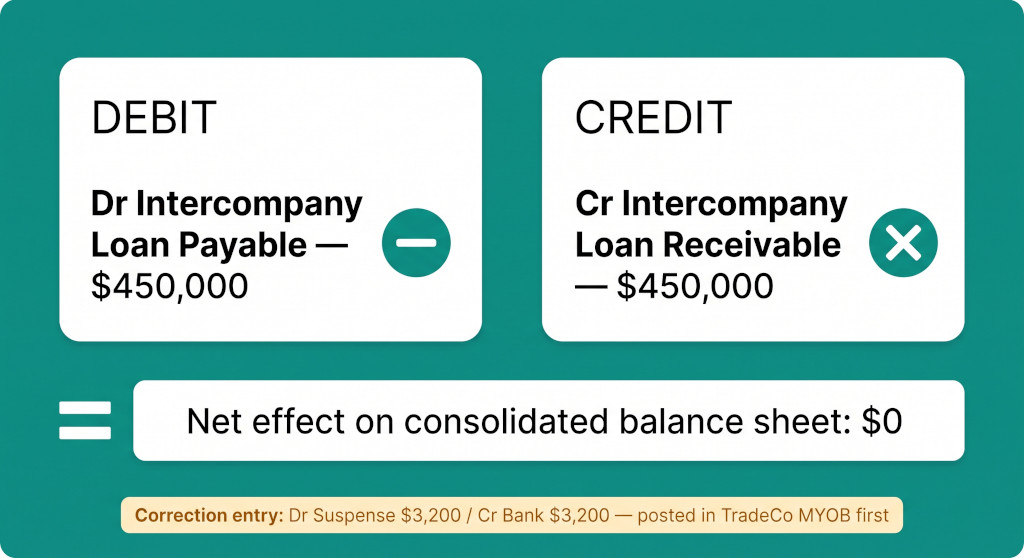
With both sides reconciled to $300,000, Rachel posts the elimination in the consolidation working paper. This entry removes the intercompany loan from both sides of the consolidated balance sheet:
Elimination entry — Consolidation working paper (not posted in MYOB)
| Account | Dr | Cr |
|---|---|---|
| Intercompany Loan Payable — HoldCo (TradeCo 1) | $300,000 | |
| Intercompany Loan Receivable — TradeCo 1 (HoldCo) | $300,000 |
This entry is posted in the consolidation working paper only. It is never entered into either MYOB file. After elimination, neither balance appears on the consolidated balance sheet. From the group’s perspective, the loan is internal — no external funding has been provided or received.
Eliminating Interest on the MYOB Intercompany Loan
If the loan carries interest — and most properly documented intercompany loans should, for transfer pricing compliance — the interest income and expense must also be eliminated. HoldCo records interest income in its MYOB P&L. TradeCo 1 records interest expense in its MYOB P&L. At consolidation, both are removed:
Interest elimination — Consolidation working paper
| Account | Dr | Cr |
|---|---|---|
| Interest Income — HoldCo (P&L) | $18,000 | |
| Interest Expense — TradeCo 1 (P&L) | $18,000 |
If interest has been accrued but not yet paid at period end, there will also be a balance sheet elimination: Dr Accrued Interest Payable (TradeCo 1) / Cr Accrued Interest Receivable (HoldCo). Confirm that both entities have accrued the same amount at the same rate before posting.
The interest elimination requires the same reconciliation check as the principal: confirm that HoldCo’s interest income and TradeCo 1’s interest expense are calculated on the same principal balance, at the same rate, over the same period. Where these differ — typically because one entity calculated interest on the opening balance and the other on the average balance — correct one of the MYOB files before eliminating. For a broader treatment of intercompany loan elimination complications, see Intercompany Loan Eliminations: A Practical Guide to the Complications That Matter.
Setting Up the MYOB Intercompany Loan Register
For groups with more than one intercompany loan — multiple subsidiaries, multiple loan directions, some with interest and some without — a single-tab register quickly becomes unmanageable. Rachel’s group has three entities, which means up to three intercompany loan directions. A loan register should capture one row per loan per period, with columns for:
| Column | What to Record |
|---|---|
| Lender entity | The MYOB entity file where the receivable sits |
| Borrower entity | The MYOB entity file where the payable sits |
| Lender account name | Exact account name in lender’s MYOB (e.g., “Intercompany Receivable — TradeCo 1”) |
| Borrower account name | Exact account name in borrower’s MYOB (e.g., “Intercompany Loan Payable — HoldCo”) |
| Closing balance — lender | Drawn from lender’s MYOB trial balance export |
| Closing balance — borrower | Drawn from borrower’s MYOB trial balance export |
| Difference | Auto-calculated; must be zero before elimination is posted |
| Difference explanation | Free text — timing, bank fees, coding error, etc. |
| Correction entry reference | Link to the MYOB journal reference number for the correction |
| Elimination posted | Yes/No, with date |
Maintaining this register as a live document — updated each month or quarter rather than only at year end — means that small discrepancies are caught and corrected before they accumulate into a large reconciliation problem at audit time. For a general framework on intercompany elimination sequencing, see Why You Should Never Start Intercompany Eliminations Before Reconciling Balances.
What MYOB Cannot Do — And Why the Register Lives Outside MYOB
MYOB Business and MYOB AccountRight are single-entity accounting systems. They have no built-in mechanism to link accounts across company files, flag intercompany imbalances, or prevent the account naming drift that causes Rachel’s reconciliation problem. Every month, each MYOB file evolves independently — new transactions coded differently, new account names added, bank fees absorbed without splitting entries — and the two sides of the loan grow further apart.
This is not a MYOB limitation that is likely to change. MYOB is designed for entity-level accounting, not for group consolidation. The register, and the correction entries it drives, must live outside the MYOB files — either in a consolidation spreadsheet or in dedicated consolidation software that connects to the MYOB APIs and performs the reconciliation automatically each period. For a practical overview of how the full MYOB consolidation process works, see How to Consolidate Multiple MYOB Companies: A Practical Guide for Multi-Entity Groups.
Practical Checklist: MYOB Intercompany Loan Reconciliation and Elimination
- List every intercompany loan across all MYOB company files. For each loan, identify the lender entity, borrower entity, and the account name used in each MYOB file.
- Standardise account names. Rename accounts in MYOB Business to a consistent convention that includes the counterparty entity name. Do this now — it takes five minutes per account and saves hours at year end.
- Export trial balances from every MYOB file at the period-end date. Pull the relevant intercompany account balances into the reconciliation register.
- Identify the difference and its source. Is it account naming (confirmed by matching to the same underlying transactions)? Bank fees absorbed into repayments? A timing cut-off? Document the explanation clearly.
- Post correction entries in MYOB for any errors or misclassifications. Bank fees should be reclassified to Finance Costs. Timing differences should be adjusted to bring both sides to the same cut-off date.
- Confirm the register shows zero difference before proceeding to the elimination step.
- Post the elimination entry in the consolidation working paper (not in MYOB): Dr Loan Payable / Cr Loan Receivable for the agreed principal balance.
- Eliminate interest separately: Dr Interest Income / Cr Interest Expense. Check for accrued interest balances and eliminate those too.
- Update the register with the correction entry references and the elimination date. Retain the register as audit evidence.
Ready to Take MYOB Intercompany Loans Off Your Month-End Problem List?
BrizoConsol connects to your MYOB company files, flags intercompany imbalances before you attempt elimination, and posts the elimination journals automatically — so the register maintains itself rather than requiring a manual refresh each period. Start Free Trial