When Your Associate Keeps Losing Money: Equity Method Loss Recognition, Suspension, and Recovery
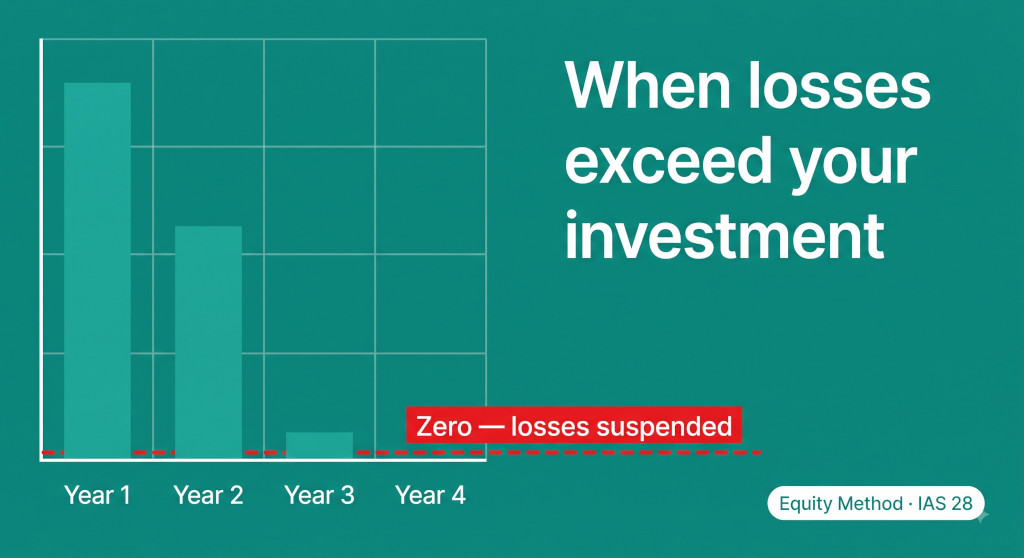
Priya runs group finance for a mid-size holding company that took a 30% stake in an associate three years ago. The investment was acquired for £500,000, the first year looked promising, and Priya’s equity pickup added a modest profit to the group P&L. Then the associate ran into difficulty. A key customer left. Margins collapsed. Two consecutive years of substantial losses followed.
Priya has been faithfully applying the equity method — picking up her 30% share of each year’s result and reducing the carrying amount of the investment accordingly. She is sitting at a carrying value of £50,000 going into the current year-end. The associate’s draft accounts have just landed in her inbox: another loss, this time £1,200,000. Her 30% share is £360,000 — seven times the remaining investment balance.
She knows she cannot debit a £360,000 loss and land the investment at negative £310,000. But she also cannot simply ignore £310,000 of losses she is economically exposed to. The question is how exactly the accounting works — and what happens if the associate eventually swings back to profit.
Stop building consolidations in spreadsheets.
BrizoConsol automates multi-entity consolidation — setup in minutes, reports the same day.
This post works through the mechanics in full: the IAS 28 suspension rule, the role of long-term interests in extending how much loss you can absorb, the journal entries at each stage, the US GAAP differences under ASC 323, and what recovery looks like.
How the Equity Method Works Before Losses Become a Problem
Under IAS 28, an investor with significant influence (typically 20–50% ownership) accounts for its associate using the equity method. The investment is initially recognised at cost. After acquisition, the carrying amount is adjusted each period to reflect the investor’s share of the associate’s profit or loss, with that share recognised in the investor’s own P&L.
Distributions received from the associate — dividends — reduce the carrying amount rather than going through P&L, since the income has already been recognised via the equity pickup. If you want the full mechanics of how this works in normal conditions, including the treatment of fair value adjustments at acquisition, see our post on equity method accounting in group consolidation.
The problem that catches finance teams out is what happens when the equity pickup is persistently negative — when the associate keeps posting losses and the carrying amount is heading toward zero.
The Suspension Rule: What IAS 28 Actually Says
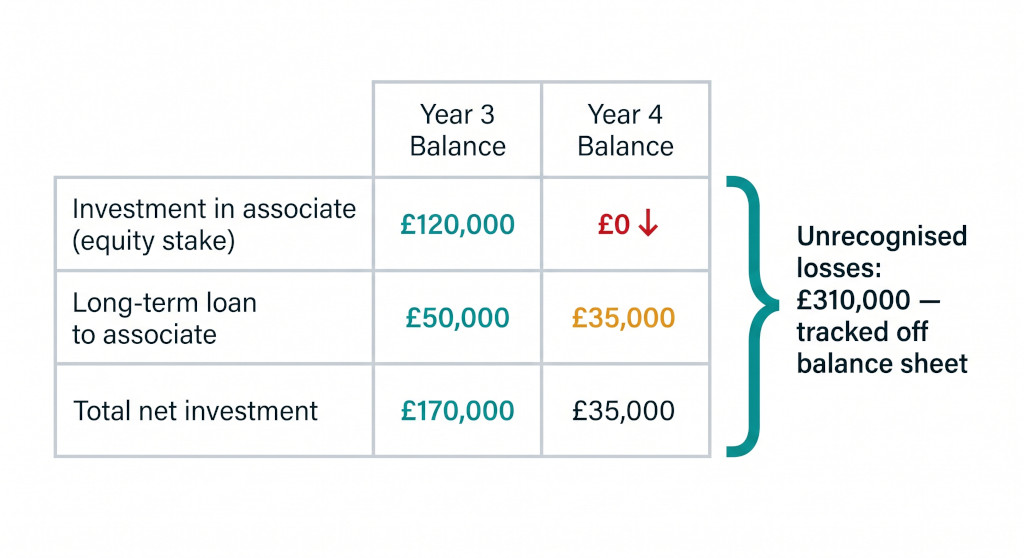
IAS 28 paragraph 38 states the rule clearly: an investor shall discontinue recognising its share of further losses once the carrying amount of the investment is reduced to zero. After that point, losses are recognised only to the extent that the investor has incurred legal or constructive obligations, or has made payments on behalf of the associate.
This means the suspended losses are tracked but not recorded in the financial statements. They sit off-balance-sheet as a memorandum figure. They matter because they determine when you can start recognising profits again if the associate recovers.
Loss suspension is not optional. It is not a policy choice. Once the carrying amount reaches zero and no obligations or long-term interests exist, you stop recognising losses. Recording a negative investment is not permitted under IFRS or FRS 102.
What Counts as a “Long-Term Interest”?
The rule is more nuanced than simply looking at the equity stake in isolation. IAS 28 paragraph 38 refers to the carrying amount of the investment in the associate together with any long-term interests that, in substance, form part of the investor’s net investment in the associate.
Long-term interests are items such as loans or preference shares for which settlement is neither planned nor likely to occur in the foreseeable future, and which are therefore effectively part of the investor’s permanent capital in the entity. A director loan with no fixed repayment date, or a preference share held by the investor that is not expected to be redeemed, would typically qualify. A normal commercial loan with a fixed repayment schedule would not.
The practical consequence: if your group has both an equity stake and a qualifying long-term loan to the associate, you absorb losses first against the equity stake (until it reaches zero), then continue absorbing losses against the loan balance (until that also reaches zero), before suspending recognition entirely.
Common mistake: Groups sometimes treat all intercompany loans to associates as long-term interests and absorb losses against them. Only loans that are not expected to be repaid in the foreseeable future qualify. If your loan has a repayment schedule, has been called, or is actively being repaid, it is not part of the net investment and should not absorb equity-method losses.
A Worked Example — With Journal Entries
Let us return to Priya’s situation and work through the numbers across four years. The group holds a 30% stake in TechAssoc Ltd, initially acquired for £500,000. The associate has no intercompany loan outstanding that qualifies as a long-term interest.
| Year | Associate result (100%) | Group share (30%) | Carrying value (start) | Carrying value (end) | Suspended losses |
|---|---|---|---|---|---|
| Year 1 | +£100,000 | +£30,000 | £500,000 | £530,000 | — |
| Year 2 | −£600,000 | −£180,000 | £530,000 | £350,000 | — |
| Year 3 | −£1,000,000 | −£300,000 | £350,000 | £50,000 | — |
| Year 4 | −£1,200,000 | −£360,000 (share) | £50,000 | £0 | £310,000 |
In Year 4, the group recognises only £50,000 of losses — enough to reduce the investment to exactly zero. The remaining £310,000 is suspended. Here are the journal entries:
Year 4 — Recognise losses to the point of zero
| Account | Dr | Cr |
|---|---|---|
| P&L — Share of associate’s losses | £50,000 | |
| Investment in TechAssoc Ltd | £50,000 |
Investment carrying value brought to nil. No further recognition of associate losses this period.
The remaining £310,000 of unrecognised losses is documented internally — typically in a memo schedule or a note to the consolidation workpapers. It is disclosed in the financial statements (see the disclosure section below) but does not appear as a balance in the group accounts.
What if there were a long-term loan?
Suppose instead that the group also held a qualifying long-term loan to TechAssoc of £200,000. The net investment is now £500,000 + £200,000 = £700,000. The loss absorption in Year 4 would work as follows:
Losses to absorb (30% × £1,200,000) = £360,000
Less: absorbed against equity stake (to zero) = (£50,000)
Remaining to absorb = £310,000
Less: absorbed against long-term loan balance = (£200,000)
Remaining suspended (unrecognised) = £110,000
The journal entries in the loan scenario would be:
| Account | Dr | Cr |
|---|---|---|
| P&L — Share of associate’s losses | £50,000 | |
| Investment in TechAssoc Ltd | £50,000 |
Equity stake reduced to nil.
| Account | Dr | Cr |
|---|---|---|
| P&L — Share of associate’s losses | £200,000 | |
| Long-term loan to TechAssoc Ltd | £200,000 |
Losses absorbed against qualifying long-term interest. Loan balance now nil.
Only the final £110,000 is suspended, and the group discloses that amount as unrecognised losses.
The order of absorption matters. Always exhaust the equity stake first, then absorb against long-term interests in reverse order of seniority (most subordinated first). Document your reasoning for which instruments qualify as long-term interests — auditors will challenge this.
What If the Group Has an Obligation?
IAS 28 paragraph 39 creates an important exception to the suspension rule: if the investor has incurred legal or constructive obligations, or has made payments on behalf of the associate, it must continue recognising losses beyond the point where the investment reaches zero.
Common situations where obligations arise include: the group has provided a guarantee on the associate’s bank debt, the group has committed to fund the associate’s working capital, or the associate has issued payroll and the group is expected to cover it. Where an obligation exists, the group recognises additional losses up to the amount of the obligation and records a corresponding liability on the group balance sheet.
| Account | Dr | Cr |
|---|---|---|
| P&L — Share of associate’s losses | £XX | |
| Provision — obligation in respect of associate | £XX |
Recognise losses to the extent of the obligation. Assess at each reporting date whether the obligation still exists and at what amount.
When the Associate Recovers: Resuming Loss Recognition
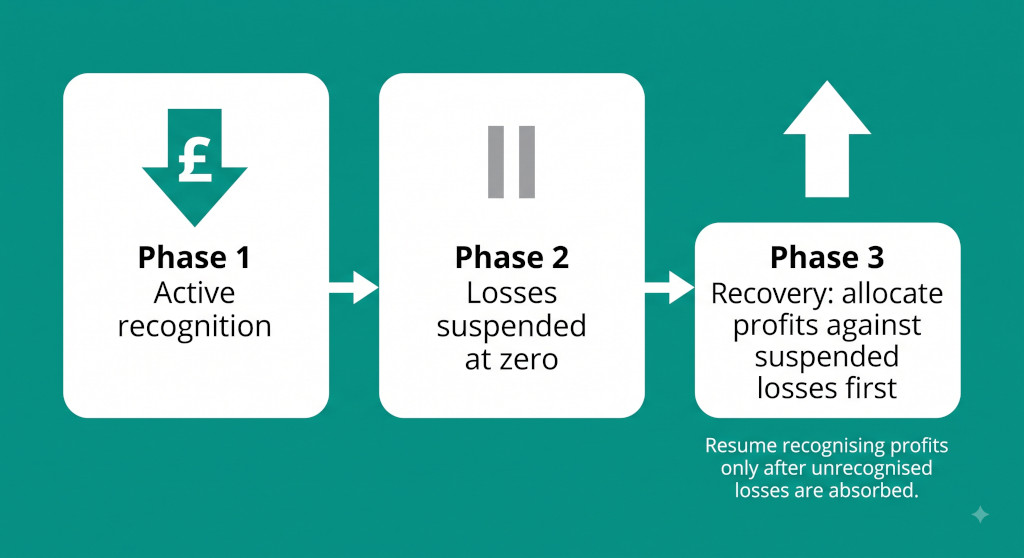
This is where many finance teams get confused. When the associate starts reporting profits again, those profits are not immediately recognised in the group P&L. The suspended losses must first be absorbed.
The rule is straightforward: the group resumes recognising its share of profits only after its share of cumulative profits equals the share of cumulative losses that were not recognised during the suspension period.
Returning to the original scenario (no long-term loan), with £310,000 of suspended losses at the end of Year 4:
| Year | Associate result (100%) | Group share (30%) | Absorbed against suspended losses | Recognised in P&L | Suspended losses remaining |
|---|---|---|---|---|---|
| Year 5 | +£600,000 | +£180,000 | £180,000 | — | £130,000 |
| Year 6 | +£800,000 | +£240,000 | £130,000 | £110,000 | — |
In Year 5, the group’s entire £180,000 share of profit goes toward absorbing suspended losses. No journal entry hits the P&L. The carrying amount remains at zero and the unrecognised loss balance drops from £310,000 to £130,000.
In Year 6, the group’s £240,000 share of profit first absorbs the remaining £130,000 of suspended losses, then the balance of £110,000 is recognised in the P&L. The journal entries:
Year 6 — the £130,000 absorbed against suspended losses clears the memorandum balance; no P&L entry is required for this portion.
| Account | Dr | Cr |
|---|---|---|
| Investment in TechAssoc Ltd | £110,000 | |
| P&L — Share of associate’s profits | £110,000 |
Suspended losses fully absorbed; resume normal equity pickup from this point.
From Year 7 onward, assuming the associate remains profitable, the group recognises its 30% share of profits in the normal way and builds the carrying amount back up from zero.
Tracking equity method adjustments across multiple associates?
BrizoConsol handles equity method investments, including loss suspension schedules and automatic recovery calculations, as part of your consolidated group accounts — no separate spreadsheets required.See It In Action
The US GAAP Position: ASC 323
The underlying principle is the same under US GAAP: an investor stops recognising losses once the investment (and any advances) are reduced to zero. ASC 323-10-35-28 contains the equivalent suspension rule.
There are, however, practical differences in how US GAAP groups apply this in practice. ASC 323 is explicit that advances to the investee — not just formal long-term loans — can form part of the net investment if they are not expected to be collected in the foreseeable future. This is broadly consistent with IAS 28’s long-term interests concept, but the threshold for what counts as “not expected to be collected” can be interpreted more narrowly under US GAAP given the more rules-based framework.
A more significant difference lies in impairment. Under US GAAP, an other-than-temporary impairment of an equity method investment is recognised immediately and the new (impaired) carrying value becomes the new cost basis — meaning subsequent reversals of impairment are not permitted, even if the associate’s performance recovers. Under IFRS, IAS 36 applies an impairment test but allows reversals where the original impairment conditions no longer exist. This creates divergent carrying values for the same investment in a group that prepares both IFRS and US GAAP statements. For a breakdown of how these standard differences cascade through a consolidation, see our guide to US GAAP vs IFRS key differences.
FRS 102 adopts substantially the same approach as IAS 28 on loss suspension, with no material practical differences for most SME groups in the UK.
Impairment: A Separate but Related Question
Loss suspension and impairment are distinct issues that can arise simultaneously. An investor might suspend further loss recognition at zero carrying value while also having an impairment question about whether the remaining investment (before it reached zero) should have been impaired earlier.
Under IAS 28 paragraph 40, after applying the equity method — including the loss suspension rules — the investor applies IAS 36 to determine whether any additional impairment loss should be recognised on the net investment as a whole. In practice, if the investment has been written down to zero through equity pickup, the impairment question is moot for the current period. But if the investment still has a positive carrying value and there are indicators of impairment (the associate is loss-making, its market value has fallen significantly), a formal impairment test is required even before losses consume the entire carrying amount.
The test compares the carrying amount of the investment to its recoverable amount (the higher of value in use and fair value less costs of disposal). An impairment write-down is recognised in the group P&L and reduces the carrying amount of the investment. For a worked example of how goodwill impairment interacts with the equity method in an associate context, our post on goodwill in group consolidation covers the impairment mechanics in detail.
Disclosure Requirements
Both IAS 28 and IFRS 12 require specific disclosures where the equity method loss suspension rules have been applied. Finance teams preparing the group notes need to include:
The investor’s share of losses of the associate — both those recognised in the current period and the cumulative unrecognised amount. This tells users of the financial statements that there is an economic exposure not fully captured in the P&L. The disclosure must make clear how much of the period’s losses have been recognised versus suspended, and the cumulative suspended amount carried forward.
Where the investor has legal or constructive obligations and has therefore recognised losses beyond zero, those obligations must be described and the amounts disclosed. Where impairment has been recognised on the net investment, that must be disclosed separately from the share of losses recognised under the equity method.
Don’t omit the memorandum disclosure. A common oversight is to correctly suspend loss recognition in the accounts but then fail to disclose the cumulative unrecognised amount in the notes. Auditors look for this specifically when an associate is reported at nil carrying value. The absence of disclosure is often treated as a more serious error than the incorrect loss recognition itself.
Practical Checklist: Equity Method Loss Suspension and Recovery
Use this sequence at each reporting date where an associate has been loss-making:
- Calculate the group’s share of the associate’s result for the period — use the investor’s ownership percentage applied to the associate’s post-tax profit or loss. Confirm that the ownership percentage and accounting policies are aligned with acquisition date values.
- Determine the opening carrying amount of the net investment — this is the equity stake carrying value plus any qualifying long-term interests (loans, preference shares with no planned repayment).
- Apply losses against the net investment in order — reduce the equity stake first, then reduce long-term interests. Stop when both reach zero or when the period’s losses are fully absorbed, whichever comes first.
- Record any remaining losses as suspended — update your memorandum schedule of unrecognised cumulative losses. Do not post a journal entry for the suspended portion.
- Assess whether any obligations exist — if the group has guaranteed the associate’s debt, committed to fund it, or made payments on its behalf, recognise additional losses up to the obligation amount and raise a provision.
- Run the impairment test — if the investment still has a positive carrying value and there are indicators of impairment, perform the IAS 36 test. Document your conclusions even if no impairment is recognised.
- Prepare the disclosures — confirm the notes include the current-period recognised share of losses, the cumulative suspended amount, and any obligation-related provisions. These are non-negotiable under IFRS 12.
- Monitor the suspension balance at each future period — when the associate recovers, absorb suspended losses against profits before recognising any positive equity pickup in the P&L. Update the memorandum schedule each period until the balance is exhausted.
The mechanics are systematic once you have the framework clearly documented. The failure point for most groups is the absence of a formal memorandum schedule — which means suspended losses are forgotten, and when the associate recovers, the group incorrectly recognises a full share of profits before the prior unrecognised losses have been absorbed.
If you are consolidating multiple associates across a group, each one needs its own suspension schedule maintained period by period. This is the kind of calculation that is easy to lose in a complex Excel consolidation model and much easier to track in a purpose-built consolidation tool. For broader context on how associate accounting fits into the full consolidation process, see our guide to equity method accounting in group consolidation.
Ready to move beyond spreadsheets for associate accounting?
BrizoConsol manages equity method investments, loss suspension schedules, and recovery tracking as part of your consolidated group accounts — so nothing falls through the cracks at month-end.Start Free Trial