When Your Construction Subsidiary Reports Under FRS 102: Aligning Accounting Policies Before You Consolidate
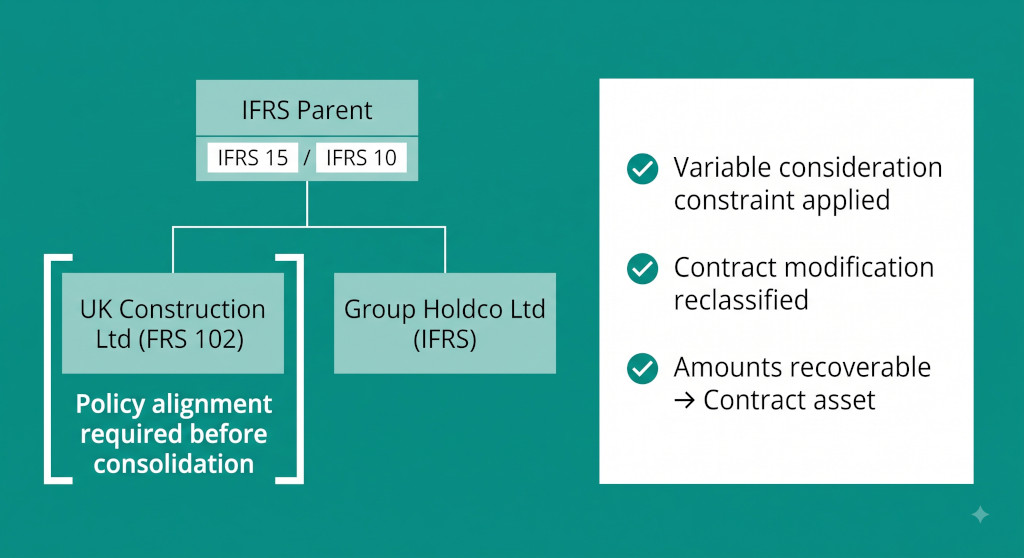
The group financial controller at a mid-sized UK construction holding company had always managed the consolidation without much difficulty. The parent prepared its accounts under IFRS; its two wholly owned subsidiaries did the same. Then the group acquired a regional civil engineering contractor — a well-run business that prepared its accounts under FRS 102, as most SME construction businesses in the UK do. The acquisition was straightforward. The first consolidation after it was not.
The civil engineering subsidiary’s accounts landed in the consolidation pack with three sets of numbers that could not simply be aggregated into the IFRS group: a variation claim that IFRS 15 would require to be constrained but FRS 102 Section 23 had included in full; a contract modification that had been treated as a cumulative catch-up under FRS 102 but would be a new contract under IFRS 15; and a balance sheet that used entirely different line items — “amounts recoverable on contracts” and “payments on account” rather than the “contract assets” and “contract liabilities” the IFRS consolidation pack was expecting.
None of these required changes to the subsidiary’s own accounts. It would continue to file under FRS 102. What was required — entirely at the consolidation stage — was a set of policy alignment journals that converted the subsidiary’s results from FRS 102 to IFRS before they were aggregated with the rest of the group. These journals exist only in the consolidation workings. They do not appear anywhere in the subsidiary’s books.
Stop building consolidations in spreadsheets.
BrizoConsol automates multi-entity consolidation — setup in minutes, reports the same day.
IFRS 10 requires a parent to consolidate all subsidiaries using uniform accounting policies. Where a subsidiary’s accounts are prepared under a different framework, the parent must make adjustments at consolidation to bring the subsidiary’s results into line with group policies. The subsidiary is not required to restate its own accounts — the conversion is a consolidation adjustment only.
Why Construction Is Particularly Exposed to This Problem
Many industries have FRS 102 subsidiaries whose results can be aggregated into an IFRS group with minimal adjustment — the differences between FRS 102 and IFRS for a straightforward trading or property business are often small in practice. Construction is different, for two reasons.
First, revenue recognition for construction contracts is the dominant accounting judgement in a contractor’s accounts, and IFRS 15 and FRS 102 Section 23 handle several aspects of that judgement differently. The differences are not cosmetic — they can produce materially different revenue and contract asset figures on the same set of projects, depending on how variable consideration, contract modifications, and onerous contract provisions are treated.
Second, construction contractors carry large, complex contract portfolios where the accounting involves significant estimation — completion percentages, cost forecasts, variation claims, retention timing. Small differences in policy produce large differences in reported results. A group that aggregates an FRS 102 construction subsidiary’s revenue without first applying the IFRS 15 constraints is not producing IFRS-compliant consolidated accounts, even if the subsidiary’s entity accounts are correct.
Difference One: Variable Consideration and the Highly Probable Constraint
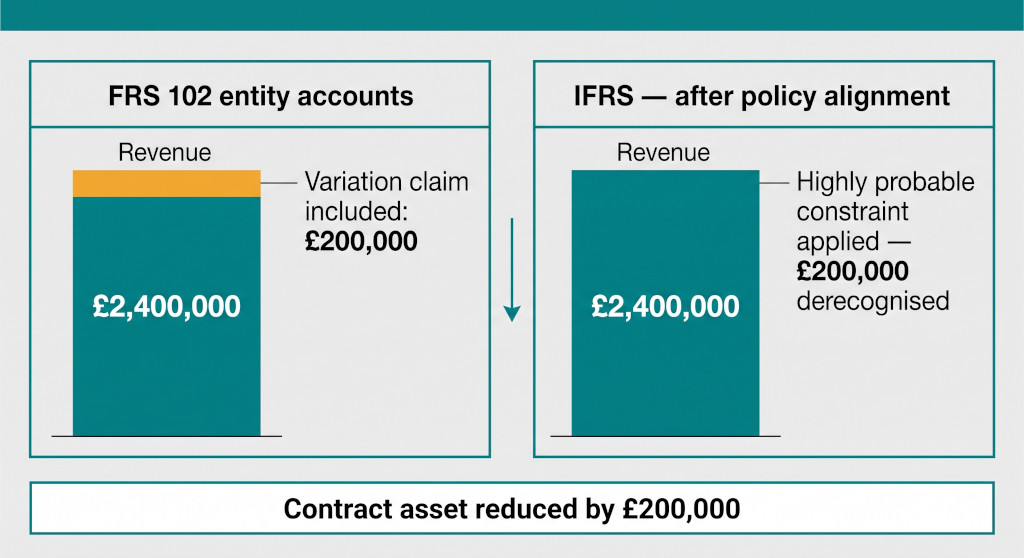
Under IFRS 15, variable consideration — amounts whose receipt depends on future events, including variation claims, incentive payments, and disputed amounts — can only be included in contract revenue to the extent that it is highly probable that a significant reversal of revenue will not occur when the uncertainty is resolved. This is the “constraint” on variable consideration, and it is applied at the individual contract level.
FRS 102 Section 23 does not use the highly probable threshold. It requires revenue to be recognised when the outcome of the contract can be estimated reliably, and it permits inclusion of claims and variations when it is probable (a lower threshold than highly probable) that the customer will accept them. In practice, many FRS 102 construction contractors include variation claims in revenue as soon as they believe the client is likely to agree — which is a less restrictive recognition point than IFRS 15 would allow.
Consider the civil engineering subsidiary’s largest contract. It has raised a variation claim for additional groundwork of £200,000. Under FRS 102, management believes the claim is probable of acceptance and has included it in revenue. Under IFRS 15, the group accountant assesses the claim as not yet highly probable — negotiations with the client are ongoing and the outcome is genuinely uncertain. The claim must be removed from consolidated revenue.
| Revenue recognised in FRS 102 accounts | £2,400,000 |
| Variation claim included — not highly probable under IFRS 15 | (£200,000) |
| Revenue after IFRS 15 constraint — used in consolidation | £2,200,000 |
| Account | Dr | Cr |
|---|---|---|
| Contract revenue (P&L) | £200,000 | |
| Contract asset — unbilled / amounts recoverable (balance sheet) | £200,000 |
Consolidation policy alignment journal — derecognises the variation claim from consolidated revenue and reduces the contract asset to the amount that meets the IFRS 15 highly probable threshold. This journal exists only in the group workings; the subsidiary’s FRS 102 accounts are unchanged.
This adjustment must be reassessed at every reporting date. If negotiations progress and the claim becomes highly probable, the constraint is lifted and the revenue reinstated in a future period’s consolidation. If the claim is ultimately rejected, it is written off — which in the FRS 102 entity accounts will appear as a reduction in revenue, requiring no further consolidation adjustment as the two positions converge.
The highly probable threshold is a strict test. “Likely” or “more probable than not” is not sufficient — IFRS 15 requires a high degree of confidence that the revenue will not be reversed. Variation claims in active negotiation, disputed claims, and claims dependent on third-party decisions (adjudication, expert determination) should be assumed to fail the highly probable test unless there is strong, documented evidence of near-certain recovery. In practice, most contested variation claims in FRS 102 accounts should be constrained for IFRS 15 consolidation purposes.
Difference Two: Contract Modifications
IFRS 15 contains detailed rules on how to account for a change in the scope or price of an existing contract — a contract modification. Depending on whether the modification adds distinct goods or services and whether the price reflects stand-alone selling prices, the modification is accounted for either as a separate new contract, as a termination of the old contract and creation of a new one, or as a cumulative catch-up adjustment to the existing contract.
FRS 102 Section 23 does not have an equivalent structured framework for contract modifications. Contractors applying FRS 102 typically update their percentage completion calculation when the contract scope or price changes, treating the modification as a revision to the total contract estimate — effectively always applying the cumulative catch-up approach.
For the consolidation, this means the group accountant must assess each significant contract modification in the subsidiary’s portfolio under IFRS 15 and determine whether it should have been accounted for differently. If a modification should be treated as a new contract under IFRS 15 (because it added distinct services at their stand-alone selling price), revenue cannot be recognised on a catch-up basis — it must be recognised prospectively as the new scope is delivered.
Consider a contract originally valued at £1,500,000 that was modified to add a new drainage system at £300,000 — a distinct scope addition at a market price. Under FRS 102, the subsidiary has updated its cumulative completion calculation and recognised a catch-up of £120,000 of additional revenue in the current period. Under IFRS 15, the drainage system is a separate contract — no catch-up is permitted, and only the revenue earned on the drainage work to date (say, 30% complete = £90,000) should be recognised.
| Catch-up revenue recognised under FRS 102 modification treatment | £120,000 |
| Revenue allowable under IFRS 15 new-contract treatment (30% × £300,000) | £90,000 |
| Consolidation adjustment — reduce revenue | (£30,000) |
| Account | Dr | Cr |
|---|---|---|
| Contract revenue (P&L) | £30,000 | |
| Contract asset — unbilled (balance sheet) | £30,000 |
Consolidation policy alignment journal — reverses the FRS 102 catch-up treatment for a contract modification that qualifies as a new contract under IFRS 15. The contract asset is reduced to the amount of revenue that would be recognised under prospective recognition of the separate contract. This journal exists only in the group workings.
Identifying which contract modifications require this treatment requires a project-by-project review. For a construction contractor with dozens of active contracts, that review can be substantial. In practice, many groups apply materiality and focus on modifications above a threshold — say, modifications representing more than 5% of the original contract value — and accept that smaller modifications are unlikely to produce a material difference in treatment between the two frameworks.
Managing policy alignment journals across multiple subsidiaries?
BrizoConsol lets your team post and track consolidation adjustment journals entity by entity, with full audit trail — so your policy alignment workings are documented, reviewable, and consistent period to period.See It In Action
Difference Three: Balance Sheet Presentation Alignment
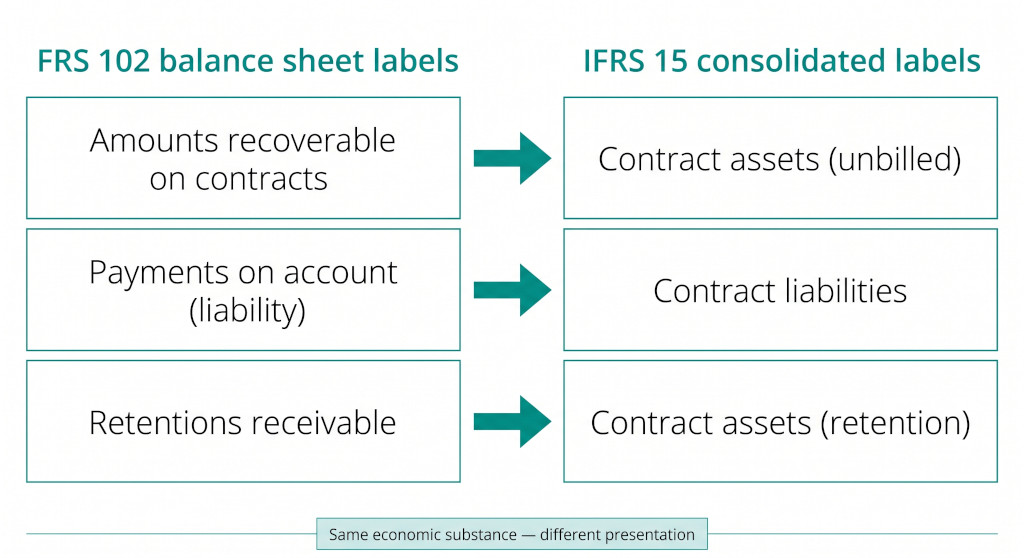
Even where the measurement of contract revenue and costs is the same under both frameworks, the balance sheet presentation differs — and the consolidation pack must use consistent line items across all entities before aggregation.
Under FRS 102, a construction contractor’s balance sheet typically shows “amounts recoverable on contracts” (a debtor, representing the excess of revenue recognised over amounts invoiced) and “payments on account” (a creditor, representing the excess of amounts invoiced over revenue recognised). These are the FRS 102 equivalents of IFRS 15’s “contract assets” and “contract liabilities”.
| FRS 102 label | IFRS 15 equivalent | Consolidation adjustment required |
|---|---|---|
| Amounts recoverable on contracts | Contract asset (unbilled) | Reclassify to contract assets — no measurement change |
| Payments on account | Contract liability | Reclassify to contract liabilities — no measurement change |
| Retentions receivable | Contract asset (retention) | Reclassify within contract assets — no measurement change |
| Retentions payable | Contract liability (retention payable) | Reclassify within contract liabilities — no measurement change |
The reclassification journal involves no P&L impact — it is purely a balance sheet reorganisation. The economic substance is identical; only the label changes. But it is necessary, because the consolidated balance sheet must use the IFRS 15 contract asset and contract liability presentation consistently across all entities. A consolidated balance sheet that shows “amounts recoverable on contracts” from one subsidiary and “contract assets” from another is mixing frameworks in the group accounts — which is not permitted under IFRS 10.
| Account | Dr | Cr |
|---|---|---|
| Contract assets — unbilled (IFRS label) | £840,000 | |
| Amounts recoverable on contracts (FRS 102 label) | £840,000 |
Reclassification journal — moves the FRS 102 “amounts recoverable on contracts” balance to the IFRS 15 “contract assets” line in the consolidated balance sheet. No measurement change; no P&L impact. Corresponding reclassifications are required for payments on account → contract liabilities, and retentions receivable → contract assets (retention component).
Difference Four: Presentation of Expected Losses
Under IFRS 15, when a contract is expected to be loss-making, the expected loss is recognised immediately — partly through the percentage completion mechanism (as costs exceed revenue recognised to date) and partly through an onerous contract provision under IAS 37. Under FRS 102, expected losses are also recognised immediately under Section 23, but the mechanics interact slightly differently with the balance sheet: FRS 102 may present the provision as a reduction in the contract asset rather than as a separate liability.
If the FRS 102 subsidiary has netted an expected loss against its amounts recoverable on contracts — presenting a net nil or negative balance for a loss-making contract — the group must gross up the presentation for IFRS purposes: a gross contract asset (the revenue recognised) offset by a separate onerous contract provision liability. This is a presentation adjustment, not a measurement one, but it affects the balance sheet totals that flow into the consolidation.
How to Build the Policy Alignment Process
The policy alignment adjustment process works most efficiently when it is formalised as a discrete step between receiving the subsidiary’s trial balance and adding it to the group consolidation model. In practice this means a standing workpaper that maps the subsidiary’s key FRS 102 balances and judgements to the IFRS 15 equivalents, identifies where the measurement or presentation differs, and produces the adjustment journals that bring the subsidiary’s contribution into line with group policy.
For a construction subsidiary, that workpaper should address at minimum:
Variable consideration — list every variation claim, incentive payment, or disputed amount included in the subsidiary’s revenue, assess each against the IFRS 15 highly probable threshold, and remove those that do not meet it. Document the basis of assessment so that the position can be rolled forward or updated consistently in future periods.
Contract modifications — review all significant scope or price changes in the period. Determine whether each should be treated as a separate contract, a termination and new contract, or a cumulative catch-up under IFRS 15. Adjust the revenue and contract asset for any that differ from the FRS 102 treatment.
Balance sheet reclassification — systematically reclassify amounts recoverable on contracts to contract assets, payments on account to contract liabilities, and retentions to their appropriate IFRS 15 sub-classifications.
Loss-making contracts — confirm that expected losses are presented gross (contract asset and provision separately) rather than netted, and that the measurement of the provision is consistent with IAS 37 and IFRS 15.
Each of these steps produces one or more consolidation adjustment journals. Those journals flow into the group consolidation alongside the standard eliminations, and the consolidated accounts are prepared as if the subsidiary had always applied IFRS 15. The subsidiary’s own accounts are untouched.
Keeping the Adjustments Consistent Period to Period
The most important operational discipline with policy alignment journals is consistency. A variation claim that is constrained out of consolidated revenue this period must remain constrained next period unless the circumstances change. A contract modification treated as a new contract this period cannot be reverted to catch-up treatment next period because it is more convenient. The adjustments carry forward — and their cumulative effect on the contract asset and retained earnings must be tracked in the consolidation workings.
When the subsidiary’s management team realises that certain variation claims are never recognised in the consolidated accounts, they sometimes ask whether the entity-level accounting should simply be changed to IFRS 15 treatment to avoid the adjustments. The answer depends on whether the entity is required to use FRS 102. If it has a choice, aligning the entity-level policy to IFRS eliminates the conversion step and produces cleaner consolidated accounts. If the entity is required to use FRS 102 (for example, because it is a small company within the FRS 102 eligibility criteria and the directors prefer that framework), the conversion workpaper is a permanent fixture of the group close process.
For a broader comparison of how FRS 102 and IFRS diverge across the full range of accounting topics — not limited to construction — the detailed comparison in IFRS vs UK GAAP: Key Differences in Financial Reporting provides the framework. And for the mechanics of how construction group consolidations are structured more generally, the overview in Financial Consolidation for Construction Groups sets out the full picture.
Practical Checklist for FRS 102 Construction Subsidiary Policy Alignment
- Review all variable consideration in the subsidiary’s revenue. For each variation claim, incentive, or disputed amount, apply the IFRS 15 highly probable test. Derecognise from consolidated revenue and reduce the contract asset for any amount that does not meet the threshold.
- Identify all significant contract modifications in the period. Assess each under the IFRS 15 framework — separate new contract, termination and new contract, or cumulative catch-up. Adjust revenue and contract asset where the IFRS 15 treatment differs from the FRS 102 treatment.
- Reclassify amounts recoverable on contracts to contract assets and payments on account to contract liabilities. Identify the retention components of each and reclassify to the appropriate IFRS 15 sub-classification.
- Review loss-making contracts for presentation differences. Gross up any netted presentation to show contract asset and onerous contract provision separately.
- Document the basis of each adjustment so that the position can be updated consistently in future periods. Variable consideration assessments in particular must be refreshed at every reporting date.
- Track the cumulative effect of policy alignment adjustments on the subsidiary’s contract assets and retained earnings in the group workings. These are consolidation-only balances that must be carried forward correctly.
- Consider whether the entity-level policy should be aligned to IFRS if the subsidiary has a choice of framework and the conversion workpaper is becoming burdensome. Eliminating the conversion step at source is cleaner than maintaining it indefinitely.
Policy alignment for an FRS 102 construction subsidiary is one of the most technically demanding elements of a mixed-GAAP group consolidation — precisely because construction revenue recognition under IFRS 15 involves more specific rules than almost any other industry, and because the differences from FRS 102 are most pronounced in the areas that matter most: variation claims, contract modifications, and contract asset presentation. Getting the alignment right at the first close after an FRS 102 acquisition sets the template for every close that follows.
Mixed GAAP group close taking longer than it should?
BrizoConsol supports multi-standard groups — post policy alignment journals alongside your standard eliminations, track them period to period, and produce a clean consolidated set of accounts regardless of what framework each entity files under. Start Free Trial