Why Zoho Analytics Can’t Replace Group Consolidation — and What It’s Actually Good For
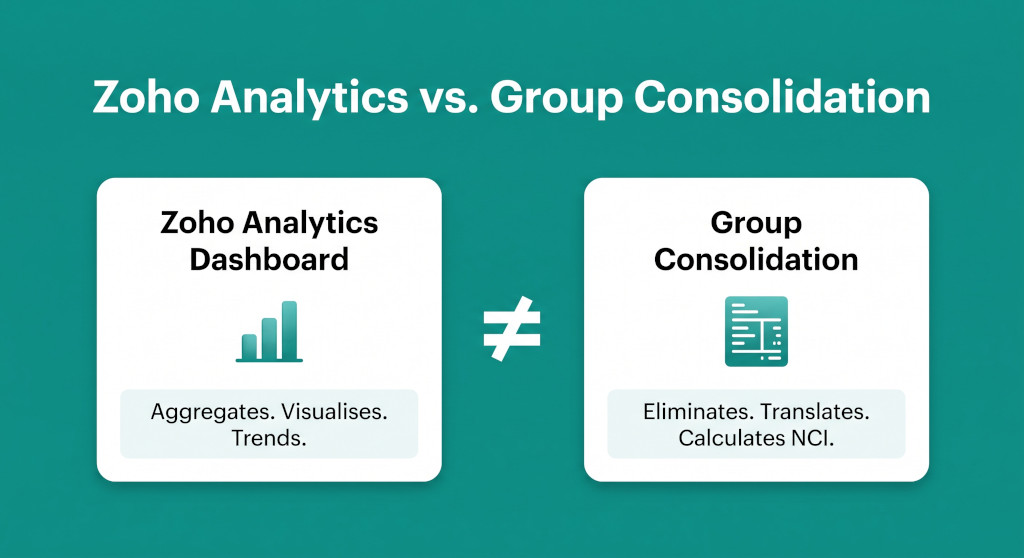
Nina is the CFO of an Australian retail group with four Zoho Books entities — a holding company, two retail trading entities, and a procurement entity. For three years, her team produced group management accounts by manually exporting trial balances from each Zoho Books organisation and pasting them into a consolidation spreadsheet each month. Last year, she decided to fix the problem properly. She implemented Zoho Analytics, connected all four Zoho Books organisations to it, and built a dashboard that showed group revenue, gross margin, inventory levels, and operating expenses across all entities in a single real-time view.
For the first six months, everyone was delighted. The board got a dashboard. The bank got a monthly summary. The operations team got KPIs broken down by entity. Nina felt she had finally solved the group reporting problem without the spreadsheet. Then the group’s auditor began the year-end audit and asked for the statutory consolidated financial statements. Nina sent the Zoho Analytics report. The auditor replied that a BI dashboard is not a consolidated financial statement.
The $150,000 in management fees charged by HoldCo to the two trading entities — visible in both organisations’ Zoho Books data — had been included in Zoho Analytics as both income (HoldCo) and expense (trading entities), inflating the group revenue line by $150,000 and misrepresenting the gross margin. The procurement entity, which operated in Singapore in SGD, had been included in the dashboard at a fixed exchange rate that hadn’t been updated in four months. And the trading entity that was 80% owned by HoldCo had its full profit included without any non-controlling interest adjustment. The Zoho Analytics dashboard showed a clear, real-time, accurate picture of each entity — and a misleading picture of the group.
Group consolidation for Zoho Books — fast and accurate.
Connect your Zoho Books organisations and consolidate into one clean group view.
What Zoho Analytics Actually Does
Zoho Analytics is a business intelligence and data visualisation platform. It connects to data sources — including Zoho Books, Zoho CRM, external databases, spreadsheets, and APIs — and allows users to build reports, dashboards, and data models from the combined data. For finance teams, the most relevant capability is the ability to connect multiple Zoho Books organisations to a single Zoho Analytics workspace, query the data across all organisations simultaneously, and display the results in a unified dashboard.
This is genuinely powerful. Rather than exporting each entity’s reports separately and combining them manually, a Zoho Analytics connected workspace can show current revenue, expenses, cash balances, and receivables across all Zoho Books entities in a single view. Filters allow the user to select one entity, compare two entities, or view the aggregate of all entities. Charts, pivot tables, and KPI widgets make the information visually accessible.
What Zoho Analytics is doing, underneath all of this, is aggregation: combining rows of data from multiple sources and calculating totals. It is not performing accounting adjustments. It does not know which revenue rows in HoldCo’s Zoho Books correspond to which expense rows in the trading entities’ Zoho Books. It does not apply exchange rates by account type (closing rate for balance sheet, average rate for P&L). It does not calculate goodwill, NCI, or deferred tax. It adds up what is there and displays it.
The Intercompany Elimination Problem
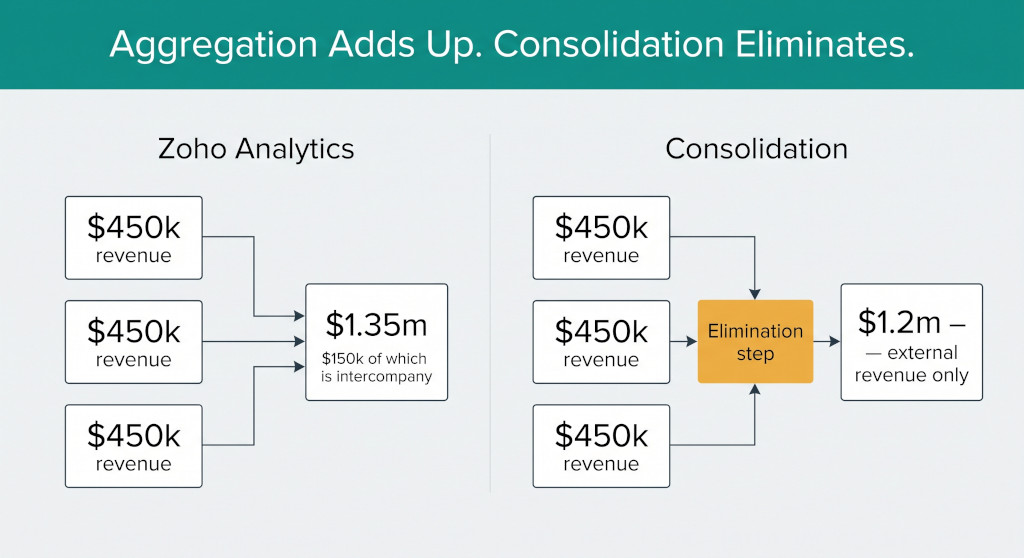
Nina’s group charges $150,000 in annual management fees from HoldCo to the two trading entities — $75,000 to each. In Zoho Books, these are correctly recorded as management fee income in HoldCo and management fee expense in each trading entity. In Zoho Analytics, when all four organisations’ data is combined, both sides appear in the aggregated dataset: $150,000 of management fee income and $150,000 of management fee expense.
From a Zoho Analytics perspective, this is correct aggregation — those transactions exist in Zoho Books. But from a consolidation perspective, both must be eliminated. The management fees never left the group. No external party received the income; no external party charged the expense. Group revenue is overstated by $150,000 and group expenses are overstated by $150,000. The net effect on consolidated profit is nil, but the revenue line — which the bank uses to calculate the leverage ratio — is inflated.
| Revenue Line | Zoho Analytics Aggregated Total | Correct Consolidated Total | Difference |
|---|---|---|---|
| External retail sales | $1,200,000 | $1,200,000 | — |
| Management fees (HoldCo) | $150,000 | — | ($150,000) |
| Total revenue | $1,350,000 | $1,200,000 | ($150,000) |
Zoho Analytics has no mechanism to perform this elimination. There is no “intercompany elimination” feature, no way to mark a revenue account in HoldCo as the counterpart of an expense account in the trading entities, and no process that cancels the two sides against each other. The elimination must happen in a separate process — a consolidation workbook or dedicated consolidation software — before the numbers are fit for statutory purposes. For an overview of how intercompany management fee eliminations work, see Intercompany Management Fee Eliminations: How to Remove Intragroup Charges From Consolidated Accounts.
The Foreign Currency Translation Problem
Nina’s procurement entity operates in Singapore with SGD as its functional currency. Zoho Analytics connects to the Singapore entity’s Zoho Books data and converts SGD amounts to AUD for display purposes — typically using a single exchange rate, either current or a manually configured rate in the workspace settings.
Under AASB 121, translating a foreign subsidiary for consolidation requires three different rates: the closing rate for all balance sheet items, the average rate for the period for income statement items, and historical rates for equity items such as share capital. The difference between translating income at the average rate and at the closing rate — plus the difference between opening and closing net assets translated at different closing rates — produces the cumulative translation adjustment, which must be reported in other comprehensive income.
Zoho Analytics applies one rate to all figures, regardless of whether they are balance sheet or P&L items, and regardless of whether the rate is the period average, the closing rate, or a historical rate. The translated figures will therefore not match what AASB 121 requires, and the CTA calculation cannot be performed within Zoho Analytics at all. The foreign currency translation must be done separately as part of the consolidation process. For a detailed treatment of this requirement, see Zoho Books Multi-Currency Consolidation: How Groups with Foreign Subsidiaries Produce Accurate Group Accounts.
The Non-Controlling Interest Problem
One of Nina’s trading entities is 80% owned by HoldCo. The remaining 20% belongs to an external investor. When Zoho Analytics aggregates that entity’s revenue and expenses into the group dashboard, it includes 100% — because 100% of the entity’s data exists in Zoho Books. There is no ownership percentage adjustment applied anywhere in the Zoho Analytics data pipeline.
Statutory consolidation requires that the 20% minority’s share of the entity’s profit is separately identified as “profit attributable to non-controlling interest” — reducing the “profit attributable to owners of the parent” by 20% of the trading entity’s net profit. The NCI must also appear in the consolidated balance sheet within equity. Zoho Analytics produces no NCI figure and applies no ownership adjustment. The group’s profit, as shown in Zoho Analytics, is overstated relative to what is attributable to the group’s owners — by exactly 20% of the 80%-owned entity’s net profit.
Zoho Books Group That Needs More Than a Dashboard?
BrizoConsol connects to all your Zoho Books organisations, eliminates intercompany transactions, applies AASB 121-compliant multi-currency translation, calculates NCI, and produces statutory-quality consolidated financial statements — from the same Zoho Books data your Zoho Analytics dashboard already uses. See It In Action
Where Zoho Analytics Fits in the Group Reporting Stack
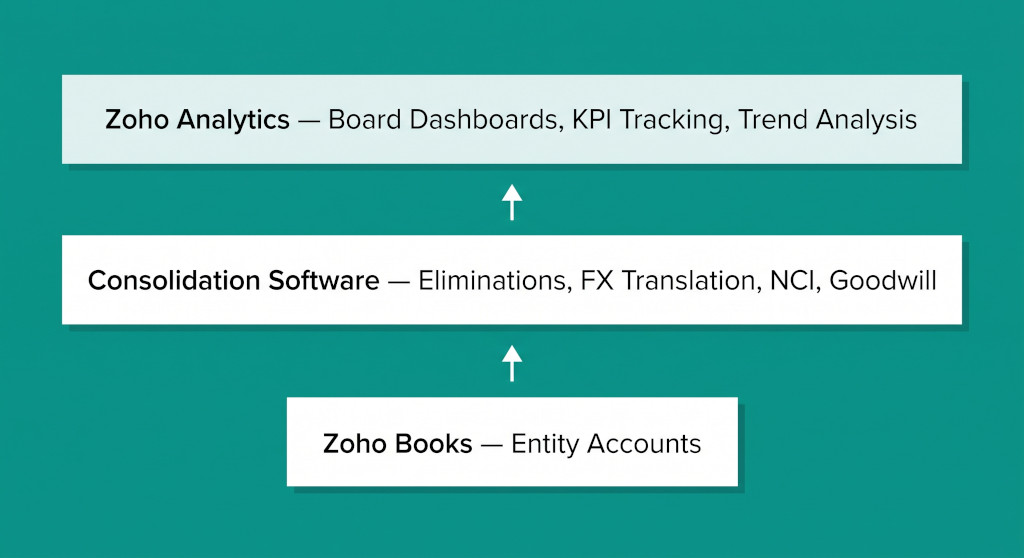
The key insight is that Zoho Analytics and group consolidation are not competing tools — they serve different purposes and sit at different layers of the group reporting stack.
Zoho Books is the entity layer: each organisation records its own transactions, manages its own accounts, and produces its own entity accounts. This is where the raw data lives.
Consolidation is the adjustment layer: the entity accounts are combined, intercompany transactions eliminated, foreign currencies translated at the correct rates, and NCI calculated. The output is the consolidated financial statements — the statutory, audit-ready view of the group as a single economic entity. This process must happen outside both Zoho Books and Zoho Analytics, because neither tool performs the accounting adjustments that consolidation requires.
Zoho Analytics is the presentation layer: once the consolidated data exists (from the consolidation process), it can be loaded into Zoho Analytics alongside entity data to produce management dashboards, KPI tracking, trend analysis, and board-level reporting. At this layer, Zoho Analytics excels — it is a powerful visualisation and reporting tool when the underlying data it is presenting has already been correctly consolidated.
The mistake Nina made was using Zoho Analytics as both the adjustment layer and the presentation layer — skipping the consolidation step and presenting aggregated entity data as if it were consolidated data.
What Zoho Analytics Is Genuinely Good For in a Group Context
None of this means Zoho Analytics has no role in multi-entity group reporting. Within its design scope, it delivers real value:
- Entity-level performance dashboards. Revenue by entity, expense trends by category, cash balance tracking — Zoho Analytics excels at making this information visual and accessible in real time. It is far better than a static monthly export for operational monitoring.
- Cross-entity comparison. Comparing gross margins, operating cost ratios, or revenue trends across entities — side by side, with filters and drill-down — is faster and more intuitive in Zoho Analytics than in a spreadsheet.
- Board-level reporting from consolidated data. Once the consolidation has been performed correctly (outside Zoho Analytics), the consolidated figures can be loaded into Zoho Analytics to produce a board dashboard that combines entity KPIs with group-level financials. This is the most effective use of Zoho Analytics in a group context.
- Non-financial data integration. Zoho Analytics can combine Zoho Books financial data with Zoho CRM, operational data, or external sources. A group dashboard that shows revenue pipeline alongside actual revenue, or inventory levels alongside cost of goods sold, is useful for operational management and hard to build in a consolidation spreadsheet.
The Capability Comparison
| Capability | Zoho Analytics | Group Consolidation |
|---|---|---|
| Pull data from multiple Zoho Books orgs | ✓ | ✓ |
| Entity-level revenue and expense reporting | ✓ | ✓ |
| Real-time dashboards and visualisations | ✓ | ✗ |
| Non-financial data integration (CRM, ops) | ✓ | ✗ |
| Eliminate intercompany revenue and expenses | ✗ | ✓ |
| Eliminate intercompany loans and receivables | ✗ | ✓ |
| Foreign currency translation (AASB 121) | ✗ | ✓ |
| Calculate cumulative translation adjustment | ✗ | ✓ |
| Calculate non-controlling interest | ✗ | ✓ |
| Recognise and track goodwill | ✗ | ✓ |
| Produce AASB 10-compliant consolidated statements | ✗ | ✓ |
If your bank, auditor, or investor has asked for consolidated financial statements: a Zoho Analytics report — however detailed and well-designed — will not satisfy that requirement. Consolidated financial statements require all the steps in the right column above. Zoho Analytics performs none of them. The two tools are complementary, not interchangeable.
For Nina’s group, the right solution was not to choose between Zoho Analytics and consolidation — it was to add consolidation software that sits between Zoho Books and Zoho Analytics. The consolidation software pulls from Zoho Books, performs the eliminations and FX translation, and outputs a set of consolidated accounts. Those accounts then feed into Zoho Analytics alongside the entity data, giving the board both the statutory consolidated view and the operational entity KPIs they had come to rely on. For a full overview of how this works for Zoho Books groups, see How to Consolidate Multiple Zoho Books Organisations Without Excel.
Add Proper Consolidation to Your Zoho Ecosystem
BrizoConsol slots between your Zoho Books organisations and your reporting layer — performing eliminations, FX translation, and NCI calculations, then delivering consolidated accounts your auditor accepts and your Zoho Analytics dashboard can display. Start Free Trial