Intercompany Management Fee Eliminations: How to Remove Intragroup Charges From Consolidated Accounts
Management fees are one of the most common intragroup transactions in any multi-entity group — and one of the most consistently mishandled at consolidation. The principle is simple enough: a charge levied by one group entity on another is internal to the group and must be eliminated from the consolidated accounts. But the journal has two sides, the NCI complicates the attribution, timing mismatches create imbalances that persist past year-end, and the arm’s length requirement adds a tax dimension that consolidation accountants often leave to the transfer pricing team without realising it affects the consolidation itself.
This guide covers the full mechanics of intercompany management fee elimination: what the fee is, why it eliminates, the exact journal, what happens when NCI is present, how to handle timing mismatches, and the five errors that appear most often in consolidation workpapers.
What Counts as an Intragroup Management Fee
A management fee is any charge levied by one entity within a group on another entity in the same group in return for services rendered. The services are typically central or shared — costs that sit in one entity but benefit the group as a whole. Common examples include:
Intercompany eliminations without the manual work.
BrizoConsol identifies and eliminates intercompany balances automatically at consolidation.
- A holding company charges trading subsidiaries a monthly fee for group finance, HR, legal, and IT functions it provides centrally.
- A shared service centre charges each trading entity a fee based on headcount or usage for the services it delivers.
- A brand-owning entity charges operating entities a royalty or licence fee for use of the brand — often structured as a management fee rather than a separate royalty agreement.
- A parent with strategic oversight charges subsidiaries for board-level management time, group strategy, and M&A support.
The label on the invoice — “management fee,” “group services charge,” “central cost allocation,” “brand royalty” — does not affect the consolidation treatment. If the charge moves from one group entity to another in exchange for services, it eliminates at consolidation.
Why Management Fees Eliminate at Consolidation
From the perspective of the consolidated group, all transactions between entities within the consolidation boundary are internal. The consolidated financial statements represent the group as a single economic entity looking outward at customers, suppliers, lenders, and tax authorities. A management fee paid from OpCo to HoldCo is money moving within the same economic entity — no cost has been incurred by the group, and no revenue has been earned by the group. Both sides of the transaction must therefore be removed.
The consolidated P&L profit is unchanged by the elimination — the income and expense cancel each other. But revenue is reduced (HoldCo’s fee income disappears) and expenses are reduced by the same amount (OpCo’s fee expense disappears). Any ratio calculated from gross revenue or gross expenses — gross margin, cost-to-income — will be affected by the elimination. This is why management fee structures can distort entity-level profitability analysis without affecting consolidated profit.
The Basic Elimination Journal
Where the management fee has been fully settled — the invoice issued, the cash paid, or both sides consistently accrued in the same period — the elimination is a single journal:
Journal 1 — Standard management fee elimination (fee paid or both sides accrued in same period)
| Account | Dr (£) | Cr (£) |
|---|---|---|
| Management fee income (HoldCo P&L) | 120,000 | |
| Management fee expense (OpCo P&L) | 120,000 |
This journal eliminates both the income in HoldCo and the expense in OpCo. If the fee was paid in cash during the period, there is no balance sheet impact — the cash moved from OpCo to HoldCo but the total group cash is unchanged and the cash entries do not need to be separately eliminated (the cash has simply moved within the group). If there is an outstanding payable/receivable at the reporting date, see Journal 2.
Journal 2 — Balance sheet elimination (year-end payable/receivable outstanding)
| Account | Dr (£) | Cr (£) |
|---|---|---|
| Management fee income (HoldCo P&L) | 120,000 | |
| Management fee expense (OpCo P&L) | 120,000 | |
| Management fee payable (OpCo balance sheet) | 120,000 | |
| Management fee receivable (HoldCo balance sheet) | 120,000 |
The P&L elimination (first two lines) and the balance sheet elimination (second two lines) are logically separate adjustments — both are required when there is an outstanding intercompany balance at the reporting date. In practice, they are often posted as a single four-line journal.
The NCI Complication
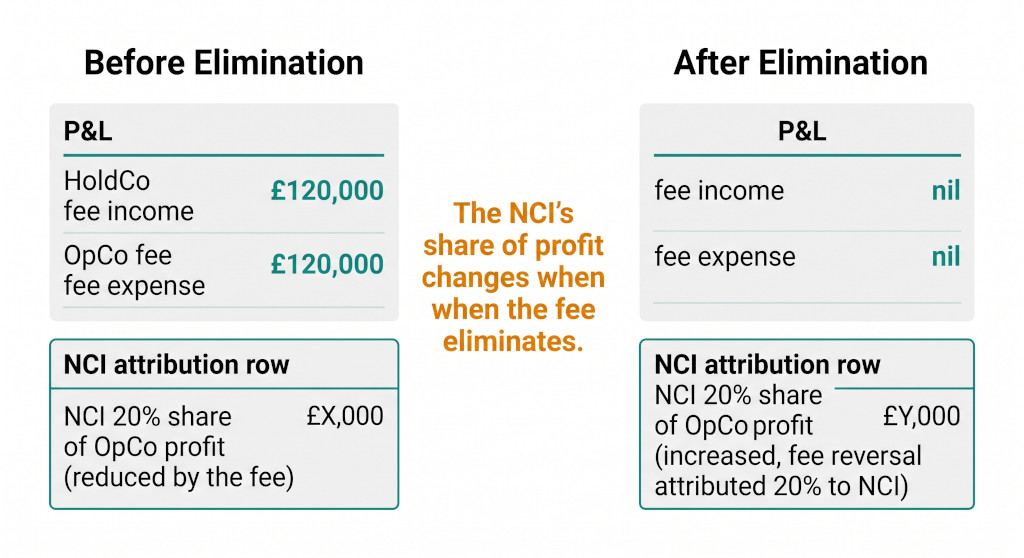
When the management fee flows through a subsidiary that has non-controlling interests, the elimination affects how consolidated profit is split between the owners of the parent and the NCI. The fee is typically a downstream transaction — the parent (HoldCo) charges the subsidiary (OpCo) — which means the elimination reverses an expense in the subsidiary. That expense reversal increases the subsidiary’s profit, and the NCI is entitled to its share of that increase.
Using a 80% HoldCo / 20% NCI ownership of OpCo, with an annual management fee of £120,000:
NCI attribution — effect of management fee elimination
| Before elimination | |
| OpCo reported profit (after the £120,000 fee expense) | £480,000 |
| NCI share of OpCo profit (20% × £480,000) | £96,000 |
| HoldCo management fee income recognised | £120,000 |
| After elimination | |
| Management fee expense reversed in OpCo — OpCo’s profit rises to | £600,000 |
| NCI share of OpCo profit (20% × £600,000) | £120,000 |
| HoldCo management fee income eliminated — reduces HoldCo’s contribution by | (£120,000) |
| Net change in profit attributable to owners of parent | (£24,000) |
| Net change in NCI | +£24,000 |
The elimination has transferred £24,000 of profit from the parent’s shareholders to the NCI — because 20% of the £120,000 expense reversal (£24,000) flows to the minority. This is the standard downstream elimination dynamic: when you reverse a cost in a partly-owned subsidiary, the minority takes its proportionate share of the improvement. The consolidated profit total is unchanged, but the attribution between parent and NCI shifts. Forgetting to update NCI attribution after the elimination is one of the most common review errors in groups with non-wholly-owned subsidiaries.
For the general mechanics of upstream and downstream elimination and their different effects on NCI, see intercompany eliminations when there is a non-controlling interest.
The Timing Mismatch Problem
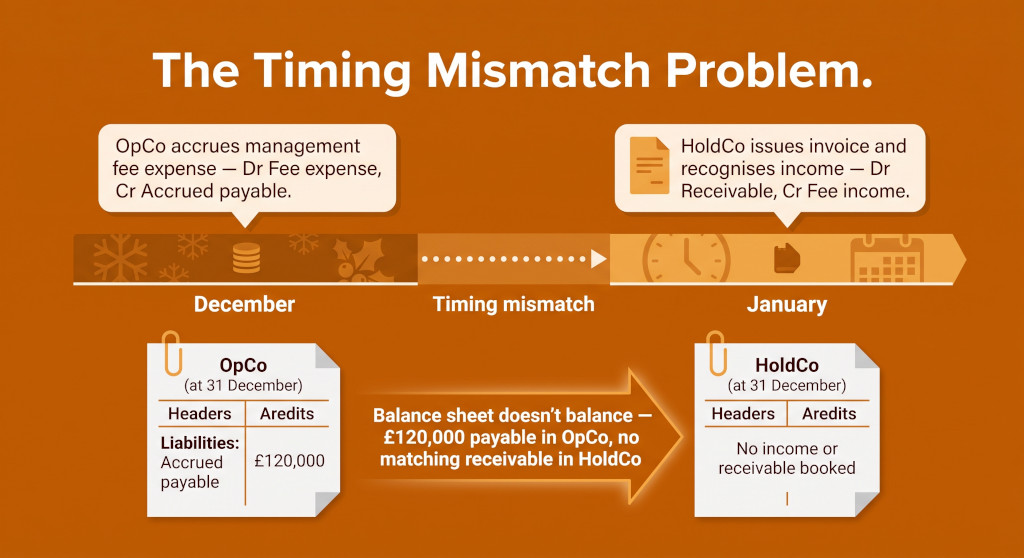
A timing mismatch arises when the paying entity accrues the management fee expense in one period, but the charging entity does not recognise the corresponding income until the next period — typically because it invoices quarterly or annually rather than monthly, or because the invoice is raised in the new financial year.
At 31 December, this produces an asymmetry:
- OpCo’s balance sheet shows a management fee payable (accrued for the December quarter fee not yet invoiced): £30,000.
- HoldCo’s balance sheet shows no corresponding receivable — the fee will only be invoiced and recognised in January.
The consolidation cannot eliminate a receivable that does not exist in HoldCo. The options are:
- HoldCo raises an accrual at 31 December to match OpCo’s payable — creating a £30,000 receivable in HoldCo and £30,000 income that can then be eliminated. This is the cleanest solution and requires a group close policy that mandates matching accruals across entities.
- Post a consolidation-only adjustment — debit OpCo’s payable and credit a suspense account at consolidation, noting the imbalance. This resolves the balance sheet mismatch but leaves a P&L asymmetry that requires explanation.
- Accept the imbalance and disclose it — not recommended for material amounts, as it will attract auditor queries and complicate the intercompany reconciliation.
Year-end timing mismatches are the most common source of intercompany imbalances at consolidation. The fix is a group close policy that requires every entity to confirm and reconcile its intercompany balances against the counterpart entity before close. Any unresolved difference — including mismatched accrual timing — should be raised in the IC reconciliation process before the consolidation workpapers are finalised.
The Arm’s Length Requirement
Management fees must be set at arm’s length — the price that would be agreed between unrelated parties acting in their own interests under comparable circumstances. The arm’s length requirement has three practical implications that consolidation accountants need to understand, even though transfer pricing is typically handled by the tax team:
Tax deductibility: If the fee is not arm’s length, the tax authority in the paying entity’s jurisdiction may disallow part of the deduction. In the consolidated accounts, this creates an asymmetry: the fee expense has been eliminated from the P&L, but if the paying entity’s tax return disallows part of the fee, the consolidated tax charge is higher than expected. The consolidation does not fix a transfer pricing problem — it simply removes the revenue and expense. The tax consequence of a non-arm’s-length fee remains in the consolidated tax line.
Minority interests: A subsidiary with NCI shareholders is exposed to a specific risk: excessive management fees extract value from the subsidiary (and therefore from the minority) and transfer it to the parent. Minority shareholders can challenge management fees that exceed arm’s length as oppressive or prejudicial conduct. For any subsidiary with external minority shareholders, the management fee should be documented against a service agreement that demonstrates the amount charged is reasonable relative to the services received.
Audit scrutiny: Auditors treat intragroup management fees as a related-party transaction requiring specific attention. They will request the underlying service agreement, confirmation that the services described were actually rendered, and evidence that the pricing is supportable. A management fee without documentary support — or at a level that cannot be explained by reference to the underlying costs or comparable transactions — is an audit risk that can delay sign-off.
Tax Rate Differences Between Entities
Where the charging entity and the paying entity are in the same tax jurisdiction at the same rate, the tax consequences of the management fee net to zero from a group perspective: the paying entity’s tax deduction saves exactly as much tax as the income recognition costs the charging entity. The fee is economically neutral for the group’s consolidated tax position.
Where the two entities are in different jurisdictions or subject to different rates, a residual tax difference persists at consolidation even after the fee income and expense have been eliminated. This is the origin of tax-motivated management fee structures — and precisely why tax authorities focus on them. The consolidated tax line will reflect the combined effect of the fee’s deductibility in one jurisdiction and taxability in another; the P&L elimination does not neutralise that asymmetry. If the group has deliberately structured fees to shift profit to lower-tax entities, the auditor and tax advisor need to be involved before the fee level is finalised, not after.
Industry-Specific Variations
The mechanics described above apply universally, but certain industries produce complications that require additional analysis:
- Hotel groups where management fees include a performance-related element (incentive fees based on GOP or EBITDA) create a recognition timing mismatch — the incentive may accrue over the year in OpCo but be recognised only when earned by the manager. See how hotel groups fix the incentive fee consolidation mismatch.
- Restaurant and F&B groups where brand royalties are structured as management fees — the royalty eliminates at consolidation even though it reflects genuine brand value; the elimination does not mean the royalty is wrong, only that it does not appear in the group’s consolidated P&L. See management fees in a restaurant group.
- Manufacturing groups where central procurement, IP, and technology services are charged across entities simultaneously as management fees and royalties — the consolidated elimination treatment is identical but the disclosure requirements differ. See eliminating management fees and royalties in a manufacturing group.
Five Errors That Appear Most Often
- 1 Eliminating one side only The income is eliminated but the expense is not (or vice versa). The elimination must be symmetric — both the revenue in the charging entity and the expense in the paying entity must be removed. Eliminating only one side reduces consolidated profit by the fee amount (if only the income is removed) or increases it by the fee amount (if only the expense is removed).
- 2 Forgetting the balance sheet elimination The P&L is eliminated but the intercompany payable and receivable are left on the balance sheet. This inflates both current liabilities (OpCo’s payable) and current assets (HoldCo’s receivable) by the same amount. Consolidated total assets and total liabilities are both overstated. Auditors will find this in the intercompany reconciliation.
- 3 Missing the NCI attribution adjustment The P&L and balance sheet are correctly eliminated but the NCI’s share of profit is not updated to reflect the reversal of the subsidiary’s fee expense. The consolidated profit total is correct but the attribution between parent shareholders and NCI is wrong. This is most likely to occur when the NCI working is prepared before the intercompany eliminations are finalised.
- 4 Eliminating VAT along with the net fee Where the management fee is subject to VAT, the VAT is not an intercompany income or expense — it is a tax collected by the charging entity and remitted to the tax authority, with a corresponding recovery claim by the paying entity. VAT should be excluded from the elimination journal. Only the net (ex-VAT) fee is eliminated.
- 5 Carrying an unresolved timing mismatch into the signed accounts An accrual in the paying entity that has no matching receivable in the charging entity creates a balance sheet imbalance that cannot be eliminated without a consolidation adjustment. If this is left unresolved at sign-off, the intercompany note in the accounts will not agree to zero — which is an immediate audit query. The fix is either a matching accrual raised by the charging entity before close, or a documented consolidation adjustment with a clear explanation.
For a complete guide to all types of intercompany elimination — not just management fees — see intercompany eliminations: a complete guide for group consolidation. For journal entry mechanics across all consolidation adjustment types, see how to use journal entries in group consolidation. For the intercompany reconciliation process that prevents these errors at source, see intercompany elimination: the foundation of group consolidation.
Management fee eliminations handled automatically at close
BrizoConsol maps intercompany management fee accounts across entities, identifies mismatches, and posts the elimination journals as part of the standard month-end close — so the fee disappears from the consolidated accounts without a manual four-line journal every period. See It in Action