Zoho Books Intercompany Loans in Multi-Currency Groups: Reconciling and Eliminating at Consolidation
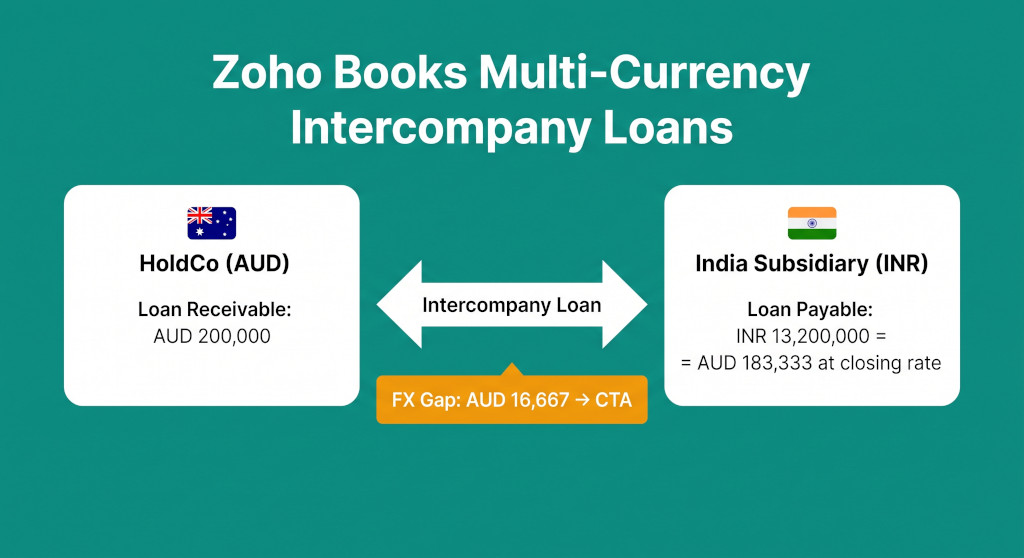
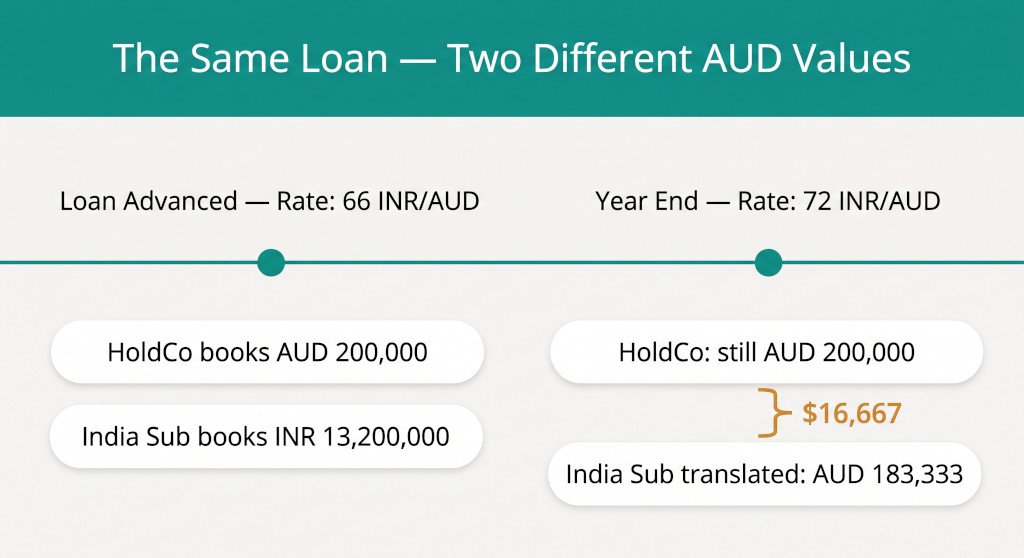
Priya is the group financial controller for an Australian technology services group. The group runs three Zoho Books organisations: the Australian HoldCo (base currency AUD), an Indian development subsidiary (base currency INR), and a Singapore sales entity (base currency SGD). Eighteen months ago, HoldCo advanced AUD 200,000 to the Indian subsidiary to fund its operations. The loan was documented in AUD, at an exchange rate of INR 66 per AUD on the day of transfer — meaning INR 13,200,000 landed in the subsidiary’s bank account.
When Priya sits down to prepare the 30 June consolidated balance sheet, she pulls the intercompany loan accounts from both Zoho organisations. HoldCo shows a loan receivable of AUD 200,000 — unchanged since the advance was made. The Indian subsidiary shows a loan payable of INR 13,200,000 — also unchanged in INR terms. But when Priya translates the Indian payable into AUD at the closing rate of INR 72 per AUD, she gets AUD 183,333. The two figures do not match. There is a AUD 16,667 difference, and she cannot work out whether it is an error in one of the Zoho files or something else entirely.
It is neither. The difference is correct. It is an exchange difference arising from the movement in the AUD/INR rate since the loan was advanced — and it belongs in other comprehensive income as part of the group’s cumulative translation adjustment, not in either entity’s accounts. Understanding this distinction is essential for any Zoho Books group with intercompany loans across currency boundaries, because mishandling it will either produce a spurious reconciliation difference that gets carried forward for years, or it will send a currency movement through consolidated profit or loss where it does not belong.
Group consolidation for Zoho Books — fast and accurate.
Connect your Zoho Books organisations and consolidate into one clean group view.
Why Multi-Currency Intercompany Loans Always Produce a Balance Mismatch
In a same-currency group, an intercompany loan mismatch typically means one entity recorded a transaction that the other did not, or the dates are misaligned. The fix is to find the missing or mis-dated entry and correct it. In a multi-currency group, the situation is fundamentally different. Even if both Zoho organisations have recorded every transaction perfectly and on the correct date, the loan balances expressed in the group’s presentation currency will diverge over time as the exchange rate moves.
Here is why. HoldCo advanced AUD 200,000. That AUD 200,000 is a monetary asset sitting on HoldCo’s balance sheet — it never gets retranslated because HoldCo’s functional currency is AUD and the loan is denominated in AUD. The Indian subsidiary received INR 13,200,000. That INR balance is a monetary liability in the subsidiary’s own books — it also never gets retranslated within the Zoho INR organisation because the subsidiary records everything in INR.
The difference emerges at consolidation. When the group prepares its consolidated financial statements, the Indian subsidiary’s entire trial balance must be translated into the group’s presentation currency (AUD). For monetary items on the balance sheet — including the intercompany loan payable — AASB 121 requires translation at the closing rate on the reporting date. At 30 June, the closing rate is INR 72 per AUD. INR 13,200,000 ÷ 72 = AUD 183,333. HoldCo’s receivable is still AUD 200,000. The difference — AUD 16,667 — is the exchange gain or loss on the intercompany monetary item, and it has a specific home in the consolidated accounts that is not the P&L.
For intercompany monetary items where settlement is neither planned nor likely in the foreseeable future, AASB 121.32 treats the exchange difference as part of the entity’s net investment in the foreign operation. The difference goes to other comprehensive income (OCI) as part of the cumulative translation adjustment (CTA) — not through consolidated profit or loss. Most intercompany loans in group structures fall into this category.
Step 1: Confirm the Loan Is Correctly Recorded in Both Zoho Organisations
Before treating any difference as a translation difference, confirm that both Zoho organisations have recorded the same underlying transactions. The reconciliation starts in the loan’s denomination currency — in Priya’s case, INR — because that is the currency in which the Indian subsidiary measures the obligation.
| Movement | HoldCo (AUD) | India Sub (INR) | India Sub (INR ÷ 66, advance rate) |
|---|---|---|---|
| Loan advanced | AUD 200,000 | INR 13,200,000 | AUD 200,000 |
| Repayments made | — | — | — |
| Closing balance | AUD 200,000 | INR 13,200,000 | AUD 200,000 |
When both sides are expressed at the advance rate, they agree at AUD 200,000. This confirms the underlying INR amount is correct — there are no missing entries, no timing differences, no errors in either Zoho file. The mismatch is purely a rate movement since the loan was advanced.
Watch out: Do not ask the Indian subsidiary to restate the INR payable at the current rate in its own Zoho file. The loan payable is INR 13,200,000 regardless of where the AUD/INR rate moves — that is the contractual obligation in INR. Adjusting the Zoho INR balance to “match” HoldCo at the closing rate would be incorrect and would misrepresent the subsidiary’s liabilities. The translation adjustment belongs in the consolidation working paper, not in the entity accounts.
Step 2: Translate Both Sides to the Presentation Currency
With the loan confirmed as correctly recorded in both organisations, Priya translates both sides into AUD at the closing rate for consolidation:
| HoldCo — Loan Receivable (already in AUD, no translation needed) | AUD 200,000 |
| India Sub — Loan Payable (INR 13,200,000 ÷ closing rate 72) | AUD 183,333 |
| Exchange difference — AUD receivable vs AUD equivalent of INR payable | AUD 16,667 |
The AUD 16,667 is the translation loss on the intercompany loan from HoldCo’s perspective (the AUD value of what is owed to it has declined as INR has weakened against AUD). From the India subsidiary’s perspective, there is no exchange gain or loss within its own accounts — it always owed INR 13,200,000 and that has not changed. The exchange movement only becomes visible when you bring the two organisations together in a common currency at consolidation.
Step 3: Classify the Exchange Difference — OCI, Not P&L
The critical question for any group with a cross-currency intercompany loan is whether the exchange difference goes through profit or loss or through other comprehensive income. The answer depends on the nature of the loan.
Under AASB 121.32, exchange differences on monetary items that form part of a reporting entity’s net investment in a foreign operation must be recognised in OCI in the consolidated financial statements. A monetary item qualifies as part of the net investment when settlement is not planned or likely in the foreseeable future. Most intercompany loans in group structures — particularly where the loan funds the subsidiary’s general operations rather than a specific short-term transaction — satisfy this condition.
Where the condition is satisfied, the AUD 16,667 difference goes to the CTA in consolidated OCI — it does not affect consolidated profit or loss. It will reverse through P&L only when the Indian subsidiary is eventually disposed of and the cumulative CTA relating to that entity is recycled. For a detailed treatment of how CTA accumulates and releases on disposal, see How to Calculate the Cumulative Translation Adjustment (CTA) in Group Consolidation.
If the loan is short-term and settlement is expected in the near term, the exchange difference goes through P&L instead — classified within finance costs or foreign exchange gains/losses. Groups should document the nature of each intercompany loan and the classification conclusion at the time the loan is made, so the treatment is applied consistently and does not shift between periods.
Step 4: Post the Elimination Entry
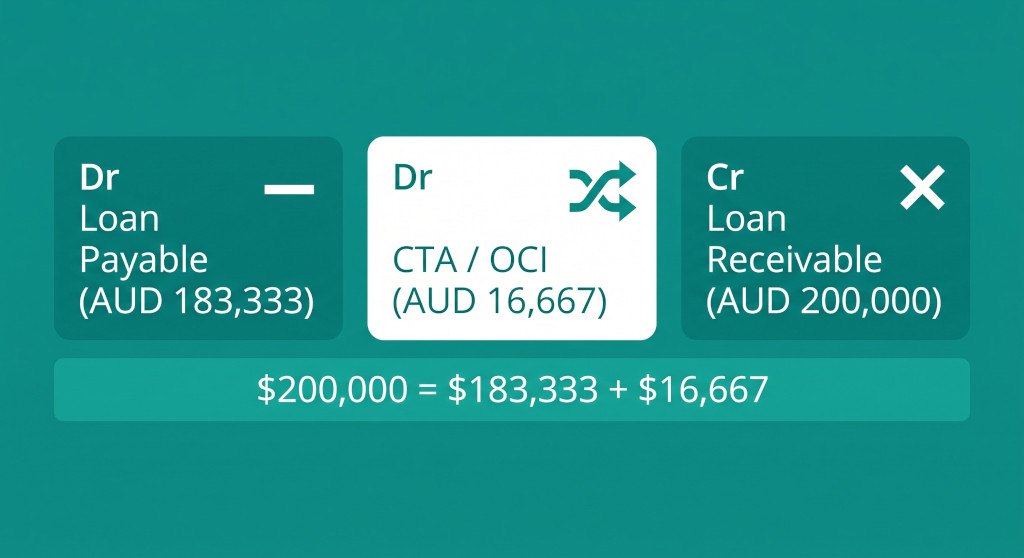
With the classification confirmed, Priya posts the elimination in the consolidation working paper. The entry removes both the receivable and the translated payable from the consolidated balance sheet and routes the exchange difference to OCI:
| Account | Dr | Cr |
|---|---|---|
| Intercompany Loan Payable — HoldCo (India Sub, translated at closing rate) | AUD 183,333 | |
| Cumulative Translation Adjustment — OCI | AUD 16,667 | |
| Intercompany Loan Receivable — India Sub (HoldCo) | AUD 200,000 |
AUD 183,333 + AUD 16,667 = AUD 200,000. This eliminates both sides of the loan from the consolidated balance sheet. The AUD 16,667 debit to OCI/CTA reflects the translation loss on the net investment in the Indian subsidiary — it does not pass through consolidated profit or loss. This entry is posted in the consolidation working paper only; neither Zoho organisation is adjusted.
After this entry, the consolidated balance sheet shows neither a loan receivable nor a loan payable for this arrangement. The AUD 16,667 sits in the group’s cumulative translation adjustment within consolidated equity, alongside all other translation differences arising from the Indian subsidiary’s trial balance translation. When Priya reviews Why Does My CTA Not Reconcile, this intercompany loan translation difference is one of the items her CTA roll-forward must capture to explain the movement in OCI for the period.
Zoho Books Group With Foreign Subsidiaries?
BrizoConsol connects to your Zoho Books organisations, handles multi-currency translation at the correct rates, reconciles intercompany balances across currencies, and routes exchange differences to the right place — OCI or P&L — without a consolidation spreadsheet in sight. See It In Action
The Same-Currency Case: When Zoho Loan Mismatches Are Just Timing
Not all Zoho Books intercompany loan mismatches are translation differences. Groups with entities in the same currency — for example, two Australian Zoho organisations both operating in AUD — face the same kind of mismatch described in the context of any multi-entity platform: one entity processes a repayment before the period end, the other records it after. The reconciliation approach is the same as for any same-currency intercompany loan: compare the two Zoho balances transaction by transaction, identify the timing or entry error, correct it in the relevant Zoho file, and then post the elimination.
The key distinction is that in a same-currency group, the reconciliation difference should always be explainable by specific transactions — a payment processed late, a journal not yet entered, a bank import misrouted to the wrong account. If both entities agree on the underlying transactions and the difference persists, there is an entry error somewhere. In a multi-currency group, a difference that exactly equals the FX movement on the opening balance is almost certainly a translation difference, not an error — and should be treated accordingly.
Groups with a mix of same-currency and cross-currency intercompany loans need to reconcile each loan separately, classifying the difference for each one before deciding how to eliminate it. The general framework for building and maintaining an intercompany loan reconciliation register is covered in Intercompany Eliminations in Multi-Currency Groups.
Interest on Multi-Currency Intercompany Loans
If the intercompany loan carries interest — as most arm’s-length intercompany loans should — the interest itself creates an additional cross-currency flow. HoldCo charges interest in AUD. The Indian subsidiary pays interest in INR, converting at whatever rate applies on the payment date. By year end, the cumulative interest income recorded by HoldCo (in AUD) and the cumulative interest expense recorded by the Indian subsidiary (in INR, translated to AUD) will also differ slightly due to rate movements between payment dates.
The interest P&L elimination works the same way as for a same-currency group — Dr Interest Income (HoldCo), Cr Interest Expense (India Sub, translated to AUD) — but the two figures will not be equal if the rate has moved since the interest was accrued or paid. The difference goes through consolidated P&L as a foreign exchange gain or loss, because interest charges are a trading item, not a net investment item. The AASB 121.32 OCI treatment applies only to the principal balance of a qualifying net investment monetary item, not to the income flows from it.
Watch out: Do not route the interest rate difference to OCI alongside the principal translation difference. Interest income and expense are P&L items; their FX differences are P&L items. Only the principal balance of a qualifying net investment monetary item goes to OCI. Conflating the two is a common source of CTA reconciliation errors in multi-currency groups. For the full treatment of intercompany loan elimination complications, see Intercompany Loan Eliminations: A Practical Guide to the Complications That Matter.
What Zoho Books Cannot Do — and Where the Work Lives
Zoho Books records transactions faithfully within each organisation in its base currency. It does not perform intercompany loan reconciliation across organisations, it does not translate balances at multiple rates for consolidation purposes, and it does not route exchange differences between P&L and OCI based on the nature of the intercompany relationship. All of that work happens outside Zoho, in a consolidation working paper or dedicated consolidation software.
For groups with one or two intercompany loans in simple currency pairs, a well-structured spreadsheet with a per-loan reconciliation tab can handle the process. As the group grows — more entities, more currencies, more loans, more interest accruals — the manual process becomes the primary source of consolidation risk. A loan table that was easy to maintain with two entities and one loan becomes a document that no one fully trusts by the time the group has five entities and eight active loan arrangements across three currency pairs. How to Consolidate Multiple Zoho Books Organisations Without Excel explains the broader process and where dedicated consolidation tools change the picture.
Practical Checklist: Multi-Currency Intercompany Loans in Zoho Books Groups
- List every intercompany loan across all Zoho organisations, noting the denomination currency, the lender entity, the borrower entity, and the original amount and rate.
- Reconcile in the denomination currency first. Express both sides of the loan in the denomination currency and confirm they agree. If they do not agree, find the missing or incorrect transaction before proceeding.
- Translate to presentation currency at the closing rate. Apply the period-end exchange rate to the borrower entity’s balance to arrive at the AUD (or group presentation currency) equivalent.
- Calculate the exchange difference. Lender’s AUD balance minus borrower’s translated AUD equivalent. This is the amount that needs to be classified and routed correctly.
- Classify the exchange difference. If the loan forms part of the net investment in a foreign operation (settlement not planned or likely), route to OCI/CTA. If the loan is short-term and expected to settle, route to P&L as FX gain/loss.
- Post the elimination entry. Dr Loan Payable (translated at closing rate) + Dr CTA or Dr FX P&L (the exchange difference) = Cr Loan Receivable (lender’s carrying amount in presentation currency).
- Eliminate interest separately. Dr Interest Income (lender), Cr Interest Expense (borrower, translated). Route any difference between the two sides to P&L as an FX item — not to OCI.
- Update the CTA roll-forward. Add the intercompany loan translation difference to the CTA movement schedule for the relevant subsidiary. Confirm it reconciles to the OCI movement in the consolidated statement of comprehensive income.
- Document the net investment assessment for each loan and retain it as audit evidence. The classification between OCI and P&L is a judgment that your auditor will ask to see supported.
Ready to Remove Multi-Currency Intercompany Loans From Your Month-End Problem List?
BrizoConsol connects to your Zoho Books organisations, translates intercompany loan balances at the correct rates, and routes exchange differences to OCI or P&L automatically. Start your free trial today. Start Free Trial