ASC 842 Leases in Group Consolidation: What US GAAP Multi-Entity Groups Need to Know
When ASC 842 replaced ASC 840, the most headline-grabbing change was straightforward: operating leases, previously kept off balance sheet, now appear as right-of-use assets and lease liabilities. For an individual entity, the mechanics of recognising those balances are well-documented by now. For a multi-entity US GAAP group preparing consolidated financial statements, however, ASC 842 introduces a layer of complexity that the standard itself addresses only indirectly. When one group entity leases property to another, what happens to the right-of-use asset in the consolidated accounts? When a subsidiary in another country holds leases denominated in a foreign currency, how does the lease liability interact with ASC 830 translation? And when the parent company needs consistent lease accounting policies across a group where some entities adopted ASC 842 under the modified retrospective method and others under full retrospective, how does that affect the consolidated comparatives?
This guide focuses on ASC 842 from a group consolidation perspective — the mechanics of recognising and measuring leases, the operating versus finance lease distinction that ASC 842 retained, the intercompany lease elimination process and the ghost asset trap it creates, and the key practical differences from IFRS 16 that matter for groups with both US GAAP and IFRS entities.
What ASC 842 Changed and What It Kept
ASC 842 put nearly all leases on the balance sheet for lessees. Under its predecessor ASC 840, operating leases were off-balance-sheet commitments disclosed in the footnotes. The new standard requires any lease with a term of more than twelve months to be recognised as a right-of-use (ROU) asset representing the lessee’s right to use the underlying asset and a corresponding lease liability representing the obligation to make lease payments.
Stop building consolidations in spreadsheets.
BrizoConsol automates multi-entity consolidation — setup in minutes, reports the same day.
What ASC 842 did not eliminate — unlike IFRS 16 — is the operating versus finance lease distinction for lessees. Under IFRS 16, almost all leases are treated as finance leases (the right-of-use model applies without classification). Under ASC 842, lessees still classify each lease as either operating or finance, and the income statement treatment differs significantly between the two categories. This distinction has real consequences for group P&L presentation and for how the lease balances are described in the notes.
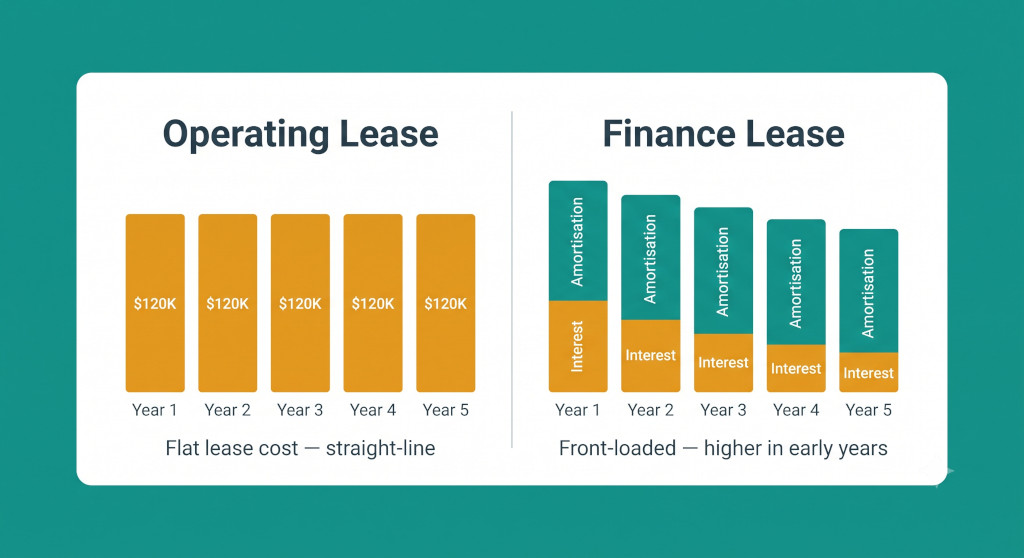
For operating leases under ASC 842, the lessee recognises a single straight-line lease cost each period — effectively the same total expense as under old ASC 840, just now with an ROU asset and lease liability on the balance sheet. The balance sheet grew; the income statement pattern did not change.
For finance leases, the lessee recognises amortisation of the ROU asset (typically straight-line) separately from interest expense on the lease liability (calculated under the effective interest method). This produces a front-loaded total expense — interest is highest in early years when the liability balance is largest — identical to the treatment of a bought asset financed by borrowing.
Finance Lease Classification Criteria Under ASC 842
A lease is classified as a finance lease if any one of five criteria is met at the commencement date:
- The lease transfers ownership of the underlying asset to the lessee by the end of the lease term.
- The lessee has an option to purchase the underlying asset that it is reasonably certain to exercise.
- The lease term is for the major part of the remaining economic life of the asset — the ASC 842 bright line is 75% of remaining economic life.
- The present value of lease payments plus any residual value guaranteed by the lessee amounts to substantially all of the fair value of the underlying asset — the bright line is 90% of fair value.
- The underlying asset is of such a specialised nature that it is expected to have no alternative use to the lessor at the end of the lease term.
These criteria will be familiar to anyone who encountered the old ASC 840 capital lease classification tests — they are similar in structure, though slightly revised. In practice, most real estate leases (offices, warehouses) fail all five criteria and are classified as operating leases. Most equipment leases where the group effectively intends to own the asset eventually will meet one or more criteria and be classified as finance leases.
Groups that operate across both US GAAP (ASC 842) and IFRS (IFRS 16) should note that a lease classified as an operating lease under ASC 842 would typically be treated as a finance-type lease under IFRS 16 — the distinction does not exist for IFRS lessees. This means the consolidated income statement under US GAAP will show flat lease costs for operating leases; if the same lease were held in an IFRS subsidiary, the IFRS 16 treatment would front-load the expense. Cross-framework groups need to be aware of this asymmetry when consolidating entities that apply different standards.
Recognising the Right-of-Use Asset: A Worked Example
A US GAAP subsidiary enters into a five-year lease of office space with annual payments of $120,000 payable at the end of each year. The incremental borrowing rate is 5%. The lease does not meet any of the finance lease criteria; it is an operating lease under ASC 842. Payments are equal, so the straight-line lease cost equals the annual payment of $120,000.
PV of lease payments (5 years, $120,000/yr, 5% IBR):
Year 1: $120,000 ÷ 1.050 = $114,286
Year 2: $120,000 ÷ 1.103 = $108,844
Year 3: $120,000 ÷ 1.158 = $103,660
Year 4: $120,000 ÷ 1.216 = $98,724
Year 5: $120,000 ÷ 1.276 = $94,023
ROU Asset & Lease Liability at commencement $519,537
At lease commencement, the lessee records:
Dr Right-of-use asset $519,537
Cr Lease liability $519,537
Initial recognition of operating lease ROU asset and liability under ASC 842-20-30.
Each year, the lease cost is recognised straight-line. The lease liability rolls forward using the effective interest method, and the ROU asset is reduced by the difference between the straight-line lease cost and the interest on the liability. The table below shows the balance sheet and income statement impact across all five years.
| Year | Opening Liability | Interest (5%) | Cash Payment | Closing Liability | ROU Reduction | Closing ROU | P&L Lease Cost |
|---|---|---|---|---|---|---|---|
| 1 | 519,537 | 25,977 | (120,000) | 425,514 | 94,023 | 425,514 | 120,000 |
| 2 | 425,514 | 21,276 | (120,000) | 326,790 | 98,724 | 326,790 | 120,000 |
| 3 | 326,790 | 16,340 | (120,000) | 223,130 | 103,660 | 223,130 | 120,000 |
| 4 | 223,130 | 11,157 | (120,000) | 114,287 | 108,843 | 114,287 | 120,000 |
| 5 | 114,287 | 5,714 | (120,000) | 1 | 114,286 | 1 | 120,000 |
| Total | 80,464 | (600,000) | 519,536 | 600,000 |
The straight-line lease cost of $120,000 per year equals the cash payment — because payments are level, the straight-line cost and cash are the same. The key change from pre-ASC 842 is solely on the balance sheet: the ROU asset and lease liability both appear, declining in tandem each year to zero at lease expiry.
Under a finance lease with the same economics, the P&L would look different. The ROU asset would be amortised straight-line at $103,907 per year ($519,537 ÷ 5) while interest expense would follow the effective interest curve — $25,977 in Year 1, declining to $5,714 in Year 5. Total Year 1 expense would be $129,884 versus $120,000 for the operating lease; Year 5 expense would be $109,621 versus $120,000. The finance lease front-loads expense; the operating lease distributes it evenly. The present value recognised on the balance sheet on Day 1 is identical under both treatments.
ASC 842 across every entity in your group — automated
BrizoConsol calculates ROU assets, rolls lease liabilities, and posts the consolidation eliminations — connected directly to Xero, QuickBooks, MYOB, or Zoho Books. See It in Action
The Short-Term Exemption: What ASC 842 Allows (and What It Doesn’t)
ASC 842 provides a practical expedient for short-term leases: a lessee may elect, by class of underlying asset, not to apply the recognition requirements to leases with a term of twelve months or less at the commencement date, including any renewal options that the lessee is reasonably certain to exercise. When elected, the lease payments are recognised as lease cost on a straight-line basis over the lease term — the old-style off-balance-sheet treatment.
The election is made by class of underlying asset, not lease by lease. A group that elects the short-term exemption for vehicle leases must apply it to all vehicle leases with terms of twelve months or less; it cannot pick individual leases within the same class.
What ASC 842 does not provide — and this is a material difference from IFRS 16 — is a low-value asset exemption. IFRS 16 allows lessees to exclude from recognition leases where the underlying asset has a value when new of approximately $5,000 or below (the IASB’s illustrative threshold), applied on a lease-by-lease basis regardless of asset class. Under ASC 842, there is no equivalent exemption. A fleet of five hundred laptop computers, each individually low-value, must still go through the ASC 842 recognition process unless they qualify as short-term leases or meet the definition of a service contract rather than a lease. For multi-entity US GAAP groups with large numbers of small-ticket leases — equipment, vehicles, technology assets — this distinction has a meaningful impact on the volume of lease contracts that need to be captured and maintained in the lease accounting system.
No low-value exemption under ASC 842: Groups that apply both ASC 842 (for US GAAP entities) and IFRS 16 (for IFRS entities) will find that their IFRS subsidiaries can exclude low-value leases from the balance sheet while their US GAAP entities cannot. When preparing consolidated financial statements under US GAAP, all leases of IFRS subsidiaries that are below the low-value threshold but above the short-term threshold must be recognised on balance sheet — the IFRS 16 exemption does not carry over into the US GAAP consolidation. The group must track which leases the IFRS subsidiaries excluded under the low-value exemption and add them back for consolidation purposes.
Intercompany Leases: The Ghost Asset Trap
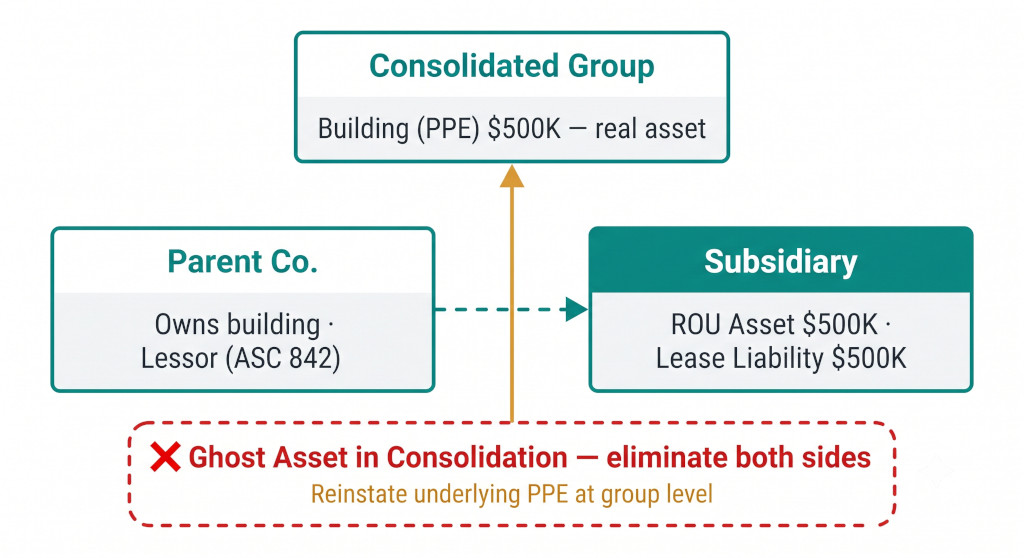
The most practically significant ASC 842 issue for multi-entity US GAAP groups is the treatment of intercompany leases in consolidation. Consider the most common scenario: the parent company owns a building and leases it to a subsidiary. From the subsidiary’s perspective, this is a lease that must be accounted for under ASC 842 — it recognises a right-of-use asset and a lease liability on its individual financial statements. From the parent’s perspective, it is a lessor recognising rental income and a lease receivable (or, for a direct financing lease, a net investment in the lease).
At the consolidation level, both the intercompany receivable and the intercompany payable must be eliminated, and the intercompany rental income and rental expense must be eliminated against each other. So far, this is standard intercompany elimination. The complication is what remains after the elimination: the subsidiary’s right-of-use asset sitting on the consolidated balance sheet.
That ROU asset represents the subsidiary’s right to use the parent’s building. In the consolidated accounts, the group already owns the building outright — it appears as property, plant, and equipment on the parent’s balance sheet. The subsidiary’s ROU asset is therefore a ghost: it represents a right that the group, as a whole, does not need to recognise because the group owns the underlying asset directly.
The correct consolidation treatment is to:
- Eliminate the intercompany lease receivable (parent) against the lease liability (subsidiary) — standard intercompany monetary item elimination.
- Eliminate the intercompany rental income (parent) against the rental expense (subsidiary) — standard intercompany P&L elimination.
- Remove the subsidiary’s right-of-use asset from the consolidated balance sheet — it is a ghost asset that duplicates the parent’s owned building.
- Ensure the parent’s underlying property, plant, and equipment is correctly presented in the consolidated accounts at its own carrying value, not displaced by the ROU asset.
- Adjust the consolidated depreciation/amortisation charge: replace the subsidiary’s ROU amortisation with the parent’s PPE depreciation on the underlying asset.
Common mistake: Eliminating only the intercompany receivable and payable, and leaving the subsidiary’s ROU asset on the consolidated balance sheet. The result is that the group’s own building appears twice in the consolidated accounts — once as PPE (parent) and once as an ROU asset (subsidiary). This overstates total assets and is incorrect. The ghost asset must be removed. Many consolidation workbooks that were built before ASC 842 lack a specific step for this elimination, making it an easy item to miss in the first post-adoption consolidation cycle.
The intercompany lease ghost asset problem is not unique to ASC 842 — the same issue arises under IFRS 16 and, historically, under ASC 840 for capital leases. What ASC 842 changed is the volume of leases it affects: operating leases were previously off-balance-sheet and created no ghost asset in consolidation. Post-ASC 842, every intercompany operating lease of more than twelve months creates a ghost asset that must be eliminated.
Foreign Currency Leases in Multi-Currency Groups
For US GAAP groups with foreign subsidiaries, leases denominated in a foreign currency interact with ASC 830 translation. The lease liability is a monetary item — it must be translated at the closing rate at each balance sheet date, with exchange differences recognised in the cumulative translation adjustment (CTA) account within equity, not in profit or loss (assuming the subsidiary’s functional currency differs from the presentation currency).
The right-of-use asset, by contrast, is a non-monetary item in the individual subsidiary’s accounts — measured at cost and not retranslated at subsequent dates in the subsidiary’s own functional-currency statements. However, when the entire subsidiary is translated into the group’s presentation currency under the current rate method of ASC 830, all assets and liabilities (including the ROU asset) are translated at the closing rate, generating a CTA movement that is recognised in OCI and accumulated in equity as part of the foreign currency translation reserve.
The practical result: in a group where the US dollar is the presentation currency and a European subsidiary holds euro-denominated leases, the dollar value of both the ROU asset and the lease liability will move each period with the USD/EUR exchange rate, generating CTA movements. These are not P&L items under ASC 830. For a full treatment of the current rate method and CTA mechanics, see our ASC 830 guide for multi-entity groups.
ASC 842 vs IFRS 16: What Actually Differs
For groups that apply both standards — US GAAP for some entities, IFRS for others — understanding where ASC 842 and IFRS 16 diverge is essential for avoiding consolidation errors and for communicating the group’s lease position accurately to stakeholders.
| Area | ASC 842 | IFRS 16 |
|---|---|---|
| Lessee balance sheet recognition | All leases >12 months: ROU asset + lease liability | Same |
| Operating vs finance lease distinction (lessee) | KEY DIFFERENCE Retained. Operating = flat P&L; Finance = front-loaded P&L | Eliminated. All leases treated as finance-type; always front-loaded |
| Low-value asset exemption | KEY DIFFERENCE Not available | Available (≈<$5,000 when new); applied lease-by-lease |
| Short-term exemption (≤12 months) | Available; elected by class of underlying asset | Available; elected on lease-by-lease or class basis |
| Discount rate | IBR if implicit rate not readily determinable. Private company practical expedient: use risk-free rate | IBR if implicit rate cannot be readily determined. No risk-free rate expedient |
| Variable lease payments | Index/rate-based: included in lease liability. Other variable: excluded | Same |
| Sublease presentation (lessor) | Lessor accounting largely unchanged from ASC 840; operating vs direct financing vs sales-type | Operating vs finance sublease |
| Income statement line presentation | Operating lease: single “lease cost” line in operating expenses. Finance lease: amortisation + interest (below operating income) | Amortisation in operating expenses; interest in finance costs — always split, for all leases |
| Effective date | Public entities: fiscal years beginning after Dec 15, 2018. Private: Dec 15, 2021 | Annual periods beginning on or after 1 Jan 2019 |
The operating/finance lease distinction is the most consequential difference for consolidated P&L presentation. A multi-entity group where the parent applies US GAAP and subsidiaries apply IFRS will present lease costs differently depending on where the lease sits — and the consolidated US GAAP statements will need to confirm that IFRS subsidiaries’ lease accounting is mapped correctly into the US GAAP presentation framework, including the classification of what IFRS would treat as a single right-of-use expense into either operating or finance lease treatment for US GAAP purposes.
For the full IFRS 16 mechanics including a worked finance lease example, intercompany elimination treatment under IFRS, and a comparison with FRS 102 lease accounting, see our IFRS 16 guide for multi-entity groups.
ASC 842 in the Consolidation Process: A Practical Checklist
- Inventory all leases across group entities. Confirm which leases exceed twelve months and must be recognised. Confirm the short-term exemption election by asset class for each entity, and document whether it is consistent across the group (consistency is not required by ASC 842 but is recommended for consolidation clarity).
- Classify each lease: operating or finance. Apply the five criteria at commencement date. Document the classification, particularly for leases that are close to the 75% economic life or 90% fair value bright lines.
- Calculate the ROU asset and lease liability at commencement. Use the implicit rate if readily determinable; otherwise use the incremental borrowing rate. For private company entities, consider whether the risk-free rate practical expedient is in use and ensure consistency within the group.
- Roll the lease liability using the effective interest method each period. Reduce the ROU asset by the difference between the straight-line lease cost (operating) or straight-line amortisation (finance) and the interest accrual.
- Identify all intercompany leases. Map every lease from one group entity to another. For each: eliminate the receivable/payable, eliminate the income/expense, and remove the lessee’s ROU asset as a ghost asset from the consolidated balance sheet. Reinstate the lessor entity’s underlying PPE at group level.
- For foreign-currency leases, confirm CTA treatment. Lease liabilities are monetary items — their CTA movements are part of the subsidiary’s overall ASC 830 translation adjustment and go to OCI. Do not run them through P&L in the consolidation.
- For IFRS subsidiaries consolidated into a US GAAP parent: Confirm that leases excluded under the IFRS 16 low-value exemption are added back into the consolidated balance sheet for US GAAP reporting. Confirm that the single IFRS 16 lease expense line is reclassified into operating or finance lease treatment for US GAAP presentation purposes.
- Reconcile the consolidated lease liability note. ASC 842 requires a maturity analysis of future lease payments by year and in aggregate, separated by operating and finance leases. Build this from the individual entity schedules, after eliminating intercompany leases.
BrizoConsol maintains lease schedules by entity and rolls the ROU asset and liability calculations automatically each period, applying the correct interest rate and P&L treatment for operating versus finance leases. The consolidation module eliminates intercompany leases — including the ghost asset adjustment — and flags any IFRS subsidiaries with low-value lease exclusions that need to be added back for a US GAAP consolidation. For the broader multi-entity close process, our month-end close checklist sets out where lease accounting fits in the full consolidation sequence. For the consolidation framework that ASC 842 sits within, the ASC 810 consolidation guide covers the full scope of US GAAP group accounting.
Group lease accounting on autopilot
ROU assets, lease liabilities, intercompany eliminations, ghost asset removal — BrizoConsol handles the ASC 842 consolidation mechanics so your close team doesn’t have to. Start free, no credit card required. Start Free Trial