US GAAP Foreign Currency Translation: A Practical Guide to ASC 830 for Multi-Entity Groups
The Australian subsidiary had been running profitably for three years. In its own accounts, denominated in Australian dollars, it had generated AUD 4.2 million in revenue and AUD 680,000 in net income for the year. When the US parent’s finance team sat down to consolidate those numbers into the group’s USD accounts under US GAAP, the subsidiary’s contribution looked quite different: the Australian dollar had weakened by eleven percent against the USD over the reporting period, and the resulting translation adjustments consumed a meaningful portion of the subsidiary’s reported profit at the group level. More confusing still, the team couldn’t work out where the exchange difference should go — was it income, or equity?
The answer depends entirely on ASC 830, the US GAAP standard that governs the translation of foreign currency financial statements. ASC 830 — Foreign Currency Matters — establishes which exchange rates to use for different line items, determines whether translation differences flow through the income statement or sit in other comprehensive income, and sets out the specific steps required to bring a foreign subsidiary’s financials into a USD-denominated consolidated set of accounts. For multi-entity groups with at least one entity operating in a currency other than USD, understanding ASC 830 is not optional; it is the technical foundation on which accurate group accounts are built.
This guide covers the practical mechanics of ASC 830: how to determine a subsidiary’s functional currency, which translation method applies, how to calculate and present the cumulative translation adjustment (CTA), and how ASC 830 compares to its IFRS counterpart, IAS 21. A worked example illustrates the numbers.
Foreign currency consolidation, handled automatically.
BrizoConsol applies the correct CTA/FCTR treatment across all entities — no spreadsheets needed.
What ASC 830 Governs
ASC 830 applies whenever a US GAAP entity has transactions or operations in a currency other than its own reporting currency — which for most US-based groups means USD. The standard covers three distinct situations: foreign currency transactions (a US entity buys or sells in a foreign currency), foreign currency financial statements (a foreign subsidiary reports in a currency other than USD), and intercompany transactions between entities with different functional currencies.
For group consolidation purposes, the most significant part of ASC 830 is Subtopic 830-30, which governs the translation of a foreign subsidiary’s complete set of financial statements into the parent’s reporting currency. This is the process that transforms the Australian subsidiary’s AUD accounts into USD figures for inclusion in the consolidated group accounts. The mechanics of that translation — which rates to apply, where the resulting differences land — depend on a single prior determination: what is the subsidiary’s functional currency?
Determining the Functional Currency
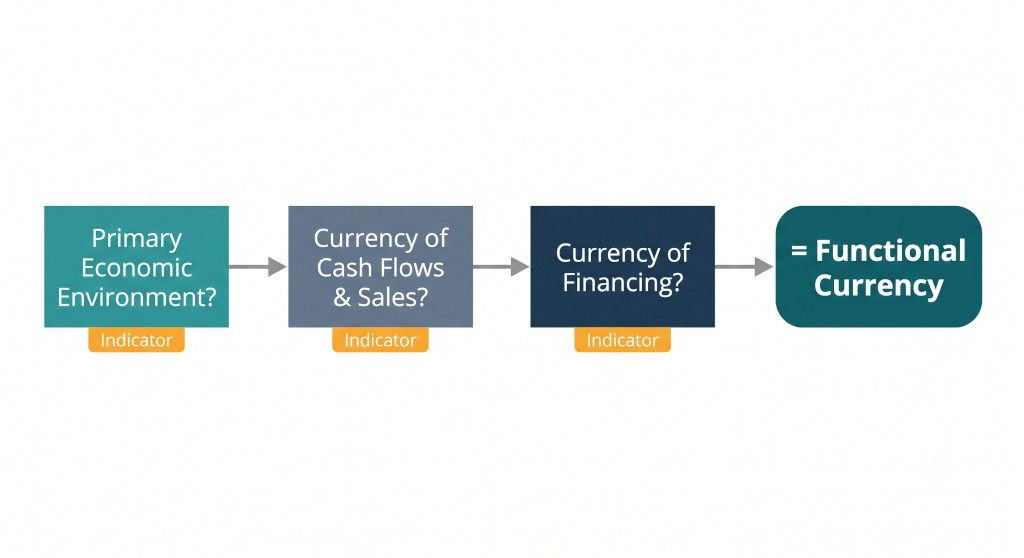
The functional currency is the currency of the primary economic environment in which the entity operates. For most wholly owned foreign subsidiaries that operate independently in their local market — generating revenue, incurring costs, and holding most of their assets in a single non-USD currency — the functional currency will be that local currency. An Australian subsidiary that sells to Australian customers, pays Australian wages, and holds its cash in AUD will almost always have AUD as its functional currency.
But the determination is not always straightforward. ASC 830 identifies a hierarchy of factors to consider when determining the functional currency:
Primary indicators: the currency that primarily determines sales prices; the currency of the country whose competitive forces and regulations mainly influence pricing; and the currency in which labour, materials, and other costs are denominated and settled.
Secondary indicators: the currency in which financing activities are conducted; and the currency in which receipts from operating activities are typically retained.
Where indicators are mixed — a subsidiary that sells in USD but pays costs in EUR — judgement is required. The determination should reflect economic substance, not just the denomination of a majority of transactions. Once made, the functional currency determination should be applied consistently and changed only when there is a significant change in the underlying economic facts.
Common mistake: Some groups default to the parent’s reporting currency (USD) as the functional currency for all subsidiaries, on the basis that the group “operates in USD.” This is only correct where the subsidiary is an extension of the parent — selling in USD, funded in USD, with most decisions made by the US parent. An independent foreign subsidiary with local operations almost always has the local currency as its functional currency, even if the parent reports in USD.
The functional currency determination matters because it dictates which of ASC 830’s two translation methods applies: the current rate method (when the functional currency is a currency other than USD) or the temporal method, also known as remeasurement (when the functional currency is USD but the books are maintained in another currency).
The Two Translation Methods Under ASC 830
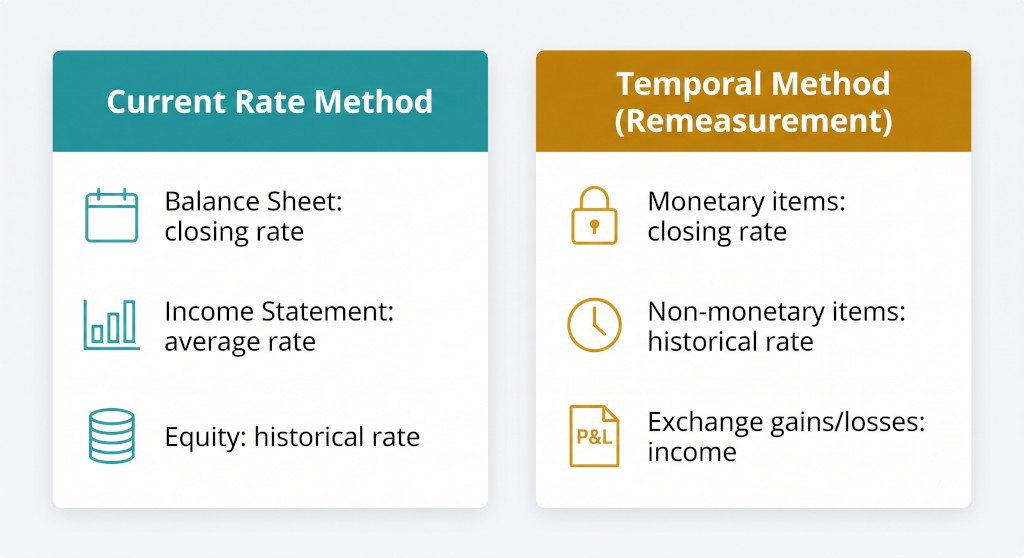
The distinction between the two methods is one of the most practically important aspects of ASC 830, because the methods produce different numbers and route translation differences to different parts of the financial statements.
The Current Rate Method
Applied when the subsidiary’s functional currency is its local currency (the standard case for most independent foreign subsidiaries). Under the current rate method:
Balance sheet items — all assets and liabilities — are translated at the exchange rate in effect at the balance sheet date (the closing rate). This includes both monetary items (cash, receivables, payables) and non-monetary items (inventory, property, plant and equipment), which is the key distinction from the temporal method.
Income statement items — revenues, expenses, gains and losses — are translated at the exchange rate in effect when the transaction occurred. In practice, most groups use a weighted average rate for the period as an approximation, which is permitted by ASC 830 provided exchange rates do not fluctuate significantly.
Equity items — share capital, additional paid-in capital, and retained earnings brought forward — are translated at historical rates (the rates in effect when the equity was contributed or the earnings were generated). Retained earnings for the current period flow from the translated income statement at average rates.
Because balance sheet items are translated at the closing rate but equity is translated at historical rates, a balancing difference arises. This difference — the translation adjustment — is not recognised in the income statement. It is recorded in other comprehensive income (OCI) and accumulates in equity as the cumulative translation adjustment (CTA). This treatment reflects the view that the translation difference is a function of the long-term currency exposure inherent in holding a foreign subsidiary, not a gain or loss from current-period operations.
The Temporal Method (Remeasurement)
Applied when a subsidiary’s functional currency is USD but its books are maintained in a local currency — for example, a holding company incorporated in Luxembourg that books its transactions in EUR but operates primarily in USD. Remeasurement converts those local-currency books into the functional currency (USD) before any consolidation takes place.
Under the temporal method, the translation rates differ by asset type:
Monetary assets and liabilities (cash, receivables, payables, long-term debt) are remeasured at the closing rate, as with the current rate method.
Non-monetary assets and liabilities (inventory at cost, property plant and equipment, prepayments) are remeasured at the historical rate — the rate in effect when the asset was acquired or the liability incurred. This preserves the USD-equivalent cost basis of non-monetary assets.
Income statement items related to non-monetary assets (depreciation, cost of sales for inventory) are remeasured using the historical rate applicable to the underlying asset. Other income and expense items use the transaction date rate or weighted average.
The critical difference from the current rate method: under the temporal method, remeasurement differences are recognised in the income statement as foreign currency gains or losses, not in OCI. Because the subsidiary is essentially operating as a USD entity whose books happen to be in another currency, the translation effects are treated as ordinary transaction gains and losses.
The simplest way to remember the difference: if the subsidiary is genuinely a local-market business (functional currency = local currency), translation differences go to OCI via the current rate method. If the subsidiary is effectively a USD business that happens to book in another currency (functional currency = USD), remeasurement differences go to the income statement via the temporal method.
Calculating the Cumulative Translation Adjustment: A Worked Example
To make the current rate method concrete, consider a simple example. A US parent (reporting in USD) has a wholly-owned UK subsidiary whose functional currency is GBP. At the start of the year, GBP/USD was 1.30. By year-end it had moved to 1.25. The average rate for the year was 1.27.
The subsidiary’s GBP balance sheet and income statement are as follows:
| Item | GBP | Rate Used | USD |
|---|---|---|---|
| Cash and receivables | 480,000 | 1.25 (closing) | 600,000 |
| Property, plant & equipment (net) | 820,000 | 1.25 (closing) | 1,025,000 |
| Other assets | 200,000 | 1.25 (closing) | 250,000 |
| Total assets | 1,500,000 | 1,875,000 | |
| Liabilities | (600,000) | 1.25 (closing) | (750,000) |
| Share capital | (500,000) | 1.30 (historical) | (650,000) |
| Retained earnings b/fwd | (200,000) | 1.30 (historical) | (260,000) |
| Net income (current year) | (160,000) | 1.27 (average) | (203,200) |
| CTA (balancing figure → OCI) | — | — | +11,800 |
| Total liabilities & equity | (1,500,000) | (1,875,000) ✓ |
The CTA of USD 11,800 (a debit, reducing equity) represents the loss arising because the GBP weakened over the period — assets translated at the lower closing rate of 1.25 are worth fewer dollars than they were when translated at the opening rate of 1.30. This amount sits in OCI and does not affect the consolidated income statement. It will only be recycled through the income statement if and when the subsidiary is sold or liquidated — a concept known as CTA recycling or reclassification upon disposal.
The CTA is not a “real” loss in the sense that cash has left the business. It is an accounting consequence of consolidating a self-sustaining foreign operation in a reporting currency that has strengthened relative to the subsidiary’s functional currency. When GBP eventually strengthens, the CTA moves in the opposite direction.
Multi-currency consolidation without the spreadsheet pain
BrizoConsol applies ASC 830 translation rates automatically — closing rate for the balance sheet, average rate for the P&L — and posts the CTA to OCI without manual journals. Connect your entities and get consolidated accounts the same day. See It in Action
Intercompany Balances and Foreign Currency
A frequently misunderstood area of ASC 830 is the treatment of intercompany balances between entities with different functional currencies. When a US parent lends USD to a GBP-functional subsidiary, the subsidiary records a USD-denominated payable in its GBP books. At each balance sheet date, the subsidiary remeasures that payable to GBP at the closing rate — generating a foreign exchange gain or loss in its own income statement each period as the USD/GBP rate moves.
On consolidation, that intercompany balance is eliminated. But the exchange gain or loss recognised in the subsidiary’s P&L does not necessarily disappear. ASC 830-20-35 provides an important exception: if an intercompany loan is of a long-term investment nature — meaning settlement is not planned or anticipated in the foreseeable future — the exchange differences on that loan are recognised in OCI (as part of the CTA) rather than in the income statement, at both the entity level and the consolidated level. This exception applies only when the parent and the counterparty to the loan are consolidated entities, and requires affirmative documentation of the long-term nature of the arrangement.
Common mistake: Groups assume that all intercompany exchange differences are automatically eliminated on consolidation and disappear from the consolidated accounts. They do not — only the intercompany balance itself is eliminated. Exchange gains and losses already recognised in the subsidiary’s income statement on that balance remain in the consolidated P&L unless the long-term investment exception under ASC 830-20-35 applies.
ASC 830 vs IAS 21: Key Differences
For groups that report under both US GAAP and IFRS — or that are consolidating a US GAAP subsidiary into an IFRS parent — the practical differences between ASC 830 and IAS 21 (the IFRS equivalent) are generally limited but worth knowing.
| Area | US GAAP (ASC 830) | IFRS (IAS 21) |
|---|---|---|
| Functional currency concept | Yes — same concept, similar indicators | Yes — materially the same framework |
| Translation of local-currency functional entities | Current rate method: closing rate for B/S, average for P&L | Same: closing rate for B/S, average (or transaction date) for P&L |
| Translation differences | Recognised in OCI; accumulated as CTA in equity | Recognised in OCI; accumulated in a separate equity component |
| Remeasurement (temporal method) | Differences recognised in income statement | Same: differences recognised in profit or loss |
| CTA recycling on disposal | CTA reclassified to income on disposal of a foreign operation | CTA reclassified to profit or loss on disposal |
| Highly inflationary economies | Use USD as functional currency when three-year cumulative inflation exceeds 100% (ASC 830-10-45-11) | Restate local-currency statements for inflation before translation (IAS 29) |
| Presentation currency | Not a separate concept from reporting currency in ASC 830 | IAS 21 explicitly permits use of a presentation currency different from functional currency |
The most practically significant divergence is the treatment of highly inflationary economies. Under ASC 830, when a foreign subsidiary operates in a country whose cumulative three-year inflation exceeds 100%, the subsidiary’s functional currency is effectively overridden and USD is used as the functional currency — the entity’s financials are remeasured into USD using the temporal method. Under IFRS, IAS 29 takes a different approach: the local-currency statements are first restated for inflation (using a general price index) and then translated into the presentation currency using the closing rate. The two approaches can produce materially different results when applied to the same hyperinflationary subsidiary.
For groups operating in countries such as Argentina, Turkey, or Zimbabwe — where hyperinflationary accounting has been required in recent years — the choice of reporting framework produces one of the most significant differences in consolidated accounts. Our guide to US GAAP vs IFRS key differences covers this and other divergences in the broader context of standards comparison.
How BrizoConsol Handles ASC 830 Translation
For multi-entity groups applying ASC 830, the translation process at each consolidation involves applying different exchange rates to different line items, calculating the CTA as a balancing figure, posting it to OCI, and aggregating it into the consolidated equity section. Doing this manually across several foreign subsidiaries, in a spreadsheet, with monthly exchange rate updates, is where errors consistently appear — particularly when rates are applied inconsistently between the balance sheet and income statement, or when CTA balances from prior periods are not correctly carried forward.
BrizoConsol connects directly to your accounting software — Xero, QuickBooks, MYOB, or Zoho Books — and applies ASC 830 translation rates automatically at each consolidation run. The system uses the closing rate for balance sheet line items and the average rate for the income statement, calculates the CTA as the balancing difference, and posts it to OCI without requiring manual journal entries. Historical CTA balances are accumulated correctly period over period, and the audit trail for each exchange rate applied is maintained in full.
For groups that have subsidiaries operating under different accounting frameworks — IFRS subsidiaries alongside US GAAP entities — BrizoConsol supports framework tagging at the entity level, so the appropriate translation rules are applied to each subsidiary based on its designated standard. You can see the full feature set on the multi-accounting standards page, and a broader explanation of what consolidation software handles mechanically in our guide to financial consolidation software and what it does.
Applying ASC 830 in Practice: Summary Steps
For finance teams approaching ASC 830 for the first time — or revisiting it after a period of doing the translation manually — the following sequence covers the core process for each foreign subsidiary at each consolidation date.
- Determine the functional currency. Apply the primary and secondary indicators from ASC 830-10-55. Document the determination; it should be reconsidered only if facts change materially.
- Identify the applicable method. Functional currency = local currency → current rate method. Functional currency = USD but books in local currency → temporal method (remeasurement).
- Gather the exchange rates. Current rate method requires the closing rate at period end and an average rate for the period. Temporal method additionally requires historical rates for specific non-monetary assets.
- Translate the balance sheet. Under the current rate method: all assets and liabilities at closing rate; equity at historical rates.
- Translate the income statement. Revenues and expenses at average rate (or transaction date rates where rates fluctuate significantly).
- Calculate the CTA. The difference between total translated assets and total translated liabilities plus equity (at historical rates) is the current-period translation adjustment. Add it to the cumulative CTA balance in OCI.
- Eliminate intercompany items. Remove intercompany balances and transactions. Assess whether exchange differences on long-term intercompany loans qualify for OCI treatment under ASC 830-20-35.
- Aggregate into the consolidated accounts. Add translated subsidiary balances to the parent’s USD accounts line by line. CTA sits in equity; no income statement impact under the current rate method.
Ready to automate your ASC 830 translation?
BrizoConsol applies closing and average rates automatically, calculates your CTA, and produces consolidated accounts without manual exchange rate spreadsheets. Start free — no credit card required. Start Free Trial