E-commerce Group Cash Flow Statement: Where the Money Actually Goes
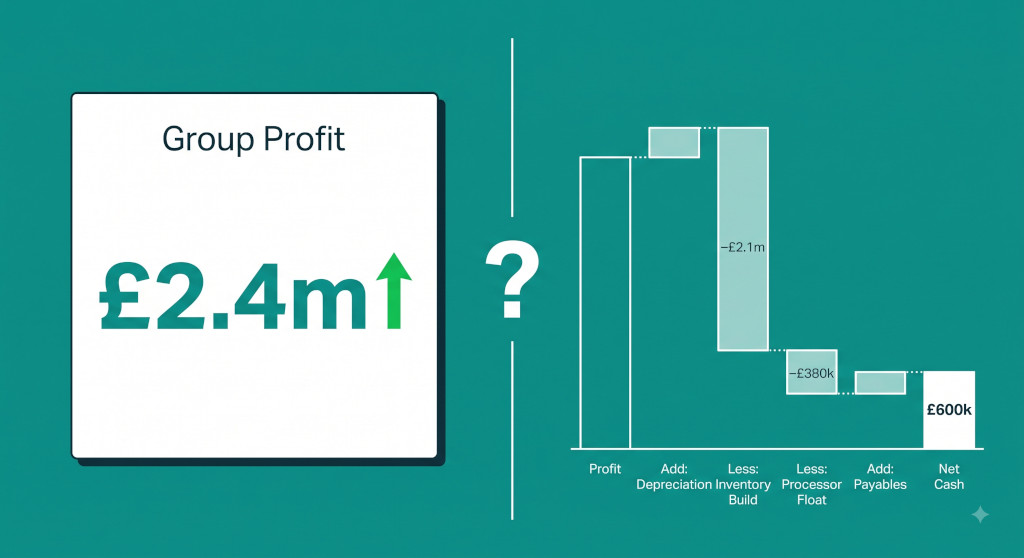
Nina had prepared the quarterly board pack and was expecting questions about the strong trading performance. NorthCart Group — a four-entity e-commerce operation running UK direct-to-consumer sales, a US Amazon marketplace presence, a European fulfilment warehouse, and an Australian clearance channel — had delivered £2.4 million in consolidated profit before tax for the year. Revenue was up 22%. Margins had held. The board had every reason to be pleased.
The cash flow statement changed the atmosphere in the room. Net cash generated from operations: £600,000. The chairperson pushed the pack aside and asked, simply, “Where did the money go?”
Nina knew the answer. She had spent two weeks reconstructing the consolidated cash flow from entity-level statements, untangling intercompany funding movements, reclassifying payment processor balances, and explaining why the group had bought £2.1 million of stock in August to trade in December. But none of that was in the pack in a way the board could follow. This article works through the four cash flow problems that every multi-entity e-commerce group encounters, and sets out a five-step process for producing a consolidated cash flow statement that tells the real story clearly.
Stop building consolidations in spreadsheets.
BrizoConsol automates multi-entity consolidation — setup in minutes, reports the same day.
Why You Cannot Build the Consolidated Cash Flow by Adding Entity Statements
The most common starting point for group cash flow preparation is to take each entity’s statement of cash flows and combine them. For a simple group with no intercompany activity, this is a reasonable approximation. For an e-commerce group, it produces a statement that is wrong in almost every section.
The reason is intercompany cash. During the year, NorthCart UK advanced £400,000 to NorthCart EU to fund a pre-Christmas inventory build. On NorthCart UK’s cash flow statement, this appears as a financing outflow (or an investing outflow if presented as a loan). On NorthCart EU’s statement, it appears as a financing inflow. If you add the two statements together, both entries survive. The consolidated cash flow statement must show only the external cash movements of the group as a single economic entity — and that intercompany loan never happened from the group’s perspective.
The same problem applies to intercompany trading settlements. When NorthCart UK pays NorthCart EU for fulfilment services, that payment appears as an operating outflow for UK and an operating inflow for EU. At consolidation, both sides disappear. The consolidated statement reflects only what the group as a whole paid to and received from external parties.
The consolidated cash flow statement must be built from consolidated balance sheet movements, not from the sum of entity cash flow statements. Every intercompany balance eliminated on the consolidated balance sheet must also be eliminated — implicitly or explicitly — from the consolidated cash flows.
This is easier to say than to execute. Working from consolidated balance sheet movements means you need a complete, correctly prepared consolidated balance sheet at both the opening and closing date, with all intercompany balances already eliminated. If the intercompany reconciliation is incomplete, the cash flow statement will be unreliable. The intercompany reconciliation is not just a housekeeping step — it is a prerequisite for a credible consolidated cash flow.
Problem 1 — Payment Processor Float
E-commerce groups collect revenue through payment processors — Stripe, PayPal, Amazon Pay, Afterpay, Klarna, and others — rather than directly into their bank accounts. Each processor has its own settlement cycle:
| Processor | Typical Settlement Cycle | Notes |
|---|---|---|
| Stripe | 2–3 business days | After payout trigger; varies by country |
| PayPal | 1–5 business days | Instant available with PayPal balance; bank transfer takes longer |
| Amazon Pay / Marketplace | 7–14 days | Amazon disbursement cycle; rolling reserve withheld (see below) |
| Afterpay / Clearpay | 2–3 business days | Merchant receives full amount upfront; Afterpay takes the instalment risk |
| Klarna | 2–5 business days | Merchant settlement after buyer confirmation |
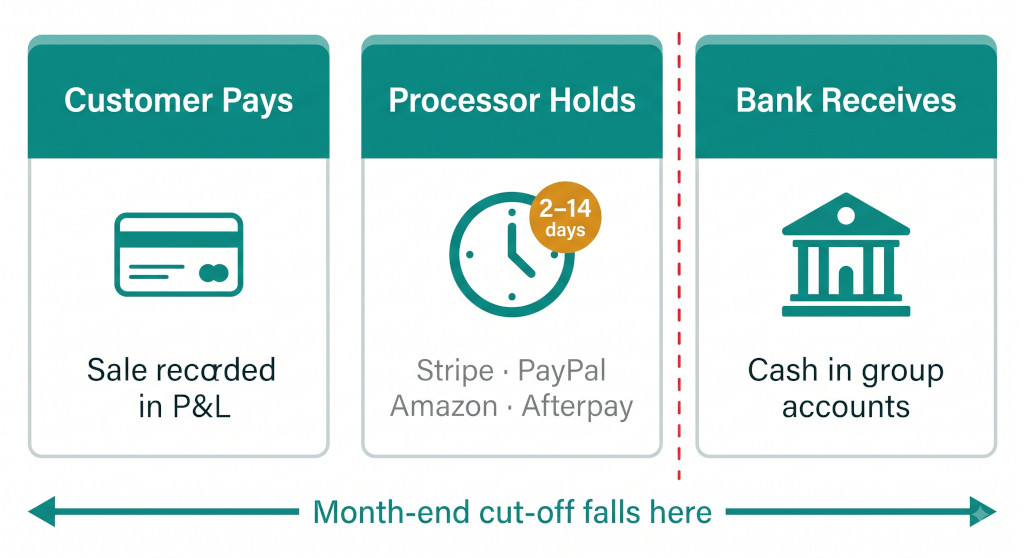
At any month-end — and especially at year-end — there will be cash sitting inside these processors that has been received from customers, recognised as revenue in the P&L, but not yet arrived in any bank account. This is payment processor float.
The accounting treatment matters. Payment processor balances are not cash. They are financial assets — a form of trade receivable from the processor. When an entity books Stripe receipts directly to its bank account in the accounting system, and the bank reconciliation is done against the Stripe payout rather than against individual sales, a timing mismatch opens up at month-end.
For NorthCart Group at the year-end, the combined float was £380,000:
NorthCart UK — Stripe balance awaiting payout (31 Dec): £142,000
NorthCart UK — Amazon UK reserve (rolling 7-day): £ 98,000
NorthCart US — Stripe USD balance (translated at closing): £ 87,000
NorthCart AU — Afterpay settlement in transit (AUD): £ 53,000
Total payment processor receivables: £380,000
If each entity had correctly reclassified these balances from “cash” to “payment processor receivables” in its own accounts, the movement would flow automatically into the working capital section of the consolidated cash flow statement as an increase in receivables (an operating cash outflow). If entities had left these balances inside their cash figure, the consolidated cash position would be overstated by £380,000 and the operating cash flow would not reflect the actual cash received from external sources during the period.
| DR | CR | |
| Payment Processor Receivable — Stripe UK | 142,000 | |
| Payment Processor Receivable — Amazon UK | 98,000 | |
| Payment Processor Receivable — Stripe US | 87,000 | |
| Payment Processor Receivable — Afterpay AU | 53,000 | |
| Cash and Cash Equivalents | 380,000 |
Year-end reclassification: amounts received by processors but not yet settled to group bank accounts are financial assets, not cash equivalents. Apply at each entity before consolidation.
Common mistake: Booking the Stripe or Amazon bank reconciliation against the payout date rather than the transaction date means the processor balance never appears as a separate asset — it just shows up as “cash not yet in the bank” on the bank rec. At month-end this creates a phantom cash balance that inflates the group cash position and understates working capital movements in the cash flow statement.
Problem 2 — Marketplace Holdbacks and Seller Reserves
Amazon, and to a lesser extent other large marketplaces, maintains a seller reserve — a portion of settlement funds withheld as protection against returns, chargebacks, and A-to-Z claims. For high-volume UK sellers, this reserve is typically equivalent to seven days of disbursements and is held on a rolling basis.
For NorthCart UK, trading approximately £1.4 million per month through Amazon in the peak quarter, the rolling reserve at year-end was approximately £98,000 — roughly seven days of November’s daily disbursement rate. This amount sits in Amazon’s systems, belongs to NorthCart UK, will eventually be paid, but is not in the bank and is not immediately accessible.
The £98,000 is already captured in the £380,000 reclassification above. The additional complication arises when the reserve balance changes materially between periods. If the reserve was £40,000 at the prior year-end and £98,000 at the current year-end, the increase of £58,000 is an operating cash outflow — cash tied up in Amazon’s hands rather than available to the group. This movement must appear in the working capital section of the consolidated cash flow statement as an increase in receivables.
Groups that do not track the reserve balance explicitly will not capture this movement at all. The reserve just sits unexamined inside “other receivables” or worse, inside the cash figure, and the cash flow statement loses accuracy every time the reserve changes.
Problem 3 — Intercompany Cash Transfers and the Elimination Requirement
NorthCart UK advanced £400,000 to NorthCart EU in August to fund the pre-Christmas inventory purchase. The commercial logic was straightforward: NorthCart EU needed to commit to supplier orders before it had generated enough cash from trading to pay for them, and the UK entity had surplus operating cash. An intercompany loan at a commercial rate solved the liquidity problem within the group.
At the entity level, both cash flow statements record this movement accurately. At the consolidated level, neither entry should appear. The group did not raise external financing, and the group did not deploy cash into an external investment. Cash moved between two pockets of the same consolidated entity.
The elimination in the consolidated cash flow is not a separate journal entry — it is a consequence of building the consolidated cash flow from consolidated balance sheet movements. When the intercompany loan is eliminated from the consolidated balance sheet (DR Intercompany Loan Payable EU / CR Intercompany Loan Receivable UK), the corresponding cash flow movements also disappear, because the opening and closing consolidated balance sheet figures used to calculate working capital and financing movements no longer include the intercompany balances.
The practical risk is that groups do not eliminate these balances before running the cash flow calculation. If the entity statements are simply combined, both the financing outflow in UK and the financing inflow in EU will appear in the consolidated statement. The gross cash flows will be overstated, and the financing section will show £400,000 advanced on a loan that — from the group’s perspective — does not exist.
A correctly prepared consolidated cash flow statement requires a correctly prepared consolidated balance sheet as its foundation. Any intercompany balance that remains uneliminated on the balance sheet will distort the cash flow movements derived from it.
For groups managing this process across multiple entities, the intercompany elimination process must be complete before cash flow preparation begins. This is not a step that can be done in parallel.
Problem 4 — Seasonal Inventory Build and Its Cash Flow Impact
E-commerce groups with a significant Christmas peak spend heavily on inventory in August, September, and October. The cash goes out months before the revenue arrives. For NorthCart Group, the consolidated inventory balance increased by £2.1 million over the year, almost entirely driven by the Q3 stock build for Q4 trading.
This is not a sign of financial difficulty — it is the normal operating cycle of a seasonal e-commerce business. But it produces a cash flow statement that looks alarming to anyone who reads it without context. A £2.4 million profit producing only £600,000 in operating cash sounds like the business is burning cash when in fact it is building working capital ahead of its most profitable quarter.
The presentation problem arises when the inventory movement is not clearly labelled and the intercompany funding leg appears alongside it. In NorthCart’s case:
- NorthCart EU purchased £2.1m of stock from external suppliers — legitimate operating outflow
- NorthCart EU received a £400k intercompany loan from NorthCart UK to help fund it — eliminated from consolidated financing activities
- The net consolidated position: £2.1m operating outflow for inventory, funded partly by group surplus cash and partly by external supplier credit (payables increased £420k)
The consolidated cash flow correctly shows the £2.1m as an operating outflow (increase in inventories) and the £420k as an operating inflow (increase in trade payables). The intercompany loan does not appear at all. The board needs to understand that the £1.7m net inventory cash outflow (£2.1m less £420k payables increase) is not a problem — it is a receivable that will convert to cash as Q4 stock is sold.
Presentation tip: Add a note to the consolidated cash flow statement explaining the seasonal working capital cycle. A sentence stating “Inventories increased by £2.1m in advance of peak trading in Q4, funded partly by extended supplier credit of £420k” transforms a worrying-looking cash outflow into a board-comprehensible operational decision.
Struggling to reconcile your group cash position each month?
BrizoConsol consolidates multi-entity groups automatically — intercompany eliminations, currency translation, and working capital movements included.See It In Action
Building the Consolidated Cash Flow Statement: A Five-Step Process
The following process applies to any e-commerce group preparing a consolidated cash flow statement using the indirect method. It assumes the consolidated P&L and balance sheet are already correctly prepared with all intercompany eliminations in place.
Step 1: Start from consolidated profit, not entity profit
The opening figure for the indirect method is consolidated profit before tax (or profit before interest and tax if you are reconciling to operating cash flow). This must be the consolidated P&L figure — not the sum of entity P&Ls, which will include intercompany management fees, intercompany interest income, and other eliminated items. Using entity P&Ls as the starting point and then trying to back out intercompany income creates unnecessary complexity and introduces error risk.
Step 2: Add back non-cash items from the consolidated P&L
Depreciation and amortisation are the primary non-cash items. Add these back from the consolidated depreciation charge, not entity-level charges, because intercompany asset transfers can create depreciation that must be partially eliminated at the group level. If the group has share-based payments, these are also a non-cash item to add back. Foreign exchange losses on monetary items (translation of foreign-currency intercompany balances before elimination) may also appear in the consolidated P&L — these are non-cash and must be adjusted.
For NorthCart Group: depreciation on consolidated assets was £290,000. Foreign exchange losses on the intercompany loan (before elimination) amounted to £18,000 but these are eliminated as part of the intercompany elimination, so they do not appear in the consolidated P&L. No adjustment needed for FX in this case. See IAS 21 / ASC 830 / FRS 102 currency translation rules for how monetary item translation differences flow through the P&L versus OCI.
Step 3: Calculate working capital movements from consolidated balance sheet positions
This is where the payment processor reclassification matters most. The working capital movements must reflect the consolidated balance sheet at both dates, with intercompany balances eliminated and processor balances correctly classified as receivables rather than cash. The movements to capture are:
| Working Capital Item | NorthCart Group Movement | Cash Flow Impact |
|---|---|---|
| Trade and other receivables | Increased £30k | −£30k (outflow) |
| Payment processor receivables | Increased £380k (new classification) | −£380k (outflow) |
| Inventories | Increased £2,100k | −£2,100k (outflow) |
| Trade and other payables | Increased £420k | +£420k (inflow) |
| Net working capital movement | — | −£2,090k |
Step 4: Derive operating cash flow
With the non-cash add-backs and working capital movements calculated, the operating cash flow follows directly:
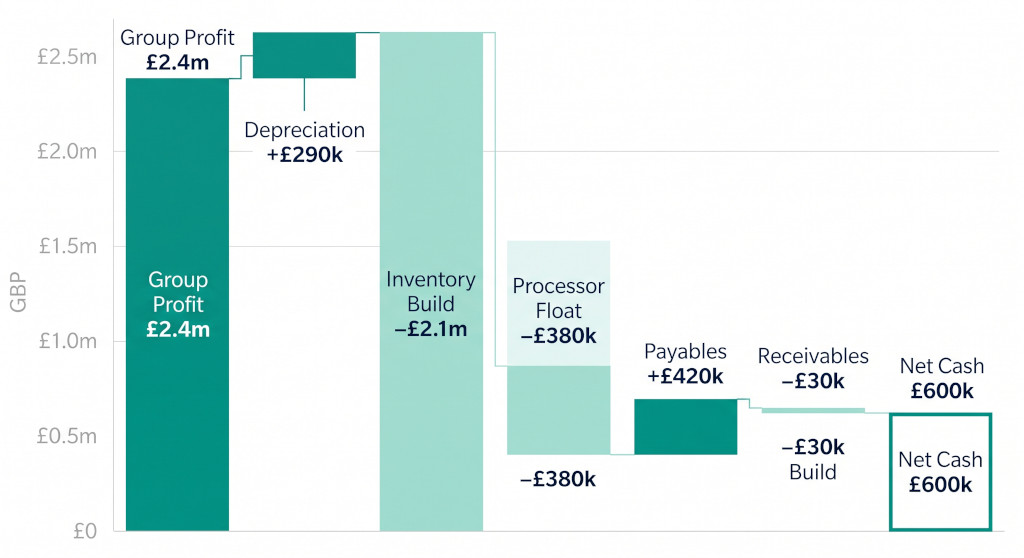
Consolidated profit before tax: £2,400,000
Add: Depreciation (non-cash): +290,000
Less: Increase in trade receivables: −30,000
Less: Increase in processor receivables: −380,000
Less: Increase in inventories: −2,100,000
Add: Increase in trade payables: +420,000
Cash generated from operations: £600,000
The gap between profit (£2.4m) and operating cash (£600k) is explained entirely by working capital — primarily the seasonal inventory build (£2.1m) and the increase in payment processor receivables (£380k). There is no mystery. The board question has a precise, quantified answer.
Step 5: Present investing and financing activities using external transactions only
Investing activities include capital expenditure paid to external suppliers (new warehouse equipment at NorthCart EU: £85,000) and any proceeds from disposal of external assets. The intercompany loan from NorthCart UK to NorthCart EU (£400,000) does not appear — it is eliminated. Any external borrowing facilities drawn during the year appear in financing activities; the intercompany loan used to partially fund inventory does not.
For groups with foreign entities, investing and financing cash flows denominated in foreign currencies must be translated at the exchange rate ruling at the transaction date (or an average rate if this is a reasonable approximation). The effect of exchange rate changes on cash held in foreign currencies is then presented as a separate reconciling line at the bottom of the cash flow statement — the “effect of exchange rate changes on cash and cash equivalents.” This line reflects the retranslation of the opening foreign-currency cash balances at the closing rate, and it will never be zero for a multi-currency group. For more on how currency translation works across standards, see the IAS 21 / ASC 830 / FRS 102 currency translation guide.
The multi-entity month-end close checklist is a useful reference for the sequencing of steps that feed into a reliable cash flow statement — intercompany reconciliation must be confirmed complete before cash flow preparation begins.
A Completed NorthCart Group Cash Flow Statement
The full consolidated statement of cash flows for NorthCart Group, year ended 31 December:
| Item | £000 |
|---|---|
| Operating Activities | |
| Profit before tax | 2,400 |
| Adjustments for non-cash items: | |
| Depreciation and amortisation | 290 |
| Changes in working capital: | |
| (Increase) in trade and other receivables | (30) |
| (Increase) in payment processor receivables | (380) |
| (Increase) in inventories | (2,100) |
| Increase in trade and other payables | 420 |
| Income tax paid | — |
| Net cash generated from operating activities | 600 |
| Investing Activities | |
| Purchase of property, plant and equipment | (85) |
| Net cash used in investing activities | (85) |
| Financing Activities | |
| Repayment of external borrowing | (60) |
| Net cash used in financing activities | (60) |
| Effect of exchange rate changes on cash | (22) |
| Net increase in cash and cash equivalents | 433 |
| Cash and cash equivalents at start of year | 1,241 |
| Cash and cash equivalents at end of year | 1,674 |
The intercompany loan (£400k advance from NorthCart UK to NorthCart EU) does not appear anywhere in this statement. The payment processor receivables (£380k) appear as a working capital outflow — cash that has been earned but is held by third-party processors at year-end. The seasonal inventory build (£2,100k) explains the bulk of the operating cash gap versus profit. The board has a complete, accurate picture.
The “effect of exchange rate changes on cash” line (£22k) reflects the retranslation of opening USD, EUR, and AUD cash balances at the closing GBP rate. This is not an operating or investing item — it reconciles the mathematical difference between the opening and closing cash balance after all other movements have been accounted for in the functional currency of the parent.
For a detailed treatment of the underlying consolidation for a multi-entity e-commerce group — including intercompany eliminations for stock transfers and revenue policy differences — see Financial Consolidation for E-commerce Groups.
Pre-Close Checklist for Consolidated Cash Flow Preparation
Apply this checklist in sequence before finalising the consolidated statement of cash flows for a multi-entity e-commerce group:
- Confirm intercompany reconciliation is complete. Every intercompany balance must be agreed and eliminated before cash flow preparation begins. Any unreconciled balance will distort the working capital movements derived from consolidated balance sheet comparatives. See the process for intercompany reconciliation in multi-entity groups.
- Reclassify payment processor balances at each entity. Review the bank reconciliation for each entity and identify amounts sitting with Stripe, PayPal, Amazon, Afterpay, Klarna, or any other processor that are not yet in the bank account. Reclassify these as payment processor receivables (current assets) rather than cash. Do this before the consolidated balance sheet is prepared.
- Identify and document the Amazon seller reserve balance. Obtain the current reserve balance from Amazon Seller Central for each entity trading on Amazon. Record this as a component of payment processor receivables and compare to the prior period to quantify the movement.
- Remove intercompany cash transfers from the consolidated investing and financing sections. Verify that no intercompany loan advances, repayments, or cash dividends appear in the consolidated investing or financing activities. These should be eliminated automatically if working from consolidated balance sheet movements, but manual cross-checks on large items are worth running.
- Translate foreign-currency investing and financing flows at transaction-date rates. Capital expenditure paid in EUR, USD, or AUD must be translated at the rate prevailing on the payment date (or an appropriate average rate). Do not use the closing rate for cash flow translation — this applies only to balance sheet items.
- Calculate the exchange rate effect as the balancing figure. Once operating, investing, and financing cash flows are determined, the effect of exchange rate changes on cash is the difference between (a) the net movement in cash per the cash flow statement and (b) the actual movement in the consolidated cash balance between opening and closing balance sheets when both are expressed at their respective closing rates. If this line is implausibly large, it is a signal that cash flows have been translated incorrectly or that intercompany balances remain in the cash position.
Ready to stop building the consolidated cash flow in spreadsheets?
BrizoConsol handles intercompany eliminations, multi-currency translation, and working capital aggregation automatically — so your cash flow statement is a natural output of the consolidation, not a separate manual exercise.Start Free Trial