Currency Translation Under IAS 21, ASC 830 and FRS 102: What Changes Across Standards
The group had three subsidiaries in three countries, each reporting under a different accounting standard. The UK holding company reported under FRS 102. The US subsidiary was set up under US GAAP for local statutory purposes. And the Singapore subsidiary had been producing IFRS-compliant accounts since its establishment. When the group finance director sat down to prepare consolidated accounts for the first time, she assumed currency translation would work the same way under all three. It mostly did — but the differences in how each standard treated certain edge cases produced translation adjustments that, when aggregated, refused to reconcile.
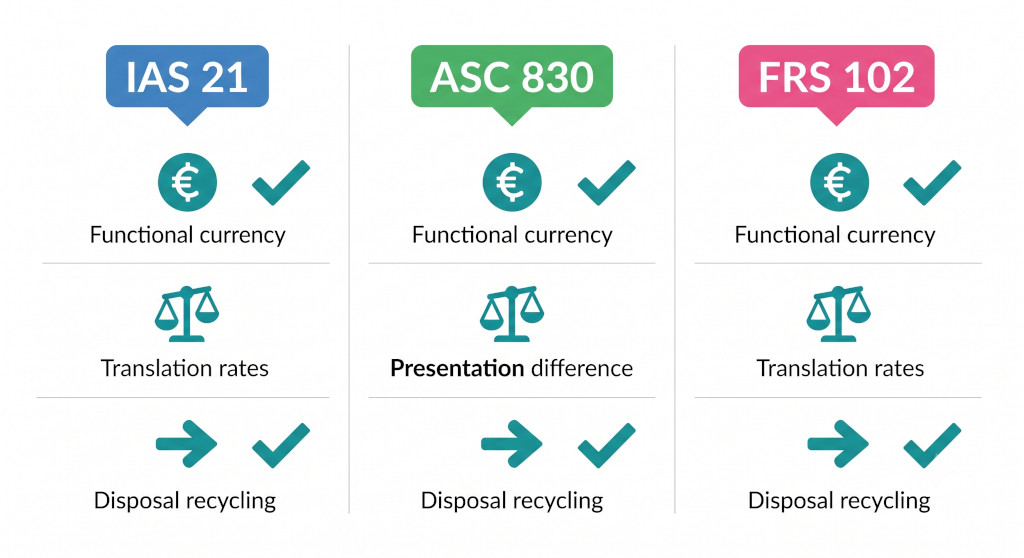
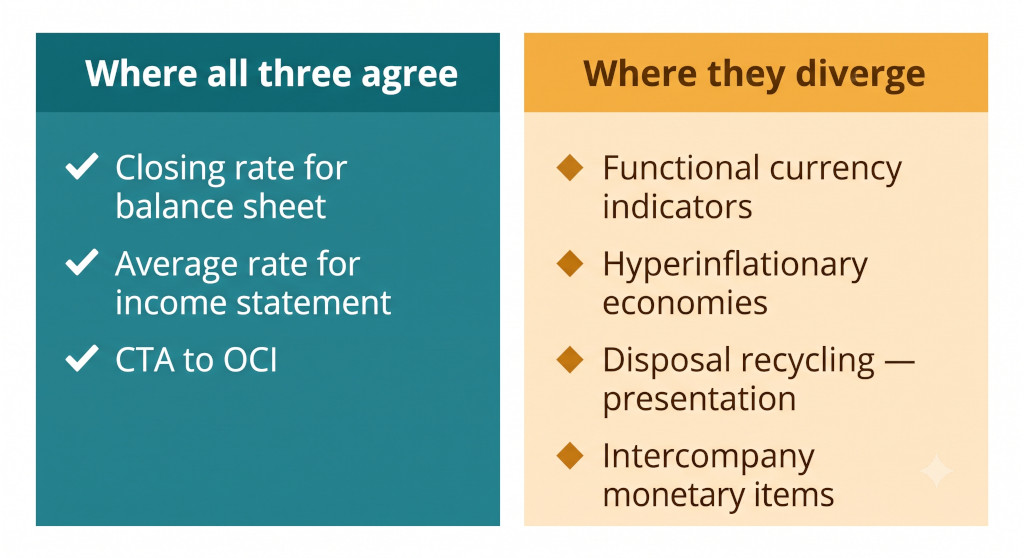
The good news is that IAS 21, ASC 830, and FRS 102 Section 30 are closely aligned on the fundamentals of currency translation. All three use the same core approach: closing rate for balance sheet items, average rate for income statement items, and historical rates for equity. The resulting translation difference goes to other comprehensive income in all three frameworks.
The less good news is that the differences — while narrower than most finance teams expect — sit in exactly the areas that cause problems in practice: functional currency determination, treatment of intercompany monetary items, hyperinflationary economies, and the precise presentation of the CTA on disposal. This article maps where the three standards agree, where they diverge, and what the practical implications are for groups consolidating entities under more than one framework.
Foreign currency consolidation, handled automatically.
BrizoConsol applies the correct CTA/FCTR treatment across all entities — no spreadsheets needed.
The Shared Foundation: How All Three Standards Approach Translation
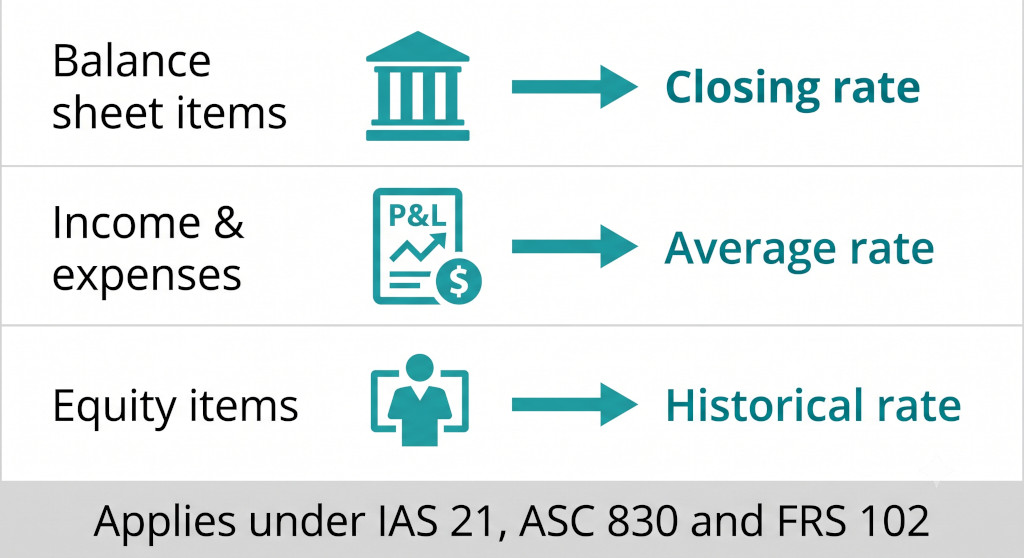
Despite their different origins — IAS 21 from the IASB, ASC 830 from the FASB, and FRS 102 Section 30 from the UK’s FRC — all three standards converge on the same basic translation model for foreign operations whose functional currency differs from the parent’s presentation currency.
The translation rates
Under all three standards, the rules are the same:
- Assets and liabilities are translated at the closing (spot) rate at the balance sheet date
- Income and expenses are translated at the exchange rate at the date of the transaction, or the average rate for the period as a practical approximation
- Equity items — share capital, share premium, retained earnings — are translated at the historical rates at which they arose
The resulting translation difference — the balancing figure arising from applying different rates to different elements — is recognised in other comprehensive income under all three frameworks. Under IFRS it accumulates in the Foreign Currency Translation Reserve (FCTR); under US GAAP it accumulates in Accumulated Other Comprehensive Income (AOCI); under FRS 102 it accumulates in a translation reserve within equity. The label differs; the mechanics are the same.
Functional currency determination
All three standards require entities to identify their functional currency — the currency of the primary economic environment in which the entity operates — before any translation work can be done. An entity’s functional currency determines whether it is a foreign operation (to be translated using the closing rate method) or an extension of the parent (to be remeasured using the temporal method before translation).
The primary indicators are consistent across all three: the currency in which sales prices are denominated, the currency of the country whose competitive forces primarily determine selling prices, and the currency in which costs are incurred. But the standards differ in emphasis and in their handling of edge cases, as discussed below.
For most SME groups with clearly localised foreign subsidiaries — earning revenue in the local currency, paying staff and suppliers in the local currency, and being managed as autonomous operations — the functional currency determination is straightforward and identical under all three standards. The complexity arises at the margins: holding companies, finance subsidiaries, and entities with mixed currency revenues.
IAS 21: The IFRS Framework
IAS 21 is the primary standard for currency translation under IFRS and applies to all entities preparing IFRS financial statements globally. The standard was most recently revised in 2023 (effective for periods beginning on or after 1 January 2025), with amendments clarifying the treatment of the exchange rate to use when there is a lack of exchangeability between currencies.
Key features of IAS 21:
- Functional currency indicators: IAS 21.9–14 sets out primary and secondary indicators for functional currency. The primary indicators are determinative where they are clear; secondary indicators (currency of financing, currency of receipts from operating activities) are considered only where primary indicators are mixed.
- Intercompany monetary items: Under IAS 21.32, exchange differences on long-term intercompany loans that form part of the group’s net investment in a foreign operation are recognised in OCI in the consolidated financial statements, forming part of the FCTR. At entity level, they go through profit or loss. This treatment requires a formal designation or clear criteria to be met — the loan must be one for which settlement is neither planned nor likely in the foreseeable future.
- Disposal and recycling: IAS 21.48 requires the cumulative FCTR to be reclassified from OCI to profit or loss when a foreign operation is disposed of. Partial disposals that result in loss of control also trigger full recycling; partial disposals that retain control do not.
- Hyperinflationary economies: Where a foreign operation’s functional currency is that of a hyperinflationary economy, IAS 29 applies first — the subsidiary’s financial statements are restated for the effects of inflation using a general price index before being translated at the closing rate. The comparative period is also restated.
- Goodwill and fair value adjustments: Under IAS 21.47, goodwill and fair value adjustments arising on the acquisition of a foreign operation are treated as assets and liabilities of the foreign operation, expressed in the functional currency of the foreign operation, and translated at the closing rate. The resulting CTA on goodwill is included in the FCTR.
ASC 830: The US GAAP Framework
ASC 830 (Foreign Currency Matters) is the US GAAP equivalent of IAS 21, issued by the FASB. It pre-dates IAS 21 in origin (drawn from the earlier SFAS 52) and shares the same closing rate / average rate translation model. The translation adjustment accumulates in AOCI within stockholders’ equity.
Key features of ASC 830, and where it diverges from IAS 21:
- Functional currency indicators: ASC 830-10-55 provides a detailed list of economic factors for functional currency determination — broadly similar to IAS 21 but more explicitly prescriptive. The standard distinguishes clearly between a “self-contained and integrated” foreign subsidiary (which has its own functional currency and uses the closing rate method) and one that is an “extension of the parent” (which uses the temporal/remeasurement method). Where indicators are mixed, ASC 830 requires management judgment, as does IAS 21.
- Intercompany monetary items: ASC 830-20-35-3 contains a similar provision to IAS 21.32 for long-term intercompany items forming part of the net investment, but the criteria for qualification are stated slightly differently. In practice, the treatment is the same for most groups.
- Disposal and recycling: ASC 830-30-40-1 also requires reclassification of the cumulative translation adjustment from AOCI to net income on complete or substantially complete liquidation of an investment in a foreign entity. The mechanics are the same as IAS 21; the terminology differs (AOCI vs FCTR; net income vs profit or loss).
- Hyperinflationary economies: Under ASC 830-10-45-11, a foreign operation in a highly inflationary economy (defined as cumulative three-year inflation exceeding 100%) uses the temporal method rather than the closing rate method — the parent’s reporting currency becomes the functional currency. This is a key difference from IFRS: under IAS 29/IAS 21, the subsidiary restates its financials for inflation and then translates at the closing rate. Under ASC 830, it simply uses the temporal method. The resulting P&L effects can differ materially for groups with subsidiaries in high-inflation jurisdictions.
- Goodwill and fair value adjustments: Under ASC 830, goodwill and fair value adjustments at acquisition are also treated as assets of the foreign operation and translated at the closing rate — consistent with IAS 21.
FRS 102 Section 30: The UK GAAP Framework
FRS 102 is the principal financial reporting standard for UK entities not applying IFRS. Section 30 (Foreign Currency Translation) governs translation of foreign operations and is broadly consistent with IAS 21, reflecting the FRC’s policy of aligning UK GAAP with IFRS where practical.
Key features of FRS 102 Section 30:
- Functional currency indicators: FRS 102.30.3–30.6 uses the same primary and secondary indicators as IAS 21. There is no material difference in the determination framework for most entities.
- Translation rates: Identical to IAS 21 — closing rate for balance sheet items, average rate for income statement, historical rates for equity.
- CTA to OCI: Under FRS 102.30.14, translation differences on the net investment in a foreign operation are recognised in OCI and accumulated in a translation reserve in equity. This is the same as IAS 21. One practical difference: FRS 102 entities may use the “other comprehensive income” concept as presented in the statement of comprehensive income, or may present the statement of changes in equity without a separate SOCI — the standard is more flexible on presentation format than IFRS.
- Intercompany monetary items: FRS 102.30.13 mirrors IAS 21.32 for long-term intercompany items forming part of the net investment.
- Disposal and recycling: FRS 102.30.15 requires the cumulative translation differences in the reserve to be reclassified from equity to profit or loss on disposal of the foreign operation — the same as IAS 21.48.
- Hyperinflationary economies: FRS 102 Section 31 deals with hyperinflation. Like IFRS, it requires restatement of the subsidiary’s financial statements before translation — not the temporal method switch used under US GAAP. For UK groups with subsidiaries in highly inflationary economies, the treatment therefore aligns with IFRS rather than with US GAAP.
FRS 102 was substantially revised in 2024 (effective for periods beginning on or after 1 January 2026, with early adoption permitted). The revised standard brings FRS 102 even closer to IFRS — including alignment on a number of lease and revenue topics — but Section 30 on foreign currency translation was not materially changed. The closing rate / average rate / OCI model remains the same.
Side-by-Side Comparison
| Topic | IAS 21 (IFRS) | ASC 830 (US GAAP) | FRS 102 Section 30 (UK GAAP) |
|---|---|---|---|
| Balance sheet translation rate | Closing rate | Closing rate | Closing rate |
| Income statement translation rate | Average rate (or transaction date) | Average rate (or transaction date) | Average rate (or transaction date) |
| CTA / translation difference | OCI → FCTR in equity | OCI → AOCI in equity | OCI → translation reserve in equity |
| Functional currency determination | Primary + secondary indicators; judgment where mixed | Similar indicators; more prescriptive list in guidance | Same primary + secondary indicators as IAS 21 |
| Intercompany long-term loans (net investment) | OCI in consolidated accounts if criteria met (IAS 21.32) | Similar treatment if criteria met (ASC 830-20-35-3) | Same as IAS 21 (FRS 102.30.13) |
| Recycling on disposal | Full CTA recycled to P&L on loss of control (IAS 21.48) | Full AOCI recycled to net income on disposal (ASC 830-30-40-1) | Full translation reserve recycled to P&L (FRS 102.30.15) |
| Goodwill and fair value adjustments | Treated as assets of foreign operation; translated at closing rate | Same treatment | Same treatment |
| Hyperinflationary economies | IAS 29 restatement first; then translate at closing rate | Temporal method (parent currency becomes functional currency) | FRS 102 Section 31 restatement first; then translate at closing rate — aligns with IFRS, not US GAAP |
| Lack of exchangeability | 2023 amendments to IAS 21 provide specific guidance on rate to use | No equivalent recent amendment; judgment applies | No equivalent specific guidance; judgment applies |
The Practical Difference That Matters Most: Hyperinflationary Subsidiaries
For most SME groups, the differences between IAS 21, ASC 830, and FRS 102 Section 30 are immaterial in practice. The closing rate / average rate model is shared, functional currency determinations typically reach the same conclusion, and the treatment of intercompany loans and recycling on disposal are substantively the same.
The one area where the standards diverge enough to produce meaningfully different numbers is hyperinflationary economies. Under IFRS and FRS 102, a subsidiary in a hyperinflationary economy (Argentina, Turkey, and similar jurisdictions as designated by the IASB) restates its financial statements for the effects of inflation using a general price index, and the restated figures are then translated at the closing rate. The effect is that the income statement reflects real purchasing power rather than nominal local currency amounts, and the closing rate translation does not artificially amplify or suppress the reported results.
Under US GAAP, the approach is fundamentally different. A subsidiary in a highly inflationary economy (as defined by ASC 830 — three-year cumulative inflation exceeding 100%) switches to using the parent’s reporting currency as its functional currency. The subsidiary’s financial statements are remeasured into the parent’s currency using the temporal method: monetary assets and liabilities at the closing rate, non-monetary items at historical rates, and the remeasurement difference goes through the income statement — not OCI. This means the foreign currency effect on a US GAAP-reporting group with a subsidiary in Argentina, for example, flows directly through earnings rather than through AOCI.
For a multi-standard group — a UK holding company (FRS 102) with a US subsidiary (US GAAP, filing locally) and an Argentine subsidiary — the Argentine subsidiary’s treatment will differ depending on which standard the consolidated accounts are prepared under.
The consolidated accounts will be prepared under FRS 102 (or IFRS, if adopted), which means the IAS 29/FRS 102 Section 31 approach applies at the consolidation level regardless of what the Argentine subsidiary does for its local filings.
Watch out: If your group consolidates a subsidiary that operates in a hyperinflationary economy, the standard used for the consolidated accounts — not the standard used for the subsidiary’s local filing — determines the translation treatment. A US GAAP local filing using the temporal method does not mean the consolidated IFRS accounts should do the same.
Multi-Standard Groups: Practical Consolidation Considerations
Groups that hold subsidiaries preparing accounts under different standards face a specific consolidation challenge: the subsidiary’s financial statements, prepared under its local standard, may need to be adjusted before being incorporated into the consolidated accounts.
For most translation-related items, no adjustment is required — the underlying numbers are the same under all three standards. But where a difference does exist (most commonly in the hyperinflationary economy treatment), the subsidiary’s local accounts must be adjusted to reflect the treatment required by the consolidation standard before translation. This is a GAAP conversion adjustment, not a consolidation elimination, and it should be documented and auditable.
The more common practical issue for multi-standard groups is not accounting differences but data collection: each subsidiary produces accounts on its own timeline, in its own format, using its own chart of accounts. Getting those accounts into a consistent format for consolidation — with the right exchange rates applied at the right levels — is where most of the practical difficulty sits, regardless of whether IAS 21, ASC 830, or FRS 102 Section 30 is the applicable standard.
BrizoConsol supports groups where different entities report under different accounting standards — IFRS, US GAAP, UK GAAP, and SFRS — assigning the appropriate standard to each entity at setup and applying the correct translation treatment accordingly. This is particularly useful for international groups where subsidiaries have been set up for local compliance under non-IFRS standards but the consolidated accounts are prepared under IFRS or FRS 102.
Consolidate Across IFRS, US GAAP and UK GAAP Entities
BrizoConsol assigns each entity its own accounting standard, applies the right translation treatment, and produces consolidated accounts under your group’s reporting standard — without manual GAAP conversion workpapers. Start Free Trial
The 2023 IAS 21 Amendments: Lack of Exchangeability
One area where IAS 21 has recently moved ahead of its peers is the treatment of currencies that lack exchangeability — situations where an entity cannot exchange its local currency for a foreign currency, or can only do so at a rate determined by a government or central bank that does not reflect the economic reality of the exchange.
The 2023 amendments to IAS 21 (effective 1 January 2025) introduced specific guidance on how to estimate the exchange rate to use when a currency is not exchangeable, and require disclosure when a currency is determined to lack exchangeability. Neither ASC 830 nor FRS 102 contains equivalent specific guidance — both require judgment in these circumstances, but without the IAS 21 framework for making that judgment.
For IFRS reporters with subsidiaries in countries where currency controls limit exchangeability, the 2023 amendments provide a clearer path. For FRS 102 and US GAAP reporters in the same position, existing judgment-based approaches continue to apply.
Conclusion: Where the Standards Stand
For the vast majority of multi-entity groups, IAS 21, ASC 830, and FRS 102 Section 30 will produce the same translation results:
- Balance sheet at closing rate, income statement at average rate, equity at historical rates — identical under all three
- Translation difference to OCI, accumulated in a translation reserve — identical under all three
- Recycling of cumulative translation reserve to profit on disposal — identical under all three
- Goodwill at closing rate — identical under all three
- Long-term intercompany items forming part of the net investment — substantively the same under all three
The areas where meaningful differences can arise:
- Hyperinflationary subsidiaries: US GAAP uses the temporal method (difference through income); IFRS and FRS 102 use IAS 29/Section 31 restatement (difference through OCI). Material for groups with subsidiaries in Argentina, Turkey, Zimbabwe, and similar economies.
- Lack of exchangeability: IAS 21 now has specific guidance; ASC 830 and FRS 102 rely on judgment.
- Functional currency edge cases: Where an entity has genuinely mixed indicators, the slightly different emphasis of each standard’s guidance can lead to different conclusions — though in practice this is rare for clearly localised operations.
For groups preparing consolidated accounts and wanting to understand the translation treatment in detail, the CTA calculation guide, the post on splitting the CTA with NCI, and the guide to recycling the CTA on disposal cover the IFRS mechanics in full. For most SME groups, those IFRS mechanics apply equally under FRS 102 and, in all but the hyperinflationary cases, under US GAAP as well.
Multi-Standard Groups, One Consolidated View
BrizoConsol handles IFRS, US GAAP, UK GAAP and SFRS entities in the same group — with the right translation treatment applied to each. No spreadsheet wrangling, no GAAP conversion workpapers. Start Free Trial