Why Your Equity Pickup Is Wrong After Acquiring an Associate: Fair Value Adjustments and Embedded Goodwill
Sarah is group controller at a holding company that completed a 35% acquisition of DesignAssoc Ltd eight months ago. The acquisition was straightforward — the shares were purchased for £700,000, the deal closed cleanly, and the investment was recognised in the group balance sheet at cost. Now the first post-acquisition year-end has arrived. The associate’s audited accounts have landed, showing a profit of £200,000 for the year. Sarah calculates her equity pickup: 35% × £200,000 = £70,000. She posts the journal and moves on.
Her external auditors review the equity method workings and come back with a question. They want to see the fair value exercise completed at the acquisition date, the allocation of the excess purchase price over net book value, and the amortisation of fair value uplifts running through the equity pickup. Sarah looks at them blankly. She did not know any of that was required. The £70,000 is wrong.
This is one of the most commonly missed steps in applying the equity method. When a group pays more than the book value of its share of an associate’s net assets — which is almost always the case in a real acquisition — that excess has to be allocated and then worked through the equity pickup every year thereafter. This post explains exactly how to do it.
Stop building consolidations in spreadsheets.
BrizoConsol automates multi-entity consolidation — setup in minutes, reports the same day.
What the Cost of Your Investment Actually Represents
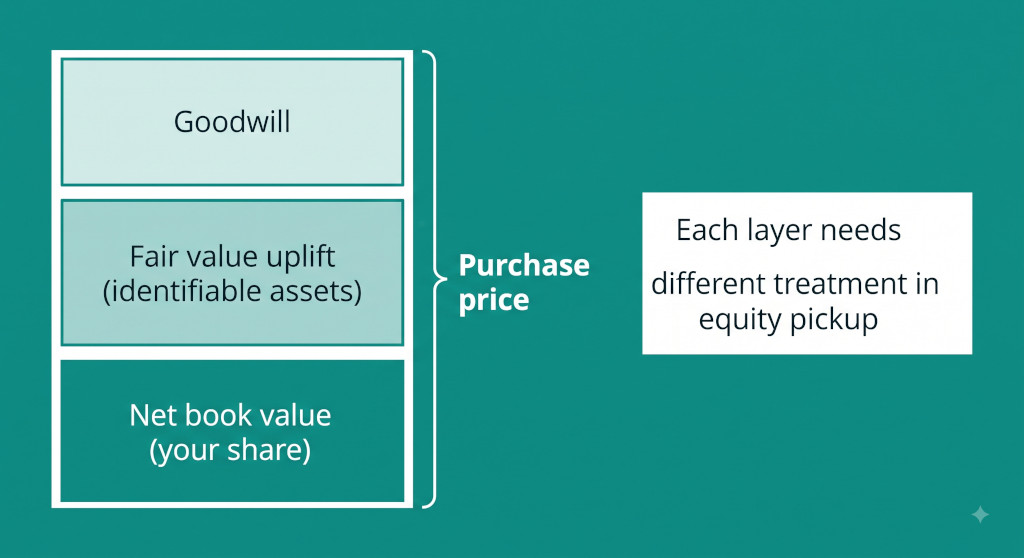
When a group pays £700,000 for a 35% stake in an associate whose net assets have a book value of £1,400,000, the cost is not simply £700,000 of undifferentiated value. It breaks down into layers, each of which behaves differently in the consolidation.
The first layer is the group’s share of the associate’s net book value: 35% × £1,400,000 = £490,000. That is the amount attributable to the associate’s assets and liabilities as they stand in its own financial statements.
The remaining £210,000 is the excess — the premium paid over book value. Under IAS 28 paragraph 32, at the date of acquisition, the investor identifies the fair values of the associate’s identifiable assets, liabilities, and contingent liabilities. Any difference between those fair values and the book values represents hidden value that the purchase price implicitly reflects. The excess is allocated first to those identifiable fair value differences, and whatever remains after that allocation is goodwill.
This process mirrors what happens in a full acquisition under IFRS 3 — but with one critical difference. In a subsidiary acquisition, the fair value uplifts and goodwill appear explicitly in the consolidated balance sheet. In an associate acquisition, they are absorbed inside the single “Investment in associate” line. They do not appear separately. They are invisible — which is precisely why they are so often forgotten.
Identifying the Fair Value Differences
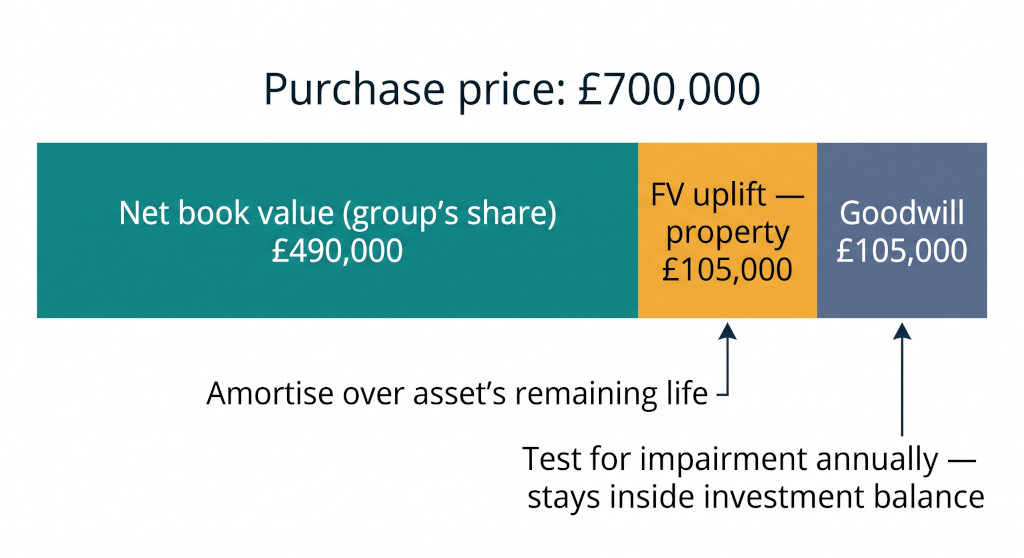
At the date of acquiring the 35% stake in DesignAssoc Ltd, a fair value exercise is conducted on the associate’s identifiable assets and liabilities. The exercise identifies that DesignAssoc holds a freehold property with a book value of £800,000 and a fair value of £1,100,000 — a £300,000 uplift. The property has a remaining useful life of 15 years.
The group’s share of that fair value uplift is 35% × £300,000 = £105,000. This reduces the unexplained excess from £210,000 to £105,000. That remaining £105,000 is goodwill — the premium paid for factors such as the associate’s customer relationships, brand, and workforce that cannot be separately identified and valued.
| Purchase price of 35% stake | £700,000 |
| Group’s share of net book value (35% × £1,400,000) | (£490,000) |
| Total excess over net book value | £210,000 |
| Allocated to: FV uplift on property (35% × £300,000) | (£105,000) |
| Residual goodwill embedded in investment | £105,000 |
All three components — net book value, FV uplift, and goodwill — are subsumed into the single £700,000 carrying amount of the investment in the group balance sheet. Externally, the balance sheet shows one number. Internally, the group must maintain a schedule that tracks each layer, because they have different accounting treatments going forward.
Goodwill Embedded in the Investment
In a subsidiary acquisition, goodwill is recognised as a separate intangible asset and tested for impairment under IAS 36 at least annually. In an associate acquisition, the goodwill is not separated out. It remains inside the carrying value of the investment in associate.
This has two practical consequences. First, there is no separate goodwill amortisation — goodwill in associates is not amortised under IFRS (unlike under FRS 102, where goodwill is amortised over its useful life). Second, impairment is tested at the level of the overall investment in associate, not at the goodwill level in isolation. If there are impairment indicators — the associate is loss-making, its market value has fallen, or it has lost a major customer — the group tests the entire carrying value of the investment against its recoverable amount.
Common mistake: Some preparers, knowing that goodwill under IFRS is not amortised, conclude that there is nothing to do with the embedded goodwill each year beyond not amortising it. That is correct as far as it goes — but it omits the impairment test obligation. The investment in associate must be reviewed for impairment indicators at every reporting date, and formally tested when indicators exist. Skipping this because the goodwill is invisible inside the investment line is an error.
For a broader discussion of how goodwill impairment works in the group consolidation context, our post on goodwill in group consolidation covers the mechanics in detail.
How Fair Value Adjustments Affect the Annual Equity Pickup
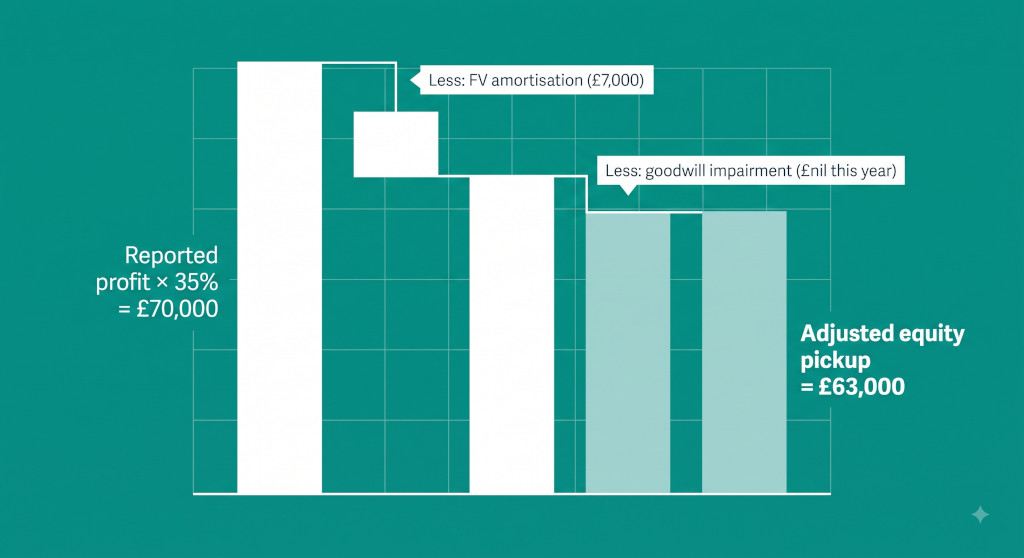
The fair value uplift on the associate’s property must be amortised over the asset’s remaining useful life. The associate depreciates the property based on its own book value of £800,000. But from the group’s perspective, the economic cost of that asset is £1,100,000 — because that is what the group implicitly paid for it. The group must therefore recognise additional depreciation each year corresponding to its share of the fair value uplift, reducing the equity pickup accordingly.
The annual FV amortisation charge is the group’s share of the uplift divided by the asset’s remaining useful life:
| Group’s share of FV uplift on property | £105,000 |
| Remaining useful life of property | 15 years |
| Annual FV amortisation to reduce equity pickup | £7,000 |
The adjusted equity pickup for Year 1, compared with Sarah’s original unadjusted calculation:
| Component | Unadjusted | Adjusted |
|---|---|---|
| Associate reported profit | £200,000 | £200,000 |
| Group’s ownership percentage | 35% | 35% |
| Share of reported profits | £70,000 | £70,000 |
| Less: FV amortisation (property uplift ÷ 15 years) | — | (£7,000) |
| Less: goodwill impairment | — | nil |
| Adjusted equity pickup | £70,000 | £63,000 |
The difference is £7,000 in Year 1. Over 15 years, that is £105,000 of cumulative overstatement if the adjustment is never made — exactly equal to the group’s share of the original fair value uplift. The logic is consistent: the group paid a premium for an asset that is being consumed over time, and the consumption must be reflected in the group’s results.
The Journal Entries
The equity pickup process involves three distinct journal entries in a year where both FV amortisation and goodwill impairment are relevant. In Sarah’s Year 1, goodwill is not impaired, so only two entries are required.
Step 1 — Record the share of reported profits
| Account | Dr | Cr |
|---|---|---|
| Investment in DesignAssoc Ltd | £70,000 | |
| P&L — Share of associate’s profits | £70,000 |
35% × £200,000 reported profit. Based on the associate’s audited accounts for the period.
Step 2 — Charge FV amortisation against the equity pickup
| Account | Dr | Cr |
|---|---|---|
| P&L — Share of associate’s profits (FV amortisation) | £7,000 | |
| Investment in DesignAssoc Ltd | £7,000 |
Annual amortisation of FV uplift on property: £105,000 ÷ 15 years. Reduces both the equity pickup and the carrying value of the investment. This entry repeats each year over the asset’s remaining life.
The net effect on the investment account after both entries: +£70,000 − £7,000 = +£63,000. The investment balance moves from £700,000 at acquisition to £763,000 at the end of Year 1.
If goodwill impairment arises in a later year
Should an impairment review conclude that the investment’s recoverable amount is below its carrying value, the impairment is recognised immediately in full. It is not unwound in subsequent years if the associate recovers — unlike IAS 36 impairments on other assets, goodwill impairment is permanent.
| Account | Dr | Cr |
|---|---|---|
| P&L — Impairment of investment in associate | £XX | |
| Investment in DesignAssoc Ltd | £XX |
Impairment of investment in associate to recoverable amount. Recognised when carrying value exceeds the higher of value in use and fair value less costs of disposal. Not reversible in subsequent periods.
Getting the equity pickup right every year-end?
BrizoConsol tracks FV amortisation schedules, embedded goodwill, and equity pickup adjustments as part of your group consolidation — so the numbers are always reconcilable and audit-ready.See It In Action
Maintaining the FV Schedule Over Time
The FV amortisation calculation is not a one-off exercise. It must be repeated every year for the remaining life of each adjusted asset. If the associate has multiple assets with fair value differences at acquisition — property, plant, customer lists, favourable leases — each one has its own amortisation profile. The group must maintain a schedule that tracks:
The nature of each FV difference (which asset or liability), the group’s share of the uplift at acquisition, the amortisation method and useful life, the cumulative amortisation to date, and the remaining unamortised balance. That remaining balance is what continues to reduce the equity pickup each year, and it is also what reduces the carrying amount of the investment gradually back toward the share of net book value plus goodwill.
If the associate subsequently revalues or disposes of the uplifted asset, the FV amortisation schedule must be updated accordingly. A disposal of the property in Year 5, for example, would mean the remaining unamortised uplift (£105,000 − 5 × £7,000 = £70,000) is recognised in full in that year as an additional charge against the equity pickup, rather than being spread over the remaining ten years.
The FV schedule is the document auditors will ask for first when reviewing your equity method workings. If it does not exist, the audit will require you to reconstruct it from the acquisition date — which means going back to the original purchase documentation and any valuation reports obtained at the time. Maintaining it contemporaneously is far less painful.
What If the Purchase Price Is Below Book Value?
Occasionally a group acquires an associate stake at below the share of net book value — a so-called bargain purchase. Under IAS 28 paragraph 32, a negative excess (where the group’s share of fair values exceeds the cost) is recognised immediately as income in the period of acquisition. It is not deferred or amortised.
In practice, genuine bargain purchases in associate transactions are rare. More commonly, an apparent negative excess reflects the need for a more careful fair value exercise — perhaps unidentified contingent liabilities, intangible assets that should have been written down, or goodwill that is simply negative because of the distressed circumstances of the sale. Before recognising bargain purchase income, the group should reassure itself that all fair values have been assessed properly.
The FRS 102 Difference: Goodwill Is Amortised
Under FRS 102 section 14, the equity method follows the same broad framework as IAS 28. However, there is a material difference in the treatment of goodwill. FRS 102 requires goodwill to be amortised over its useful economic life — or, if that cannot be estimated reliably, over a maximum period of ten years.
This means a UK group applying FRS 102 that acquires an associate with embedded goodwill of £105,000 must amortise that goodwill each year. If the useful life is assessed as ten years, the annual goodwill amortisation is £10,500, recognised as a further reduction to the equity pickup alongside any FV amortisation on identifiable assets.
| Share of reported profits (35% × £200,000) | £70,000 |
| Less: FV amortisation — property (£105,000 ÷ 15 years) | (£7,000) |
| Less: goodwill amortisation (£105,000 ÷ 10 years) [FRS 102 only] | (£10,500) |
| Adjusted equity pickup under FRS 102 | £52,500 |
The contrast with the IFRS result (£63,000) is significant — £10,500 per year, or £105,000 over ten years. A group that applies IFRS for one entity and FRS 102 for another, or that is preparing a dual-GAAP set of accounts, needs to be explicit about which standard governs the associate treatment and ensure the schedules are maintained separately. For a detailed comparison of how the two standards diverge on key consolidation topics, see our guide to IFRS vs UK GAAP key differences.
Under US GAAP, ASC 323 applies a similar principle for identifiable FV differences — they are amortised over the relevant asset lives. US GAAP also requires goodwill within an equity method investment to be tested for impairment, consistent with ASC 350, rather than amortised — aligning with the IFRS position rather than FRS 102.
Practical Checklist: Fair Value Adjustments on Associate Acquisitions
Run through this sequence whenever a new associate stake is acquired, and at every subsequent year-end:
- At acquisition — obtain a valuation of the associate’s identifiable assets and liabilities. This does not need to be a full formal appraisal, but it should be a documented assessment of fair values for material items — property, plant, intangible assets, contingent liabilities. Engage a valuer if the associate holds significant property or specialised assets.
- Calculate the excess over net book value and allocate it. Subtract the group’s share of net book value from the purchase price. Allocate the excess first to identifiable FV differences (at the group’s ownership percentage), then treat the residual as embedded goodwill. Document the allocation in a schedule.
- Determine amortisation profiles for each FV difference. For each asset with a fair value uplift, record the remaining useful life and the annual amortisation charge (group’s share of uplift ÷ useful life). Note the accounting standard — FRS 102 requires goodwill amortisation; IFRS does not.
- Reduce the annual equity pickup by FV amortisation charges. After calculating the basic share of reported profits, deduct each FV amortisation charge. Post the reduction as a credit to the investment account and a debit to the equity pickup P&L line.
- Update the FV schedule each year-end. Reduce cumulative amortisation balances, adjust for any associate disposals of uplifted assets, and record the remaining unamortised amounts. This schedule is your audit trail.
- Review for impairment indicators at each reporting date. Consider whether there are objective signs of impairment in the associate investment — persistent losses, significant fall in fair value, loss of key contracts. If indicators exist, conduct a formal IAS 36 impairment test on the carrying value of the investment as a whole.
- Reconcile the investment carrying value. The investment balance should reconcile as: cost at acquisition + cumulative equity pickups (net of FV amortisation and impairment) − cumulative dividends received. If it does not reconcile, the FV schedule is incomplete or an equity pickup has been posted incorrectly.
The fair value adjustment discipline is one of the most frequently absent pieces of equity method accounting in practice. It is rarely caught until an audit, a refinancing, or a disposal — at which point reconstructing the schedule from scratch across multiple years is a significant and disruptive exercise. Building the schedule at the point of acquisition and maintaining it annually takes a fraction of that effort.
For the full picture of how the equity method fits into your group consolidation process, including the treatment of associates in loss-making years and impairment at zero carrying value, see our post on equity method accounting in group consolidation. And for the parallel process that applies when you acquire a controlling interest rather than an associate stake, our guide to acquisition accounting under IFRS 3 covers the full PPA mechanics.
Ready to take the manual work out of associate accounting?
BrizoConsol manages equity method investments, FV amortisation schedules, and annual pickup calculations as part of your group consolidation — with a full audit trail from acquisition to disposal. Start Free Trial