Foreign Subsidiary Consolidation: Why Profit Changes on Translation and Where the Difference Goes
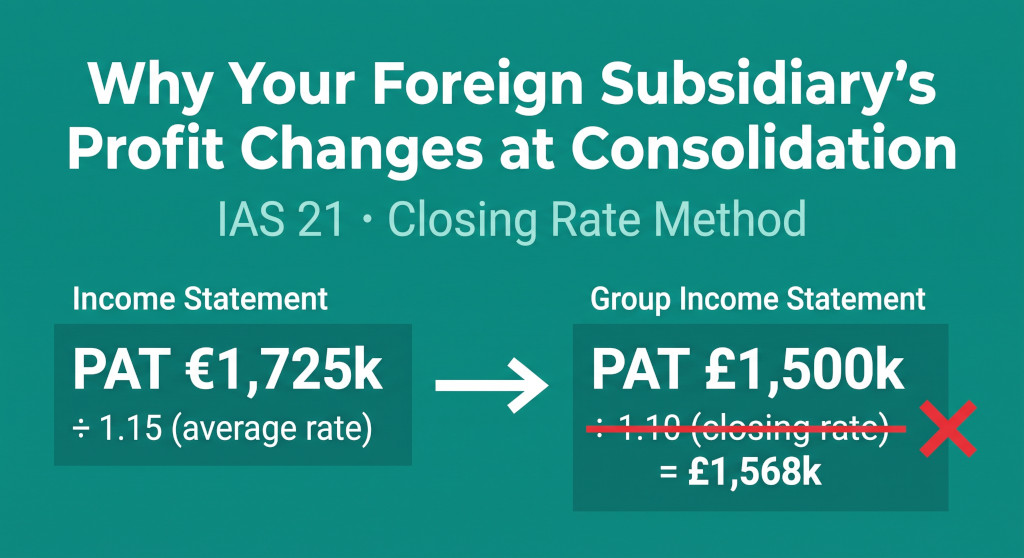
The group finance director of a UK consumer goods company received the monthly flash report from her German subsidiary. SalesCo GmbH had delivered a strong year: PAT of €1,725,000. She translated that at the year-end closing rate — £1 = €1.10 — and got £1,568,000. When she later saw the consolidated accounts, the group’s share of SalesCo’s profit was shown as £1,500,000. There was a £68,000 discrepancy, and nobody in the team could immediately explain it.
The answer is IAS 21. Under the closing rate method — the standard approach for translating a foreign subsidiary with a different functional currency — profit and loss items are translated at the average rate for the period, not at the closing rate. The two rates are almost never the same. The difference is not a mistake, not a rounding error, and not the auditors being difficult. It is a structural feature of how IAS 21 works, and it feeds directly into a reserve in OCI called the foreign currency translation reserve (FCTR). Understanding why the rates differ, where each rate applies, and how the FCTR is calculated is essential for any group accountant working with foreign subsidiaries.
Why Translation Is a Consolidation-Only Problem
SalesCo GmbH prepares its own statutory accounts in euros. It measures revenue, costs, assets, and liabilities in euros. Its functional currency — the currency of the primary economic environment in which it operates — is the euro. There is no translation involved at entity level. The translation only becomes necessary when SalesCo’s results are brought into the consolidated accounts of the UK parent, whose presentation currency is sterling.
Foreign currency consolidation, handled automatically.
BrizoConsol applies the correct CTA/FCTR treatment across all entities — no spreadsheets needed.
IAS 21.38 and 21.39 set out how to translate the financial statements of a foreign operation whose functional currency differs from the group’s presentation currency. The resulting translated figures are what appear in the consolidated income statement and balance sheet. The process generates a translation difference — the FCTR — that is recognised in OCI and accumulated in equity. That FCTR is entirely invisible in SalesCo’s own accounts. It only exists at group level.
The Three Rates and Where Each Applies
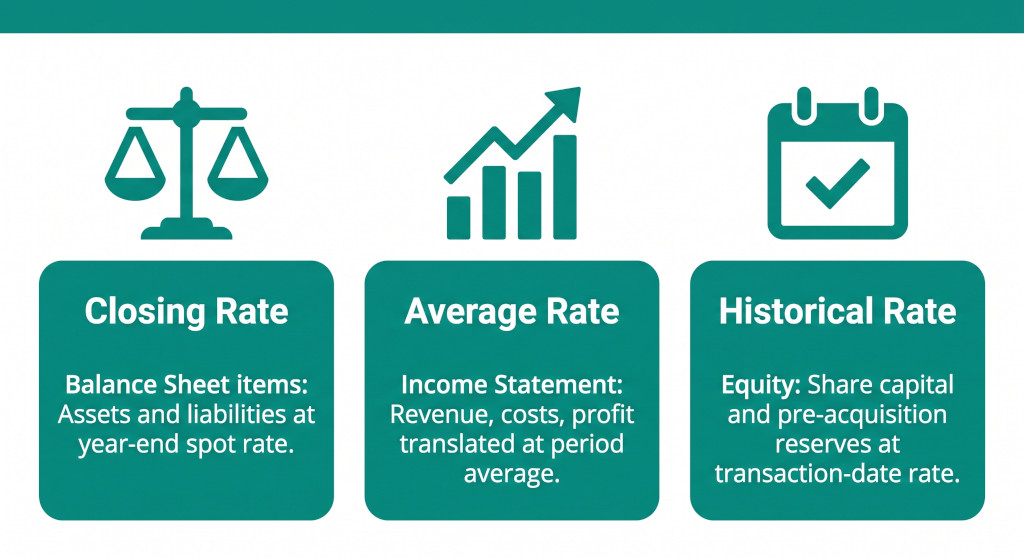
IAS 21 applies different exchange rates to different elements of the foreign subsidiary’s financial statements. Getting this wrong — for example, translating the entire balance sheet and income statement at the closing rate — produces incorrect consolidated figures and bypasses the FCTR mechanism entirely.
| Element | Rate applied | IAS 21 reference |
|---|---|---|
| Assets (all — monetary and non-monetary) | Closing rate (year-end spot) | IAS 21.39(a) |
| Liabilities | Closing rate (year-end spot) | IAS 21.39(a) |
| Revenue | Rate at date of transaction (average rate acceptable if not volatile) | IAS 21.39(b) |
| Expenses (including depreciation, COGS) | Rate at date of transaction (average rate acceptable) | IAS 21.39(b) |
| Share capital | Historical rate (rate at date capital was contributed) | IAS 21.39(c) |
| Pre-acquisition retained earnings | Historical rate (as established on acquisition) | IAS 21.39(c) |
| Translation difference (FCTR) | Recognised in OCI — balancing figure | IAS 21.39(c) |
The practical result: the closing rate applies to everything on the balance sheet, the average rate applies to everything on the income statement, and historical rates apply to the equity components that predate the current period. Anything left over — the inevitable arithmetic difference — is the FCTR, credited or debited directly to OCI.
The Translation in Practice: SalesCo GmbH
The UK group acquired SalesCo GmbH on 1 January, Year 1, at a rate of £1 = €1.20. At that date, SalesCo’s net assets consisted entirely of share capital of €6,000,000. During Year 1, SalesCo traded as follows:
Exchange rates for Year 1:
| Acquisition / historical rate (1 Jan) | £1 = €1.20 |
| Average rate (Year 1) | £1 = €1.15 |
| Closing rate (31 Dec) | £1 = €1.10 |
The euro strengthened against sterling during Year 1 — it now takes fewer euros to buy a pound. This means the closing rate produces larger sterling amounts than the average or historical rate, which is why SalesCo’s translated figures are higher at year-end than they would have been if rates had not moved.
Step 1 — Translate the income statement
| P&L line | EUR (€000) | Rate | GBP (£000) |
|---|---|---|---|
| Revenue | 11,500 | ÷ 1.15 | 10,000 |
| Cost of sales | (6,900) | ÷ 1.15 | (6,000) |
| Gross profit | 4,600 | 4,000 | |
| Operating expenses | (2,300) | ÷ 1.15 | (2,000) |
| Operating profit | 2,300 | 2,000 | |
| Tax (25%) | (575) | ÷ 1.15 | (500) |
| Profit after tax | 1,725 | 1,500 |
The PAT that enters the consolidated income statement is £1,500,000 — not £1,568,000 (which is what the closing rate would produce, and what the group finance director had initially calculated). The £68,000 difference is not lost. It will reappear as part of the FCTR.
Step 2 — Translate the balance sheet
| Balance sheet line | EUR (€000) | Rate | GBP (£000) |
|---|---|---|---|
| Fixed assets | 5,000 | ÷ 1.10 | 4,545 |
| Current assets | 4,725 | ÷ 1.10 | 4,295 |
| Total assets | 9,725 | 8,841 | |
| Liabilities | (2,000) | ÷ 1.10 | (1,818) |
| Net assets | 7,725 | 7,023 |
Net assets of €7,725,000 translate to £7,023,000 at the year-end closing rate.
Step 3 — Reconcile the equity
The translated net assets of £7,023,000 must be explained by three equity components: share capital at the historical rate, retained profit at the average rate, and the FCTR as the balancing figure.
| Share capital (€6,000k ÷ 1.20 historical) | £5,000k |
| Retained earnings / PAT (€1,725k ÷ 1.15 average) | £1,500k |
| Subtotal (before FCTR) | £6,500k |
| FCTR — balancing figure | £523k |
| Total equity = net assets at closing rate | £7,023k |
The FCTR of £523,000 is credited to OCI in the consolidated statement of comprehensive income. It does not pass through the consolidated P&L.
Where the FCTR Comes From
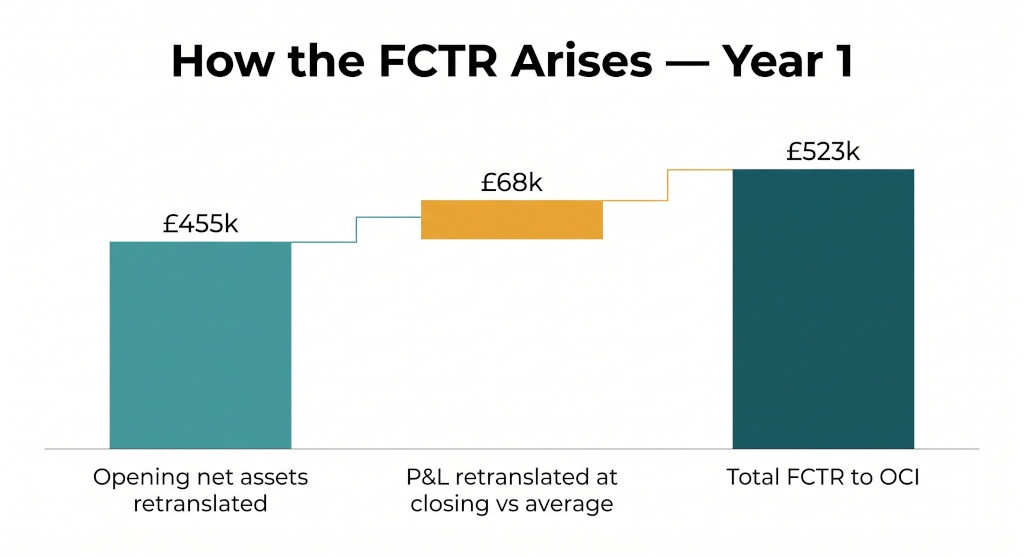
The £523,000 FCTR is not arbitrary. It has two identifiable components, each arising from the rate mismatch in a different part of the translation.
Component 1 — Retranslation of opening net assets
Opening net assets were €6,000,000 (the share capital contributed on 1 January). They were recorded in the consolidated accounts at the historical rate: £5,000,000. By 31 December, the same €6,000,000 translates at the closing rate to £5,455,000. The increase of £455,000 is a translation gain — the euro-denominated assets of the subsidiary are worth more in sterling terms because the euro strengthened.
| Opening net assets at closing rate (€6,000k ÷ 1.10) | £5,455k |
| Opening net assets at historical rate (€6,000k ÷ 1.20) | (£5,000k) |
| FCTR component 1 — opening retranslation | £455k |
Component 2 — P&L translated at average vs closing
PAT of €1,725,000 enters the consolidated P&L at the average rate: £1,500,000. But PAT also increases net assets, and those net assets appear on the consolidated balance sheet at the closing rate. At the closing rate, €1,725,000 = £1,568,000. The difference between what went into P&L (£1,500,000) and what the closing balance sheet implies (£1,568,000) is £68,000. This too is captured as FCTR.
| PAT at closing rate (€1,725k ÷ 1.10) | £1,568k |
| PAT at average rate (€1,725k ÷ 1.15) — entered in P&L | (£1,500k) |
| FCTR component 2 — P&L rate difference | £68k |
| Component 1 — opening retranslation | £455k |
| Component 2 — P&L rate difference | £68k |
| Total FCTR — Year 1 | £523k |
This answers the group finance director’s question exactly. The £68,000 “missing” from SalesCo’s profit is not missing at all — it is sitting in OCI as part of the FCTR.
The consolidation journal for the FCTR
| Account | Dr | Cr |
|---|---|---|
| Foreign currency translation reserve (OCI) | £523,000 | |
| Net assets of SalesCo GmbH (working) | £523,000 |
In practice this is a working paper entry, not a standalone journal. The FCTR is the arithmetic difference between net assets translated at the closing rate (£7,023k) and the equity components translated at historical and average rates (£6,500k). It is credited to the FCTR column in the consolidated SOCE and to the OCI section of the statement of comprehensive income.
The FCTR is a group-level balance. It exists only in the consolidated accounts. SalesCo GmbH’s own statutory accounts, prepared in euros, contain no FCTR. The reserve accumulates year on year as long as SalesCo remains in the group, and the group’s presentation currency and SalesCo’s functional currency differ.
Year Two and Beyond — How the FCTR Accumulates
In Year 2, the same process repeats. The opening net assets (now £7,023,000 in the consolidated balance sheet) are retranslated at the new year-end closing rate. Any movement feeds into the FCTR for the year. The current year P&L is translated at the Year 2 average rate, and the difference between the average rate P&L and the closing rate impact on net assets is the second component of the Year 2 FCTR movement.
If the euro weakens against sterling in Year 2 — say the closing rate moves from £1=€1.10 to £1=€1.20 — the FCTR movement is negative (a charge to OCI), partially unwinding the Year 1 gain. The FCTR balance in the consolidated balance sheet will reduce. The group has neither gained nor lost economically — the operational performance of SalesCo is unchanged — but the sterling translation of its assets and liabilities has declined in value.
A common group reporting error: translating the prior year comparative balance sheet at the new year-end closing rate rather than the prior year closing rate. IAS 21.42 requires that comparative period balance sheets are presented using the exchange rates ruling at that prior balance sheet date. Restating comparatives at the current closing rate overstates or understates prior year net assets and distorts the FCTR movement.
Goodwill and Fair Value Adjustments
When a foreign subsidiary is acquired and goodwill arises at consolidation, that goodwill is treated as an asset of the foreign subsidiary — it is denominated in the subsidiary’s functional currency and must be translated at the closing rate at each balance sheet date. Any movement in goodwill due to exchange rate changes feeds into the FCTR alongside the retranslation of the subsidiary’s other net assets.
Similarly, any fair value adjustments recognised on acquisition — uplifts to PPE, recognition of customer lists, inventory write-ups — are denominated in the subsidiary’s functional currency and are subject to the same closing rate translation at each subsequent balance sheet date. The depreciation and amortisation of those fair value adjustments is translated at the average rate (as an income statement item), generating further FCTR movements year after year.
For groups that want to simplify, it is worth noting that if the acquisition is structured as a purchase of assets rather than shares, or if the subsidiary has a functional currency identical to the parent’s presentation currency, no translation under IAS 21.39 is required and no FCTR arises.
What Happens to the FCTR on Disposal
When the group disposes of a foreign subsidiary, the cumulative FCTR relating to that subsidiary is recycled from equity to the consolidated income statement as part of the gain or loss on disposal. This is one of the few instances in IFRS where amounts previously recognised in OCI are subsequently reclassified to profit or loss — what IAS 1 calls a “reclassification adjustment.”
The recycling can have a significant effect on the reported disposal gain. A subsidiary acquired when sterling was weak (and the FCTR has accumulated as a large credit) may show a substantially larger disposal gain in P&L when the FCTR is recycled than the underlying economics would suggest. Conversely, a subsidiary acquired when sterling was strong, whose FCTR is a cumulative debit, will see a smaller (or negative) disposal gain when the reserve recycles. For the mechanics of intercompany foreign currency positions that also feed the FCTR, similar recycling principles apply on settlement or disposal.
Multiple foreign subsidiaries? Let the system handle the rates
BrizoConsol automates the closing rate / average rate split, calculates the FCTR movement for each foreign entity, and posts it to OCI — every period, without manual working papers. See how it handles multi-currency consolidation. See It In Action
Intercompany Balances With a Foreign Subsidiary
A further complication arises when the UK parent has intercompany balances with SalesCo — for example, an intercompany loan denominated in euros. In the parent’s GBP accounts, that euro loan will be retranslated at each closing rate, generating an exchange difference in the parent’s P&L (IAS 21.23). At consolidation, the intercompany loan eliminates, but the exchange difference in the parent’s P&L does not automatically disappear. The correct treatment depends on whether the loan forms part of the net investment in the foreign operation. If it does, the exchange difference should be reclassified to OCI and included in the FCTR rather than left in P&L — a treatment that requires a specific consolidation adjustment. The detailed mechanics are covered in the post on intercompany loans in foreign currency and the OCI vs P&L problem.
Checklist: Translating a Foreign Subsidiary Under IAS 21
- Confirm the subsidiary’s functional currency. IAS 21.9-14 define functional currency based on the primary economic environment. A subsidiary that invoices in euros and pays costs in euros has a euro functional currency even if it is owned by a UK parent. Only a foreign subsidiary — one whose functional currency differs from the group’s presentation currency — requires translation under IAS 21.39.
- Determine the three rates for the period. You need the closing rate (year-end spot), the average rate for the period (typically a monthly weighted average), and the historical rate for any equity components contributed in earlier periods. Lock these rates in the consolidation pack before starting.
- Translate the income statement at the average rate. Every P&L line — revenue, cost of sales, operating expenses, interest, tax — is translated at the average rate. Do not use the closing rate for P&L items. The resulting translated PAT is what enters the consolidated income statement.
- Translate the balance sheet at the closing rate. All assets and liabilities, including goodwill and fair value adjustments recognised on acquisition, are translated at the year-end closing rate. Apply this consistently to both current and non-current items.
- Translate equity at historical rates. Share capital and pre-acquisition retained earnings are translated at the historical rates established on acquisition. Post-acquisition retained earnings equal the cumulative translated PAT from prior periods (at average rates).
- Calculate the FCTR as the balancing figure. FCTR = closing rate net assets − (historical rate equity + average rate current-year PAT + cumulative prior-year retained earnings). Credit a positive FCTR to OCI. Debit a negative FCTR to OCI.
- Accumulate the FCTR in a separate equity reserve. Track the FCTR by subsidiary. When the subsidiary is disposed of, the cumulative FCTR for that subsidiary recycles to the consolidated income statement as part of the disposal gain or loss calculation.
- Apply consistent treatment to goodwill and fair value adjustments. Goodwill denominated in the subsidiary’s functional currency is retranslated at the closing rate each period. Depreciation and amortisation of fair value adjustments translate at the average rate (as a P&L charge), with the resulting balance sheet carrying amount at closing rate — generating further FCTR each year.
- Check intercompany balances for net investment designation. If any intercompany monetary item (loan, long-term receivable) forms part of the net investment in the foreign operation, the exchange differences on that item in the individual entity accounts should be reclassified to OCI at consolidation. Do not leave net investment exchange differences in the consolidated P&L.
Stop building translation working papers from scratch every period
BrizoConsol translates each foreign subsidiary automatically using the rates you set, calculates the FCTR, and feeds it directly into the consolidated OCI. Free trial — no card required. Start Free Trial