Intercompany Loans in a Foreign Currency: Why the Exchange Difference Goes to P&L in One Entity and OCI in Another — and How to Eliminate Both at Consolidation
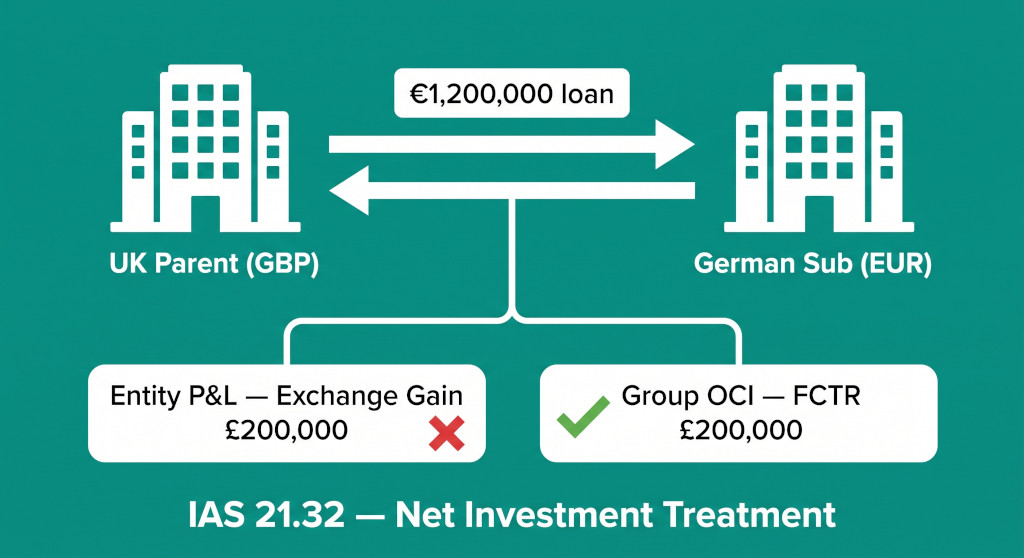
Claire had just finished the first draft of the group accounts when the external auditor flagged something in the UK parent’s standalone accounts. There was a £200,000 foreign exchange gain sitting in the parent’s P&L — the result of sterling weakening against the euro during the year on a €1,200,000 loan the parent had made to its German subsidiary. The auditor’s question was short: is this loan part of the net investment in GermanCo? And if so, this gain cannot stay in the consolidated P&L. It needs to go to OCI.
Claire knew the loan existed and had been tracking it. She had not questioned where the exchange difference should land. The parent’s accounting software had posted it to P&L, which seemed correct — it was a monetary item denominated in a foreign currency, and that is where exchange differences on monetary items go under IAS 21. What she had missed was the exception: IAS 21 paragraph 32, which treats certain intercompany monetary items differently from all other foreign currency transactions, precisely because they are not really arm’s-length transactions at all.
The problem is not rare. It arises in every group that has long-term intercompany funding arrangements across currency boundaries. The entity-level accounting is correct under IAS 21’s general rules. But the group-level accounting requires a reclassification that most consolidation checklists do not include as a separate step — and when it is missed, the consolidated P&L contains exchange gains and losses that belong in the foreign currency translation reserve instead.
Foreign currency consolidation, handled automatically.
BrizoConsol applies the correct CTA/FCTR treatment across all entities — no spreadsheets needed.
The Rule: IAS 21 Paragraph 32
IAS 21 divides foreign currency monetary items into two categories for consolidation purposes. The first is ordinary trading and financial balances — intercompany receivables with defined settlement dates, short-term intercompany payables, and similar items. Exchange differences on these go to P&L at both entity level and group level. They are eliminated as part of the standard intercompany loan elimination, and no further adjustment is needed.
The second category is narrower and more consequential. IAS 21.32 states that exchange differences arising on a monetary item that forms part of a reporting entity’s net investment in a foreign operation must be recognised in OCI — in the group accounts — rather than in profit or loss. The same exchange difference is correctly included in P&L at entity level. It is only at consolidation that the reclassification is required.
A monetary item qualifies as part of the net investment when settlement is neither planned nor likely to occur in the foreseeable future. In practice, this means: no fixed repayment schedule, no expectation from management that the loan will be called in within the planning horizon, and an amount that represents permanent or quasi-permanent funding of the subsidiary rather than operational working capital. If those conditions are met, every exchange difference on the item — cumulative from the date of the loan — belongs in the foreign currency translation reserve (FCTR), not in P&L.
The test is the intent and expectation around repayment, not the legal form of the document. A loan with no maturity date can still fail the test if management intends to recall it within the year. Conversely, a formally documented loan with a ten-year bullet repayment may qualify if management views it as permanent funding.
Scenario A: Loan in the Subsidiary’s Currency
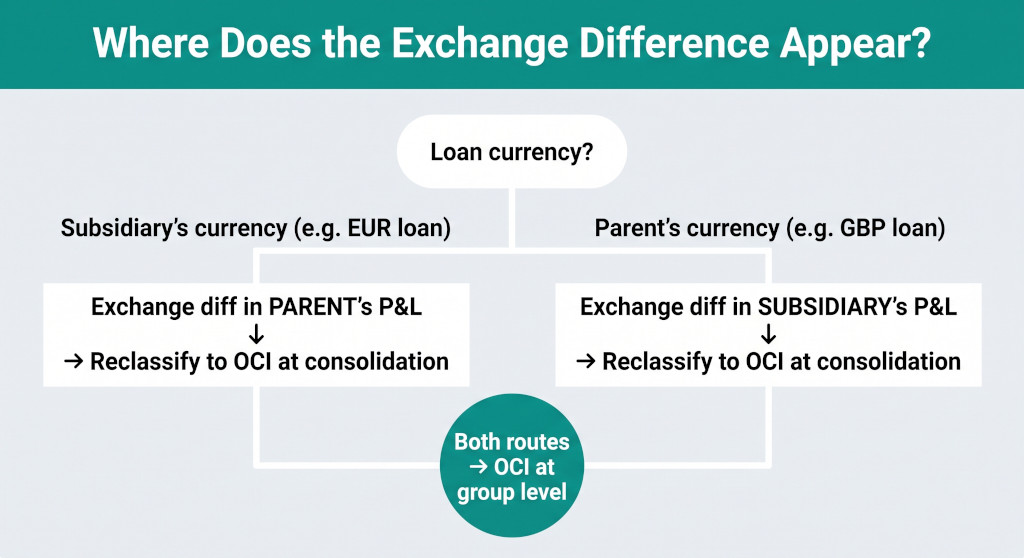
The UK parent (GBP functional currency) advances €1,200,000 to GermanCo (EUR functional currency) on 1 January. The loan has no repayment date and management views it as permanent funding. It qualifies as part of the net investment.
| Item | Rate | GBP equivalent |
|---|---|---|
| Loan advanced — 1 Jan (£1 = €1.20) | 1.20 | £1,000,000 |
| Closing rate — 31 Dec (£1 = €1.00) | 1.00 | £1,200,000 |
| Exchange gain in parent’s P&L | £200,000 |
GBP weakened significantly against EUR during the year. The parent’s €1,200,000 receivable, denominated in the subsidiary’s currency, is worth £200,000 more at year-end than when it was advanced. The parent correctly records a £200,000 gain in its own P&L under IAS 21’s general rules.
GermanCo records a €1,200,000 payable throughout the year. Because EUR is its functional currency, there is no exchange difference in GermanCo’s accounts.
At consolidation, three things happen:
Step 1 — Translate GermanCo’s payable into GBP for consolidation
GermanCo’s €1,200,000 payable is translated at the closing rate of €1.00 per pound, giving £1,200,000. The parent’s receivable is already stated at £1,200,000 (retranslated at closing rate). The balances match in GBP.
Step 2 — Eliminate the intercompany loan
| Account | Dr | Cr |
|---|---|---|
| Intercompany loan payable (GermanCo) | £1,200,000 | |
| Intercompany loan receivable (Parent) | £1,200,000 |
Both sides translate to £1,200,000 at closing rate. The elimination is clean with no residual difference.
Step 3 — Reclassify the exchange gain from P&L to OCI
| Account | Dr | Cr |
|---|---|---|
| Exchange gain — P&L (Parent) | £200,000 | |
| Foreign Currency Translation Reserve — OCI | £200,000 |
This entry does not reverse the exchange difference — it reclassifies it. The £200,000 economic gain is real. It just does not belong in the consolidated income statement; it belongs in OCI alongside the other translation movements on GermanCo’s net assets.
After this entry, the consolidated P&L contains no exchange difference related to this loan. The £200,000 sits in the FCTR alongside the other translation adjustments arising from retranslating GermanCo’s net assets at the closing rate. The group’s total equity is unchanged — the gain has simply moved between two components of equity.
Scenario B: Loan in the Parent’s Currency
The currency of the loan changes which entity records the exchange difference — but it does not change where the difference must land at group level.
Suppose instead that the UK parent had lent £1,000,000 (GBP) to GermanCo. The parent records a sterling receivable: no exchange difference arises in the parent’s accounts because the item is in its own functional currency. GermanCo, however, must translate the GBP payable into EUR each period.
| GBP payable in GermanCo — 1 Jan (£1 = €1.20) | €1,200,000 |
| GBP payable in GermanCo — 31 Dec (£1 = €1.00) | €1,000,000 |
| Exchange gain in GermanCo’s P&L (EUR) | €200,000 |
GBP weakened, so GermanCo’s GBP-denominated payable is cheaper to repay in EUR terms — hence a gain in GermanCo’s P&L of €200,000. Translated into GBP at the average rate (say £1 = €1.10) for inclusion in the consolidated income statement, this gain is approximately £181,818.
At consolidation: the parent’s receivable is £1,000,000. GermanCo’s payable, translated at the closing rate of €1.00 per pound, is also £1,000,000. The loan elimination is again clean. But GermanCo’s P&L contains an exchange gain that belongs in OCI:
| Account | Dr | Cr |
|---|---|---|
| Exchange gain — P&L (GermanCo, translated) | £181,818 | |
| Foreign Currency Translation Reserve — OCI | £181,818 |
The exchange difference is now in GermanCo’s P&L rather than the parent’s, but the reclassification to FCTR at consolidation works identically.
The most common mistake: finance teams eliminate the loan balance correctly but do not look for the exchange difference. In Scenario A it is in the parent’s accounts; in Scenario B it is in the subsidiary’s accounts. If you only look in one place, you will miss it in the other. The reclassification is required regardless of which entity’s accounts the difference appears in.
A Side-by-Side Comparison
| Feature | Loan in subsidiary’s currency (Scenario A) | Loan in parent’s currency (Scenario B) |
|---|---|---|
| Exchange difference at entity level | In parent’s P&L | In subsidiary’s P&L |
| Exchange difference at group level | OCI / FCTR | OCI / FCTR |
| Loan elimination: balances match? | Yes — both at closing rate in GBP | Yes — both at closing rate in GBP |
| Reclassification entry required? | Yes — from parent’s P&L to OCI | Yes — from subsidiary’s P&L to OCI |
| Impact on group equity | None — moves between P&L and OCI components | None — moves between P&L and OCI components |
What If the Loan Does Not Qualify as Net Investment?
If the loan does not meet the IAS 21.32 test — for example, if it has a fixed three-year repayment schedule or management is actively planning to recall it — the exchange difference stays in P&L at both entity and group level. In that case, no reclassification entry is needed at consolidation. The standard intercompany elimination removes both the receivable and the payable, and the exchange difference in the relevant entity’s P&L remains in the consolidated income statement.
This means the qualifying test matters enormously for the shape of the consolidated accounts. Two groups with identical loan balances and identical exchange rate movements can end up with very different consolidated income statements simply because one loan qualifies as part of the net investment and the other does not. Finance teams should document the qualifying assessment at the point the loan is established, not when the question arises at year-end.
Multi-currency consolidation without the manual reclassification risk
BrizoConsol tracks the net investment designation for intercompany loan balances and applies the OCI reclassification automatically at each reporting date. See how it works for your group structure. See It In Action
Interest on the Loan: A Different Rule
IAS 21.32 applies to the principal balance of the qualifying intercompany loan. It does not extend to interest. Interest charged on an intercompany loan — even a loan that forms part of the net investment — is a current-period transaction with a settlement date (the interest due date). Exchange differences arising on intercompany interest receivable and payable go to P&L at both entity and group level. They are eliminated as part of the standard intercompany interest elimination alongside the interest income and expense themselves.
This distinction matters for groups that charge interest on their intercompany funding. The principal balance has one treatment; the accumulated interest and the exchange differences on it have another. Both need to be identified separately in the consolidation working papers. For a full treatment of intercompany loan eliminations, including impairment and the complications that arise when interest is capitalised or waived, see the dedicated guide.
What Happens to the FCTR Balance When the Subsidiary Is Disposed Of
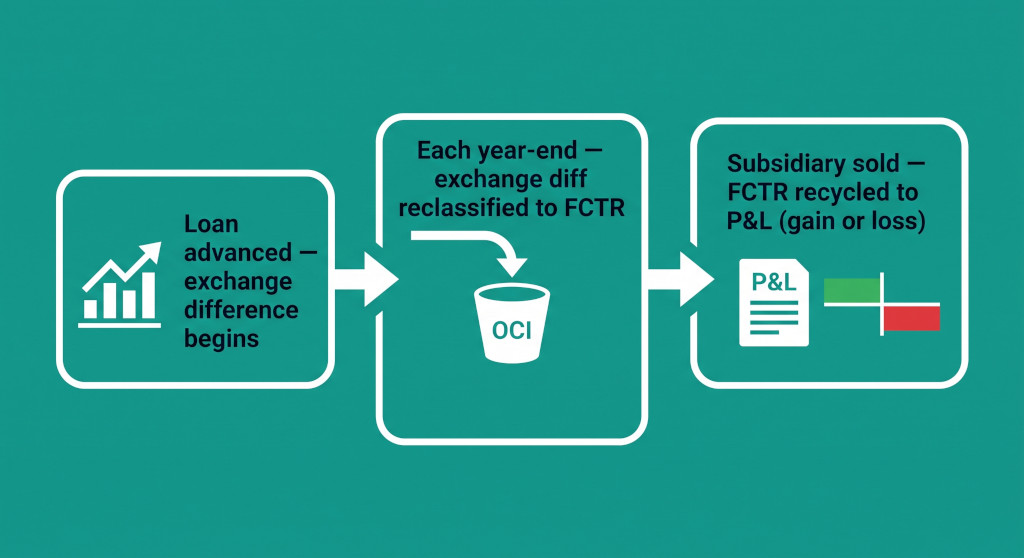
Exchange differences that are reclassified to OCI under IAS 21.32 accumulate in the FCTR over the life of the loan. They do not affect the consolidated income statement in the periods they arise. But they are not permanently parked in OCI: when the group disposes of the foreign subsidiary to which the loan related, the cumulative FCTR balance — including the amounts relating to the intercompany loan — is recycled to the consolidated income statement as part of the disposal gain or loss.
This is the same recycling mechanism that applies to all FCTR balances on disposal of a foreign operation, as explained in the guide to recycling the CTA on disposal of a foreign subsidiary. The loan-related OCI is part of the total FCTR that recycles. Finance teams need to track which portion of the FCTR relates to the net investment loan separately from the portion that relates to the retranslation of GermanCo’s net assets at closing rate — particularly if the subsidiary is only partially disposed of.
If the loan is repaid rather than the subsidiary being sold, the position is slightly different. Repayment of a qualifying net investment loan triggers recycling of the associated FCTR to P&L in the period of repayment, even without a disposal of the subsidiary itself. This is the most commonly missed consequence of deciding to repay an intercompany loan that has been treated as part of the net investment — a large FCTR balance can move to P&L in a single period when the loan is cleared.
If the group is considering early repayment of a long-standing intercompany loan that has been designated as part of the net investment, model the FCTR recycling impact first. A decision that looks financially straightforward at treasury level can produce a significant P&L impact in the group accounts.
Why This Causes CTA Reconciliation Failures
When the reclassification is missed, the FCTR in the consolidated accounts will not reconcile. The opening balance plus the current-year translation movements on GermanCo’s net assets will not equal the closing balance. The gap will be exactly the exchange difference that should have been reclassified but remained in P&L instead.
This is one of the most common causes of the “why does my CTA not reconcile?” problem in multi-currency consolidations. If your FCTR is moving by less than expected relative to the subsidiary’s exchange rate movement, look for an intercompany monetary item whose exchange difference is sitting in P&L rather than OCI. The guide on why your CTA does not reconcile covers this and the other common sources of FCTR discrepancies in detail.
The same issue interacts with the general question of how exchange differences flow through a multi-currency consolidation. For the full picture of how intercompany transactions are affected by exchange rate movements between the period of origination and the reporting date, see the guide on intercompany eliminations in multi-currency groups.
Checklist: Getting the Net Investment Loan Treatment Right
- At origination, assess and document whether the loan qualifies under IAS 21.32. The key questions are: Is settlement planned? Is it likely in the foreseeable future? Document the answer, who made the assessment, and when.
- Record the designation formally. Note it in the intercompany loan agreement or the group treasury policy so that any future change in circumstances (for example, a decision to repay) triggers a reassessment.
- Identify which entity carries the exchange difference. If the loan is in the subsidiary’s currency, the difference is in the parent’s P&L. If it is in the parent’s currency, it is in the subsidiary’s P&L. Look in both places every period.
- Make the elimination entry first, then the reclassification entry. These are two separate consolidation journals, not one. Confirm the loan balances eliminate cleanly before processing the reclassification.
- Treat interest separately. Exchange differences on accrued intercompany interest stay in P&L and are eliminated normally. Do not apply the net investment reclassification to the interest line.
- Track the cumulative FCTR balance attributable to the loan. Maintain a separate line in the FCTR roll-forward for net investment loan differences. You will need this on disposal or repayment.
- Model the P&L impact before repaying the loan. Early repayment triggers recycling of the cumulative FCTR to P&L in the repayment period. Quantify this before the treasury decision is made.
- Include the loan-related FCTR in the disposal calculation if the foreign subsidiary is sold. The full FCTR — including loan-related amounts — recycles to P&L as part of the disposal gain or loss.
Stop building the net investment reconciliation in a spreadsheet
BrizoConsol handles multi-currency intercompany loan elimination and FCTR tracking across all entities in one place. Start a free trial and run your first multi-currency consolidation today. Start Free Trial