Franchise Fee Eliminations in an F&B Group: How to Remove Royalties and Marketing Levies When the Franchisor and Franchisee Are Both Inside the Group
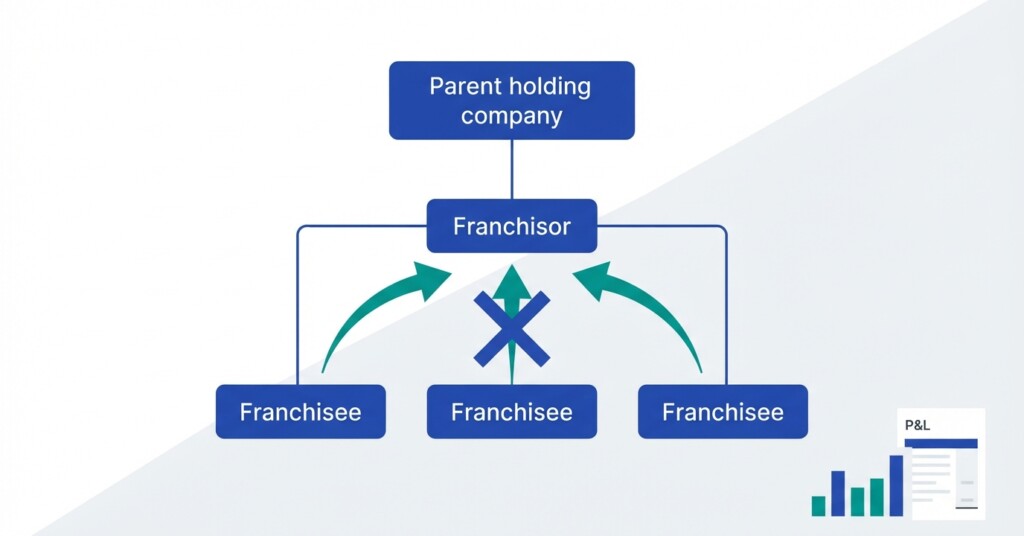
In food and beverage groups that operate both a franchisor entity and franchisee entities under common ownership, a quiet but persistent consolidation problem sits inside the intercompany schedule every month: franchise royalties and marketing levies. These fees are perfectly legitimate commercial arrangements at the individual-entity level — each franchisee records a royalty expense, the franchisor records royalty income, and everyone is happy with the statutory accounts. But the moment you try to prepare consolidated group financials, those same transactions must disappear entirely. They represent money the group is effectively paying to itself, and leaving them in the consolidated P&L overstates both revenue and expenses, distorting every margin metric the board looks at.
This article works through exactly how to identify, calculate, and eliminate franchise fees in an F&B consolidation — covering royalties, marketing levies, and the deferred elements that often get missed — with journal entries, a worked example, and practical notes on where the process tends to break down for finance teams doing this in spreadsheets.
Why Franchise Fees Are Different from Ordinary Intercompany Charges
Most intercompany eliminations follow a simple pattern: one entity charges another, you find the matching entries, and you cancel both sides. Intercompany loan interest, management fees, and shared-service recharges all behave this way. Franchise fees inside a group are slightly more complicated for a few reasons.
Intercompany eliminations without the manual work.
BrizoConsol identifies and eliminates intercompany balances automatically at consolidation.
First, the commercial substance of the arrangement is usually arm’s-length by design. The franchisor may have third-party franchisees paying the same royalty rates, so the rate is defensible for transfer-pricing purposes at the entity level. That is fine — but it does not change the consolidation treatment. Second, franchise agreements in F&B typically bundle several distinct fee types: a percentage-of-revenue royalty, a fixed or variable marketing levy (often pooled into a marketing fund), and sometimes a technology or POS fee. Each of these must be treated separately because they may sit in different P&L line items on both sides. Third, marketing levies often flow through a marketing fund that is either held inside the franchisor entity or in a dedicated trust-like structure. If the fund entity is consolidated, both the levy income and the corresponding marketing expenditure must be examined carefully.
A useful rule of thumb: any payment that flows from one consolidated entity to another consolidated entity — regardless of whether the rate or amount is commercially justified — must be fully eliminated on consolidation. The group P&L should only reflect transactions with parties outside the group boundary.
Mapping the Entities and the Fee Flows
Before you can eliminate anything, you need a clear picture of who is paying whom, on what basis, and where each amount lands in the chart of accounts. In a typical F&B group with an internal franchisor, the structure looks something like this.
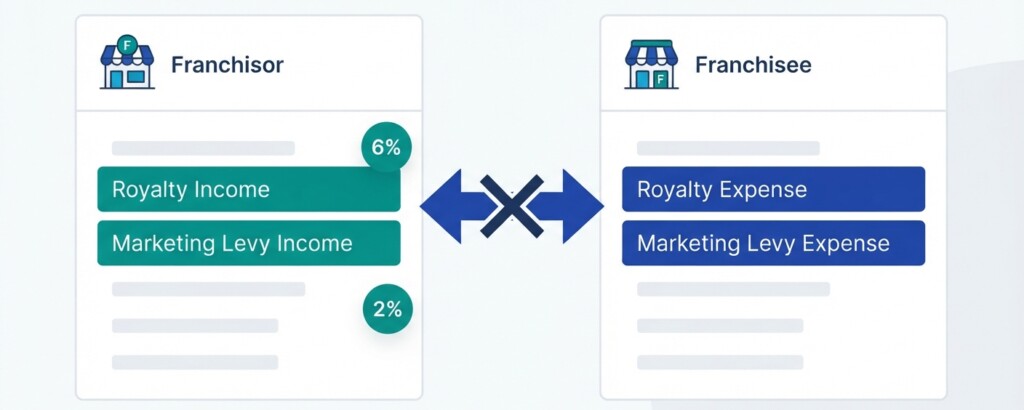
| Fee Type | Paying Entity | Receiving Entity | Franchisee P&L Line | Franchisor P&L Line |
|---|---|---|---|---|
| Royalty (% of net sales) | Each Franchisee OpCo | Franchisor OpCo | Franchise royalty expense | Royalty income / Revenue |
| Marketing levy (% of net sales) | Each Franchisee OpCo | Franchisor OpCo (or Marketing Fund entity) | Marketing levy expense | Marketing fund income |
| Technology / POS fee (fixed monthly) | Each Franchisee OpCo | Franchisor OpCo | Technology fee expense | Technology fee income |
| Initial franchise fee (upfront, amortised) | Each Franchisee OpCo | Franchisor OpCo | Prepaid franchise fee / amortisation | Deferred income / recognised income |
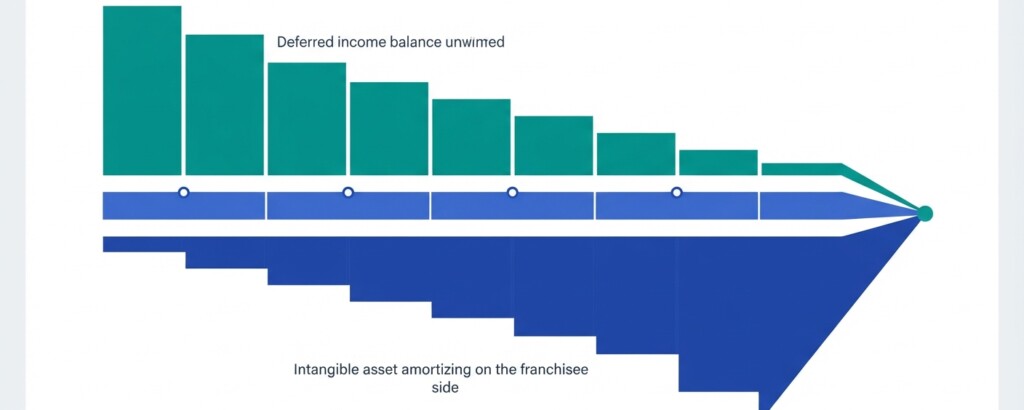
The last row — initial franchise fees — is the one most often missed in a monthly close. When a new store is opened within the group, the franchisor may charge an upfront fee that the franchisee capitalises and amortises. At consolidation, the unamortised balance sitting on the franchisee’s balance sheet (as an intangible or prepayment) must be eliminated against the deferred income or recognised income on the franchisor’s side. If the franchisor has already recognised the income but the franchisee is still amortising, there is a timing difference that needs a consolidation adjustment.
A Worked Example: Quarterly Elimination for a Three-Site Group
Consider a simplified F&B group with the following structure: a Franchisor entity (FranCo) and three Franchisee entities (Store A, Store B, Store C), all 100% owned by the same parent. For the quarter, each store pays a 6% royalty on net sales and a 2% marketing levy. There are no third-party franchisees in this example, so all royalty and levy income at FranCo is intercompany.
| Store A — net sales | $820,000 |
| Store B — net sales | $640,000 |
| Store C — net sales | $510,000 |
| Total group net sales (intra-group) | $1,970,000 |
| Royalty at 6% of $1,970,000 | $118,200 |
| Marketing levy at 2% of $1,970,000 | $39,400 |
| Total intercompany fees to eliminate | $157,600 |
In the consolidated workbook, both the $118,200 royalty and the $39,400 marketing levy must be removed from both the revenue side (FranCo) and the expense side (each store). The net effect on consolidated profit is zero — assuming FranCo has not incurred any third-party costs against the marketing fund. If FranCo has spent part of the marketing levy on genuine external advertising, only the levy income is eliminated; the external marketing spend remains in the consolidated P&L as a real group expense.
| Account | Dr | Cr |
|---|---|---|
| Royalty income (FranCo) | 118,200 | |
| Franchise royalty expense (Stores A, B, C combined) | 118,200 |
Elimination of intercompany royalty for the quarter. Removes $118,200 from group revenue and group operating expenses simultaneously, with no net P&L impact.
| Account | Dr | Cr |
|---|---|---|
| Marketing levy income (FranCo) | 39,400 | |
| Marketing levy expense (Stores A, B, C combined) | 39,400 |
Elimination of intercompany marketing levy. Where FranCo has spent funds externally (e.g., agency fees to a third party), those costs remain in the consolidated P&L and are not reversed here.
Handling Intercompany Balances on the Balance Sheet
Fees do not always clear within the same period they are charged. Franchisees may pay royalties on a monthly cycle but the period end falls mid-cycle, leaving intercompany receivables on FranCo’s balance sheet and intercompany payables on each store’s balance sheet. These must also be eliminated on consolidation, separately from the P&L elimination.
| Account | Dr | Cr |
|---|---|---|
| Intercompany payable — royalties (Stores A, B, C) | 28,400 | |
| Intercompany receivable — royalties (FranCo) | 28,400 |
Elimination of outstanding intercompany balance at period end. The $28,400 represents accrued royalties not yet cash-settled as at the reporting date. Both sides net to zero at the consolidated level.
If the intercompany receivable on FranCo and the intercompany payable on the stores do not match, you have an intercompany reconciliation break before you have even started the elimination. This is one of the most common causes of consolidation differences in F&B groups. Differences typically arise from timing (the franchisor invoices in one period, the store accrues in the next) or from different royalty calculations (FranCo calculates on gross sales; the store accrues on net sales). Resolve these at the sub-consolidation level before running group eliminations.
Deferred Income and Unamortised Franchise Fees
Initial franchise fees paid when a store is established or renewed require separate treatment. Suppose FranCo charged Store B an initial fee of $60,000 when the franchise agreement was signed two years ago, recognised over a 5-year term. Store B capitalised the fee and amortises it at $12,000 per year. At the current reporting date, the following positions exist.
| Item | FranCo (Franchisor) | Store B (Franchisee) | Consolidated Adjustment |
|---|---|---|---|
| Original fee | Recognised over 5 yrs | Capitalised at $60,000 | Eliminate on day one |
| Cumulative income recognised (2 yrs) | $24,000 in retained earnings | — | Reduce FranCo retained earnings by $24,000 (offsetting Store B amortisation reversal) |
| Deferred income remaining | $36,000 liability | — | Eliminate $36,000 deferred income |
| Gross intangible / prepayment (Store B) | — | $60,000 asset | Eliminate $60,000 asset |
| Accumulated amortisation (Store B) | — | $(24,000) | Eliminate $(24,000) accumulated amortisation (reversing cumulative expense in Store B retained earnings) |
| Net intangible on Store B balance sheet | — | $36,000 | Net elimination: $36,000 vs $36,000 deferred income |
The net position balances: the $36,000 deferred income on FranCo’s balance sheet offsets exactly against the $36,000 net intangible on Store B’s balance sheet. The cumulative $24,000 that FranCo has already recognised in prior periods offsets Store B’s cumulative $24,000 amortisation expense, leaving net consolidated opening retained earnings unaffected. This is why maintaining a schedule of all intra-group initial franchise fees — with origination dates, total amounts, recognition profiles, and current unamortised balances — is essential for anyone consolidating an F&B group.
FX Considerations When Stores Operate in Different Currencies
F&B groups that operate across borders — for example, an Australian franchisor with franchisee entities in Singapore, the UAE, or the UK — introduce a foreign exchange layer into the elimination process. The royalty is typically denominated in the functional currency of the franchisor (say, AUD), but the franchisee records it in their local functional currency (SGD, AED, or GBP). At the individual entity level, each party translates the intercompany charge using the transaction-date rate or a contractual rate. At consolidation, both sides are retranslated into the group presentation currency.
This creates a small but real difference: the amount eliminated on the revenue side (FranCo, translated to group currency) may not exactly match the amount eliminated on the expense side (Franchisee, translated to group currency) when different exchange rates (such as transaction-date rates versus period-average translation rates) apply. Where this variance arises from translating foreign subsidiary income statement items into the group presentation currency, the translation effect forms part of the foreign currency translation reserve in other comprehensive income (OCI). In contrast, any foreign exchange gains or losses recognised at the entity level on revaluing the outstanding intercompany receivable or payable under IAS 21 or ASC 830 remain in consolidated profit or loss, as short-term trading balances do not qualify for net investment OCI treatment. Finance teams doing this manually in Excel frequently confuse these two treatments, either forcing differences to zero or misclassifying translation adjustments versus transactional exchange differences.
Where Manual Processes Break Down
The eliminations described above are conceptually straightforward, but in practice they depend on having current, accurate, and consistently coded data from every entity in the group. In an F&B group with six to fifteen entities, monthly franchise fee eliminations involve: confirming that every store has coded royalties to the correct intercompany account code; confirming that FranCo has coded royalty income by entity (not just as a pooled line); reconciling any cash versus accrual timing differences; applying FX rates consistently; updating the initial fee amortisation schedule; and then assembling the elimination journals in the consolidation workbook — before any other consolidation work has begun.
When this is done in Excel, the intercompany schedule is often the longest tab in the workbook and the one most likely to contain broken links, hardcoded figures from prior months, or rates that have not been updated. Automated consolidation tools that pull entity trial balances directly, flag intercompany mismatches before the elimination step, and apply standard elimination templates significantly reduce the risk of errors reaching the consolidated financials.
- Maintain a master intercompany fee register listing every recurring and one-off fee, the paying entity, the receiving entity, the account codes on both sides, and the contractual basis for the charge.
- Agree a cut-off date for intercompany invoicing so that both sides of every transaction fall in the same reporting period.
- Reconcile intercompany balances before month-end close, not after — a mismatch found during consolidation means reopening entity books.
- Keep a separate schedule for initial franchise fees with origination dates, total amounts, recognition profiles, and current carrying values on both sides.
- Document the FX treatment for cross-currency royalties explicitly, distinguishing transactional FX recognised in P&L from translation reserve movements in OCI.
- Review the marketing fund structure annually to confirm whether the fund entity is within the consolidation boundary and whether any external spend should remain in the group P&L.
The Board View: What Consolidated Margins Should Actually Show
After all franchise fee eliminations are correctly applied, the consolidated P&L of the group should reflect the genuine economic performance of the business as if it were a single operation. Royalty lines on both sides disappear. Marketing levy income disappears, but external marketing agency costs remain. The group EBITDA represents real operational performance, not a figure inflated by internal fee circulation.
This matters most when the board is comparing individual-entity performance against consolidated performance, or when preparing information for lenders, investors, or a potential sale. An F&B group that has not correctly eliminated internal franchise fees will show overstated revenue at the consolidated level, which distorts EBITDA margins, revenue per site metrics, and any valuation multiple applied to the business. Correcting this retrospectively during a due diligence process is uncomfortable and avoidable.
Automation and the Path to a Cleaner Close
The elimination workflow described here is inherently rule-based: if entity X pays entity Y under a specific account code, eliminate both sides by a defined method. That structure lends itself well to automation. Consolidation platforms that allow finance teams to define intercompany elimination rules — specifying the account pairs, the entities involved, and the treatment of any residual FX differences — can run these eliminations consistently every period without manual journal entry, freeing the team to focus on reviewing results rather than constructing them.
For F&B groups where franchise fee structures evolve over time — new stores opening, agreement renewals, rate changes, entity restructures — having the elimination logic documented in a system rather than embedded in a spreadsheet also reduces key-person dependency. The consolidation does not break when the controller who built the model goes on leave.
See How Automated Eliminations Work in Practice
BrizoConsol is built for finance teams managing multi-entity consolidations, including intercompany eliminations, FX translation, and group reporting. If your team is spending too much time reconciling franchise fee schedules before you can even start the consolidation, it may be worth seeing what a connected consolidation workflow looks like.