How to Eliminate Intercompany Fulfilment Fees When Your E-commerce Group Uses an In-House Logistics Subsidiary
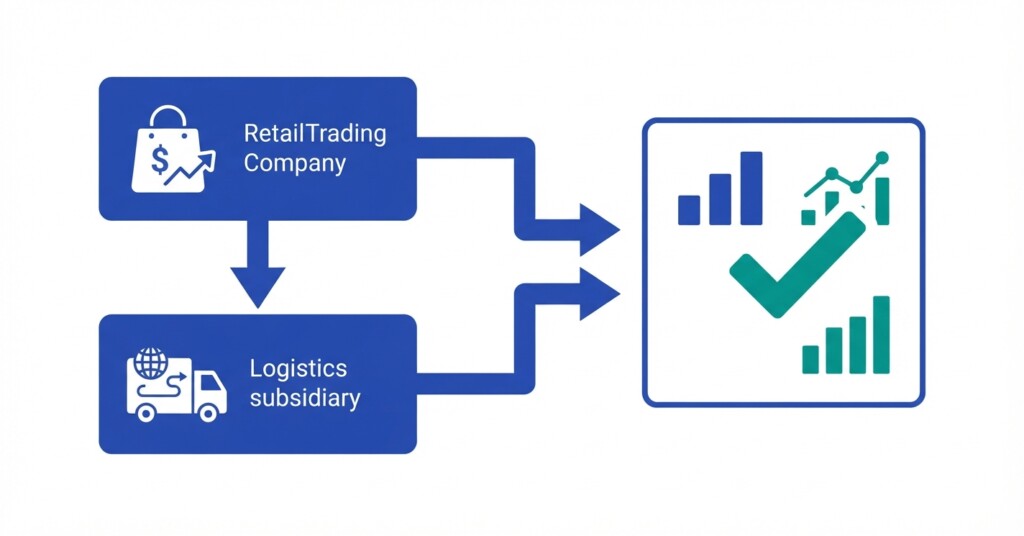
For e-commerce groups that have brought logistics in-house, the commercial logic is clear: control your fulfilment costs, improve delivery times, and capture margin that would otherwise go to a third-party courier or warehouse operator. But the accounting consequence of that structure creates one of the most persistent headaches in group reporting — intercompany fulfilment fees that inflate both revenue and expenses at the consolidated level if they are not properly eliminated.
This article walks through exactly how those fees arise, why they distort your group financial statements, and the practical steps to eliminate them correctly at month-end. It also covers the journal entries involved, how foreign currency complicates matters when your logistics entity operates in a different country, and where manual consolidation processes tend to break down.
Why Intercompany Fulfilment Fees Exist in the First Place
Suppose your group structure looks like this: a parent trading entity (‘RetailCo’) sells goods to end customers, and a wholly-owned logistics subsidiary (‘LogisCo’) handles picking, packing, and last-mile delivery on RetailCo’s behalf. LogisCo charges RetailCo a fulfilment fee for every order it processes — say £4.50 per order — and RetailCo books that as a distribution cost.
Intercompany eliminations without the manual work.
BrizoConsol identifies and eliminates intercompany balances automatically at consolidation.
From a standalone entity perspective, both sides of the transaction are legitimate. LogisCo recognises service revenue. RetailCo recognises a cost. Each entity’s individual accounts are correct. The problem only appears when you consolidate: the group as a whole has not paid anything to an external party. The fulfilment fee is internal. If you simply stack the two sets of accounts together without eliminating the intercompany transaction, your group P&L overstates both revenue and operating costs by exactly the same amount — and your group balance sheet likely carries a receivable and a payable that cancel each other out.
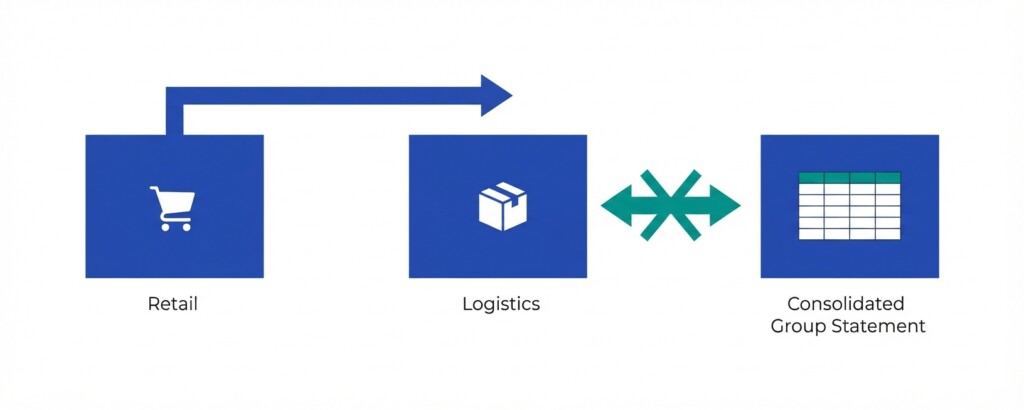
The Consolidation Elimination: What Needs to Come Out
At consolidation, you need to reverse the intercompany fulfilment income recognised by LogisCo and the intercompany fulfilment expense recognised by RetailCo. You also need to clear any outstanding intercompany balances sitting on the balance sheet — typically an intercompany receivable in LogisCo’s books and an intercompany payable in RetailCo’s books.
If these have been settled in cash during the month, the balance sheet elimination may already be zero, and you are only dealing with the P&L entries. If settlement is monthly in arrears, you will have both a P&L elimination and a balance sheet elimination to process.
| Account | Dr | Cr |
|---|---|---|
| Intercompany Fulfilment Revenue (LogisCo) | 45,000 | |
| Intercompany Fulfilment Expense (RetailCo) | 45,000 |
P&L elimination: remove 10,000 orders × £4.50 intercompany fulfilment fee for the month. Debit LogisCo revenue to reduce it; credit RetailCo distribution costs to reduce the expense. Both sides net to zero at group level.
| Account | Dr | Cr |
|---|---|---|
| Intercompany Payable (RetailCo — owed to LogisCo) | 45,000 | |
| Intercompany Receivable (LogisCo — owed from RetailCo) | 45,000 |
Balance sheet elimination: clear the outstanding intercompany payable in RetailCo and the corresponding intercompany receivable in LogisCo, where settlement has not yet occurred at month-end.
A clean intercompany elimination requires that both entities use matching intercompany account codes. If RetailCo codes the expense to a generic ‘Distribution Costs’ account and LogisCo codes the income to ‘Logistics Revenue’, your consolidation tool — or your spreadsheet — cannot automatically pair and eliminate them. Agreeing a dedicated intercompany account structure is the single most effective thing you can do before automating consolidation.
Calculating the Elimination Amount: Getting the Numbers Agreed
Before you can post the elimination, both entities need to agree on the amount. In practice, this is where most reconciliation effort lives. LogisCo may invoice on a different cut-off from RetailCo’s accrual. Order volumes may be counted differently. Disputed orders, returns, or reprocessing fees may create small differences that are hard to trace.
| Orders processed by LogisCo in the month | 10,000 |
| Standard fulfilment fee per order (£) | 4.50 |
| Gross intercompany fulfilment charge (£) | 45,000 |
| Less: credit notes for returned orders (£) | (1,350) |
| Net intercompany fulfilment fee to eliminate (£) | 43,650 |
Once both entities agree on the £43,650 net figure, the elimination journals above are posted at that amount. If there is a timing difference — for example, RetailCo has accrued based on its own despatch count and the figure is £44,100 — you need an intercompany reconciliation process to resolve the £450 gap before the group accounts are finalised. Carrying unreconciled differences through to consolidated accounts is a common source of group reporting errors.
When LogisCo Operates in a Different Currency
If your logistics subsidiary is based in a different country — say LogisCo operates in Poland and invoices in PLN, while the group reports in GBP — foreign currency (FX) translation introduces additional complexity. LogisCo will carry the intercompany receivable in PLN. RetailCo may carry the corresponding payable in GBP or in PLN depending on how the intercompany agreement is structured.
At each reporting date, the entity holding the balance in a foreign currency must remeasure the monetary receivable or payable at the closing exchange rate, with the resulting exchange difference recognised in profit or loss under IAS 21. When translating LogisCo’s balance sheet to GBP at the closing rate, the intercompany receivable and payable will match and eliminate in full. However, under paragraph 45 of IAS 21, the foreign exchange difference recognised on the monetary balance cannot be eliminated and remains in consolidated profit or loss, reflecting the group’s economic exposure to currency movements. Because short-term trade balances do not form part of a net investment in a foreign operation, this FX difference cannot be transferred to the foreign currency translation reserve in equity.
Do not net FX differences on intercompany balances against the operating fulfilment fee elimination, and do not route them to OCI. Under paragraph 45 of IAS 21, exchange differences on intragroup monetary trade balances must remain in profit or loss (typically under finance costs or foreign exchange gains/losses) because they represent a real currency exposure for the group. Only foreign exchange differences on items forming part of a net investment in a foreign operation belong in OCI.
Non-Controlling Interests: What Changes If LogisCo Is Not Wholly Owned
If your group owns 80% of LogisCo and an external investor holds 20%, the intercompany elimination still removes the full intercompany revenue and expense — but you need to think carefully about the impact on non-controlling interest (NCI).
When LogisCo provides fulfilment services for orders already delivered to external customers, RetailCo fully expenses the fee in the same period. Because both sides of the transaction hit profit or loss immediately and no unrealised margin remains in assets at period-end, the profit earned by LogisCo is considered fully realised from a group perspective. As a result, the elimination of intercompany revenue and expense nets to zero at the group level and does not reduce the subsidiary profit pool attributable to NCI. The 20% minority shareholder remains entitled to their 20% share of LogisCo’s realised operating profit (e.g. 20% of £6,650 = £1,330). NCI profit allocation is only reduced when an intercompany upstream transaction creates unrealised profit trapped in unsold group assets, such as inventory or fixed assets.
Group Reporting: What the Consolidated P&L Should Show
After all eliminations, your consolidated P&L should reflect only what the group earns from and pays to external parties. In this structure, the group’s fulfilment costs are LogisCo’s actual third-party costs — warehouse rent, staff wages, vehicle leasing, fuel — not the intercompany fee RetailCo paid. If LogisCo’s actual cost to fulfil each order is £3.20 and it charges RetailCo £4.50, the group’s true fulfilment cost per order is £3.20. The £1.30 difference is an internal margin that disappears on consolidation.
| Line Item | RetailCo Standalone (£) | LogisCo Standalone (£) | Elimination (£) | Group Consolidated (£) |
|---|---|---|---|---|
| External Revenue | 500,000 | 0 | 0 | 500,000 |
| Intercompany Fulfilment Revenue | 0 | 43,650 | (43,650) | 0 |
| Total Revenue | 500,000 | 43,650 | (43,650) | 500,000 |
| Cost of Goods Sold | (200,000) | 0 | 0 | (200,000) |
| Intercompany Fulfilment Expense | (43,650) | 0 | 43,650 | 0 |
| LogisCo Third-Party Operating Costs | 0 | (32,000) | 0 | (32,000) |
| Gross Profit | 256,350 | 11,650 | 0 | 268,000 |
| Other Overheads | (80,000) | (5,000) | 0 | (85,000) |
| Operating Profit | 176,350 | 6,650 | 0 | 183,000 |
Notice that the group operating profit of £183,000 is the same as the sum of the two entities’ standalone profits (£176,350 + £6,650 = £183,000). This is expected when the only intercompany transaction is a service fee with no unrealised profit trapped in inventory. If LogisCo were supplying goods rather than services, you would also need to consider whether any intercompany margin is sitting in unsold stock, which would require an additional elimination.
The Financial Close Problem: Why This Gets Messy in Practice
In theory, intercompany eliminations are straightforward. In practice, most SME finance teams running this in Excel face several compounding problems at month-end: entity accounts close on different days, intercompany invoices are raised with a lag, someone has coded the expense to the wrong account, or the FX rate used in the invoice differs from the rate used in the subsidiary’s management accounts.
- Agree intercompany account codes across all entities before the month starts — not retroactively.
- Set a single intercompany invoice cut-off date (e.g., last working day of the month) and enforce it.
- Circulate an intercompany schedule at T+3 showing balances owed between all entities, so reconciliation discrepancies surface early.
- Agree FX rates in advance: use the average rate for the period for all intercompany service invoices to avoid rate disputes.
- Keep a log of any manual adjustments made during the elimination process so they can be reviewed and, where appropriate, automated next month.
- Review the NCI calculation to ensure the minority share correctly accounts for any upstream unrealised profit adjustments without inappropriately deducting fully realised service fees.
Where Automation Makes a Genuine Difference
When your group has two entities and one intercompany relationship, a well-structured Excel model can handle the elimination reliably. As the group grows — more subsidiaries, more intercompany service flows, multiple currencies, external minority investors — the manual approach becomes a liability. Reconciliation effort multiplies, errors become harder to trace, and the financial close extends by days rather than hours.
Consolidation software that connects directly to entity-level accounting data can automate the matching of intercompany accounts, apply FX translation rules consistently, and produce elimination journals without manual re-entry. The value is not just speed; it is auditability. When every elimination is generated from source data with a traceable rule, your external auditors can follow the logic without a guided tour through nested spreadsheet tabs.
Connected accounting data — where the consolidation tool pulls live or near-live trial balances from each entity’s accounting system — also means that intercompany mismatches are visible before month-end rather than discovered at T+10 when everything is already late. That shift from reactive to proactive reconciliation is where finance teams genuinely get time back.
A Practical Checklist Before You Close the Month
- Confirm the agreed intercompany fulfilment fee amount is signed off by both entity controllers.
- Verify that LogisCo has recognised revenue using the correct intercompany account code.
- Verify that RetailCo has expensed the fee using the correct intercompany account code.
- Check outstanding intercompany balances on both balance sheets and confirm they agree (after FX translation adjustment where applicable).
- Post the P&L elimination journal and the balance sheet elimination journal.
- Translate LogisCo’s trial balance to the group reporting currency and route any balance sheet translation difference to the OCI translation reserve, while retaining intragroup FX differences on monetary trade balances in profit or loss.
- Confirm that NCI profit share correctly reflects LogisCo’s realised profit without inappropriate deductions for fully expensed intercompany service fees.
- Prepare the consolidated P&L, balance sheet, and cash flow statement and confirm that intercompany lines net to zero.
If your intercompany reconciliation regularly throws up unexplained differences of more than 1–2% of the fee value, the root cause is almost always a mismatch in cut-off, coding, or FX rates. Fixing the process upstream is faster than investigating the difference every month.
E-commerce groups with in-house logistics have a genuinely efficient structure — but only if the accounting reflects what the group actually earns and spends externally. A consolidated P&L that still carries inflated revenue and inflated costs because intercompany fees have not been eliminated is not just inaccurate; it gives management a misleading picture of margins, cost efficiency, and the subsidiary’s true contribution to group performance. Getting the elimination right, every month, is what makes the group reporting useful.
Automate Your Intercompany Eliminations
BrizoConsol connects to your entity accounting systems and automates intercompany eliminations, FX translation, and consolidated reporting — so your finance team spends less time reconciling and more time analysing.