How to Consolidate a Multi-Site F&B Group Where a Central Kitchen Entity Supplies Finished Goods to Restaurant Subsidiaries at a Mark-Up
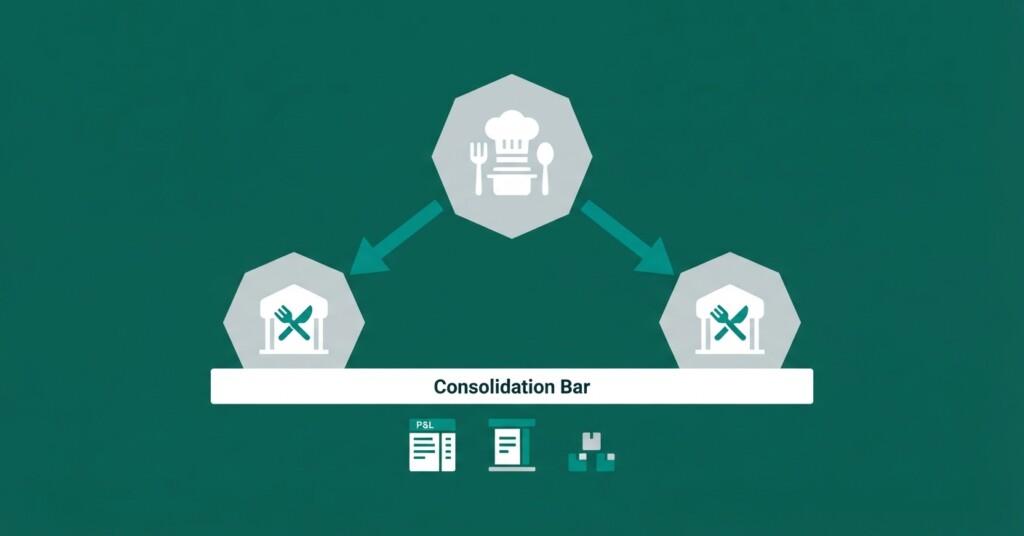
For food and beverage groups operating a central kitchen or commissary model, the monthly financial close is rarely straightforward. A central kitchen entity produces or procures food, adds a mark-up, and sells finished or semi-finished goods to restaurant subsidiaries. Each subsidiary then sells to end customers. On paper, every entity looks profitable. But until you eliminate those intercompany transactions at the group level, your consolidated P&L is overstated, your inventory is inflated, and your group gross margin is fiction. This article walks through the specific consolidation challenges this structure creates and how finance teams can tackle them systematically.
Understanding the Structure: Why a Central Kitchen Creates Complexity
The central kitchen model is common in multi-site F&B operations because it drives purchasing scale, ensures menu consistency, and centralises labour. A typical group might look like this: a parent holding company owns a central kitchen entity (‘CK Co’) and two or more restaurant subsidiaries (‘Rest A’ and ‘Rest B’). CK Co purchases raw ingredients, processes them into finished or semi-finished goods, and sells them to Rest A and Rest B at cost-plus, say with a mark-up above its own cost of production.
Each restaurant subsidiary records its purchases from CK Co as inventory and cost of goods sold. CK Co records revenue and a margin. Both look healthy in standalone management accounts. But from a group perspective, no external revenue has been earned yet. The profit CK Co books on those intercompany sales is unrealised at the consolidated level until the restaurants sell to paying customers. This is precisely what consolidation exists to correct.
Stop building consolidations in spreadsheets.
BrizoConsol automates multi-entity consolidation — setup in minutes, reports the same day.
Step One: Map Every Intercompany Flow Before Month-End
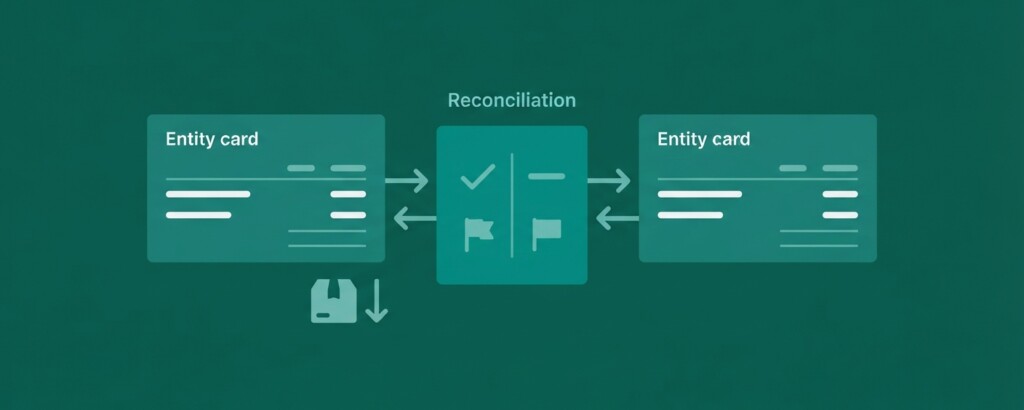
Before you can eliminate anything, you need a complete picture of what flows between entities during the period. For an F&B group using this model, intercompany flows typically include: sales of goods from CK Co to each restaurant subsidiary (with mark-up), management fees charged by the parent to subsidiaries, shared service recharges (marketing, HR, IT), intercompany loans and the related interest, and any intercompany rent if the parent holds property and leases to the restaurant entities.
Good practice is to maintain a living intercompany matrix — a simple schedule updated each period showing the type, amount, and direction of every transaction between entities. This makes reconciliation faster and gives auditors a clear trail. Even a well-maintained spreadsheet helps, but purpose-built consolidation tools can auto-populate this matrix from connected accounting data.
The Core Elimination: Intercompany Sales and Unrealised Profit in Inventory
The most significant elimination for a central kitchen group is the removal of intercompany sales and the unrealised profit embedded in inventory held by the restaurant subsidiaries. This has two components: first, eliminate the intercompany revenue and cost of sales; second, eliminate the portion of profit that relates to goods still sitting in the restaurants’ closing inventory.
Say CK Co sells £120,000 of goods to Rest A in a period. CK Co’s cost to produce those goods was £90,000, so it earns a £30,000 intercompany margin. At period end, Rest A still holds £24,000 of that stock (at the transfer price). The unrealised profit in that closing inventory is £24,000 × (30/120) = £6,000. That £6,000 must be eliminated from consolidated inventory and consolidated profit (or retained earnings).
| Intercompany sales from CK Co to Rest A (period) | £120,000 |
| CK Co production cost of goods sold to Rest A | £90,000 |
| Intercompany margin earned by CK Co | £30,000 |
| Rest A closing inventory at transfer price | £24,000 |
| Gross margin percentage on transfer price (30/120) | 25.0% |
| Unrealised profit in closing inventory (£24,000 × 25%) | £6,000 |
| Account | Dr | Cr |
|---|---|---|
| Intercompany Revenue (CK Co — group elimination) | 120,000 | |
| Intercompany Cost of Sales (Rest A — group elimination) | 120,000 |
Elimination of intercompany sales and corresponding purchase recorded by Rest A for the period.
| Account | Dr | Cr |
|---|---|---|
| Cost of Sales / Group P&L (unrealised profit) | 6,000 | |
| Inventory (Rest A closing stock — group elimination) | 6,000 |
Elimination of unrealised profit embedded in Rest A closing inventory (£24,000 × 25% gross margin on transfer price).
A common mistake is eliminating only the revenue and cost line without adjusting closing inventory. If Rest A holds goods purchased from CK Co at a marked-up transfer price, that mark-up sits in the consolidated balance sheet as inflated inventory. Auditors will look for this adjustment, and failing to make it means your group gross margin is materially misstated.
Intercompany Balances: Reconciling Payables and Receivables
Beyond the P&L eliminations, the group balance sheet will carry intercompany receivables and payables that must net to zero on consolidation. CK Co will show a receivable from Rest A; Rest A will show a payable to CK Co. In theory these should agree. In practice, timing differences — particularly around goods in transit or invoices crossing accounting periods — create mismatches that must be investigated and resolved before you can close the consolidation.
| Entity | Intercompany Receivable (£) | Intercompany Payable (£) | Difference (£) | Action Required |
|---|---|---|---|---|
| CK Co (owed by Rest A) | 48,500 | — | — | — |
| Rest A (owed to CK Co) | — | 45,000 | 3,500 | Investigate: goods in transit or unposted invoice at Rest A |
| CK Co (owed by Rest B) | 22,000 | — | — | — |
| Rest B (owed to CK Co) | — | 22,000 | — | Agrees — no action needed |
| Parent (management fees owed by Rest A) | 5,000 | — | — | — |
| Rest A (management fee payable) | — | 5,000 | — | Agrees — no action needed |
The £3,500 difference between CK Co’s receivable from Rest A and Rest A’s payable to CK Co is a classic in-transit difference. CK Co raised an invoice late in the period; Rest A had not yet posted the corresponding purchase. Both entities need to agree a cut-off policy — typically, intercompany invoices dated on or before the last day of the period are posted in that same period regardless of when they are received. Enforcing this policy consistently is far easier when both entities use accounting software with connected data rather than independent systems.
FX Translation: When Subsidiaries Operate in Different Currencies
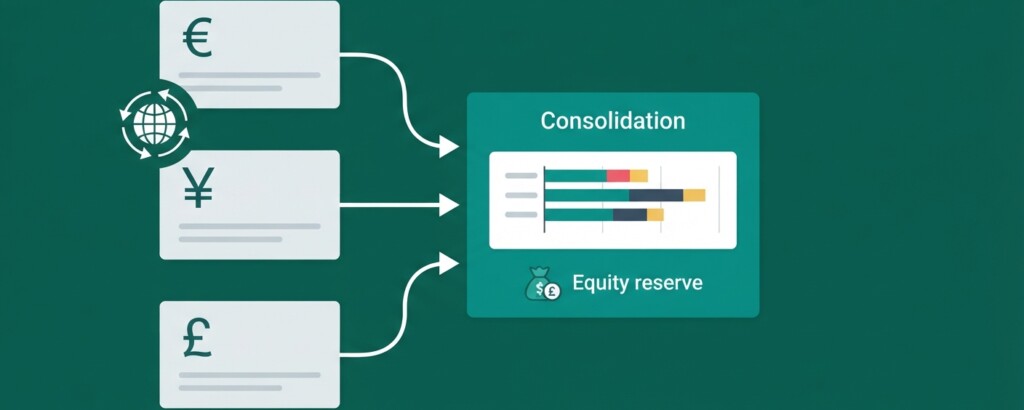
If your F&B group operates across borders — say CK Co is in the UK and a restaurant subsidiary operates in the UAE or the EU — you will also be dealing with foreign currency translation on top of the intercompany eliminations. The standard approach under IFRS and most GAAPs is to translate subsidiary P&L at the average rate for the period and translate the balance sheet at the closing rate, with the difference taken to a foreign currency translation reserve in equity.
This matters for intercompany eliminations because the intercompany balances that need to eliminate against each other may be denominated in different currencies. If CK Co invoices in GBP and Rest B records the payable in AED, Rest B must revalue that monetary payable to the closing exchange rate at period end, recognising the exchange gain or loss in its P&L in accordance with IAS 21. Once properly revalued and translated at the period-end closing rate, the intercompany balance nets to zero upon consolidation, leaving the transaction FX movement in consolidated profit or loss.
Non-Controlling Interests in a Partially Owned Restaurant Subsidiary
Not every F&B group is wholly owned. A common structure is for the parent to hold 70% or 80% of a restaurant subsidiary while a local operator or investor holds the remainder. In that case, the group must calculate and present a non-controlling interest (NCI) in both the consolidated balance sheet and the consolidated income statement.
Crucially, whether the unrealised profit elimination affects NCI depends on which entity made the sale. When a wholly owned central kitchen (CK Co) sells downstream or laterally to a partially owned restaurant (Rest B), the unrealised margin was booked by CK Co; thus, 100% of the elimination is allocated to the group, and Rest B’s NCI is unaffected. However, if the partially owned subsidiary is the seller (such as an upstream sale, or where the central kitchen entity itself has minority owners), the elimination reduces that entity’s profit before calculating the NCI share. If a 75%-owned subsidiary earned £100,000 profit as the seller, but £8,000 represents unrealised profit on goods still held in group inventory, the NCI’s share is calculated on £92,000, not £100,000.
| Subsidiary reported profit for the period (as selling entity) | £100,000 |
| Less: unrealised profit eliminated from closing inventory | (£8,000) |
| Adjusted profit for NCI allocation | £92,000 |
| NCI share (25% minority) | £23,000 |
| Group share (75%) | £69,000 |
Group Reporting: What Management Actually Wants to See
Beyond statutory consolidation, finance teams in F&B groups need to produce useful management accounts. For a central kitchen model, the most informative reporting view separates the group P&L into: the contribution of the kitchen entity (production cost efficiency, transfer pricing margin), and the contribution of each restaurant (revenue from external customers, gross margin after intercompany COGS, site-level EBITDA). This requires your consolidation to properly restate each entity’s P&L using group-level figures rather than entity-level transfer prices.
- Produce standalone entity P&Ls from each accounting system at period end.
- Upload or import trial balances into the consolidation layer (manually or via integration).
- Run intercompany reconciliation to identify and resolve mismatches.
- Post group-level elimination journals (intercompany sales, COGS, balances, unrealised profit in inventory).
- Apply FX translation adjustments for non-GBP subsidiaries.
- Calculate NCI after eliminations (allocating unrealised profit only where the partially owned entity was the seller).
- Produce consolidated P&L, balance sheet, and cash flow statement.
- Produce segmental management reporting by site and by entity type (kitchen vs. restaurant).
The Financial Close Challenge: Why This Is Hard to Do in Excel
Many SME finance teams running two to five entities still attempt this entire workflow in Excel. The problems are well known to anyone who has tried: manual data entry from multiple accounting systems introduces errors; elimination journals must be manually maintained and updated each period; FX rates are applied by hand; and the consolidation model becomes a large, fragile file that only one or two people understand. When headcount changes or the group acquires a new entity, the model often breaks.
The specific pain points for a central kitchen group include: the unrealised profit calculation changes every period as closing inventory fluctuates; transfer prices may be revised during the year; and the in-transit reconciliation between CK Co and the restaurant entities requires matching line-by-line invoices. These are all solvable problems, but solving them manually every month-end is expensive in finance team time and carries significant risk of error.
Automated consolidation tools that connect directly to your accounting systems — pulling trial balances without manual re-entry — significantly reduce the time spent on data gathering. When the consolidation layer can apply pre-configured intercompany elimination rules and flag unreconciled balances automatically, the finance team can focus on investigating exceptions rather than building the model from scratch each period.
Practical Tips for Getting Your Consolidation Right
- Agree a clear intercompany trading policy at the start of the year: which entities trade with which, at what mark-up, invoiced on what schedule.
- Enforce a consistent cut-off date across all entities — intercompany invoices dated in the period must be posted in the period.
- Use a single, agreed FX rate source (central bank or a consistent data provider) and document which rate type is used for which purpose.
- Calculate the unrealised profit in inventory adjustment from the inventory sub-ledger, not an estimate — get the actual closing stock figures from the restaurant entities.
- Keep elimination journals in a dedicated consolidation workbook or tool separate from entity-level books, and retain them period by period for audit trail purposes.
- Review your NCI calculation to ensure minority interests are only adjusted for unrealised profit when the partially owned entity is the seller.
- Reconcile your consolidated retained earnings movement back to opening balance plus group profit less dividends paid each period as a basic sanity check.
Conclusion
Consolidating an F&B group where a central kitchen entity supplies restaurant subsidiaries at a mark-up is a genuinely complex accounting task. The intercompany revenue elimination is straightforward in principle, but the unrealised profit in closing inventory, the intercompany balance reconciliation, FX translation for cross-border structures, and the correct sequencing of NCI calculations all require careful, period-by-period attention. Finance teams that get this right produce group accounts that genuinely reflect economic performance — and give management the information they need to make decisions about pricing, site profitability, and group capital allocation. Finance teams that get it wrong risk misstated gross margins, balance sheet errors, and audit findings that erode confidence in the numbers.
See How Multi-Entity Consolidation Works in Practice
BrizoConsol is built for finance teams managing multi-entity groups. Connect your accounting systems, automate intercompany eliminations, and close faster without rebuilding your consolidation model each month.