How to Consolidate a Subsidiary With a Different Financial Year-End
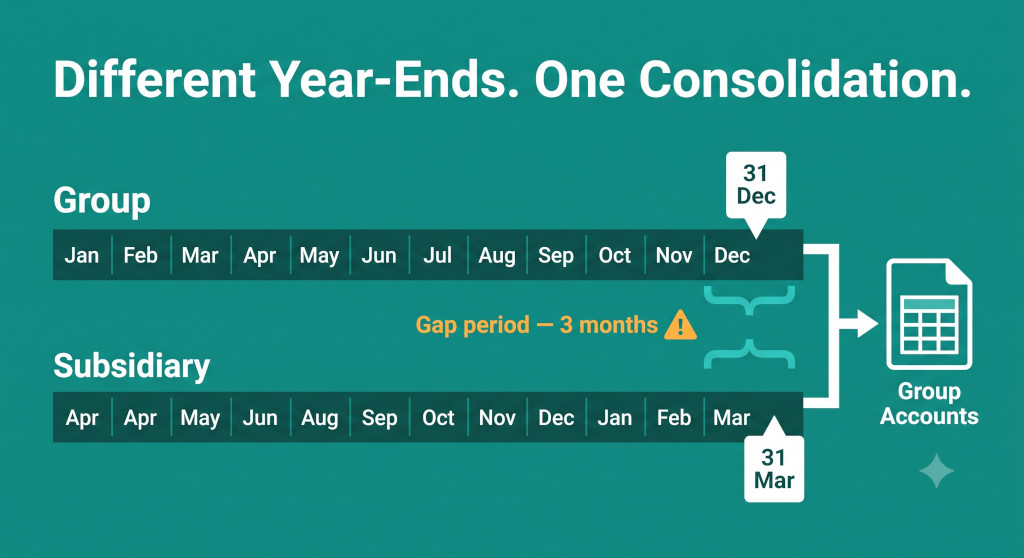
The acquisition completed in October, and by December the group was closing its financial year. The newly acquired subsidiary — a well-run distribution business that had been operating independently for eleven years — had always prepared accounts to 31 March. Its next set of statutory accounts would cover April 2025 to March 2026. The group’s accounts covered January to December 2025. Twelve months of data, but only ten of them overlapping.
For Cassie, the group financial controller, the question was immediate and practical: which twelve months of the subsidiary’s results go into the group’s December 2025 consolidation? Does she use January to December — a period for which the subsidiary has never prepared a formal set of accounts? Does she use the subsidiary’s most recent year-end (April 2024 to March 2025), even though it’s nine months out of date by the time the group files? And what about the gap between 31 December and 31 March — three months in which significant things could have happened at the subsidiary that won’t appear in the group’s accounts at all?
These are exactly the right questions, and the answers are more structured than they might initially appear. The accounting standards provide three permitted approaches, each with its own requirements and trade-offs. Which one is correct for any given subsidiary depends on the size of the year-end gap, the practical capacity of the subsidiary’s finance team, and the nature of any transactions in the gap period.
Automate NCI calculations across all your entities.
BrizoConsol handles non-controlling interest automatically — no manual adjustments required.
The Three Permitted Approaches
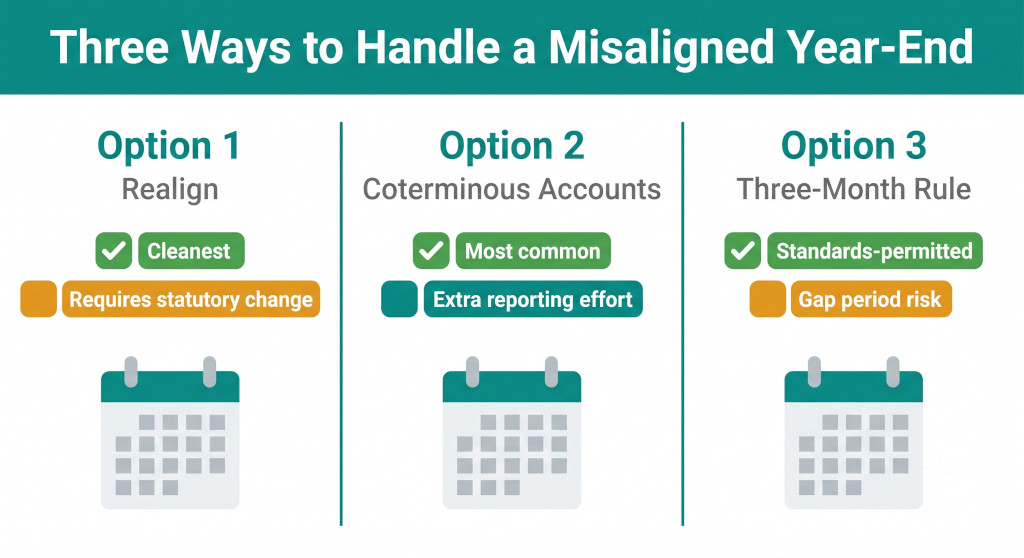
Under both IFRS (IFRS 10) and UK GAAP (FRS 102), a subsidiary with a different year-end can be consolidated using one of three approaches. The standards express a clear preference — coterminous accounts are preferred — but all three are technically permitted under the right conditions.
Option 1: Realign the subsidiary’s statutory year-end
The cleanest long-term solution is to change the subsidiary’s statutory financial year-end to match the group’s. In the UK this is done by filing a notice with Companies House and is straightforward to execute. Most other jurisdictions have an equivalent administrative process. The one-time consequence is that the subsidiary files a short-period set of accounts in the year of the change — if the subsidiary changes from a March year-end to a December year-end, it will file accounts covering April to December of the transition year (nine months) — and then reverts to twelve-month accounts going forward.
Realignment is the preferred approach for newly acquired subsidiaries because it eliminates the year-end mismatch permanently. It does involve an administrative step and requires the subsidiary’s auditors to plan for a short-period audit, but the ongoing consolidation benefit outweighs these one-time costs in almost every case. The main situations where realignment is not immediately practical are where the subsidiary is bound by a regulatory requirement to report to a specific date (some financial services entities, for example), or where the subsidiary is jointly acquired with a third party who has its own reporting calendar that cannot be disturbed.
Option 2: Prepare coterminous accounts to the group’s year-end date
Where realignment is not immediately practical, the subsidiary can prepare an additional set of management accounts — not necessarily audited, depending on the group’s auditor requirements — to the group’s year-end date. These coterminous accounts cover the same twelve-month period as the group and are used for consolidation purposes, while the subsidiary continues to file statutory accounts to its own year-end date.
This approach is the most common in practice for groups with recently acquired subsidiaries. The subsidiary effectively maintains two accounting periods: its own statutory year (April to March) and the group reporting period (January to December). The group reporting accounts are management accounts rather than statutory accounts, which means they may be produced to a lower level of formality — but they must still be prepared on the same accounting policies as the group and reviewed by the group finance team before being used in the consolidation.
Coterminous accounts for consolidation purposes do not need to be audited separately in most cases, but the group’s auditors will want to review the process by which they are prepared and may want to perform specific procedures over them. Agree the approach with the group’s auditors at the start of the first year, not after the accounts have been prepared.
The operational burden of Option 2 falls on the subsidiary’s finance team, who must close two sets of books each year — their statutory close in March and a consolidation close in December. For subsidiaries with small finance teams, this can be significant. The group finance team should factor this into integration planning and, where necessary, provide resource support at consolidation close time.
Option 3: Use the subsidiary’s own year-end accounts — the three-month rule
Both IFRS 10 and FRS 102 permit the use of a subsidiary’s accounts prepared to a different date from the group’s, provided the difference is no more than three months. If the subsidiary’s year-end is 31 March and the group’s is 31 December, the gap is exactly three months — at the outer limit of what is permitted.
Under this approach, the subsidiary’s March 2025 accounts (covering April 2024 to March 2025) would be used in the group’s December 2025 consolidation. This means the group’s consolidated accounts include twelve months of the subsidiary’s activity, but that twelve months ends three months before the group’s own year-end. There is a three-month gap — January, February, and March 2025 — during which the subsidiary’s results are in last year’s group accounts, and a further three-month gap — January, February, and March 2025 — during which the subsidiary’s activity is not reflected anywhere in the group’s current year accounts.
Critical point: The gap period is not a free pass. Under both IFRS 10 and FRS 102, adjustments must be made for the effects of significant transactions or events that occur in the gap period between the subsidiary’s year-end and the group’s year-end. These adjustments must be identified, quantified, and posted as consolidation journals. The gap period is not ignored — it is monitored, and any material item within it is brought into the group accounts.
The Gap Period Problem: What Counts as Significant
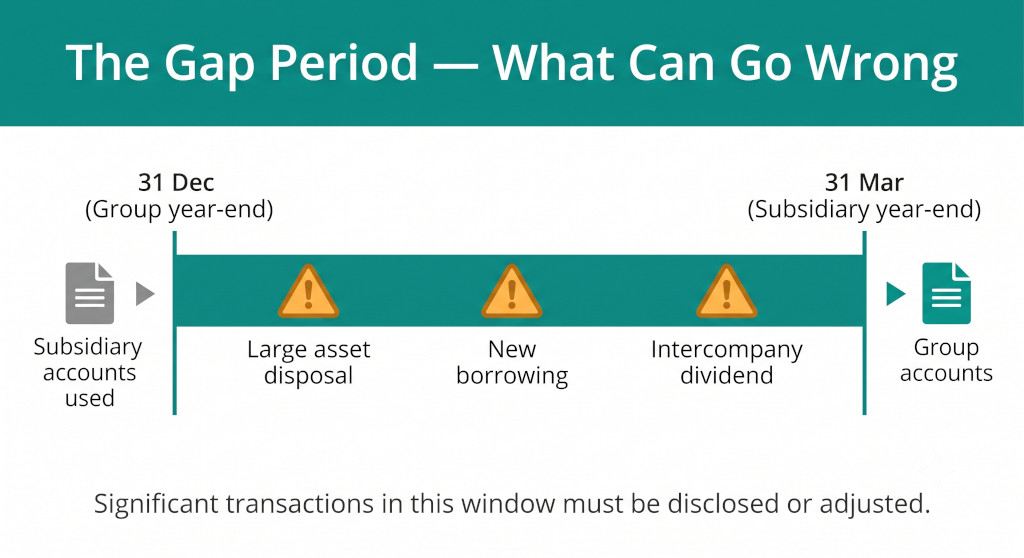
This is the element of Option 3 that is most consistently mishandled in practice. The standards require adjustments for “significant transactions or other events” in the gap period, but do not define a precise materiality threshold — the judgement is left to the preparer. In practice, the group finance team needs to obtain a summary of all material transactions at the subsidiary during the gap period and assess each one for whether it requires a consolidation adjustment.
The types of transactions that typically require adjustment are:
Large asset acquisitions or disposals — if the subsidiary acquired a significant property or disposed of a major piece of equipment in the gap period, that transaction changes the subsidiary’s asset base materially between the subsidiary’s year-end (which the consolidation uses) and the group’s year-end (which the consolidated balance sheet reflects). The group’s balance sheet would be misstated if it showed the subsidiary’s assets as at March when the actual position at December is materially different.
Significant new borrowings or debt repayments — a large bank facility drawn down in the gap period, or a loan repaid, changes the subsidiary’s liability profile. Including March figures in a December group balance sheet would then misstate both the liability and the cash position.
Intercompany dividends or loans — if the subsidiary paid a dividend to the parent or another group entity during the gap period, that affects intercompany balances and potentially the parent’s investment carrying value. If it is not adjusted for, the consolidation will fail to eliminate the correct intercompany positions.
Significant one-off revenue or cost items — an unusually large contract completion, a restructuring charge, or a significant impairment in the gap period all affect the subsidiary’s P&L. If the subsidiary’s March accounts are used in the December group accounts, those items belong in a different group year from where they would sit under a coterminous approach.
The practical process for managing this is to require the subsidiary to provide a gap period summary at the time the group is preparing its consolidation. This summary should list all transactions above an agreed threshold — typically set at a percentage of group revenue or gross assets — and should be signed off by the subsidiary’s finance director before the group uses the subsidiary’s accounts in the consolidation.
Worked Example: The Gap Period Adjustment Journal
Suppose the group uses the three-month rule for the subsidiary. The subsidiary’s March 2025 accounts are used in the December 2025 group consolidation. During the gap period (January to March 2025), the subsidiary disposed of a property for net proceeds of £840,000. The property had a carrying value of £620,000 in the subsidiary’s March 2025 accounts — meaning the disposal resulted in a gain of £220,000 which is already in the subsidiary’s March 2025 P&L and therefore in the accounts being used for consolidation.
However, from the group’s perspective, the disposal occurred in the gap period and is a significant transaction. The property that appears in the subsidiary’s March accounts has already been sold. The group’s December balance sheet should not include a property that no longer exists. But it also should not include the £840,000 cash proceeds, because from the subsidiary’s March accounts those proceeds are already reflected as cash — the proceeds are IN the March accounts, as is the gain.
Wait — this highlights why the gap period adjustment logic needs careful thought. If the subsidiary’s March 2025 accounts are used, those accounts already show the post-disposal position: no property, cash of £840,000, gain of £220,000 in the P&L. The consolidated accounts at December 2025 therefore correctly reflect the post-disposal balance sheet. In this case no adjustment is needed — the disposal happened before the subsidiary’s year-end and is already captured.
The adjustment requirement is triggered when the significant transaction occurs AFTER the subsidiary’s year-end but BEFORE the group’s year-end — i.e., within the gap period itself. In Cassie’s group: the gap runs from 1 January 2025 (after the subsidiary’s March year-end? No — the gap runs from 1 April 2025 to 31 December 2025 if the subsidiary’s year-end is 31 March 2025 and the group’s is 31 December 2025). Wait, let me re-clarify. Let me use a cleaner example.
Group year-end: 31 December 2025. Subsidiary year-end: 30 September 2025. Gap: October, November, December 2025 — three months. The subsidiary’s accounts to 30 September 2025 are used in the December 2025 group consolidation. During the gap period (October to December 2025), the subsidiary signed a new £2,000,000 revolving credit facility and drew down £1,400,000 against it.
The subsidiary’s September 2025 accounts — used in the consolidation — show no revolving credit facility. The group’s December 2025 consolidated balance sheet would therefore omit a £1,400,000 liability that actually existed at the group’s own year-end. This is a significant transaction in the gap period that requires a consolidation adjustment:
Dr Cash and cash equivalents £1,400,000
Cr Bank borrowings (current/non-current) £1,400,000
Consolidation adjustment for gap period transaction: drawdown of revolving credit facility by subsidiary between its 30 September year-end and the group’s 31 December year-end. The facility did not exist in the subsidiary’s accounts used for consolidation; this entry restores the correct balance sheet position at the group reporting date. Supporting documentation: subsidiary’s bank facility agreement dated October 2025 and drawdown confirmation dated November 2025.
The corresponding adjustment for finance costs accrued on the facility during the gap period (three months of interest) would also be posted:
Dr Finance costs (P&L) £14,000
Cr Accrued interest (current liabilities) £14,000
Accrual for three months’ interest on gap period drawdown: £1,400,000 × 4.8% × 3/12 = £16,800. Rounded to £14,000 net of arrangement fee amortisation. This cost was not in the subsidiary’s September accounts and must be reflected in the group’s December P&L.
Each gap period adjustment must be documented with the same rigour as any other consolidation journal — the source transaction, the calculation basis, and the approval. For best practice on journal documentation in the consolidation, see How to Use Journal Entries in Group Consolidation.
Intercompany Reconciliation With a Non-Coterminous Subsidiary
One of the least-discussed complications of the three-month-rule approach is its effect on intercompany reconciliation. If the group uses the subsidiary’s September accounts in the December consolidation, the subsidiary’s intercompany balances are as at September — not as at December. The other group entities, however, report their intercompany balances as at December. The intercompany positions between the subsidiary and the rest of the group will therefore never agree, because they are measured at different dates.
The standard approach is to use the subsidiary’s September intercompany positions as the baseline and identify any post-September intercompany transactions as gap period items requiring adjustment. Every intercompany transaction between the subsidiary and another group entity after the subsidiary’s year-end must be captured in the gap period summary and adjusted for in the consolidation — both sides. If the parent invoiced the subsidiary for management charges in October and November, both the parent’s receivable (at December carrying value) and the subsidiary’s payable (which doesn’t appear in its September accounts) need to be present in the consolidation before the intercompany elimination can be performed correctly.
This is significantly more complex than a coterminous intercompany reconciliation. For large groups where the non-coterminous subsidiary has substantial intercompany trading with the rest of the group, the gap period intercompany matching can become a close process in its own right. See Intercompany Reconciliation for Multi-Entity Groups for a structured framework for managing this process.
Handling multiple year-ends in your consolidation?
BrizoConsol supports entities with different period-end dates in a single group consolidation — with period mapping, intercompany reconciliation, and gap period adjustment journals all in one place.See It In Action
Disclosure Requirements
Both IFRS 10 and FRS 102 require disclosure when a subsidiary’s accounts used in the consolidation are prepared to a date different from the group’s year-end. The disclosure must state the name of the subsidiary, the date of its financial statements, and the reason why a different date was used. Under IFRS 10, this disclosure appears in the notes to the consolidated financial statements. Under FRS 102, the requirement is equivalent.
Additionally, where significant gap period adjustments have been made, those adjustments should be described — at least in aggregate — so that users of the accounts understand that the consolidated figures have been adjusted for material post-subsidiary-year-end events. The adjustment journal itself needs to be documented in the consolidation working papers in enough detail that the group’s auditors can verify it without requiring a full recreation of the subsidiary’s gap period accounts.
In practice, auditors increasingly ask for a gap period summary signed off by the subsidiary’s finance director or chief financial officer — a formal representation that all significant transactions in the gap period have been disclosed and that no material events have been omitted. This representation does not replace the auditor’s own procedures, but it establishes the subsidiary management’s responsibility for the completeness of the gap period disclosure and provides a documented trail for the group audit. For a broader overview of how to structure consolidated financials for audit review, see How to Prepare for Audit with Consolidated Financials.
Which Approach to Choose: A Decision Framework
The right approach depends on three factors assessed in order.
First: is the year-end gap three months or less? If the gap exceeds three months, neither Option 2 (coterminous accounts) nor realignment is optional — you cannot use the subsidiary’s own year-end accounts. For gaps greater than three months, the subsidiary must either prepare coterminous accounts or its year-end must be realigned before the consolidation close.
Second: is realignment feasible within the current year? If the subsidiary can change its statutory year-end before the group’s first consolidation close after acquisition, realignment is almost always the right answer. The one-time cost of a short-period audit is modest compared to the ongoing administrative complexity of Option 2 or Option 3.
Third: if realignment is not feasible in the current year, how significant is the intercompany activity between the subsidiary and the rest of the group? If the subsidiary has material intercompany trading — management charges, intercompany loans, or stock transfers — Option 2 (coterminous accounts) is strongly preferable because it eliminates the intercompany date-mismatch problem entirely. Option 3 is most defensible for subsidiaries with minimal intercompany activity and a gap period that is reliably quiet in terms of significant transactions.
| Scenario | Recommended Approach | Key Requirement |
|---|---|---|
| Gap ≤ 3 months, realignment feasible this year | Option 1 — Realign the year-end | File short-period statutory accounts; notify Companies House or local equivalent |
| Gap ≤ 3 months, realignment not feasible; high intercompany activity | Option 2 — Coterminous management accounts | Subsidiary prepares group-period management accounts; auditors review process |
| Gap ≤ 3 months, realignment not feasible; low intercompany activity | Option 3 — Three-month rule with gap period monitoring | Gap period summary prepared and signed off; significant transactions adjusted |
| Gap > 3 months | Options 2 or 1 only — Option 3 not available | Coterminous accounts required; consider immediate year-end realignment |
Practical Checklist: Consolidating a Non-Coterminous Subsidiary
- Measure the year-end gap at acquisition. If it exceeds three months, plan immediately for either year-end realignment or coterminous accounts. Option 3 is not available for gaps above three months under IFRS 10 or FRS 102.
- Assess feasibility of immediate realignment. In most jurisdictions, a year-end change can be processed within a few weeks. If the acquisition closes more than two months before the group’s year-end, realignment in time for the first consolidation is usually achievable.
- If using Option 2, agree the coterminous accounts process with the subsidiary’s finance team. The subsidiary needs to understand what is required — a trial balance to the group’s year-end date, prepared on group accounting policies — and needs sufficient resource to produce it alongside its own statutory close.
- If using Option 3, set a gap period materiality threshold in advance. Agree with the subsidiary what transaction size will trigger disclosure in the gap period summary. Document this threshold in the group’s consolidation policy.
- Obtain the gap period summary before the consolidation close, not after. The gap period summary should be a scheduled deliverable in the consolidation close timetable — received and reviewed before the group consolidation journals are finalised.
- Identify all gap period intercompany transactions. For every transaction between the subsidiary and any other group entity during the gap period, both sides of the intercompany position need to be brought into the consolidation before the elimination is performed.
- Post gap period adjustment journals with full documentation. Each adjustment must reference the source transaction, the calculation basis, and the approver. The journal should be sufficient for an auditor to verify without requiring access to the subsidiary’s day-to-day accounting records. See How to Use Journal Entries in Group Consolidation for documentation standards.
- Obtain a signed gap period representation from the subsidiary’s finance director. This should confirm that all transactions above the agreed materiality threshold have been disclosed and that no material events have been omitted.
- Include the required disclosure in the group accounts notes. State the subsidiary’s name, its year-end date, and the reason for the difference. If significant gap period adjustments were made, describe them.
- Review the approach annually. If Option 3 is being used as a temporary measure pending year-end realignment, track progress on realignment and set a target date. The gap period monitoring process adds complexity to every close — the sooner it can be eliminated through realignment, the better.
The non-coterminous subsidiary is a solvable problem in all its forms, but the solution requires a deliberate process decision — not a passive one. Groups that drift into Option 3 without consciously setting up the gap period monitoring process tend to find that gap period adjustments are missed, intercompany reconciliations are performed on mismatched dates, and disclosures are incomplete. The three-month rule is a concession to practical constraints, not an invitation to treat the subsidiary’s year-end accounts as a good-enough substitute for consolidated group-date accounts. Treat the gap period seriously, document the approach, and plan the realignment as soon as it becomes feasible. For broader guidance on structuring a group close process that accommodates subsidiaries at different stages of integration, see Multi-Entity Month-End Close Checklist.
Bring every subsidiary into the consolidation cleanly — whatever their year-end
BrizoConsol is built for groups at every stage of integration. Connect your entities, map your accounts, and run your first consolidated report in hours — not months. Start Free Trial