How to Design Intercompany Account Code Ranges in a Group Chart of Accounts So Every Entity Follows the Same Numbering Logic
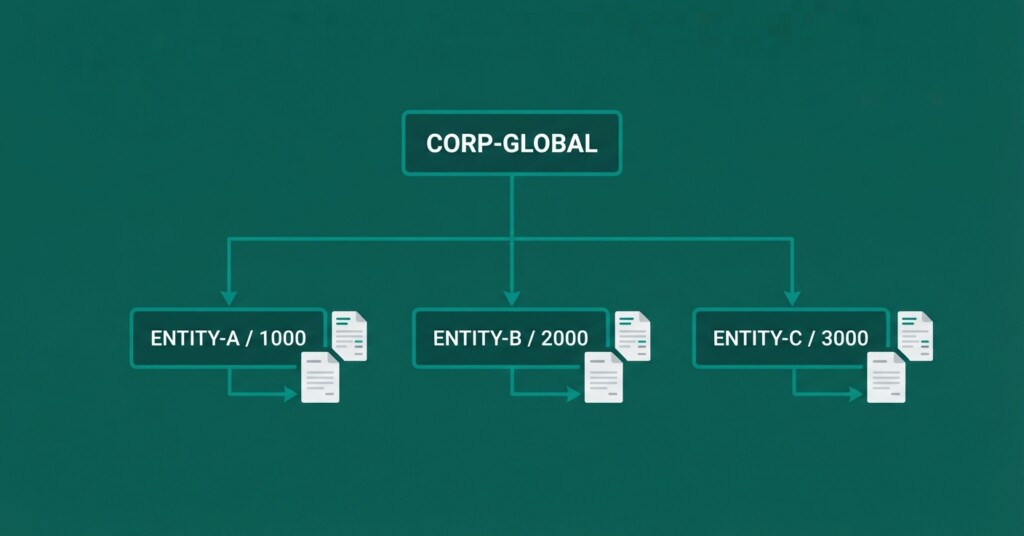
One of the most underestimated sources of month-end pain in multi-entity finance is a poorly designed chart of accounts. Specifically, when each subsidiary, branch, or acquired company uses its own account numbering system with no consistent logic for intercompany transactions, consolidation becomes a manual detective exercise. Finance teams end up chasing mismatches, building fragile VLOOKUP-laden spreadsheets, and spending days reconciling balances that should cancel out automatically. The fix starts at the structural level: designing a group chart of accounts with a dedicated, logical intercompany account code range that every entity follows from day one.
This article walks through how to build that structure, why it matters for eliminations, FX translation, and non-controlling interest (NCI) calculations, and what a working numbering convention actually looks like in practice.
Why Intercompany Account Codes Need Their Own Range
In a consolidated group, any transaction between two entities — a loan from the parent to a subsidiary, a management fee charged by a holding company, or goods sold from one operating entity to another — must be eliminated on consolidation. The consolidated financial statements should only reflect transactions with third parties. To eliminate efficiently, your consolidation process (whether manual or automated) needs to identify intercompany balances quickly and accurately.
One common chart of accounts for every entity.
BrizoMap, BrizoConsol's AI mapping assistant, suggests how each entity's accounts map to your group chart.
If intercompany receivables are coded to the same range as trade receivables, or intercompany revenue sits alongside external sales, your consolidation engine — human or software — has to make judgment calls about which balances to eliminate. That is where errors creep in. A dedicated intercompany account code range removes ambiguity entirely: any account in that range is, by definition, subject to elimination processing.
A clean intercompany account range is not just an accounting convenience — it is the foundation of reliable consolidation. When every entity uses the same codes for the same intercompany relationships, elimination entries can be systematically prepared rather than manually hunted down each month.
Choosing a Numbering Convention That Scales
Most groups use a five- or six-digit account code structure. Within that, a common approach is to reserve a specific prefix or range for intercompany accounts. A workable convention allocates a dedicated block — for example, codes beginning with ‘18’ in a balance sheet section, or a standalone range such as 7000–7999 in an income statement — exclusively for intercompany activity.
A more sophisticated design embeds the counterparty entity into the account code itself. This is especially useful when a group has more than two or three entities, since it allows the consolidation system to match receivables and payables to specific counterparties without relying solely on transaction-level descriptions or manual tagging.
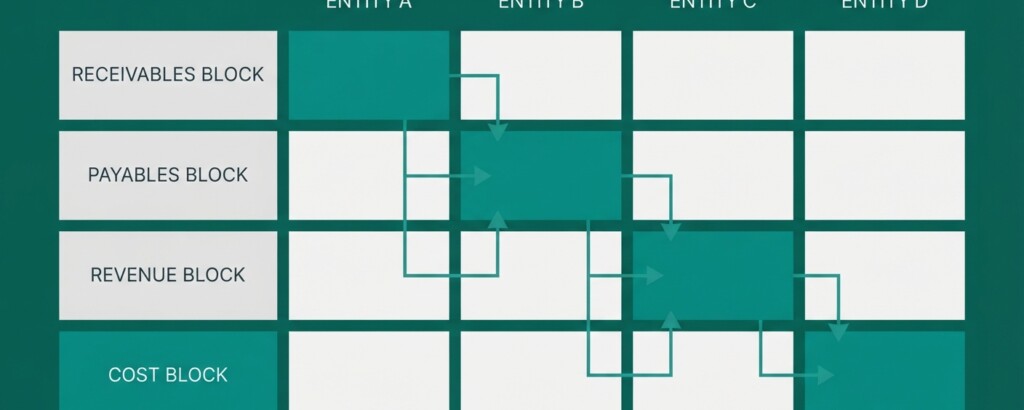
Here is an example structure for a group with four entities: the parent (Entity 01), and three subsidiaries (Entities 02, 03, 04).
| Account Code | Description | Entity Relationship | Statement |
|---|---|---|---|
| 180002 | Intercompany receivable — Entity 02 | Parent owed by Sub A | Balance Sheet |
| 180003 | Intercompany receivable — Entity 03 | Parent owed by Sub B | Balance Sheet |
| 180004 | Intercompany receivable — Entity 04 | Parent owed by Sub C | Balance Sheet |
| 210002 | Intercompany payable — Entity 02 | Parent owes Sub A | Balance Sheet |
| 210003 | Intercompany payable — Entity 03 | Parent owes Sub B | Balance Sheet |
| 700002 | Intercompany revenue — from Entity 02 | Management fee charged to Sub A | Income Statement |
| 800002 | Intercompany cost — to Entity 02 | Management fee paid to Sub A | Income Statement |
The suffix in the account code (02, 03, 04) refers to the counterparty entity identifier. Every entity in the group uses the same master account list, so when Entity 02 records an intercompany payable to the parent, it uses account 210001 (where 01 is the parent entity code). The parent records the corresponding receivable as 180002. These codes form a matching pair that can be eliminated automatically.
What the Elimination Journal Looks Like
To make this concrete, consider a simple intercompany loan: the parent has advanced £500,000 to Subsidiary A (Entity 02). Both entities have recorded their side of the transaction correctly, using the agreed account code structure.
| Account | Dr | Cr |
|---|---|---|
| 210001 — Intercompany payable to Parent (Entity 02 books) | 500,000 | |
| 180002 — Intercompany receivable from Entity 02 (Parent books) | 500,000 |
Consolidation elimination entry: removes the intercompany loan from both the parent receivable and the subsidiary payable so the balance cancels in the group statements. Both sides must net to zero for the elimination to balance.
Because both entities used the designated intercompany account codes, the consolidation process can identify this pair automatically. Without that structure, someone would need to manually review each entity’s trial balance, identify which payables and receivables relate to group entities, confirm they match, and then build the elimination. In a group with a dozen entities and hundreds of intercompany transactions, that manual process can consume days.
Handling FX Translation Within the Intercompany Range
Currency mismatch is one of the most common reasons intercompany balances do not agree at consolidation. If the parent records a £500,000 receivable but the subsidiary records a €580,000 payable (the equivalent at the transaction date), and the rate has moved by month-end, the two balances will not eliminate cleanly when both are translated into the group presentation currency.
The account code design cannot solve the underlying FX movement, but it can make the problem visible earlier. When every intercompany balance sits in a clearly labelled range, your FX translation process can apply the correct rate methodology consistently — closing rate for monetary balance sheet items, average rate for income statement items — and foreign exchange differences can be accurately recognised (in profit or loss for trading balances and short-term loans, or in a currency translation adjustment reserve within equity if the loan forms part of a net investment in a foreign operation) rather than left as an unexplained variance.
| Intercompany receivable (£) | 500,000 |
| Subsidiary payable translated at closing rate (£ equivalent) | 493,500 |
| Foreign exchange difference (recognised in P&L, or CTA if net investment) | 6,500 |
Tracking this foreign exchange difference per intercompany account pair, rather than burying it in an unexplained variance pool, gives finance teams a cleaner audit trail and makes it straightforward to explain movements to auditors or group management.
Non-Controlling Interests and Why Account Structure Matters
When a subsidiary is not wholly owned, the group must calculate the NCI share of net assets and profit. Intercompany transactions with a partially owned subsidiary still need to be eliminated in full on consolidation, but the profit or loss on upstream or downstream sales that has not yet been realised externally must be adjusted. For upstream sales, the adjustment is allocated between the controlling and non-controlling interests according to ownership percentages, whereas unrealised profit on downstream sales is allocated entirely to the parent.
If intercompany revenue and cost accounts are clearly separated from external trading accounts — which your dedicated account code range achieves — it becomes straightforward to identify which profit sits within the intercompany range and therefore requires unrealised profit elimination. Without that separation, NCI calculations become estimates rather than precise figures.
Do not allow subsidiaries to reclassify intercompany transactions into external trading accounts, even temporarily. This practice, sometimes used to ‘tidy up’ trial balances, destroys the integrity of your elimination process and can cause material misstatements in consolidated revenue and profit.
Practical Steps to Roll Out a Group Chart of Accounts
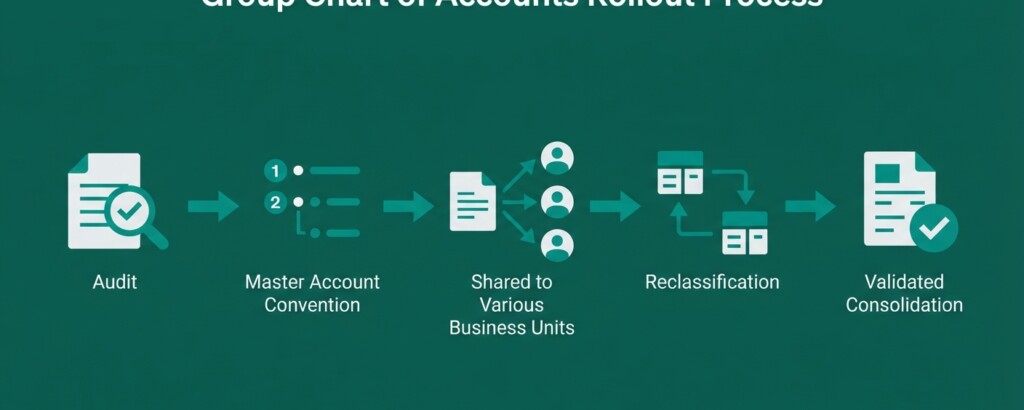
- Audit the existing charts of accounts across all entities and identify every account currently used for intercompany activity, however it is described or coded.
- Define the group numbering convention: choose your intercompany block (for example, 1800xx for receivables, 2100xx for payables, 7000xx for intercompany revenue, 8000xx for intercompany costs), and assign a two- or three-digit suffix for each entity in the group.
- Publish the master group chart of accounts as a single authoritative document. Every entity must use account codes from this master list. Local additions require group finance approval.
- Map legacy codes to new group codes and perform a one-time reclassification journal in each entity ledger to migrate historical balances into the new structure.
- Update accounting system configurations (general ledger chart of accounts, account validation rules, approval workflows) to enforce use of intercompany codes for transactions flagged as intercompany.
- Run a parallel consolidation for at least one month using both the old and new structures to validate that eliminations balance before going live.
- Document the convention clearly, including which entity number maps to which legal entity, and keep this mapping updated as the group structure changes through acquisitions or disposals.
Governance: Keeping the Structure Clean Over Time
Account code discipline erodes over time without active governance. New staff at a subsidiary might not know the intercompany convention and code a management fee to general overhead. An acquired business might bring its own chart of accounts and be allowed to operate on it for ‘a few months’ while integration is planned — and those few months stretch into years. Each exception creates manual reconciliation work at consolidation.
Practical governance measures include: requiring group finance sign-off before any new account code is created in any entity ledger; running a monthly report showing transactions posted to intercompany accounts alongside transactions posted to non-intercompany accounts involving group entities (identified by counterparty); and making intercompany account compliance a standing item on the group financial close checklist.
Automated consolidation tools can help enforce this by flagging trial balance lines that contain entity-to-entity descriptions but sit outside the designated intercompany account range. This kind of systematic check replaces the manual review that otherwise depends on a single experienced team member knowing which accounts to look at.
From Account Structure to Faster Financial Close
The payoff for investing time in this design work is a measurably faster and more reliable financial close. When every entity follows the same intercompany account numbering logic, the consolidation process becomes systematic rather than investigative. Elimination entries can be generated from structured data rather than assembled from scratch each period. FX differences are isolated and explained. NCI calculations are based on clean, separated figures. Audit queries about intercompany balances can be answered with a trial balance extract rather than a manual reconciliation narrative.
Groups that consolidate in Excel often find that a structured chart of accounts dramatically reduces the size and complexity of their consolidation workbooks, because the data coming in is already in a form that the consolidation logic can process directly. Groups using consolidation software find that the same structured inputs allow the system to automate eliminations reliably, reducing the period where automated output needs manual review.
Neither outcome requires a large-scale technology investment. The most important investment is the upfront design work: deciding on the convention, mapping it across every entity, and enforcing it consistently. That is finance team work, not a software project — though the discipline pays dividends whether the consolidation itself is done in a spreadsheet or a dedicated tool.
How BrizoConsol handles this
BrizoConsol is built around the assumption that intercompany balances arrive in a consistent structure. When you connect each entity ledger — whether through a direct Xero integration or an Excel import — you map every entity’s accounts to a single common chart of accounts using AI-assisted auto-mapping. If your group has already adopted a structured intercompany account code range of the kind described above, that mapping step is straightforward and the intercompany accounts land in the correct positions from the first pull.
From there, BrizoConsol organises intercompany eliminations by type — loans, management fees, trading balances — and handles FX differences on monetary intercompany items through its currency translation engine, isolating any residual difference rather than leaving it in an unexplained variance. Eliminations can be set to recur each period, so once the account pairs are configured, the monthly close does not require rebuilding them from scratch. The audit trail records every elimination and journal at the account level, so intercompany queries from auditors or group management can be answered directly from the system.
One common chart of accounts for every entity.
BrizoMap, BrizoConsol's AI mapping assistant, suggests how each entity's accounts map to your group chart.