The Management Fee That Won’t Eliminate: How Hotel Groups Fix the Incentive Fee Consolidation Mismatch
Priya is the group financial controller at Meridian Hospitality Group, a UK-based collection of four hotels operating under a single holding structure. Every quarter, she runs the consolidation and the management fee elimination goes roughly the same way: two lines in, two lines out. But at the December year-end, something is different. The base fee elimination clears without a problem, as always. The incentive fees do not.
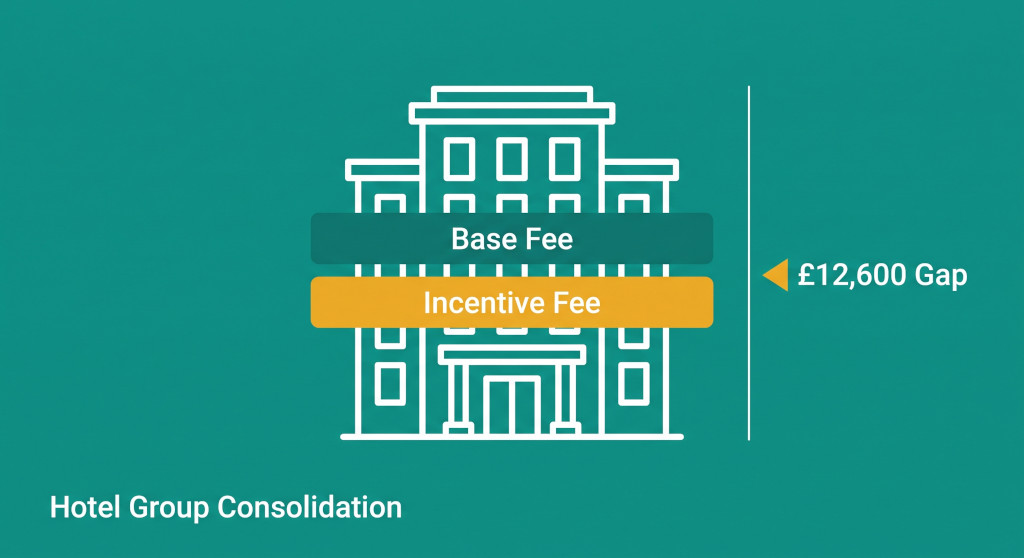
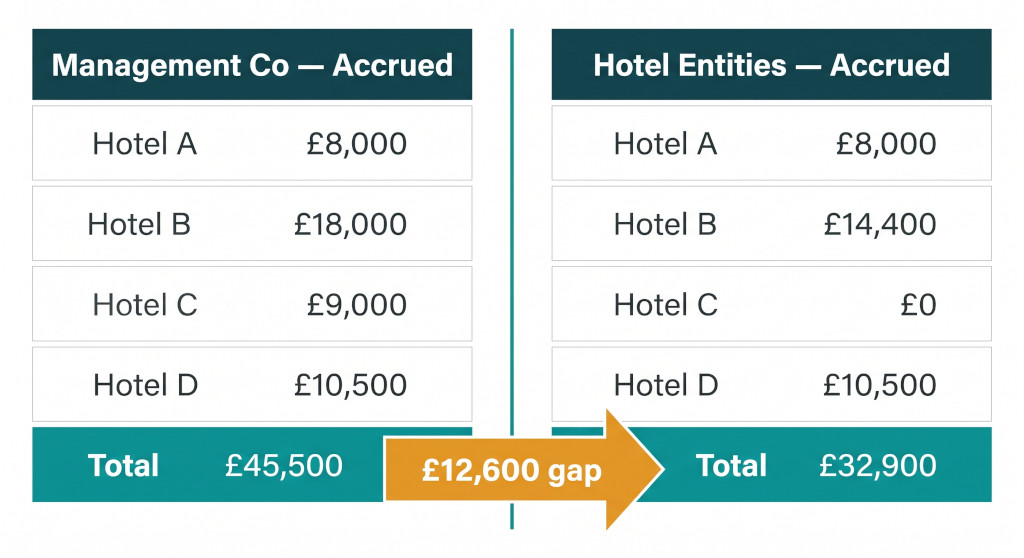
Meridian Hotel Management Ltd — the group’s management company entity — has recognised £45,500 of incentive fee income for the year across all four hotels. Combined, the four hotel operating entities have accrued £32,900 of management fee expense for those same incentive fees. The difference is £12,600. It sits in the consolidated P&L, inflating net profit by an amount that neither the auditors nor the board will accept. The individual entity accounts all look correct. The problem exists only at group level.
This is not a rare problem. Any hospitality group that separates its management function into a distinct entity — which many do, for tax efficiency, brand licensing, or governance reasons — will face this mismatch eventually. The base fee is straightforward. The incentive fee is not. Understanding why requires a close look at how these fees are structured, and why the accrual mechanisms used by the management company and the hotels almost always diverge.
Stop building consolidations in spreadsheets.
BrizoConsol automates multi-entity consolidation — setup in minutes, reports the same day.
How Hotel Management Fees Are Structured
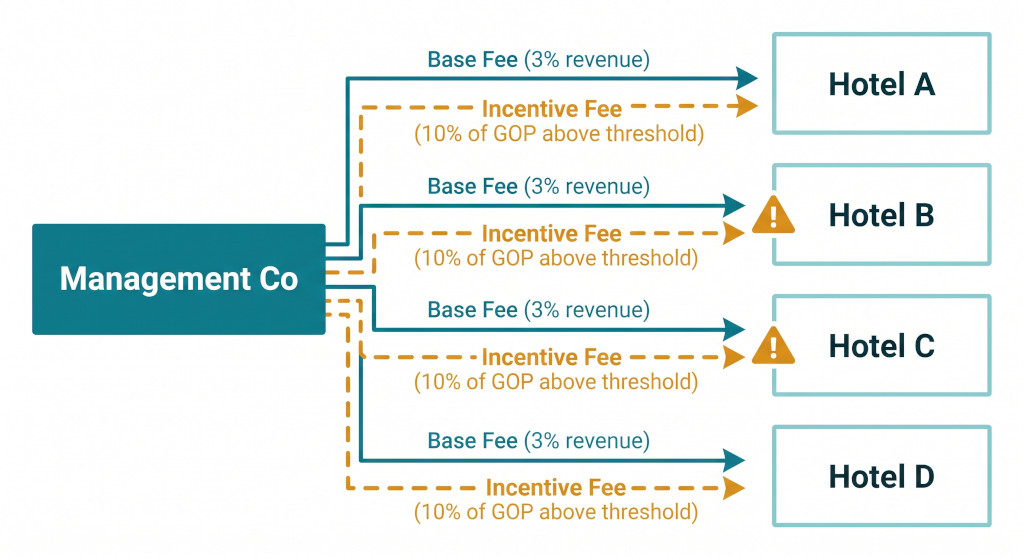
Hotel management agreements typically contain two components. The first is a base fee, expressed as a percentage of total hotel revenue — usually somewhere between 2% and 4%. Because total revenue is an objective, auditable number that both the management company and the hotel entity calculate from the same source data, the base fee generates an identical amount in both sets of accounts each month. Management Co recognises it as income; the hotels recognise it as an operating expense. The amounts always match.
The second component is the incentive fee, and it is here that the consolidation problem lives. The incentive fee is earned when a hotel’s Gross Operating Profit (GOP) exceeds a defined threshold — typically expressed as a margin percentage of total revenue. If the hotel clears the threshold, the management company earns a share of the excess GOP, often 8–12%. If it does not clear the threshold, no incentive fee is earned.
In Meridian’s management agreement, the structure is: Base fee of 3% of total revenue, plus an incentive fee of 10% of GOP above a 25% GOP margin. Both are accrued monthly and invoiced quarterly.
What makes the incentive fee hard to eliminate at consolidation is that it is a derived number, not a reported one. It depends on each party’s view of GOP — and those views can differ.
Why the Base Fee Eliminates Without Complications
Before getting into the mismatch, it is worth establishing why the base fee never causes the same problem. The base fee is a fixed percentage of an independently reported figure — total revenue — that both entities take directly from the hotel’s trial balance. There is no judgement, no threshold, no interpretation. Management Co accrues income of, say, £24,750 for Hotel A in December; Hotel A accrues an expense of £24,750. The amounts are identical because they come from the same number.
The elimination journal for the base fee is clean:
| Account | Dr | Cr |
|---|---|---|
| Management fee income (Management Co P&L) | £297,000 | |
| Management fee expense (Hotel entities P&L) | £297,000 |
Full-year base fee: 3% × £9,900,000 total group revenue. Both sides of this entry are taken directly from the same revenue figure — no estimation, no judgement.
The base fee elimination also clears the intercompany balance sheet: Management Co has a receivable equal to what the hotels have payable, because both sides use the same invoicing schedule. After elimination, nothing remains.
The Incentive Fee: Where the Mismatch Begins
The incentive fee introduces two sources of divergence that can cause the management company’s accrued income to differ from the hotels’ accrued expense, even when both sides believe their own numbers are correct.
Source one: different GOP definitions. The management agreement will define GOP — but definitions are never exhaustive. When a cost item arises that was not explicitly listed, Management Co and the hotel entity may classify it differently. Property insurance, for example, is sometimes treated as a hotel operating cost (included in GOP) and sometimes treated as an “owner’s cost” excluded from GOP. If Management Co includes it and Hotel B excludes it, Hotel B’s GOP will be lower, and its incentive fee accrual will therefore be smaller — or absent entirely. Both entities have followed their own reasonable reading of the agreement. At consolidation, the resulting gap is real and must be resolved.
Source two: different accrual timing policies. The management agreement says fees are “accrued monthly and invoiced quarterly.” Management Co follows this literally: it accrues one month of incentive fee income every month based on its estimate of that month’s GOP. Some hotel finance teams, however, adopt a more conservative policy and only recognise the expense when an invoice is received. If the Q4 invoice has not yet been issued at the balance sheet date, those hotels show nothing in their books for the final quarter’s incentive fee — while Management Co has accrued three months of income.
Common mistake: Assuming the gap is a data error and simply writing off the difference as an immaterial adjustment. If the underlying mismatch is a policy difference, it will widen each year. The correct fix is to identify the source, determine which entity’s treatment aligns with the management agreement, and adjust accordingly before running the elimination.
Tracing the £12,600: Meridian’s Worked Example
Priya opens her consolidation workbook and builds an incentive fee reconciliation by hotel:
| Hotel | Total Revenue | GOP (MC view) | GOP (Hotel view) | Threshold (25%) | Incentive — MC | Incentive — Hotel | Difference |
|---|---|---|---|---|---|---|---|
| A — Manchester | £2,400,000 | £680,000 | £680,000 | £600,000 | £8,000 | £8,000 | £0 |
| B — Edinburgh | £3,600,000 | £1,080,000 | £1,044,000 | £900,000 | £18,000 | £14,400 | £3,600 |
| C — Birmingham | £1,800,000 | £540,000 | £540,000 | £450,000 | £9,000 | £0 | £9,000 |
| D — Bristol | £2,100,000 | £630,000 | £630,000 | £525,000 | £10,500 | £10,500 | £0 |
| Group total | £9,900,000 | £2,930,000 | £2,894,000 | £2,475,000 | £45,500 | £32,900 | £12,600 |
The sources are now visible. Hotel A and Hotel D match perfectly. Hotel B and Hotel C each have a distinct problem.
Hotel B (Edinburgh) — GOP definition difference, £3,600. The Edinburgh hotel treats property insurance as an owner’s cost and excludes it from GOP, bringing GOP down from Management Co’s £1,080,000 to £1,044,000 — a difference of £36,000. Since the incentive fee is 10% of GOP above threshold, this £36,000 difference translates to a £3,600 difference in the incentive fee (£36,000 × 10%). Both entities believe they are correct.
| Management Co view of Hotel B’s GOP | £1,080,000 |
| Hotel B view of GOP (excludes property insurance) | £1,044,000 |
| GOP definition difference | £36,000 |
| Incentive fee rate | 10% |
| Incentive fee difference | £3,600 |
Hotel C (Birmingham) — accrual timing, £9,000. Hotel C’s GOP is identical in both sets of books — £540,000 — and the incentive fee calculation is agreed at £9,000. The entire difference arises because Hotel C’s finance team only accrues the incentive fee when it receives a quarterly invoice from Management Co. The Q4 invoice has not yet been raised at 31 December, so Hotel C has no year-end accrual. Management Co, accruing monthly, has recognised the full £9,000.
These are the two most common hospitality incentive fee mismatch patterns. In practice, a single group may have both in the same consolidation period — as Meridian does.
Two Corrections Before You Can Eliminate
Before Priya can post the elimination journal, she needs to resolve which side is right in each case and correct the entity that has the wrong amount.
Correction 1 — Hotel B: Management Co reduces its incentive fee accrual. Priya reviews the management agreement. The definition of GOP in the agreement explicitly lists property insurance as an “owner’s cost” to be excluded. Hotel B’s treatment is therefore correct. Management Co has over-accrued by £3,600. The correction is made in Management Co’s books:
| Account | Dr | Cr |
|---|---|---|
| Incentive fee income — Hotel B (Management Co P&L) | £3,600 | |
| Accrued incentive fee receivable — Hotel B (Management Co balance sheet) | £3,600 |
Management Co reverses the over-accrued incentive fee income to align with the contractual GOP definition. Hotel B’s books require no adjustment.
Correction 2 — Hotel C: Hotel C accrues the earned but uninvoiced incentive fee. Accrual accounting requires income and expenses to be recognised in the period they are earned or incurred, not when invoiced. Hotel C has earned £9,000 of incentive fee liability in the financial year; the fact that the invoice has not yet been issued does not defer the expense. Hotel C’s policy of booking only on invoice is incorrect under both FRS 102 and IFRS. The correction is posted in Hotel C’s books:
| Account | Dr | Cr |
|---|---|---|
| Management fee expense — incentive (Hotel C P&L) | £9,000 | |
| Accrued management fees payable (Hotel C balance sheet) | £9,000 |
Hotel C recognises the full-year incentive fee as an accrued liability. This corrects the entity’s own accounts as well as resolving the consolidation mismatch. The same correction should be made in each period going forward.
After both corrections, the incentive fee figures reconcile:
| Management Co incentive fee income (original) | £45,500 |
| Less: Correction 1 — Hotel B over-accrual reversed | (£3,600) |
| Management Co incentive fee income (corrected) | £41,900 |
| Hotel entities incentive fee expense (original) | £32,900 |
| Add: Correction 2 — Hotel C accrual posted | £9,000 |
| Hotel entities incentive fee expense (corrected) | £41,900 |
Eliminate intercompany fees in minutes, not days
BrizoConsol automates intercompany eliminations across all your hotel entities, flags mismatches before you start, and keeps your consolidated accounts audit-ready every month.See It In Action
The Elimination Journals After Correction
With both sides of the incentive fee now agreeing, the elimination can proceed cleanly. Priya posts three elimination entries: one for the incentive fees, one for the base fees, and one to remove the intercompany balance sheet balances.
| Account | Dr | Cr |
|---|---|---|
| Incentive fee income (Management Co P&L) | £41,900 | |
| Management fee expense — incentive (Hotel entities P&L) | £41,900 |
Eliminates incentive fee income from Management Co against the matching incentive fee expense in the hotel entities after entity-level corrections.
| Account | Dr | Cr |
|---|---|---|
| Base fee income (Management Co P&L) | £297,000 | |
| Management fee expense — base (Hotel entities P&L) | £297,000 |
Eliminates base fee income and expense. No correction required; both sides calculated from the same revenue figure.
| Account | Dr | Cr |
|---|---|---|
| Accrued management fees payable (Hotel entities balance sheet) | £41,900 | |
| Accrued management fee receivable (Management Co balance sheet) | £41,900 |
Eliminates the intercompany balance sheet positions after correction. The year-end incentive fee receivable in Management Co now matches the combined payable across all hotel entities.
With these three journals posted, the consolidated P&L shows no management fee income and no management fee expense — which is correct. From the group’s perspective, management services were never provided by an external party. The result is that the consolidated accounts reflect the actual cost base of running the hotels: the underlying payroll, operating costs, and depreciation that the management fee was meant to cover, rather than the fee itself. For more on this dynamic and what the consolidated P&L really shows after elimination, see Management Fees in a Restaurant Group — the same principle applies across hospitality structures.
What to Do When There Is an NCI Complication
Meridian’s Hotels A and D are partly owned — 80% and 75% respectively. This does not change the elimination journal itself: the full management fee income and the full management fee expense are still eliminated, regardless of NCI ownership percentage. Management fees are not profit transfers in the same sense as intercompany goods sales, and they do not require NCI adjustment in the way that upstream transactions between a subsidiary and an associate would.
The NCI does, however, affect the consolidated equity split after elimination. When Hotel A’s management fee expense is eliminated, the full elimination flows through the consolidated P&L — but the NCI’s 20% share of Hotel A’s post-elimination profit needs to be recalculated. If you are using a consolidation tool, it will handle this automatically once the elimination amounts are correct. If you are working in Excel, make sure your NCI percentage is applied to the post-elimination profit figures, not the entity-level accounts. For a worked example of how NCI percentages interact with intercompany eliminations, see Intercompany Eliminations When There Is a Non-Controlling Interest.
Preventing the Mismatch From Recurring
The correct response to a reconciliation mismatch is not simply to adjust the numbers at year-end and move on. Both of the sources identified in Meridian’s group — a GOP definition dispute and a wrong accrual policy — will recur in every future period unless they are fixed at the root.
For the GOP definition issue, the management agreement should be reviewed and, if necessary, amended to include an explicit schedule of “owner’s costs” — items that are excluded from GOP for the purpose of calculating the incentive fee threshold. This schedule should be agreed by both Management Co and each hotel entity’s finance director. Once agreed, both sides should apply the same list in their management accounts each month. Where a new cost category arises that is not on the list, the management company and the hotel should resolve the classification before the period closes — not at consolidation.
For the accrual timing issue, the hotel entity needs a policy update. The management agreement specifies monthly accrual; the entity’s accounts policy should reflect this. A straightforward fix is to include the incentive fee accrual as a standing line on the hotel’s month-end close checklist. The amount to accrue each month can be estimated based on the hotel’s own year-to-date GOP, applying the same formula as the management agreement. Running a monthly intercompany reconciliation between Management Co’s fee receivable and each hotel’s fee payable will surface any emerging gap before it compounds into a year-end problem. If you want to understand why reconciliation should always come before elimination, this post explains the sequencing in detail.
A clean incentive fee elimination starts with a clean management agreement. If your agreement does not define GOP unambiguously — with an explicit list of included and excluded costs — any consolidation gap it creates is a contractual ambiguity first and an accounting problem second.
Management Fee Consolidation Checklist for Hotel Groups
Before posting any management fee elimination journal at period-end, work through these steps in order:
- Extract the fee schedule by hotel. Pull Management Co’s accrued income by hotel and period. Pull each hotel entity’s accrued management fee expense on the same basis. The comparison must be at the individual hotel level — group totals can mask offsetting differences.
- Identify any hotel where the two sides do not agree. For each hotel with a difference, determine whether the gap is in the base fee (unusual and almost always a data error) or the incentive fee (the more likely source).
- Trace incentive fee differences to their source. Is the discrepancy driven by a different GOP calculation (definition issue), a different accrual frequency (timing issue), or a combination? Document the source for each hotel.
- Review the management agreement. For any GOP definition dispute, go back to the contractual definition. Determine which entity’s treatment aligns with the agreement and which does not. The entity that is out of line with the contract must adjust.
- Post entity-level corrections before the consolidation journal. Corrections to wrong accrual policies (such as Hotel C’s invoice-only approach) should be posted in the entity’s books, not as consolidation-level adjustments. This keeps the entity’s accounts correct and prevents the same problem recurring next period.
- Confirm the incentive fee totals match before posting the elimination. Only post the elimination journal once both sides of the incentive fee agree. Eliminating a mismatched figure simply moves the error from the P&L to the balance sheet — it does not resolve it.
- Eliminate base fees and incentive fees in separate journals. Keeping them separate makes it easier to trace discrepancies in future periods and provides a cleaner audit trail.
- Eliminate the intercompany balance sheet balances. After the P&L eliminations, confirm that the accrued fee receivable in Management Co equals the combined accrued fee payable across the hotel entities, and post the balance sheet elimination. Any residual here indicates a payment timing difference that should also be investigated.
Ready to stop debugging management fee eliminations manually?
BrizoConsol handles intercompany eliminations across any number of hotel entities, flags balance mismatches before they reach your board pack, and gives your team a single, auditable source of truth for group accounts. Start Free Trial