How to Produce a Consolidated Statement of Cash Flows From Multiple Xero Organisations When Each Entity Banks in a Different Currency
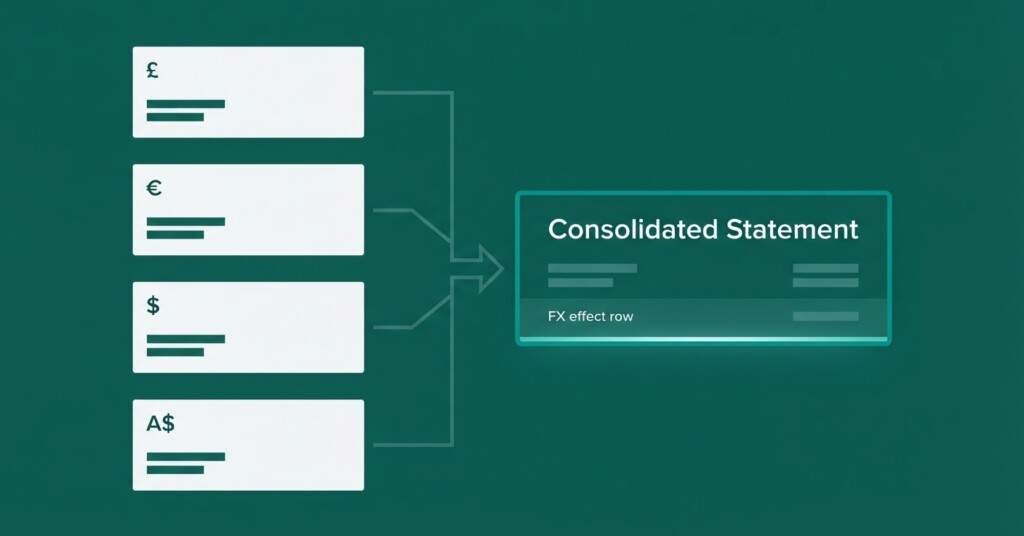
For any group that runs separate Xero organisations across different countries, producing a consolidated statement of cash flows is one of the most technically demanding tasks in the month-end or year-end close. It is not simply a matter of adding up the numbers. Each entity reports in its own functional currency, exchange rates fluctuate between periods, intercompany cash movements must be cancelled out, and the cash flow statement has its own translation rules that differ from those applied to the income statement or balance sheet. This article walks through the practical mechanics of getting it right, from raw entity data through to a properly presented group cash flow statement.
Why the Consolidated Cash Flow Statement Is Harder Than It Looks
Most finance teams working across multiple Xero files are comfortable with the idea of consolidating a profit and loss account or a balance sheet. You translate each entity at the appropriate rate and aggregate. The cash flow statement introduces an extra layer of complexity for two reasons. First, under IAS 7 (and its equivalents in other frameworks), cash flows must be translated at the rates that applied on the dates the transactions actually occurred — or at a reasonable approximation such as an average rate for the period. The closing rate used for the balance sheet does not apply here. Second, a reconciling line called the ‘effect of exchange rate changes on cash and cash equivalents’ must be presented to explain the difference between opening and closing cash balances that arises purely from rate movements, not from actual cash inflows or outflows. If that line is missing or misstated, the statement will not balance, and auditors will notice.
IAS 7 requires that the effect of exchange rate changes on cash held in foreign currencies be presented as a separate reconciling item in the statement of cash flows. This is not an optional disclosure — it is a requirement under IFRS and is mirrored in most national GAAP frameworks. Omitting it is one of the most common errors in SME group financial statements.
Consolidate your Xero entities — automatically.
BrizoConsol pulls from all your Xero organisations and delivers group reports in minutes.
Setting Up the Translation Framework Across Xero Organisations
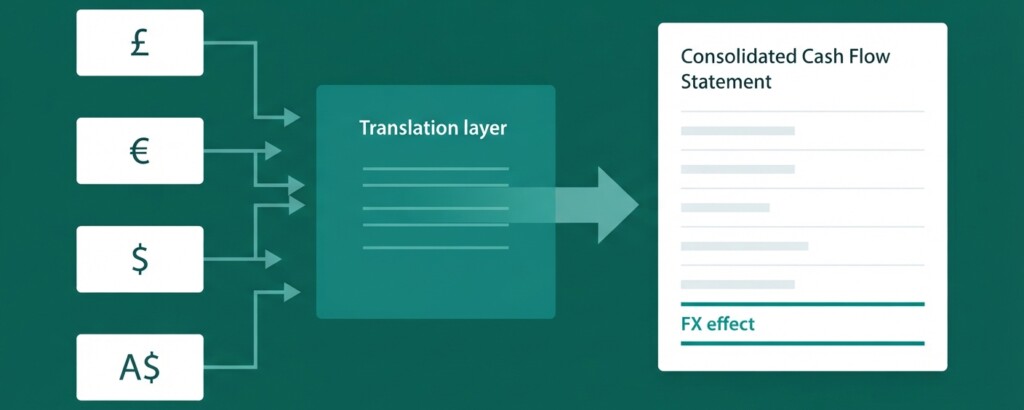
Before any consolidation work begins, you need to establish three key rates for each entity and each period: the opening rate (the closing rate from the prior period), the closing rate (the rate at the balance sheet date), and the average rate for the period (used to translate income statement items and, under IAS 7, cash flows themselves). Xero records transactions in local currency and can hold foreign currency bank accounts, but it does not automatically produce group-level translated or consolidated reports across multiple organisations. That data must be extracted and reassembled in a consolidation layer.
| Entity | Functional Currency | Opening Rate (to GBP) | Average Rate (to GBP) | Closing Rate (to GBP) |
|---|---|---|---|---|
| UK Parent | GBP | 1.0000 | 1.0000 | 1.0000 |
| German Subsidiary | EUR | 0.8750 | 0.8620 | 0.8540 |
| Australian Branch | AUD | 0.5310 | 0.5290 | 0.5150 |
| US Subsidiary | USD | 0.7920 | 0.7870 | 0.8010 |
With these rates established, each entity’s cash flow statement — operating, investing, and financing activities — is translated at the average rate. Cash and cash equivalent balances at the start and end of the period are translated at the opening and closing rates respectively. The difference that cannot be explained by translated cash flows is the exchange rate effect, which sits as a separate line.
Step-by-Step: Building the Consolidated Cash Flow Statement
The mechanical process has five stages. Working through each one systematically prevents the most common errors.
- Extract the cash flow statement from each Xero organisation for the reporting period in its functional currency.
- Translate each line of operating, investing, and financing cash flows at the average rate for the period.
- Translate opening and closing cash balances at the opening and closing rates respectively.
- Eliminate intercompany cash flows — for example, a loan repayment from the German subsidiary to the UK parent that appears as an inflow in the parent and an outflow in the subsidiary must be removed from both.
- Calculate the exchange rate effect as the balancing figure: translated closing cash minus translated opening cash minus the sum of translated cash flows equals the FX effect.
| Translated closing cash (group, at closing rates) | £1,842,300 |
| Less: Translated opening cash (group, at opening rates) | −£1,694,100 |
| Less: Net translated cash flows (operating + investing + financing, at average rates) | −£183,400 |
| Effect of exchange rate changes on cash and cash equivalents | £(35,200) |
In this example, the group held net cash that declined in sterling terms purely because of exchange rate movements — particularly the weakening of the Australian dollar and euro against sterling during the period. The negative £35,200 is not a cash loss; it is a translation effect, and it belongs as its own line in the cash flow statement rather than being buried inside operating activities.
Eliminating Intercompany Cash Flows
Intercompany eliminations in the cash flow statement follow the same principle as in the profit and loss and balance sheet: transactions between group entities do not represent cash flows from the perspective of the group as a whole. The trickiest scenario is when cash actually moves between entities in different currencies. Consider a situation where the UK parent makes a £200,000 cash advance to the US subsidiary. The parent records an outflow of £200,000 under financing activities. The US subsidiary receives USD at the prevailing spot rate — say USD 254,000 — and records that as a financing inflow. When translated back to sterling at the average rate, the subsidiary’s inflow might appear as £199,900 due to rate timing differences. Both sides must be eliminated. Any residual difference arising from timing or rate differences is itself an intercompany FX translation difference and should be eliminated within equity reserves rather than left in the cash flow statement.
| Account | Dr | Cr |
|---|---|---|
| Intercompany Financing Outflow — UK Parent (elimination) | 200,000 | |
| Intercompany Financing Inflow — US Subsidiary (elimination) | 199,900 | |
| Intercompany FX Translation Difference — Equity Reserve | 100 |
Elimination of intercompany cash advance on consolidation. The £100 residual arises from the difference between the spot rate at which the advance was made and the average rate used to translate the subsidiary’s cash flow statement. It is taken to equity reserves rather than distorting the cash flow statement.
Do not net intercompany eliminations against the FX effect line. A common mistake is to leave unexplained intercompany differences inside the exchange rate effect as a plug figure. This makes the statement appear to balance but creates a misstatement. The intercompany difference is an equity item; the FX effect is a genuine translation movement on external cash balances. They must be kept separate.
Handling Non-Controlling Interests in Cash Flow Reporting
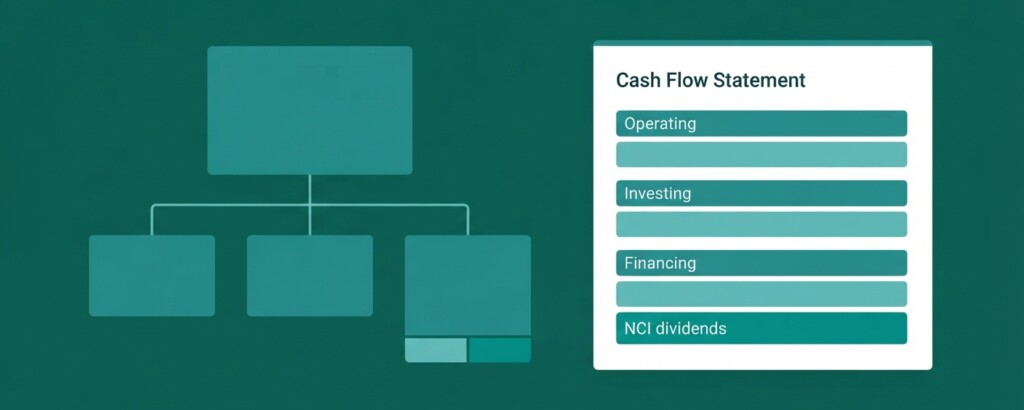
If your group includes subsidiaries that are not wholly owned, the cash flows of those subsidiaries are included in full within the consolidated cash flow statement — not proportionally. The NCI share of net assets and profits is shown separately in the balance sheet and income statement, but cash flows are not split between parent and minority. Where dividends are paid to non-controlling shareholders from a partially owned subsidiary, those payments appear as a financing outflow in the consolidated cash flow statement. This is one of the areas where groups using manual Excel consolidations often make errors, either excluding NCI subsidiary cash flows entirely or only including the group’s proportionate share.
Practical Challenges When Using Xero Across Multiple Jurisdictions
Xero is well designed for entity-level bookkeeping, but it has structural limitations for group consolidation. Each Xero organisation is independent — there is no native way to run a multi-entity cash flow report across organisations, apply consistent group exchange rates, or perform intercompany eliminations. Finance teams typically deal with this by exporting each entity’s cash flow report to Excel and attempting the consolidation manually. This approach is workable for two entities with minimal intercompany activity, but it breaks down quickly as the group grows. Rate consistency becomes a problem when different team members pull exchange rates from different sources. Intercompany reconciliations become time-consuming as transaction volumes grow. And the FX effect calculation — already non-intuitive — is prone to error when built from scratch in spreadsheets each period.
| Task | Manual Excel Approach | Key Risk |
|---|---|---|
| Exchange rate sourcing | Rates manually keyed or pasted from a web source | Inconsistency across entities; no audit trail |
| Intercompany matching | Manual reconciliation of intercompany balances before elimination | Mismatches left unresolved; eliminations missed |
| FX effect calculation | Balancing figure computed as a plug in the spreadsheet | Errors absorbed into FX line rather than corrected |
| NCI cash flows | Often excluded or proportioned incorrectly | Understated or overstated group cash flows |
| Period-over-period rollforward | Prior period closing rates manually copied as opening rates | Copy-paste errors in rate tables |
Structuring the Final Consolidated Cash Flow Statement
Once all translations are done and eliminations applied, the consolidated statement should follow the standard structure. Operating activities are typically presented using the indirect method, starting from consolidated profit before tax and adjusting for non-cash items and working capital movements. Investing and financing activities are presented directly. The FX effect sits between the net movement in cash and the reconciliation to opening and closing balances. Every figure in the statement should be traceable to a translated and eliminated source — either from an entity-level cash flow or from a specific elimination entry. If a number cannot be traced, it should not be in the statement.
Groups that manage this process well tend to share a few common practices: they agree exchange rates centrally before each period-end rather than letting each entity apply its own; they reconcile intercompany balances before the consolidation begins rather than during it; and they treat the FX effect line as something to be explained rather than something to be calculated as a residual. That mindset shift — from ‘what is left over?’ to ‘does this make sense given rate movements on our cash balances?’ — is what separates a reliable consolidated cash flow statement from one that merely balances.
A useful sense-check for the FX effect: multiply each entity’s average cash balance for the period by the movement in exchange rates from opening to closing. Sum these across entities. The result should be broadly consistent with the FX effect line in your consolidated statement. Large unexplained variances usually indicate an intercompany elimination error or a rate inconsistency.
Reducing the Manual Workload Through Connected Accounting Data
The fundamental challenge with multi-entity cash flow consolidation is that it requires consistent, connected data across organisations that were designed to operate independently. Each step — extraction, translation, elimination, aggregation — is an opportunity for error when done manually. Tools that connect directly to Xero’s API can automate the extraction of trial balance and cash flow data, apply centrally managed exchange rates consistently across entities, and maintain intercompany reconciliation records that make eliminations traceable. The accounting entries for eliminations can be stored and reapplied each period rather than rebuilt from scratch. The FX effect can be calculated algorithmically from the same rate and balance data rather than as a manual plug. For finance teams managing three or more entities with active intercompany activity and multiple functional currencies, the reduction in reconciliation effort and the improvement in accuracy are significant — not because the accounting becomes simpler, but because the data handling becomes reliable.
See Multi-Entity Cash Flow Consolidation in Practice
BrizoConsol connects to multiple Xero organisations, applies consistent exchange rates, manages intercompany eliminations, and produces a consolidated statement of cash flows with the FX effect correctly calculated and disclosed. If your team is currently building this in Excel each period, it is worth seeing how the process can work differently.