Intercompany Eliminations When There Is a Non-Controlling Interest: Upstream, Downstream, and Lateral Sales
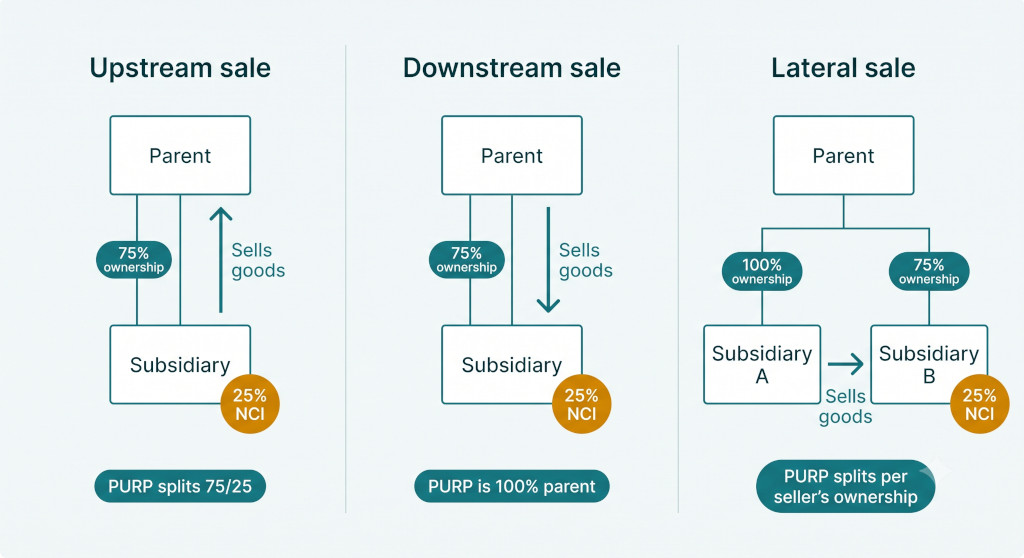
When every subsidiary in a group is wholly owned, intercompany eliminations are mechanically straightforward: the full profit on any intragroup transaction is eliminated, and the reduction flows entirely through the parent’s share of consolidated profit. But the moment a group includes a partly-owned subsidiary — one with a non-controlling interest — the question of how to eliminate intercompany profits becomes considerably more nuanced.
The issue is this: where the profit being eliminated was earned by a partly-owned subsidiary, the NCI has a share of that profit in the entity accounts. When the profit is identified as unrealised at the group level and eliminated from the consolidated accounts, the question is whether the NCI’s share of that profit is also eliminated. The answer depends on the direction of the sale — whether the intragroup transaction ran from the subsidiary to the parent (upstream), from the parent to the subsidiary (downstream), or between two subsidiaries (lateral). Each direction has a different answer.
This post works through each direction with specific numbers, explains the journal entries, and covers the practical implications for the NCI column in the consolidated statement of changes in equity.
Automate NCI calculations across all your entities.
BrizoConsol handles non-controlling interest automatically — no manual adjustments required.
The Group Setup
Vertex Group — Group Structure
Vertex Holdings Ltd — parent, 100% owned by the shareholders
Vertex Manufacturing Ltd — subsidiary, 75% owned by Holdings (25% NCI)
Vertex Distribution Ltd — subsidiary, 100% owned by Holdings (no NCI)
During the year, intragroup trading takes place in three scenarios that we will work through separately. In each case, goods are sold at a 25% margin on selling price (i.e., cost plus 33.3%) and a portion of those goods remain unsold in the buyer’s inventory at year-end, giving rise to unrealised profit (PURP) that must be eliminated.
The PURP in each scenario is £30,000. The question is: whose equity does that £30,000 come from?
Upstream Sales: Subsidiary Sells to Parent
↑ Upstream
In the upstream scenario, Vertex Manufacturing (75% owned — 25% NCI) sells goods to Vertex Holdings. The profit on those goods sits in Manufacturing’s entity accounts. At year-end, some of those goods remain unsold in Holdings’ inventory, giving rise to unrealised profit of £30,000.
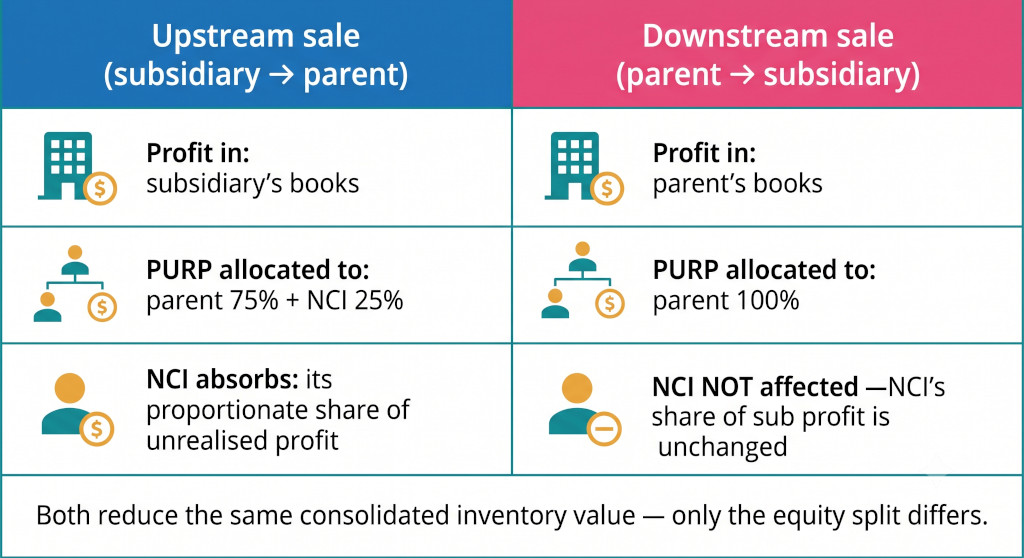
In Manufacturing’s entity accounts, that £30,000 profit belongs to all of Manufacturing’s shareholders — 75% to Holdings and 25% to the NCI. When the profit is eliminated in the consolidated accounts as unrealised, the elimination must reflect the same ownership split. The NCI cannot retain its 25% share of profit that the group has determined is not yet earned — it must also give up its proportion.
Upstream PURP — the split
| PURP allocation | Calculation | Amount (£) |
|---|---|---|
| Total unrealised profit to eliminate | Given | 30,000 |
| Parent’s share (75%) | £30,000 × 75% | 22,500 |
| NCI’s share (25%) | £30,000 × 25% | 7,500 |
Journal — Upstream PURP Elimination
| Account | Dr (£) | Cr (£) | Notes |
|---|---|---|---|
| Cost of sales / Retained earnings (consolidated) | 30,000 | Full PURP eliminated | |
| Inventory (consolidated balance sheet) | 30,000 | Reduce to cost to the group |
The journal entry is the same as for a wholly-owned subsidiary — the full £30,000 is eliminated against cost of sales and inventory. The difference in the NCI case is what happens to that debit. In the consolidated retained earnings workings, the £30,000 reduction in profit is split:
- £22,500 (75%) reduces the profit attributable to the parent’s shareholders
- £7,500 (25%) reduces the profit attributable to the NCI
This means the NCI’s share of consolidated profit for the year is lower by £7,500 than it would be if simply applying 25% to Manufacturing’s reported entity profit. The NCI has absorbed its proportionate share of the elimination, as it should — the unrealised profit belonged to all of Manufacturing’s shareholders, so all shareholders bear the reversal when that profit is removed.
Under both IFRS 10 and FRS 102 Section 9, unrealised profits on upstream intragroup sales are eliminated in full, with the elimination allocated between the parent and the NCI in proportion to their ownership interests. This is not an accounting policy choice — it is mandatory. A group that eliminates the full PURP but attributes all of it to the parent’s share of profit (ignoring the NCI’s portion) has misstated the split of consolidated profit between the two groups of shareholders.
Downstream Sales: Parent Sells to Subsidiary
↓ Downstream
In the downstream scenario, Vertex Holdings (the parent) sells goods to Vertex Manufacturing (75% owned). The profit on those goods sits in Holdings’ entity accounts — not in Manufacturing’s. At year-end, some of those goods remain unsold in Manufacturing’s inventory, giving rise to unrealised profit of £30,000.
The critical difference from the upstream case: the profit belongs entirely to Holdings, not to Manufacturing. The NCI has no share of profit sitting in Holdings’ books — its interest is in Manufacturing only. When the £30,000 is eliminated as unrealised profit, the entire elimination is borne by the parent’s shareholders. The NCI’s share of Manufacturing’s profit is unaffected.
Downstream PURP — the split
| PURP allocation | Calculation | Amount (£) |
|---|---|---|
| Total unrealised profit to eliminate | Given | 30,000 |
| Parent’s share (100%) | £30,000 × 100% | 30,000 |
| NCI’s share | Not applicable — profit is in parent’s books | nil |
Journal — Downstream PURP Elimination
| Account | Dr (£) | Cr (£) | Notes |
|---|---|---|---|
| Cost of sales / Retained earnings (consolidated) | 30,000 | Full PURP — parent’s profit only | |
| Inventory (consolidated balance sheet) | 30,000 | Reduce to cost to the group |
The journal entry looks identical — but now the full £30,000 debit falls against the parent’s share of consolidated profit. The NCI’s share of Manufacturing’s profit for the year is calculated from Manufacturing’s own entity accounts (after the inventory line reflects the goods at the intercompany transfer price, which is what Manufacturing paid). The PURP does not flow through Manufacturing’s income statement, so the NCI is not affected.
Side-by-Side Comparison: The Same PURP, Two Different Outcomes
Using identical numbers (£30,000 PURP, 75% parent / 25% NCI), here is how the consolidated profit attribution differs between the upstream and downstream cases:
| Item | Without PURP (£) | Upstream PURP (£) | Downstream PURP (£) |
|---|---|---|---|
| Profit attributable to parent shareholders | 300,000 | 277,500 (−22,500) | 270,000 (−30,000) |
| Profit attributable to NCI | 50,000 | 42,500 (−7,500) | 50,000 (nil) |
| Total consolidated profit | 350,000 | 320,000 | 320,000 |
Both scenarios reduce total consolidated profit by the same £30,000 — the inventory is overstated by the same amount and must be reduced to the group’s cost regardless of which direction the sale ran. The difference is entirely in how that reduction is split between the two categories of shareholders. In the upstream case, the NCI absorbs £7,500; in the downstream case, the NCI absorbs nothing.
The most common error in practice: applying 100% of the PURP against the parent’s share of profit regardless of the direction of sale. This produces the correct total consolidated profit figure but misallocates it between the parent and the NCI — understating the NCI’s cost when the sale is upstream and (in the opposite error) overstating the NCI’s cost when the sale is downstream. Both errors affect earnings per share attributable to parent shareholders and the carrying amount of the NCI in the consolidated balance sheet.
Lateral Sales: Between Two Subsidiaries
↔ Lateral
Lateral sales occur between two subsidiaries rather than between a subsidiary and the parent. The treatment depends on the ownership of the selling subsidiary.
Where the selling subsidiary is wholly owned (no NCI)
If Vertex Distribution (100% owned) sells goods to Vertex Manufacturing (75% owned), the profit sits in Distribution’s books — a wholly-owned entity. Since the parent owns 100% of Distribution, the full PURP is attributable to the parent, and the NCI in Manufacturing is unaffected. This is economically equivalent to a downstream sale.
Where the selling subsidiary has an NCI
If Vertex Manufacturing (75% owned, 25% NCI) sells goods to Vertex Distribution (100% owned), the profit sits in Manufacturing — the partly-owned entity. The PURP is allocated proportionately: 75% to the parent, 25% to the NCI. This is economically equivalent to an upstream sale.
The general principle is consistent: the PURP is always allocated in proportion to the ownership of the entity whose books contain the profit being eliminated.
| Sale Direction | Profit Sits In | Parent’s Share of PURP | NCI’s Share of PURP |
|---|---|---|---|
| Upstream (sub 75% → parent) | Subsidiary (partly owned) | 75% | 25% |
| Downstream (parent → sub 75%) | Parent (100% parent’s) | 100% | nil |
| Lateral (100% sub → 75% sub) | Wholly-owned subsidiary | 100% | nil |
| Lateral (75% sub → 100% sub) | Partly-owned subsidiary | 75% | 25% |
PURP on Fixed Assets: The Same Logic Applies
The upstream/downstream distinction applies equally to the unrealised profit on intercompany asset transfers — where one group entity sells a fixed asset to another at a profit, and the asset is still held by the buying entity at year-end. The same analysis applies: identify which entity’s books contain the profit, and allocate the PURP adjustment proportionately to that entity’s ownership structure.
The additional complexity with fixed assets is depreciation. Where a partly-owned subsidiary has purchased an asset from the parent at an inflated intercompany price, it is depreciating that asset from a higher base than the group’s cost. The annual depreciation adjustment (reducing the excess depreciation back to the group’s cost basis) must also be allocated proportionately — if the buying entity is partly owned, the NCI benefits from the depreciation adjustment in proportion to its ownership stake.
Effect on the NCI Column in the SOCIE
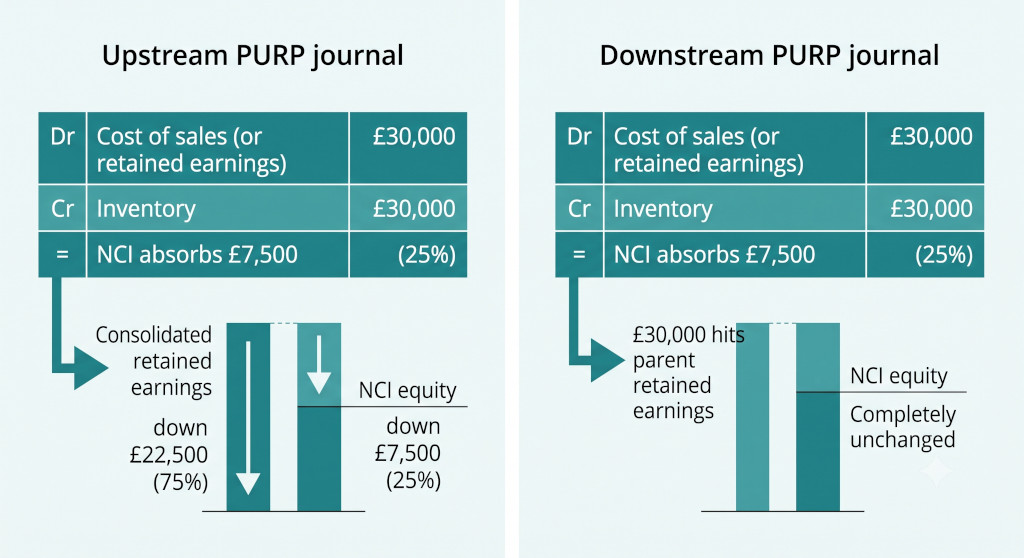
In the consolidated statement of changes in equity, the NCI column must reflect the NCI’s adjusted share of the subsidiary’s profit — after the upstream PURP has reduced the subsidiary’s contribution to consolidated earnings. This affects the “profit for the year” line in the NCI column, not a separate adjustment line.
Using the upstream scenario: Manufacturing’s entity profit is £200,000. The NCI’s 25% share in the entity accounts is £50,000. After eliminating the upstream PURP of £30,000, the NCI’s adjusted share of Manufacturing’s contribution to consolidated profit is:
| Item | Amount (£) |
|---|---|
| Manufacturing entity profit | 200,000 |
| Less: PURP (upstream sale — full elimination) | (30,000) |
| Adjusted profit for NCI calculation | 170,000 |
| NCI’s 25% share of adjusted profit | 42,500 |
The £42,500 (rather than the unadjusted £50,000) is what appears in the NCI column of the SOCIE for the current year’s profit. The difference of £7,500 — the NCI’s share of the upstream PURP — reduces both the NCI’s current-year profit and the NCI’s closing equity balance in the consolidated balance sheet.
In subsequent periods, when the goods are sold by Holdings to an external customer, the PURP reverses — the previously unrealised profit is now realised, and the £7,500 that was deducted from NCI’s profit in the prior year is added back. This reversal flows through the SOCIE in the same way as the original adjustment but in the opposite direction.
Common Errors — A Checklist
1. Treating all PURP as attributable 100% to the parent
The most frequent error. When the profit being eliminated is in a partly-owned subsidiary’s books (upstream or lateral from a partly-owned seller), the NCI must absorb its proportionate share. Attributing the full PURP to the parent misoverstates the NCI’s closing equity and misrepresents the NCI’s share of profit.
2. Failing to adjust the NCI’s profit in the consolidated income statement
Related to the above: some consolidations correctly eliminate the PURP against cost of sales and inventory but then calculate the NCI’s share of profit from the subsidiary’s unadjusted entity accounts rather than from the post-PURP adjusted profit. The income statement shows the correct total, but the split between parent and NCI is wrong.
3. Forgetting to reverse prior-year PURP through the NCI column
When an upstream PURP from year one is realised in year two (the goods are sold externally), the prior-year PURP reverses. The NCI’s share of the reversal (£7,500 in our example) must be added back to the NCI’s profit in year two. Groups that track the PURP reversal only in the parent’s retained earnings miss the NCI component, leaving the NCI’s accumulated equity incorrect by a growing amount over time.
4. Misidentifying the direction of the sale
In groups with multiple subsidiaries at different ownership levels, it is not always immediately obvious whether a sale is upstream, downstream, or lateral, or how to characterise a lateral sale between two partly-owned subsidiaries at different ownership percentages. The key question is always: in which entity’s books does the profit sit? The ownership of that entity determines the PURP split.
5. Ignoring the depreciation adjustment on upstream asset transfers
Where a partly-owned subsidiary has purchased an asset from the parent at above-cost, the excess depreciation adjustment in subsequent years must also be allocated partly to the NCI. Groups that make the PURP adjustment correctly at the time of the asset transfer sometimes forget to include the NCI’s share of the ongoing annual depreciation adjustment.
NCI Calculations and Intercompany Eliminations, Done Together
BrizoConsol computes your NCI’s share of profit after applying intercompany eliminations — correctly splitting upstream PURP adjustments between parent and minority shareholders, period after period. Start Free Trial
Putting It All Together: The Practical Workflow
For a group with partly-owned subsidiaries and intragroup trading, the intercompany elimination process at consolidation close needs one additional step compared with a wholly-owned group: identifying the direction of each intragroup sale that gives rise to unrealised profit, and calculating the NCI’s share of the PURP accordingly.
In practice, this means the intercompany trading schedule — which lists all intragroup sales, the margin applied, and the closing inventory — should also record the ownership of the selling entity for each line. Where the selling entity is partly owned, the PURP is flagged for proportionate allocation; where the selling entity is wholly owned, the full PURP falls to the parent. This additional column adds almost no work but ensures the downstream/upstream split is applied correctly at the elimination stage.
For groups managing this across multiple currencies as well as multiple ownership levels, the full picture — upstream PURP with NCI split, translated at the appropriate rate — is one of the more complex consolidation adjustments to get right in a spreadsheet model. It is, however, exactly the kind of calculation that consolidation software handles systematically: BrizoConsol’s NCI module computes the adjusted NCI share of profit after applying both PURP and other elimination adjustments at each period close.
Related reading: the mechanics of the PURP calculation itself are covered in the intercompany eliminations guide; how the NCI is calculated and presented in the consolidated balance sheet is covered in the NCI calculation guide; and how OCI items like CTA are split between parent and NCI is covered in the post on splitting the CTA with NCI.
Multi-Entity. Multi-Currency. Partly Owned. One Consolidation.
BrizoConsol handles the full complexity of group consolidation — intercompany eliminations, NCI splits, CTA, and PURP reversals — without the risk of spreadsheet error. Start Free Trial