Step Acquisition Accounting: How to Consolidate When an Associate Becomes a Subsidiary
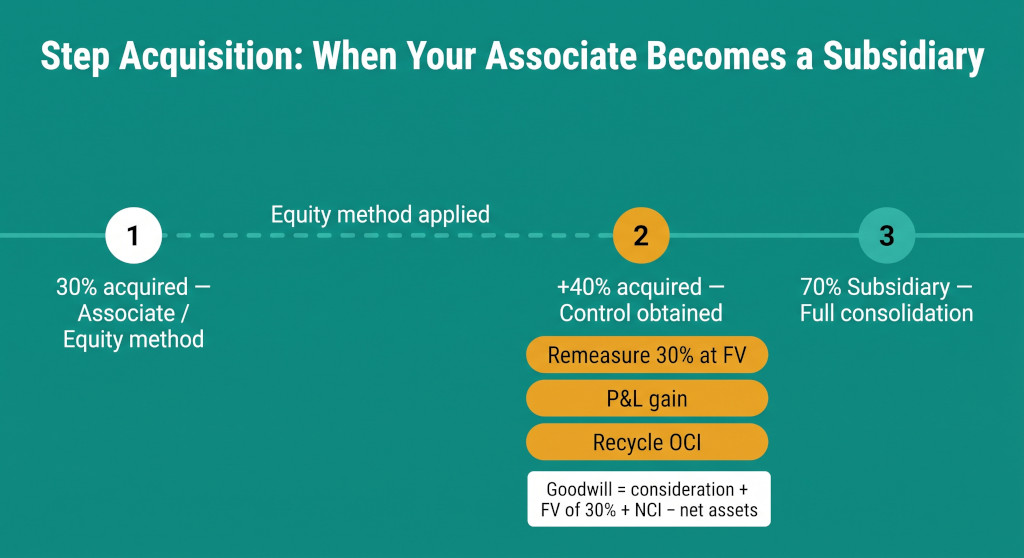
When a group holds an associate stake and acquires enough additional shares to cross the control threshold, the transaction is not simply a matter of adding the new consideration to the existing investment and consolidating from there. IFRS 3 paragraph 42 requires something quite different: the previously-held interest must be remeasured to its fair value at the date control is obtained, and the difference between that fair value and the equity method carrying amount must be recognised in profit or loss. Any OCI accumulated in respect of the former associate — typically a currency translation adjustment — must also be recycled to P&L as if the associate had been disposed of at that date.
These requirements have two significant consequences. First, the group recognises a gain (or loss) in the consolidated income statement in the year of the step acquisition — even though no additional cash changed hands in relation to the pre-existing stake. Second, the goodwill calculation at acquisition uses the fair value of the previously-held interest as one of its inputs — not the equity method carrying amount. Using the carrying amount instead of the fair value in the goodwill calculation is the most common error in step acquisition accounting, and it always produces wrong goodwill.
This guide covers all three stages of a step acquisition — remeasuring the previously-held interest, recycling OCI, and calculating goodwill correctly — with a worked example that runs through each journal.
Stop building consolidations in spreadsheets.
BrizoConsol automates multi-entity consolidation — setup in minutes, reports the same day.
The IFRS 3 Rule: Business Combinations Achieved in Stages
IFRS 3 paragraph 41 addresses business combinations achieved in stages (the standard’s term for step acquisitions). It states that the acquirer must remeasure its previously-held equity interest in the acquiree at its acquisition-date fair value and recognise the resulting gain or loss, if any, in profit or loss or other comprehensive income, as appropriate.
The reasoning behind this treatment is that, on the date control is obtained, the group is treated as if it had disposed of its old associate interest and reacquired it as part of a new, controlling investment. The entire business combination is measured fresh at the acquisition date — the previously-held interest is no longer a stake in an associate and must be valued at what it is actually worth on the control date, not at what the equity method says it is worth.
The Three Steps at the Control Date
Three things happen simultaneously on the date the group obtains control — all in the period’s consolidation:
- Step 1 — Remeasure the previously-held interest to FV. The equity method investment is derecognised at its carrying amount and recognised at its fair value at the acquisition date. The difference is a gain or loss in the consolidated P&L.
- Step 2 — Recycle OCI to P&L. Any amounts previously recognised in OCI in respect of the former associate — most commonly the associate’s share of currency translation adjustments — are recycled to P&L as if the associate had been disposed of at the acquisition date.
- Step 3 — Calculate goodwill using FV of the previously-held interest. The IFRS 3 goodwill calculation uses the FV of the previously-held interest (established in Step 1), not its carrying amount. This is mandatory — IFRS 3 para 42 is explicit that the FV is used in the acquisition-date measurement of the business combination.
The Group Before the Step Acquisition: VentureCo and TargetCo
1) Remeasure the Previously-Held 30% Interest at FV
Derecognise the equity method carrying amount. Recognise at FV. Difference → consolidated P&L.
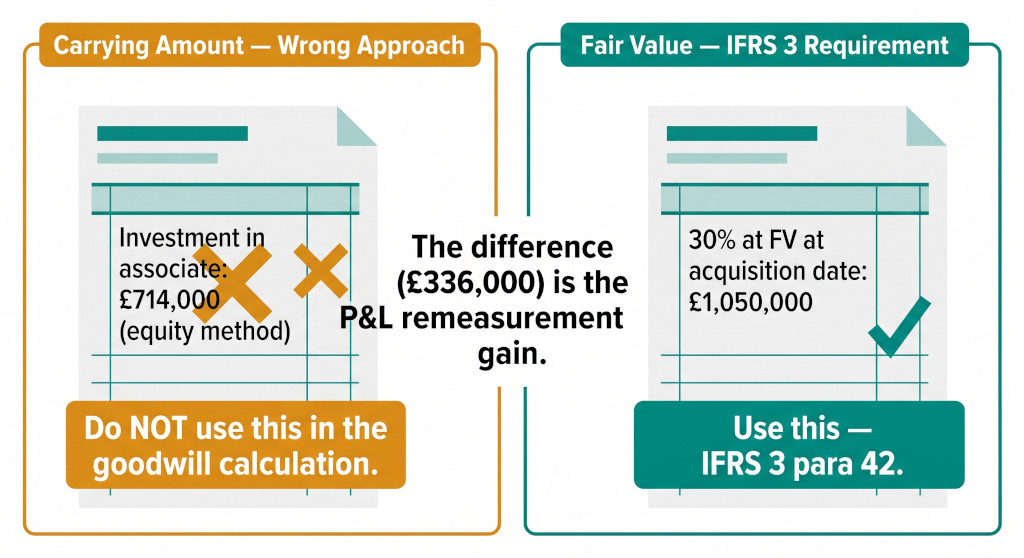
Remeasurement gain — 30% previously-held interest
| FV of 30% at 1 January 2026 (30% × implied enterprise value £3,500,000) | 1,050,000 |
| Equity method carrying amount at 31 December 2025 | (714,000) |
| Remeasurement gain recognised in consolidated P&L | 336,000 |
Journal 1 — Remeasure previously-held interest to FV
| Account | Dr (£) | Cr (£) |
|---|---|---|
| Investment in associate (step-up to FV: £1,050,000 − £714,000) | 336,000 | |
| IFRS 3 remeasurement gain (consolidated P&L) | 336,000 |
After this journal, the investment in associate balance is £1,050,000 — the FV at the acquisition date. This is then eliminated in Journal 3 as part of the full acquisition journal.
This gain is a consolidation entry only. In VentureCo’s individual entity accounts, the investment in TargetCo is carried at cost — £600,000 (original cost) + £1,400,000 (new purchase) = £2,000,000. The £336,000 remeasurement gain exists only in the consolidated accounts. It is non-cash and non-recurring, and many groups exclude it from adjusted or underlying earnings when reporting to investors.
2) Recycle OCI Accumulated on the Former Associate
Any CTA or other OCI items from the associate period are recycled to P&L — as if TargetCo were being disposed of at the acquisition date.
If TargetCo had been a foreign operation during the associate period — preparing its accounts in a functional currency other than VentureCo’s presentation currency — VentureCo would have accumulated a share of TargetCo’s CTA in OCI. Under IAS 21 paragraph 48A (applicable via IAS 28), when the status of an investment in a foreign associate changes, the CTA previously recognised in OCI relating to that associate must be reclassified to profit or loss.
In the base scenario above, TargetCo is a domestic entity with no CTA. To illustrate OCI recycling, assume instead that TargetCo had a functional currency of USD and VentureCo presents in GBP. Over the 2024–2025 associate period, VentureCo has accumulated a CTA credit of £45,000 in OCI (VentureCo’s 30% share of TargetCo’s positive CTA as the USD strengthened).
Journal 2 — Recycle associate CTA from OCI to P&L
| Account | Dr (£) | Cr (£) |
|---|---|---|
| OCI — CTA reserve (associate period, derecognised) | 45,000 | |
| P&L — CTA recycled on step acquisition of associate | 45,000 |
This recycling treats the obtaining of control as a deemed disposal of the associate interest for OCI purposes. The CTA that was held in OCI (and would have been recycled to P&L on an actual disposal) is now recycled on this deemed disposal. The group’s total step acquisition P&L gain — remeasurement gain plus recycled CTA — is £336,000 + £45,000 = £381,000. From the acquisition date, TargetCo is fully consolidated and a new CTA will accumulate based on TargetCo’s net assets as a subsidiary (not as a 30% associate stake).
3) Calculate Goodwill Using FV of the Previously-Held Interest
The FV established in Step 1 — not the equity method carrying amount — is the input to the IFRS 3 goodwill formula.
Goodwill formula — step acquisition (IFRS 3 para 32 + para 42)
| + | Consideration paid for the additional stake (Step 2 payment) |
| Cash, shares, or contingent consideration at FV at the acquisition date | |
| + | FV of previously-held interest at acquisition date (not carrying amount) |
| Established by the Step 1 remeasurement — £1,050,000 in the worked example | |
| + | NCI at acquisition (at FV or proportionate share — accounting policy choice) |
| 30% of TargetCo not owned by VentureCo after the step acquisition | |
| − | FV of identifiable net assets at the acquisition date |
| All assets and liabilities at FV at 1 January 2026 | |
| = | Goodwill |
Goodwill calculation — VentureCo / TargetCo step acquisition
| Consideration for additional 40% (cash paid 1 Jan 2026) | 1,400,000 |
| FV of previously-held 30% (Step 1 FV — not carrying amount) | 1,050,000 |
| NCI (30%) at proportionate share: 30% × £2,200,000 | 660,000 |
| Total | 3,110,000 |
| Less: FV of net identifiable assets at 1 January 2026 | (2,200,000) |
| Goodwill | 910,000 |
Journal 3 — Full acquisition journal at 1 January 2026
| Account | Dr (£) | Cr (£) |
|---|---|---|
| Net identifiable assets of TargetCo (at FV) | 2,200,000 | |
| Goodwill | 910,000 | |
| Cash (consideration for additional 40%) | 1,400,000 | |
| Investment in associate (derecognised at FV: £1,050,000) | 1,050,000 | |
| NCI equity (30% at proportionate share) | 660,000 |
The investment in associate credit of £1,050,000 is the FV after the Step 1 remeasurement (Journal 1 increased it from £714,000 to £1,050,000; this journal eliminates it). The net assets of £2,200,000 include all of TargetCo’s identifiable assets and liabilities at FV — including any FV adjustments made at the acquisition date. From 1 January 2026, TargetCo is consolidated line-by-line, its results included 100% with the 30% NCI deducted in the attribution.
The Goodwill Error: Carrying Amount Instead of FV
The most common error in step acquisition goodwill calculations is substituting the equity method carrying amount for the FV of the previously-held interest. In the worked example, this error produces:
The understatement is £336,000 — exactly equal to the remeasurement gain. This is not a coincidence: the remeasurement gain and the goodwill adjustment are two sides of the same correction. Using the carrying amount in the goodwill formula effectively hides the step-up value that should appear partly as a P&L gain and partly as goodwill.
When reviewing a step acquisition calculation, a quick cross-check is available: the goodwill under the correct approach minus the goodwill under the carrying-amount approach should equal the remeasurement gain (before tax). If those two figures do not reconcile, there is a calculation error somewhere in the step acquisition workings.
Income Statement Impact in the Acquisition Year
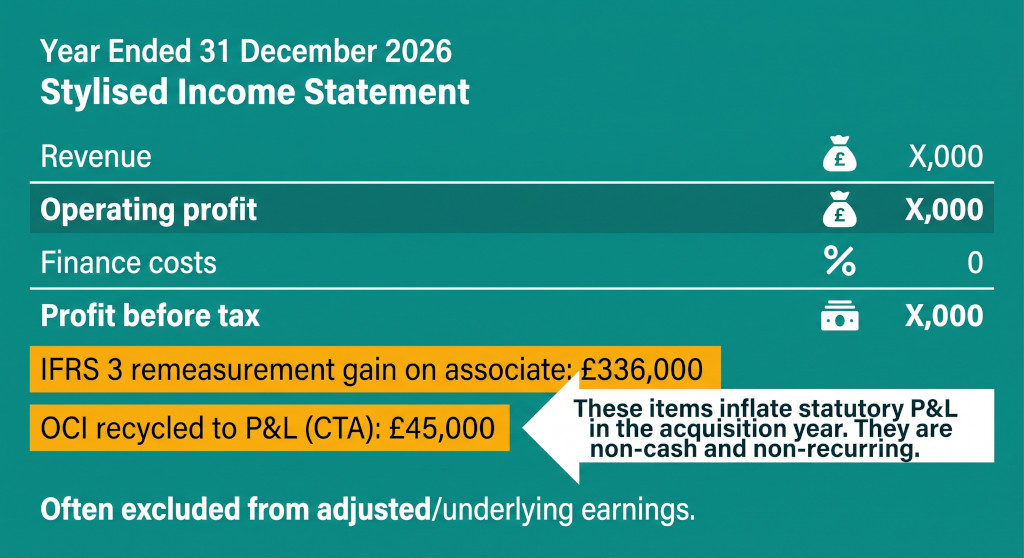
In the year of the step acquisition, the consolidated income statement is affected in three ways that do not appear in a straightforward first-acquisition:
- The remeasurement gain (£336,000 in the example) appears as a separate line, typically below operating profit and above or within finance income, labelled as “gain on remeasurement of previously-held interest in TargetCo” or similar. It is taxable in most jurisdictions — the gain may give rise to a deferred tax or current tax liability.
- Recycled OCI (£45,000 in the CTA scenario) also appears in P&L, typically on the same line or as part of the same disclosure. The recycling is in addition to, not instead of, the remeasurement gain.
- Equity pickup stops from the acquisition date. In a mid-year acquisition, the equity pickup would be recognised up to the step acquisition date; thereafter, the subsidiary’s full results are consolidated and the NCI’s share is deducted in the attribution.
Both the remeasurement gain and the recycled OCI are non-cash and non-recurring. Groups with adjusted earnings metrics typically exclude them when reporting underlying performance. However, they are fully recognised in statutory P&L and affect reported earnings per share. This can make the year of a step acquisition look unusually profitable — a dynamic that requires clear disclosure so that investors understand the source of the uplift.
Where the Step Acquisition Starts: Accumulating Towards Control
The step acquisition framework applies whenever a previously-held interest becomes a controlling interest. The most common path is associate (20–50%) → additional purchase → subsidiary (above 50%). But the framework also applies in less common scenarios:
- FVOCI investment → subsidiary: If the group held a minority interest as an FVOCI financial asset (typically below 20%), the same remeasurement rule applies on obtaining control. The FVOCI carrying amount is FV by definition — so the remeasurement gain in P&L is zero, but the accumulated FVOCI reserve in OCI (the cumulative FV movement recognised directly in equity) is recycled to P&L.
- Joint venture → subsidiary: If joint control converts to sole control (e.g., one party acquires the other’s stake), the same IFRS 3 para 42 mechanics apply — the previously-held interest in the joint venture is remeasured to FV through P&L.
- Multiple step purchases over time: IFRS 3 applies on the date control is first obtained. Each purchase before that date is simply an addition to the associate or FVOCI investment — the step acquisition remeasurement occurs only once, at the point control crosses the threshold.
FRS 102 Position
FRS 102 Section 19 addresses business combinations. For step acquisitions, FRS 102 paragraph 19.7A requires an acquirer that achieves a business combination in stages to remeasure its previously-held equity interest in the acquiree at fair value at the acquisition date and recognise any resulting gain or loss in profit or loss. This is consistent with IFRS 3 para 42 — the same mandatory FV remeasurement, the same P&L gain recognition, and the same use of FV (not carrying amount) in the goodwill calculation. The practical mechanics of a step acquisition are the same under FRS 102 as under IFRS 3.
Practical Checklist: Step Acquisition Accounting
- Confirm the acquisition date precisely. The step acquisition accounting applies at the date control is obtained — this is the date the additional shares complete, not the announcement date or the signing date.
- Determine the FV of the previously-held interest at the acquisition date. The transaction price for the additional stake provides evidence of FV (e.g., 40% at £1,400,000 implies 30% at £1,050,000). Document the FV determination and have it reviewed by the auditor early — this is the most scrutinised figure in a step acquisition.
- Calculate the remeasurement gain. FV of previously-held interest minus equity method carrying amount at the acquisition date. Post the consolidation journal.
- Identify and recycle any OCI. Review the OCI balance relating to the former associate — CTA, revaluation reserve, or other items. Recycle to P&L as at the acquisition date.
- Calculate goodwill using FV of the previously-held interest. Do not use the equity method carrying amount. Apply the IFRS 3 goodwill formula with the FV of all components: new consideration, FV of previously-held interest, NCI, less FV of net identifiable assets.
- Perform the FV assessment of net identifiable assets. A step acquisition triggers a full IFRS 3 purchase price allocation — all of the acquiree’s assets and liabilities must be recognised at FV at the acquisition date, including intangibles not previously recognised in the acquiree’s own accounts.
- Cross-check the goodwill. Goodwill (correct) minus goodwill (using carrying amount) should equal the remeasurement gain. If not, there is a calculation error.
- Disclose clearly. The remeasurement gain, recycled OCI, and the change in accounting for TargetCo (from equity method to full consolidation) are all disclosure items under IFRS 3 and IFRS 12. Prepare the disclosures alongside the journals.
- Stop the equity pickup from the acquisition date. For mid-year acquisitions, calculate the equity pickup up to the acquisition date, then switch to full consolidation. Do not continue applying the equity method for the full reporting period.
- Consider the deferred tax position. The remeasurement gain may give rise to a current or deferred tax position depending on the jurisdiction. The FV adjustments to net identifiable assets create temporary differences requiring deferred tax recognition at the acquisition date.
For the equity method mechanics that apply during the associate period before the step acquisition, see equity method accounting in group consolidation: associates, joint ventures, and significant influence. For the embedded goodwill in the associate and its relationship to the step acquisition FV, see why your equity pickup is wrong after acquiring an associate: fair value adjustments and embedded goodwill. For the mirror-image transaction — a subsidiary becoming an associate through partial disposal — see partially disposing of an associate. For the industry-specific mechanics in construction groups where step acquisitions commonly arise from converting project interests, see step acquisition in a construction group.
Group consolidation through the full investment lifecycle
BrizoConsol supports the transition from associate to subsidiary — tracking equity method carrying amounts, recording the FV remeasurement at acquisition, and switching seamlessly to full consolidation from the step acquisition date. See how it handles your group’s investment structure. See It in Action