Step Acquisition in a Construction Group: The Consolidation Accounting When Your Associate Becomes a Subsidiary
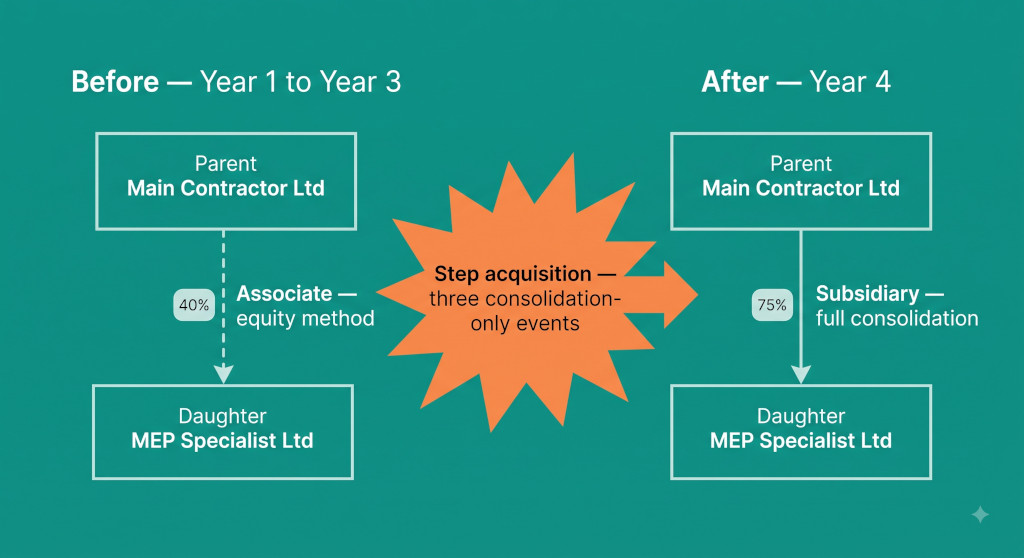
Construction groups often hold minority stakes in specialist subcontractors before acquiring control. A main contractor might take a 30% or 40% stake in a specialist MEP, fit-out, or groundworks firm to secure preferred subcontract relationships and share in its profitability — without committing to full ownership. Years later, when the strategy changes or an opportunity arises to consolidate the supply chain further, the group acquires additional shares and crosses the threshold into control.
At that moment, two things change simultaneously. In the commercial world, the group has simply bought more shares. In the accounting world, three separate consolidation events occur in the same set of group journals — and all three exist only at group level. Neither the parent’s entity accounts nor the subsidiary’s entity accounts record any of them.
The first event is a deemed disposal of the previously held associate interest — the 40% stake is treated as if it were sold at fair value on the day control is obtained, regardless of the fact that no sale took place. The second event is the recognition of a gain or loss on that deemed disposal, which flows through the consolidated P&L. The third event is the calculation of goodwill on the full acquisition, which uses the fair value of the previously held interest — not its carrying amount — as part of the consideration. Get any one of these wrong and the consolidated balance sheet, P&L, and goodwill figure are all incorrect.
Stop building consolidations in spreadsheets.
BrizoConsol automates multi-entity consolidation — setup in minutes, reports the same day.
The Scenario: Apex Construction Acquires Control of MEP Specialist
Apex Construction Group has held a 40% stake in MEP Specialist Ltd since Year 1. The stake has been accounted for under the equity method — Apex’s share of MEP’s profits has been included in the consolidated P&L as “share of associate’s profit”, and the investment carrying value has been built up as MEP’s post-acquisition retained profits have accrued to Apex.
At the start of Year 4, Apex acquires a further 35% of MEP Specialist from a retiring shareholder for £3,500,000 in cash. Following this purchase, Apex holds 75% of MEP Specialist and controls it for the first time.
The relevant figures at the acquisition date (1 January Year 4):
| Item | Amount |
|---|---|
| Cost of the new 35% stake acquired | £3,500,000 |
| Carrying value of existing 40% associate (equity method) | £1,840,000 |
| Fair value of existing 40% stake at acquisition date | £2,400,000 |
| Fair value of MEP Specialist’s net assets at acquisition date | £4,200,000 |
| Fair value of NCI (25%) at acquisition date | £1,050,000 |
Step One: The Deemed Disposal of the Previously Held Interest
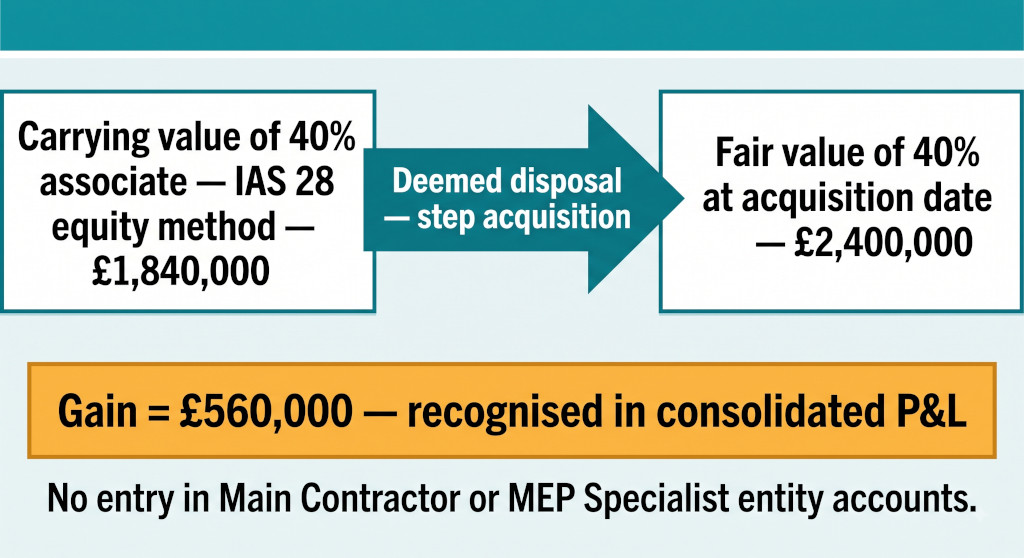
Under IFRS 3 and IFRS 10, when a group obtains control of an entity it previously held as an associate, the previously held interest is treated as if it were disposed of at its fair value on the acquisition date and immediately re-acquired as part of the controlling investment. This is called the deemed disposal.
The logic is that the nature of the investment has fundamentally changed — from a passive minority stake accounted for on the equity method, to a controlling interest accounted for under full consolidation. IFRS 3 requires the group to remeasure the old stake to fair value and recognise any difference between fair value and the equity method carrying amount in the consolidated P&L.
| Fair value of 40% stake at acquisition date | £2,400,000 |
| Carrying value of 40% stake under equity method | £(1,840,000) |
| Deemed disposal gain — consolidated P&L | £560,000 |
The consolidation journal records the deemed disposal:
| Account | Dr | Cr |
|---|---|---|
| Investment in associate (derecognised) | £1,840,000 | |
| Gain on deemed disposal of associate — consolidated P&L | £560,000 | |
| Fair value of previously held interest — acquisition calculation | £2,400,000 |
Deemed disposal journal — consolidated workings only. The investment in associate (£1,840,000 equity method carrying value) is derecognised. The previously held interest is restated at fair value (£2,400,000) for use in the goodwill calculation. The difference (£560,000) is a gain in the consolidated P&L — typically presented in finance income or as a separate exceptional item. Neither Apex Construction’s entity accounts nor MEP Specialist’s entity accounts record any of this.
The deemed disposal gain is real income in the consolidated P&L even though no cash changed hands and no shares were sold. It reflects the fact that the group is now recognising MEP Specialist’s full net assets at fair value — and the group’s share of that fair value exceeds what the equity method had accumulated. Analysts and auditors will scrutinise this item carefully, and it should be clearly disclosed in the notes.
Step Two: Calculating Goodwill at the Acquisition Date
Having established the fair value of the previously held interest, the goodwill calculation uses both the new stake purchased and the remeasured old stake as components of total consideration. IFRS 3 requires this so that the goodwill figure reflects the full fair value of the business acquired, not just the incremental interest purchased.
| Cash paid for new 35% stake | £3,500,000 |
| Fair value of previously held 40% interest (deemed disposal value) | £2,400,000 |
| Fair value of NCI (25%) at acquisition date | £1,050,000 |
| Total consideration (including NCI) | £6,950,000 |
| Fair value of MEP Specialist’s net assets at acquisition date | £(4,200,000) |
| Goodwill recognised at acquisition | £2,750,000 |
A common error is to use the equity method carrying value (£1,840,000) rather than the fair value (£2,400,000) in the goodwill calculation. This understates goodwill by £560,000 — exactly the amount of the deemed disposal gain. The deemed disposal and the goodwill calculation are two sides of the same journal. If the fair value is used in one, it must be used in the other. Using carrying value in the goodwill calculation and recognising the full gain in P&L double-counts; using fair value in both is correct.
The acquisition date consolidation journal records MEP Specialist’s assets and liabilities at fair value, derecognises the investment in associate, and establishes goodwill and NCI:
| Account | Dr | Cr |
|---|---|---|
| MEP Specialist net assets at fair value (100%) | £4,200,000 | |
| Goodwill | £2,750,000 | |
| Investment in associate (previously held interest — at FV after deemed disposal) | £2,400,000 | |
| Cash — new 35% stake | £3,500,000 | |
| NCI — 25% at fair value | £1,050,000 |
Acquisition date consolidation journal — establishes MEP Specialist as a fully consolidated subsidiary. 100% of net assets at fair value, goodwill (£2,750,000), and NCI (£1,050,000) are all recognised for the first time in the consolidated accounts. The investment in associate line is eliminated. These entries exist only in the group consolidation workings.
Step Three: The Equity Method Period — What Was Included Before?
Before the step acquisition, Apex Construction was including MEP Specialist in the consolidated accounts under the equity method. This means:
- One line in the consolidated P&L: “Share of associate’s profit — £X”
- One line in the consolidated balance sheet: “Investment in associate — £1,840,000”
- Intercompany transactions were eliminated only at the 40% proportionate share (not fully, as would be required once MEP is a subsidiary)
For the period up to the acquisition date in Year 4, the consolidated accounts will still show MEP under the equity method. From the acquisition date onwards, MEP is fully consolidated — every asset, liability, revenue, and cost line is included 100%, with a deduction for NCI.
The transition creates a mid-year split that the consolidation workings must handle precisely. If the acquisition occurred on 1 January Year 4 (the start of the year), the equity method applies for zero months and full consolidation applies for twelve months — clean. If the acquisition occurred on 1 July Year 4 (mid-year), six months of equity method one-line entries followed by six months of full consolidation — more complex, and requiring MEP’s management accounts to be split at the acquisition date.
The Switch from Equity Method to Full Consolidation — P&L Impact
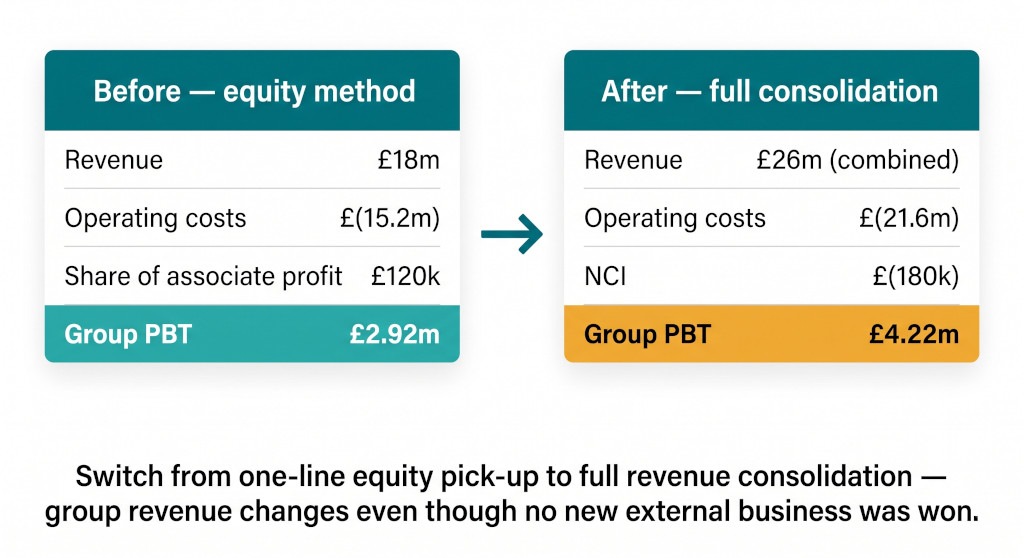
The most visible consequence of the step acquisition in the group’s consolidated P&L is the change in how MEP Specialist’s performance is presented. This change does not reflect any new business won or lost — it is purely an accounting presentation shift driven by the change in relationship from associate to subsidiary.
| Consolidated P&L line | Year 3 (equity method) | Year 4 (full consolidation) |
|---|---|---|
| Group revenue (Apex Construction) | £18,000,000 | £18,000,000 |
| MEP Specialist revenue (consolidated 100%) | — | £8,200,000 |
| Intercompany eliminations (Apex → MEP subcontracts) | — | £(2,100,000) |
| Combined group revenue | £18,000,000 | £24,100,000 |
| Share of associate’s profit (equity method) | £300,000 | — |
| NCI deduction (25% of MEP’s post-acquisition profit) | — | £(180,000) |
| Deemed disposal gain (one-off) | — | £560,000 |
Group revenue increases from £18m to £24.1m in Year 4 — not because new contracts were won, but because MEP Specialist’s revenue is now consolidated in full. Anyone reading the group accounts without understanding the step acquisition would see a 34% revenue increase and draw the wrong conclusion. The notes must explain this clearly.
Intercompany Transactions — The Rule Changes at Acquisition
Before the step acquisition, when Apex Construction subcontracted work to MEP Specialist, the intercompany profit elimination was proportionate — only 40% of any unrealised profit was eliminated, matching Apex’s share in MEP. After the step acquisition, MEP is a subsidiary and intercompany transactions are eliminated in full. Any profits on intercompany subcontracts remaining in WIP or contract assets at the year end are eliminated 100%, with the NCI’s share allocated to NCI profit.
This change in elimination basis is another consolidation-only adjustment. Neither Apex nor MEP changes how it records intercompany transactions in its entity accounts. The group workings apply different elimination rules before and after the acquisition date.
Suppose at the year end, MEP has recognised revenue of £350,000 on a subcontract from Apex, of which £140,000 remains as unbilled WIP in MEP’s balance sheet. The intercompany elimination after the step acquisition:
| MEP unbilled WIP on Apex subcontract at year end | £140,000 |
| MEP’s gross margin on this work (25%) | 25% |
| Intercompany profit in WIP | £35,000 |
| Pre-acquisition (equity method) — 40% eliminated | £14,000 |
| Post-acquisition (full consolidation) — 100% eliminated | £35,000 |
| Account | Dr | Cr |
|---|---|---|
| Revenue — intercompany subcontract (MEP) | £350,000 | |
| Cost of sales / subcontract cost (Apex) | £350,000 |
Revenue and cost elimination — full consolidation basis post-acquisition. The £350,000 of intercompany subcontract revenue in MEP is eliminated against the matching cost in Apex. Additionally, the £35,000 intercompany profit remaining in MEP’s WIP is eliminated (Dr WIP / Cr Group profit), with the NCI’s 25% share (£8,750) allocated to NCI rather than absorbed entirely by the parent.
Goodwill Impairment Testing — A New Annual Obligation
Prior to the step acquisition, MEP Specialist was an associate. There was no goodwill in the consolidated balance sheet. Any impairment of the equity method carrying value was assessed under IAS 28 and IAS 36 as a single asset.
After the step acquisition, goodwill of £2,750,000 is recognised. Under IAS 36, goodwill must be tested for impairment at least annually — not amortised. The goodwill is allocated to a cash-generating unit (CGU), which for MEP Specialist would typically be the MEP operations as a whole. Each year, the recoverable amount of that CGU (the higher of fair value less costs of disposal and value in use) is compared to its carrying amount including goodwill. If the carrying amount exceeds recoverable amount, an impairment charge is recognised in the consolidated P&L and cannot be reversed.
This is another consolidation-only obligation. MEP Specialist’s entity accounts record no goodwill; MEP’s entity accounts are unaffected by the impairment assessment. The CGU carrying amount and the annual impairment test workings sit entirely in the group consolidation.
Prior Period Comparative Restatement
One subtlety that often surprises: the comparative figures in Year 4’s consolidated accounts will show Year 3 with MEP Specialist as an associate (one-line equity pick-up, no revenue). Year 4’s consolidated accounts will show MEP Specialist fully consolidated. This creates a material presentation discontinuity in the comparatives — revenue, costs, and most balance sheet lines change significantly between the comparative and current year, even though most of the change is a presentation reclassification rather than underlying business change.
IFRS 3 does not require restatement of prior period comparatives for a business combination — the acquisition is accounted for prospectively from the acquisition date. The notes must explain the impact on the current year figures and, ideally, provide a like-for-like comparison of the current year had MEP always been fully consolidated (a pro forma disclosure). Without this explanation, the apparent revenue growth will be misleading.
Practical Checklist for Step Acquisitions
- Identify the date control is obtained — not the date the board resolves to buy, not the date legal completion occurs, but the date Apex first has power over MEP’s relevant activities. In most share purchases this is legal completion, but cross-check the shareholders’ agreement for any conditions precedent that delay transfer of control.
- Obtain an independent fair value of the previously held interest at the acquisition date. The fair value of the 40% stake drives both the deemed disposal gain and the goodwill calculation. For a private company, this requires a valuation — typically based on a multiple of MEP’s maintainable earnings or EBITDA, adjusted for the minority discount applicable to a 40% stake.
- Calculate and record the deemed disposal gain — fair value minus equity method carrying value — through the consolidated P&L. Identify the appropriate line item (finance income, exceptional item, or gain on disposal of associate — consistent with group accounting policy).
- Calculate goodwill using the fair value of the previously held interest, not its carrying amount. Include NCI measured at fair value (full goodwill method) or at proportionate share of net assets (partial goodwill) — consistent with the group’s policy choice under IFRS 3.
- Perform the IFRS 3 fair value exercise on MEP Specialist’s net assets at the acquisition date — including any separately identifiable intangibles (customer relationships, order backlog, brand). These fair value uplifts exist only in the consolidated accounts.
- Change the intercompany elimination basis from proportionate (40%) to full (100%) from the acquisition date. Ensure any mid-year workings split intercompany transactions correctly between the pre-acquisition and post-acquisition periods.
- Set up the annual goodwill impairment test — define the CGU, assign the goodwill, and document the recoverable amount assessment. This annual exercise is a permanent addition to the group’s year-end consolidation timetable.
- Prepare clear disclosures in the consolidated financial statements — the nature and effect of the step acquisition, the deemed disposal gain, the goodwill calculation, and the impact on consolidated revenue and profit. The comparative discontinuity requires explicit explanation.
Step acquisitions concentrate several complex consolidation events into a single transaction date. The deemed disposal, the goodwill calculation, the switch in consolidation method, and the change in intercompany elimination basis all happen simultaneously — and all of them exist only in the group workings. The entity accounts of Apex Construction and MEP Specialist will show a straightforward share purchase in the parent and nothing at all in the subsidiary. The group consolidation carries the full complexity of the transaction.
For the broader context of construction group consolidation — including ongoing intercompany subcontract eliminations and intragroup asset transfers — the guides on intercompany subcontract revenue elimination and intragroup PPE construction elimination cover the recurring period-end workings that follow once MEP is fully in the consolidation.
Step acquisition changed your group structure?
BrizoConsol handles the transition from equity method to full consolidation — post your deemed disposal, goodwill, and intercompany eliminations alongside each other and produce a consolidated pack that reflects the full economics of the deal from day one. See It In Action