How to Consolidate a US GAAP Subsidiary into a UK GAAP (FRS 102) Parent: Four Conversion Journals and USD to GBP Translation
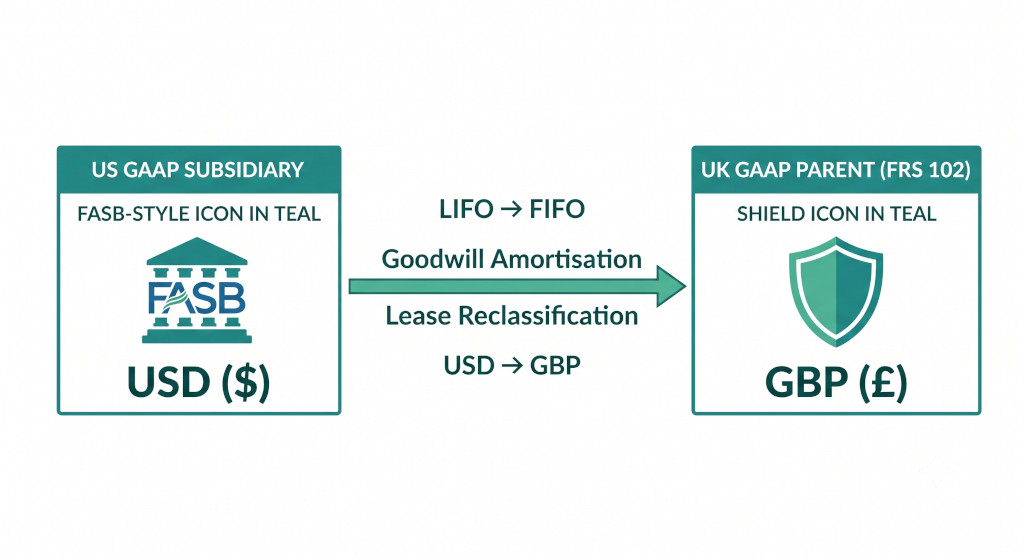
For UK FRS 102 groups that have acquired US businesses, the consolidation adjustment list is longer than for any other standard combination in the cross-standard series. IFRS and FRS 102 share their roots and differ mainly on leases and goodwill. US GAAP and FRS 102 diverge on both of those — plus LIFO inventory, development cost treatment, and the VIE consolidation model. The result is four substantive GAAP conversion journals rather than the two or three that other combinations typically require.
This guide walks through each conversion adjustment in sequence, explains why the FRS 102 path differs from the IFRS path for two of the four adjustments, and covers the USD-to-GBP currency translation under FRS 102 Section 30. For context on the conceptual differences between the two frameworks, see the IFRS to UK GAAP consolidation guide which covers the overlapping adjustments in detail.
The Group Structure Used in This Guide
- BrizoUK Holdings Ltd — UK parent, applies FRS 102, reports in GBP, fiscal year 1 January to 31 December
- BrizoUS Inc — US subsidiary, 100% owned, applies US GAAP, reports in USD, fiscal year 1 January to 31 December
- Exchange rates (illustrative): closing USD/GBP 0.785; average USD/GBP 0.796; historical rate at acquisition USD/GBP 0.810
BrizoUS Inc is a manufacturing business. It uses LIFO inventory costing, holds an intangible goodwill balance arising from a prior acquisition, carries operating leases under ASC 842, and has qualifying development activities that it expenses in full under ASC 730. All four of these areas require conversion.
Stop building consolidations in spreadsheets.
BrizoConsol automates multi-entity consolidation — setup in minutes, reports the same day.
Step 1 — How This Path Differs from US GAAP to IFRS
Step 1
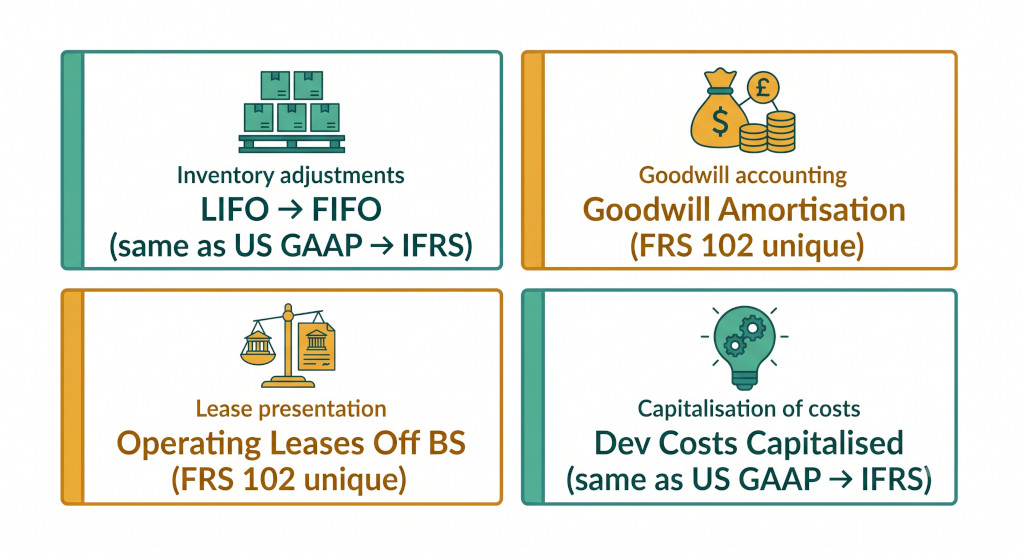
Finance teams familiar with the US GAAP-to-IFRS conversion will notice that the FRS 102 path shares two of the same adjustments but introduces two that work differently. The comparison below maps the four conversion areas across the two parent frameworks:
| Adjustment area | US GAAP → IFRS parent | US GAAP → FRS 102 parent |
|---|---|---|
| LIFO inventory | Reverse LIFO reserve → FIFO | ✅ Same — FRS 102 prohibits LIFO (Section 13) |
| Development costs | Capitalise qualifying spend (IAS 38) | ✅ Same — FRS 102 Section 18 allows capitalisation |
| Leases | Reclassify P&L only — both IFRS 16 and ASC 842 put leases on balance sheet | ⚠️ Different — FRS 102 Section 20 keeps operating leases off balance sheet; remove ROU asset and lease liability entirely |
| Goodwill | No adjustment — both IFRS 3 and ASC 350 use impairment-only | ⚠️ Different — FRS 102 Section 19 requires amortisation; introduce systematic amortisation |
The two FRS 102-specific adjustments — lease removal and goodwill amortisation introduction — are the same adjustments made when consolidating an IFRS subsidiary into an FRS 102 parent. The difference is that for an IFRS subsidiary, the lease and goodwill positions are already on the IFRS basis that requires correction; for a US GAAP subsidiary, the starting point is different in each case (ASC 842 vs IFRS 16 for leases; both impairment-only for goodwill — so goodwill requires no correction coming from IFRS, but does coming from US GAAP). The end result of the FRS 102 conversion journals is the same regardless of whether the subsidiary started from IFRS or US GAAP.
Step 2 — GAAP Conversion Journals
Step 2
All journals are prepared in USD — BrizoUS Inc’s functional currency — and translated into GBP in Step 4.
Adjustment 1: LIFO to FIFO — Reverse the LIFO Reserve
FRS 102 Section 13 (Inventories) prohibits the use of LIFO — consistent with IAS 2. BrizoUS’s inventory must be restated to FIFO. The opening LIFO reserve is reversed through retained earnings (net of deferred tax); the current-year movement reduces Cost of Sales.
BrizoUS LIFO position: opening reserve USD 1,800,000; closing reserve USD 2,050,000; current-year movement USD 250,000.
Journal 1A — Reverse opening LIFO reserve
DR Inventory USD 1,800,000
CR Deferred Tax Liability (21% US rate) USD 378,000
CR Retained Earnings USD 1,422,000
Inventory is restated to FIFO cost; the LIFO conformity rule means BrizoUS continues to use LIFO for its US statutory accounts and tax return. This journal applies for group consolidation purposes only. A deferred tax liability arises because the IFRS/FRS 102 inventory carrying value now exceeds the LIFO tax base — a taxable temporary difference at the US corporate rate of 21%.
Journal 1B — Reverse current-year LIFO movement
DR Inventory USD 250,000
CR Cost of Sales USD 250,000
Reverses the current-year LIFO increment from Cost of Sales; reduces COGS and increases gross profit on the FRS 102-restated income statement. The related deferred tax on USD 250,000 (USD 52,500 at 21%) is processed in Journal 4.
Adjustment 2: Goodwill — Introduce Amortisation Under FRS 102
This is the adjustment that most distinguishes the FRS 102 path from the IFRS path for US GAAP subsidiaries. Both US GAAP (ASC 350) and IFRS 3 use impairment-only goodwill — so no goodwill adjustment is needed when converting from US GAAP to IFRS. But FRS 102 Section 19 requires goodwill to be amortised over its useful economic life, with a maximum of ten years where that life cannot be reliably estimated. Converting from US GAAP to FRS 102 therefore requires introducing amortisation that neither framework previously recognised.
BrizoUS Inc acquired a competitor three years ago. Goodwill at acquisition: USD 1,500,000. BrizoUK’s group accounting policy under FRS 102: ten-year straight-line amortisation. Annual charge: USD 150,000. Three years cumulative: USD 450,000.
Journal 2A — Introduce prior-year cumulative goodwill amortisation
DR Retained Earnings USD 300,000
CR Goodwill USD 300,000
Two prior years’ amortisation (USD 150,000 × 2) charged to opening retained earnings. Goodwill reduces from USD 1,500,000 to USD 1,200,000 as at the opening balance sheet date.
Journal 2B — Charge current-year goodwill amortisation
DR Goodwill Amortisation Expense USD 150,000
CR Goodwill USD 150,000
Current-year amortisation charge — hits the consolidated income statement as an operating expense. After this journal, goodwill on the FRS 102 balance sheet is USD 1,050,000 versus USD 1,500,000 under US GAAP. The gap grows by USD 150,000 per year. BrizoUK should still review for goodwill impairment indicators at each reporting date under FRS 102 Section 27.
The goodwill amortisation journal is the starkest example of how the FRS 102 path diverges from IFRS. An IFRS parent acquiring the same US business would require no goodwill journal at all — both frameworks agree on impairment-only. A FRS 102 parent must introduce amortisation for the first time, shrinking goodwill every year and reducing consolidated profit relative to what an IFRS group would report on the same underlying business. This affects comparability between UK FRS 102 groups and international IFRS groups in the same sector.
Adjustment 3: Leases — Remove ASC 842 Operating Leases from the Balance Sheet
ASC 842 requires all leases — both operating and finance — to be recognised on the balance sheet as a Right-of-Use asset and a lease liability. FRS 102 Section 20 takes the older approach: operating leases remain off the balance sheet, with lease payments charged to the income statement on a straight-line basis. Only finance leases (those that substantially transfer all the risks and rewards of ownership) are capitalised under FRS 102.
BrizoUS’s office and distribution leases are all operating in nature — none substantially transfer ownership risks and rewards. Under ASC 842 they are on the balance sheet; under FRS 102 Section 20 they must be removed.
BrizoUS ASC 842 operating lease position: ROU asset gross USD 1,200,000, accumulated depreciation USD 190,000, net USD 1,010,000; lease liability USD 1,040,000. Current-year ASC 842 charges: depreciation USD 190,000, interest USD 30,000, total USD 220,000. Equivalent FRS 102 straight-line lease expense: USD 215,000.
Journal 3A — Remove ROU asset and lease liability (opening balances)
DR Lease Liability (operating) USD 1,040,000
CR Right-of-Use Asset (gross) USD 1,200,000
DR Accumulated Depreciation — ROU USD 190,000
CR Retained Earnings USD 30,000
Removes the ASC 842 operating lease balance sheet items in full. Total assets decrease by USD 1,010,000 (net ROU asset); total liabilities decrease by USD 1,040,000 (lease liability). The USD 30,000 credit to retained earnings is the cumulative prior-period income difference — ASC 842 front-loads total lease cost, so in early lease years removing it and reinstating straight-line expense produces a net income benefit.
Journal 3B — Reverse ASC 842 charges; reinstate straight-line lease expense
DR Depreciation — ROU Asset USD 190,000
DR Interest Expense — Lease Liability USD 30,000
CR Operating Lease Expense USD 215,000
CR Retained Earnings USD 5,000
Reverses the ASC 842 income statement charges (USD 220,000 combined) and replaces them with the FRS 102 straight-line lease expense of USD 215,000. Operating lease expense is now classified above EBIT, whereas ASC 842 depreciation was above EBIT and interest was below — the net income difference in the period is USD 5,000 credit to retained earnings. EBITDA increases under FRS 102 (lease costs are now fully above EBITDA line); EBIT changes by the difference in presentation.
Adjustment 4: Development Costs — Capitalise Qualifying Expenditure
FRS 102 Section 18 permits — and requires — capitalisation of development costs when specified criteria are met, equivalent in substance to the IAS 38 criteria. US GAAP ASC 730 requires all research and development costs to be expensed as incurred. The conversion journals capitalise qualifying development spend and amortise it over the asset’s useful life.
BrizoUS qualifying development spend: prior year USD 600,000 (now two years into a four-year amortisation life, net book value USD 300,000); current year USD 500,000 (not yet amortising — asset will be available for use at the start of the next period).
Journal 4A — Capitalise prior-year development costs (opening position)
DR Development Costs — Intangible (gross) USD 600,000
CR Accumulated Amortisation — Dev Costs USD 300,000
CR Retained Earnings USD 300,000
Recognises the prior-year development spend as an intangible asset at cost; net book value USD 300,000 after two years’ amortisation (USD 150,000/year × 2). Opening retained earnings increases by USD 300,000 — reversing the prior-year expensing of qualifying development costs under ASC 730.
Journal 4B — Capitalise current-year development spend; charge amortisation
DR Development Costs — Intangible (gross) USD 500,000
CR Research & Development Expense USD 500,000
Reverses the current-year qualifying development expenditure from R&D Expense and recognises it as an intangible asset. The asset will begin amortising next period. Separately: DR Amortisation Expense USD 150,000 / CR Accumulated Amortisation USD 150,000 — current-year amortisation charge on the prior-year asset (year 2 of 4 on USD 600,000 asset).
Adjustment 5: Deferred Tax on All Conversion Journals
Each conversion journal creates or adjusts a temporary difference between the FRS 102 carrying value and the US tax base:
- LIFO reversal (current year): USD 250,000 × 21% = USD 52,500 additional deferred tax liability.
- Goodwill amortisation: In most cases, goodwill amortisation is not tax-deductible in the US for acquisitions structured as stock purchases. The FRS 102 carrying value decreases faster than the tax base (nil or original amount), creating a deferred tax liability. On the cumulative USD 450,000 amortisation: USD 94,500 at 21%.
- Lease removal: Removing the ROU asset and lease liability eliminates the deferred tax position that existed under ASC 842. The net deferred tax impact depends on which was larger — the deferred tax asset on the lease liability or the deferred tax liability on the ROU asset. These typically broadly offset in early lease years.
- Development costs: Capitalised development costs have a carrying value that exceeds their tax base (expensed for tax under ASC 730 / Section 174). USD 800,000 net carrying value (USD 300,000 prior + USD 500,000 current) × 21% = USD 168,000 deferred tax liability.
US Section 174 R&D capitalisation (effective 2022): US tax law now requires capitalisation and amortisation of R&D expenditure for tax purposes under amended Section 174 (five-year amortisation for domestic R&D, fifteen years for foreign). This means the tax base of capitalised development costs may not be nil — it depends on how much of the tax amortisation has been claimed. Confirm the tax treatment with BrizoUS’s US tax advisers before determining the deferred tax position on the development cost intangible.
Step 3 — Fiscal Year Considerations
Step 3
BrizoUS Inc and BrizoUK Holdings share a 31 December year-end — no adjustment is required. FRS 102 paragraph 9.16 limits the permissible gap between subsidiary and parent year-ends to three months; beyond that, stub-period accounts or gap-period adjustments are required on the same basis as IFRS 10. US subsidiaries using a 52/53-week fiscal year ending near 31 December should be documented each period; the nominal gap is immaterial if it falls within a week of the calendar year-end and is treated consistently. For full guidance on managing year-end misalignments, see our fiscal year alignment guide.
Step 4 — Currency Translation: USD to GBP (FCTR)
Step 4
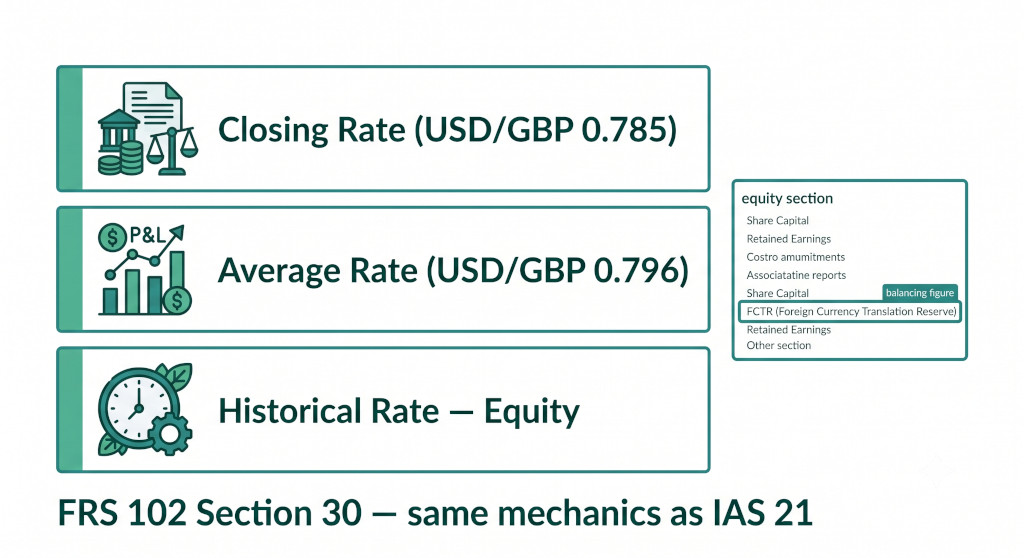
FRS 102 Section 30 mirrors IAS 21 in all material respects for the translation of foreign operations. The Foreign Currency Translation Reserve (FCTR) under FRS 102 is the equivalent of the Cumulative Translation Adjustment (CTA) under IFRS and US GAAP — a balancing equity item in other comprehensive income that accumulates until the subsidiary is sold or wound up.
| Item | Rate | Note |
|---|---|---|
| Balance sheet — all assets and liabilities | Closing rate (USD/GBP 0.785) | Year-end spot rate; USD 1 converts to GBP 0.785 |
| Income statement — revenues and expenses | Average rate (USD/GBP 0.796) | Annual average; approximates transaction-date rates throughout the year |
| Share capital and share premium | Historical rate (USD/GBP 0.810) | Rate on the date BrizoUK Holdings acquired BrizoUS Inc; locked for the investment’s life |
| Opening retained earnings | Brought forward from prior year | Cumulative prior-period translation applied consistently |
| FCTR (Foreign Currency Translation Reserve) | Balancing figure | Deferred in equity under FRS 102 Section 30; recycled to P&L on disposal of BrizoUS |
Worked Translation Example
Using BrizoUS Inc’s FRS 102-restated figures in USD — after all five conversion journals above — and translating to GBP:
| Item | USD (FRS 102 restated) | Rate | GBP |
|---|---|---|---|
| Income Statement | |||
| Revenue | 11,000,000 | Avg 0.796 | 8,756,000 |
| Cost of Sales (FIFO-restated) | (5,800,000) | Avg 0.796 | (4,616,800) |
| Operating Expenses (incl. goodwill amortisation, dev cost amortisation, lease expense) | (2,400,000) | Avg 0.796 | (1,910,400) |
| Net Profit | 2,800,000 | 2,228,800 | |
| Balance Sheet | |||
| Total Assets (no ROU asset; goodwill reduced; FIFO inventory; dev cost intangible added) | 20,000,000 | Close 0.785 | 15,700,000 |
| Total Liabilities (no operating lease liability; LIFO deferred tax; dev cost deferred tax) | (10,800,000) | Close 0.785 | (8,478,000) |
| Net Assets | 9,200,000 | 7,222,000 | |
| Equity Reconciliation | |||
| Share Capital (historical rate 0.810) | 2,500,000 | Hist 0.810 | 2,025,000 |
| Opening Retained Earnings (brought forward) | 3,900,000 | Prior year | 3,120,000 |
| Current Year Net Profit | 2,800,000 | Avg 0.796 | 2,228,800 |
| FCTR (balancing figure) | — | Plug | (151,800) |
| Total Equity | 9,200,000 | 7,222,000 | |
The negative FCTR of GBP (151,800) reflects USD weakening against sterling over the period — the closing rate of 0.785 is lower than the average rate of 0.796 used for the income statement, which is in turn lower than the historical rate of 0.810 applied to equity. A weaker dollar reduces the sterling value of BrizoUS’s net assets when translated at the closing rate. The FCTR sits in equity until BrizoUS is sold, at which point it is released to the consolidated profit or loss under FRS 102 Section 30.
📚 Cross-Standard Consolidation SeriesUS GAAP Subsidiary → IFRS ParentUS GAAP Subsidiary → SFRS ParentIFRS Subsidiary → UK GAAP ParentSFRS Subsidiary → UK GAAP ParentIFRS Subsidiary → US GAAP Parent
Practical Checklist: US GAAP Subsidiary into an FRS 102 Group
✅ Period-End Consolidation Checklist
- Obtain BrizoUS Inc’s trial balance in USD under US GAAP
- Confirm inventory costing method — if LIFO, calculate opening and closing LIFO reserve; prepare Journal 1A (opening reversal to retained earnings) and Journal 1B (current-year movement reduces COGS)
- Confirm the LIFO conformity rule applies — ensure conversion is for consolidation only; BrizoUS continues to file US accounts and tax returns under LIFO
- Calculate cumulative goodwill amortisation from the acquisition date at the group’s chosen useful life (maximum 10 years under FRS 102); prepare Journal 2A (prior years to retained earnings) and Journal 2B (current year to P&L)
- Identify all ASC 842 operating leases — confirm none meet the FRS 102 Section 20 finance lease criteria (substantial transfer of risks and rewards); prepare Journal 3A to remove ROU assets and lease liabilities, and Journal 3B to reinstate straight-line lease expense
- Review R&D expenditure: classify into research (expense) and development (capitalise under FRS 102 Section 18 if criteria met); prepare Journal 4A for prior-year opening balance and Journal 4B for current-year capitalisation and amortisation
- Prepare deferred tax adjustments (Journal 5) for all of the above at the applicable US blended tax rate — note the Section 174 R&D capitalisation rules for the development cost tax base
- Review for any VIE entities consolidated by BrizoUS under ASC 810 that would not meet FRS 102’s control criteria under paragraph 9.4; adjust consolidation scope if applicable
- Review any previously impaired assets under US GAAP (ASC 360 — no reversals permitted) — assess whether the FRS 102 Section 27 recoverable amount now exceeds the impaired carrying value; prepare impairment reversal journal if applicable
- Confirm 31 December year-end alignment; document 52/53-week nominal year-end difference if applicable
- Source and document USD/GBP closing rate, average rate, and historical rate
- Translate all balance sheet items at closing rate; all income statement items at average rate
- Apply historical rate to share capital; carry forward prior-year translated retained earnings at prior-year translated amount
- Calculate FCTR as the equity balancing figure; record in other comprehensive income
- Load GBP-translated FRS 102 figures into the group consolidation model
- Eliminate all intercompany balances and transactions; classify USD/GBP loan FX differences as net investment (→ FCTR) or working capital (→ P&L)
- Review FCTR movement for reasonableness against USD/GBP rate movement in the period
UK FRS 102 group with a US subsidiary?
BrizoConsol connects Xero, QuickBooks, MYOB, and Zoho Books across all your entities — automating GAAP conversion journals, USD to GBP currency translation, intercompany eliminations, and FRS 102 consolidated reporting. Start Free Trial