US GAAP Business Combinations: A Practical Guide to ASC 805 for Multi-Entity Groups
The deal closed on 1 March. A US-based professional services group had acquired a 75% controlling stake in a regional competitor for a total consideration of $8.4 million, including $1.1 million held back in an earnout tied to the target’s revenue performance over the next two years. The group’s CFO had overseen three acquisitions in the past decade, but all under a private equity structure that produced IFRS accounts. This was the first acquisition that would be reported under US GAAP, and the question of how to handle the earnout — was it part of the purchase price or a future expense? — was the first of several places where IFRS intuition and ASC 805 produced different answers.
ASC 805 — Business Combinations — is the US GAAP standard that governs how an acquirer accounts for an acquisition from the moment control transfers. It covers the measurement of what was acquired and what was paid, the recognition of assets and liabilities that may not have appeared on the target’s books, the calculation and subsequent treatment of goodwill, and a range of specific issues including contingent consideration, step acquisitions, and in-process research and development. For multi-entity groups making acquisitions and reporting under US GAAP, ASC 805 is the technical foundation on which the opening consolidated balance sheet is built.
This guide covers the key requirements of ASC 805 in practical terms: what the acquisition method requires, how purchase price allocation works, how goodwill is calculated and subsequently treated — including the private company alternative that many SME groups are eligible to apply — and where ASC 805 diverges from its IFRS counterpart, IFRS 3.
Stop building consolidations in spreadsheets.
BrizoConsol automates multi-entity consolidation — setup in minutes, reports the same day.
What ASC 805 Covers and When It Applies
ASC 805 applies whenever one entity obtains control of one or more businesses. The standard uses the same definition of control as ASC 810: the acquirer is the entity that obtains the power to govern the financial and operating policies of the acquiree. In the typical case — a majority share purchase — the acquirer is the entity that ends up holding more than 50% of the voting shares. But control can also be obtained through contractual arrangements, through the acquisition of a sufficiently large minority stake combined with other factors, or through the acquisition of assets that constitute a business rather than just a group of assets.
That last point is important. ASC 805 applies only to transactions that constitute a business combination — the acquisition of a business, not merely a collection of assets. The distinction matters because if the acquired set of activities and assets does not meet the definition of a business under ASC 805, the transaction is accounted for as an asset acquisition, which has different recognition, measurement, and disclosure requirements. The definition of a business was narrowed under ASU 2017-01, which introduced a concentration test: if substantially all of the fair value of the gross assets acquired is concentrated in a single identifiable asset or group of similar identifiable assets, the set is not a business. Groups that acquire single-property real estate entities or IP portfolios frequently encounter this threshold.
The Acquisition Method: the Only Permitted Approach
ASC 805 requires all business combinations to be accounted for using the acquisition method. The pooling of interests method — which was permitted under the old APB 16 and allowed combining entities to add their balance sheets together at book value — has been prohibited since 2001 and remains prohibited under current US GAAP. Every acquisition is treated as a purchase: the acquirer measures what it paid (the consideration transferred) and what it received (the identifiable assets and liabilities of the acquiree), with any excess recorded as goodwill.
The acquisition method involves four steps: (1) identifying the acquirer; (2) determining the acquisition date; (3) recognising and measuring the identifiable assets acquired, liabilities assumed, and any non-controlling interest; and (4) recognising and measuring goodwill or a gain from a bargain purchase.
Purchase Price Allocation: Measuring What You Acquired
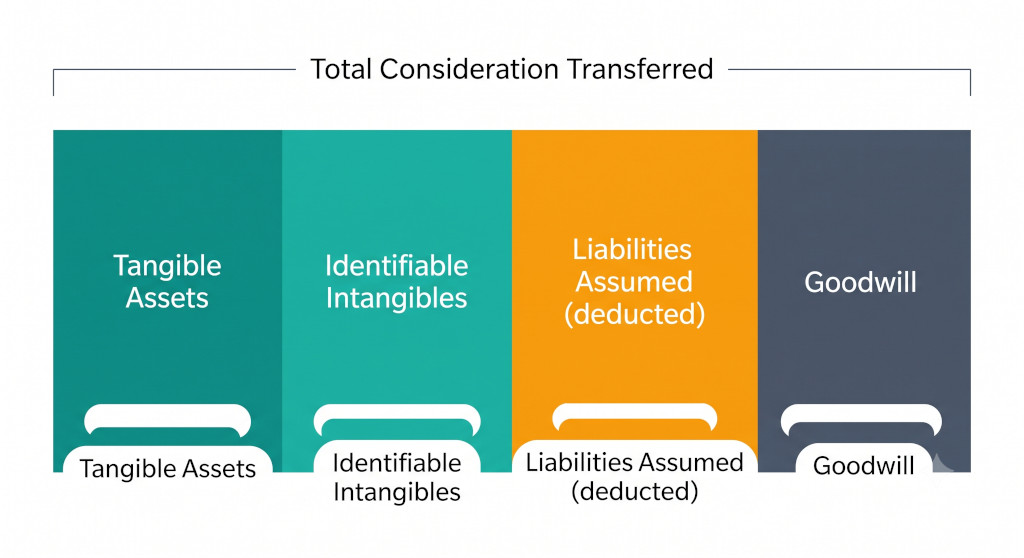
Purchase price allocation (PPA) is the process of assigning the total consideration transferred to the individual assets acquired and liabilities assumed. The goal is to recognise everything the acquirer received at its fair value on the acquisition date — including assets that the target never recognised in its own accounts because they did not meet the recognition criteria for self-generated intangibles under US GAAP.
The most commonly identified intangibles in a PPA include customer relationships, trade names and trademarks, technology (both patented and unpatented), non-compete agreements, and order or production backlogs. Each of these must be recognised separately from goodwill if they are either separable (capable of being sold, transferred, or licensed) or arise from contractual or legal rights. The practical consequence is that the acquiring group’s post-acquisition balance sheet will typically show more intangible assets — and less goodwill — than the target’s pre-acquisition accounts, since many of these intangibles were never recognised by the target as internally generated.
A target company that built its customer base organically will have no customer relationship intangible on its own balance sheet. The acquirer must recognise it on day one of consolidation at fair value, typically determined by a third-party valuation using the multi-period excess earnings method or the with-and-without method. This recognised intangible is then amortised over its useful life — often five to fifteen years — generating a post-acquisition P&L charge that did not exist in the target’s standalone accounts.
Liabilities assumed include not only those recorded on the target’s balance sheet but also contingent liabilities that meet the recognition criteria. Under ASC 805, a contingent liability is recognised at acquisition date if it is a present obligation arising from past events and its fair value can be measured reliably — a broader recognition threshold than the “probable” standard that applies to contingencies under ASC 450 in the ordinary course.
Non-Controlling Interest Measurement
Where the acquirer obtains less than 100% of the target, the remaining equity held by outside shareholders — the non-controlling interest (NCI) — must be measured at the acquisition date. ASC 805 permits two measurement approaches, applied as an accounting policy choice for each business combination:
Fair value method (full goodwill): NCI is measured at its fair value on the acquisition date. This typically means the NCI’s proportionate share of the business’s total enterprise value, which may include a control premium applied to the entire entity. The result is that goodwill recognised on the consolidated balance sheet includes both the parent’s share and the NCI’s share — hence “full goodwill.”
Proportionate share method (partial goodwill): NCI is measured at the NCI’s proportionate share of the acquiree’s identifiable net assets (at fair value). Only the parent’s share of goodwill is recognised; the NCI’s implied share of goodwill is excluded from the balance sheet.
The choice between these two methods affects the goodwill balance, the NCI balance in equity, and any subsequent impairment calculations. The fair value method produces a higher goodwill balance and a higher NCI balance; the proportionate share method is simpler and produces lower goodwill. For private companies, the proportionate share method is more commonly used in practice.
Calculating Goodwill: A Worked Example
With the PPA complete, goodwill is calculated as the excess of the consideration transferred plus the NCI (at the chosen measurement basis) over the net fair value of the identifiable assets and liabilities acquired. The following example uses the proportionate share method for NCI.
Assume the acquirer pays $8,400,000 for a 75% stake. On the acquisition date, the target’s identifiable net assets at fair value are assessed as follows:
Fair value of identifiable assets acquired:
Tangible assets (PP&E, inventory, receivables) $4,200,000
Customer relationships intangible $1,800,000
Trade name intangible $600,000
Technology intangible $400,000
Less: liabilities assumed ($1,500,000)
Fair value of identifiable net assets $5,500,000
Consideration transferred (cash + earnout at FV) $8,400,000
NCI at proportionate share (25% × $5,500,000) $1,375,000
Total $9,775,000
Less: fair value of identifiable net assets ($5,500,000)
Goodwill recognised $4,275,000
Dr Tangible assets 4,200,000
Dr Customer relationships 1,800,000
Dr Trade name 600,000
Dr Technology 400,000
Dr Goodwill 4,275,000
Cr Liabilities assumed 1,500,000
Cr Cash (consideration paid) 8,400,000
Cr Non-controlling interest 1,375,000
Acquisition date journal entry — acquisition method, proportionate share NCI. Earnout of $1.1m included in consideration at fair value on acquisition date.
The $1.1 million earnout is included in the consideration transferred at its acquisition-date fair value — not expensed as it accrues. This is one of the most significant differences from pre-ASC 805 US GAAP practice and from some preparers’ IFRS intuition: under ASC 805, contingent consideration that is part of the exchange for the acquiree is measured at fair value on day one and included in the purchase price. Subsequent changes in the fair value of the earnout (for earnouts classified as liabilities) flow through the income statement, not as a retrospective adjustment to goodwill.
Common mistake: Treating the earnout as a contingent liability to be accrued only when it becomes probable. Under ASC 805, if the earnout is part of the consideration for the business, it is recognised at fair value on the acquisition date regardless of probability. Only earnouts that are compensation arrangements — where payment depends on the seller remaining employed — are excluded from consideration and expensed over the service period.
From acquisition close to consolidated accounts — without the spreadsheet
BrizoConsol handles the post-acquisition consolidation: PPA amortisation, goodwill tracking, NCI calculations, and intercompany eliminations — all automated from your connected accounting software. See It in Action
Goodwill After the Acquisition Date
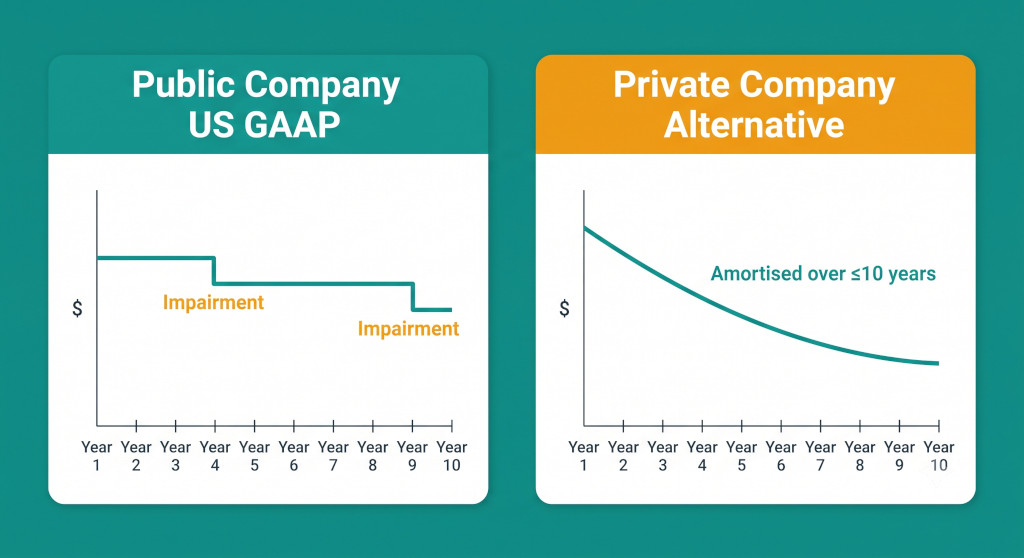
Once recognised, goodwill is not amortised under standard US GAAP. Instead, it is tested for impairment annually — or more frequently if events indicate that its carrying amount may not be recoverable. This impairment-only model has applied since SFAS 142 (now codified in ASC 350) replaced the old amortisation requirement in 2001.
Goodwill impairment testing under ASC 350 is performed at the reporting unit level. A reporting unit is an operating segment or one level below an operating segment. For many private multi-entity groups, the entire business may be a single reporting unit — which simplifies the allocation but means that impairment of any part of the business affects the entire goodwill balance.
The impairment test compares the fair value of the reporting unit to its carrying amount (including goodwill). If the carrying amount exceeds the fair value, an impairment charge equal to that excess is recognised — but not to exceed the total goodwill balance allocated to the reporting unit. There is no step two test under current ASC 350 (following the simplification in ASU 2017-04); impairment is the difference between carrying amount and fair value, full stop.
The Private Company Alternative: Goodwill Amortisation
For private companies — entities that are not public business entities as defined under US GAAP — the Financial Accounting Standards Board (FASB) introduced an alternative accounting approach under ASU 2014-02 (now codified in ASC 350-20): qualifying private companies may elect to amortise goodwill on a straight-line basis over a useful life of up to ten years, rather than testing it for impairment annually.
Under the private company alternative, goodwill is still tested for impairment, but only when a triggering event occurs — there is no requirement for an annual quantitative test. The test is also simplified: it is performed at the entity level (not the reporting unit level), and a qualitative assessment is permitted first to determine whether it is more likely than not that the fair value of the entity is less than its carrying amount. If not, no further testing is required.
The practical appeal of the private company alternative for SME groups is significant. Annual goodwill impairment testing requires a fair value determination for the reporting unit, which typically involves engaging a valuations specialist and producing a detailed discounted cash flow model. For a private group that acquired a single competitor and has no intention of selling it, that annual cost — in fees and finance team time — is difficult to justify. The amortisation alternative converts goodwill into a predictable P&L charge and eliminates the annual valuation requirement, at the cost of lower reported earnings during the amortisation period.
Electing the private company alternative is an irrevocable decision at the entity level, applied to all existing and future goodwill. A group that transitions from private to public company status — through an IPO or a listing — must prospectively cease amortising goodwill and transition to the impairment-only model from the date of transition. Goodwill already amortised is not reinstated.
ASC 805 vs IFRS 3: Key Differences
For groups that have previously reported acquisitions under IFRS and are now applying US GAAP — or that consolidate subsidiaries reporting under different frameworks — the differences between ASC 805 and IFRS 3 are worth understanding. The two standards are substantially converged but diverge in several practically important areas.
| Area | US GAAP (ASC 805) | IFRS (IFRS 3) |
|---|---|---|
| NCI measurement | Fair value (full goodwill) or proportionate share — policy choice per acquisition | Same: fair value or proportionate share — policy choice per acquisition |
| Contingent consideration | Recognised at fair value on acquisition date; classified as liability or equity; liability remeasured through P&L | Same: recognised at fair value; liability remeasured through P&L (some differences in classification criteria) |
| Transaction costs | Expensed as incurred — not included in consideration | Same: expensed as incurred |
| In-process R&D | Recognised as an indefinite-lived intangible asset; subsequently tested for impairment until project complete or abandoned | Recognised as an intangible asset; subsequently amortised or impaired in accordance with IAS 38 |
| Goodwill after acquisition | Impairment-only (public); optional amortisation ≤10 years (private companies) | Impairment-only (no amortisation option under full IFRS); impairment tested annually |
| Impairment test level | Reporting unit (ASC 350) | Cash-generating unit (IAS 36) |
| Bargain purchase (negative goodwill) | Recognised immediately in earnings after reassessment | Recognised immediately in profit or loss after reassessment |
| Measurement period | Up to one year from acquisition date to finalise PPA | Up to one year from acquisition date — same |
The in-process R&D treatment is worth highlighting for technology acquirers. Under ASC 805, acquired in-process research and development (IPR&D) is capitalised as an indefinite-lived intangible until the project is completed (at which point it is reclassified and amortised) or abandoned (at which point it is written off). Under IFRS 3, acquired IPR&D is recognised and then subject to IAS 38’s normal requirements — meaning it may be amortised sooner if the asset has a determinable useful life. The difference can produce materially different post-acquisition P&L profiles for technology-heavy acquisitions.
For a full comparison of the two frameworks across all major accounting areas, our guide to US GAAP vs IFRS key differences in financial reporting covers the broader landscape, including lease accounting, revenue recognition, and financial instruments.
Running the Post-Acquisition Consolidation
Once the PPA is complete and the opening balance sheet is established, the monthly consolidation must incorporate the acquisition’s ongoing effects: amortisation of identified intangibles (customer relationships, technology, trade names) charged at the group level, annual goodwill monitoring or amortisation under the private company alternative, NCI allocation of the subsidiary’s earnings at the correct ownership percentage, and any fair value adjustments to inventory or PP&E that affect cost of sales or depreciation charges.
For groups managing this in spreadsheets, the PPA amortisation schedule quickly becomes one of the most error-prone parts of the consolidation. The intangibles recognised at acquisition may have different useful lives, different amortisation methods, and different rates. Adding a second acquisition compounds the complexity. BrizoConsol connects to your accounting software — Xero, QuickBooks, MYOB, or Zoho Books — and holds the consolidation adjustments including PPA amortisation entries, posting them automatically at each close without manual journals.
The broader mechanics of what consolidation software handles — entity connection, intercompany elimination, NCI allocation — are covered in our guide to financial consolidation software and what it does. For groups specifically navigating a first US GAAP consolidation after an acquisition, the ASC 810 guide covers how control is assessed and what the consolidation procedures require once the acquisition scope is determined.
Applying ASC 805 in Practice: Summary Steps
- Identify the acquirer. In most cases this is the entity that transfers cash or issues equity. In reverse acquisitions or mergers of equals, additional judgement is required.
- Determine the acquisition date. This is the date on which the acquirer obtains control — typically the closing date of the transaction. All fair values and exchange rates are measured at this date.
- Assess whether the transaction is a business combination. Apply the concentration test under ASU 2017-01. If substantially all fair value is in a single asset, the transaction may be an asset acquisition, not a business combination.
- Measure the consideration transferred. Include cash, equity issued, and contingent consideration at acquisition-date fair value. Exclude transaction costs (expense as incurred) and arrangements that are in substance compensation (expense over the service period).
- Perform the purchase price allocation. Identify and measure all identifiable assets acquired and liabilities assumed at fair value. Engage a valuation specialist for significant intangibles and contingent liabilities.
- Measure non-controlling interest. Choose fair value (full goodwill) or proportionate share for this acquisition and apply consistently.
- Calculate goodwill. Consideration + NCI less net identifiable assets at fair value. If negative, reassess — a genuine bargain purchase is recognised immediately in earnings.
- Elect the private company alternative if eligible. If the entity is a private company, consider whether to amortise goodwill over up to ten years. The election is irrevocable and applies to all goodwill.
- Set up the post-acquisition consolidation schedule. Establish intangible amortisation schedules, document the goodwill monitoring approach, and integrate PPA adjustments into the monthly consolidation process.
Consolidate your acquisition from day one
BrizoConsol automates the post-acquisition consolidation — PPA amortisation, NCI, intercompany eliminations — connected directly to your accounting software. Start free, no credit card required. Start Free Trial