The Consolidated Statement of Changes in Equity: How to Build the Full SOCE From Entity-Level Movements
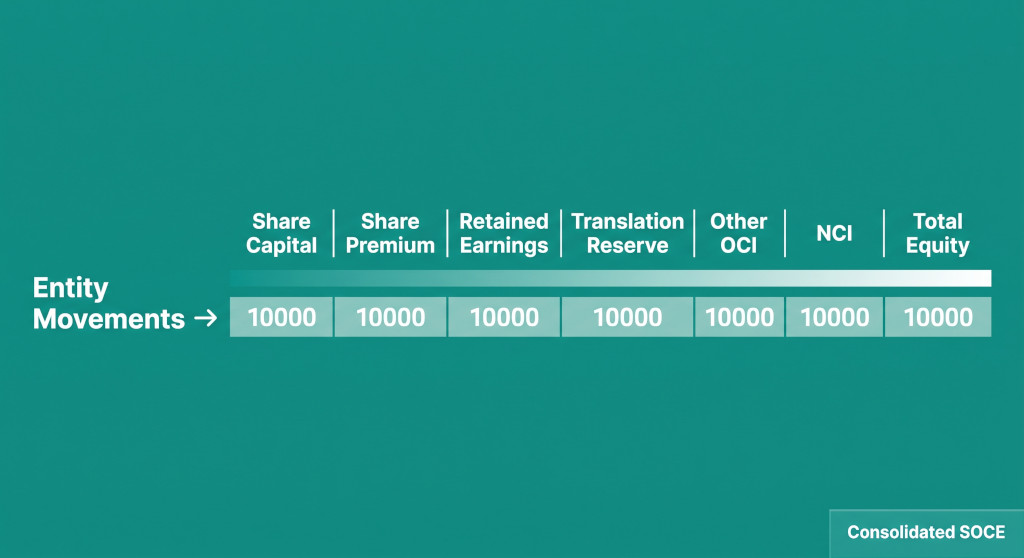
Priya had been group controller for three years. She had consolidated balance sheets, intercompany eliminations, goodwill calculations, and currency translation all under control. But when the auditors asked for a fully columnar consolidated statement of changes in equity — not just a total equity column, but share capital, retained earnings, translation reserve, other OCI, NCI, and grand total all reconciled individually — she hit a wall.
Her first instinct was to pull the SOCE from each entity’s accounts and combine them. It seemed logical. The entities had already done the hard work. But within twenty minutes she had a problem: the intercompany dividend paid by the German subsidiary to the UK parent appeared in both the German entity’s SOCE (as a distribution) and implicitly in the parent’s retained earnings (as dividend income flowing through profit). At consolidation, that dividend had been eliminated entirely. So where — if anywhere — did it belong in the consolidated SOCE?
That question is the heart of why building the consolidated SOCE is harder than it looks. The statement cannot be assembled by stacking entity SOCEs. Every movement has to be traced to its consolidated source, re-attributed to the correct column, and stress-tested against the closing balance sheet. This post walks through exactly how to do that, column by column, with a worked example at the end.
Automate NCI calculations across all your entities.
BrizoConsol handles non-controlling interest automatically — no manual adjustments required.
Why You Cannot Simply Stack Entity SOCEs
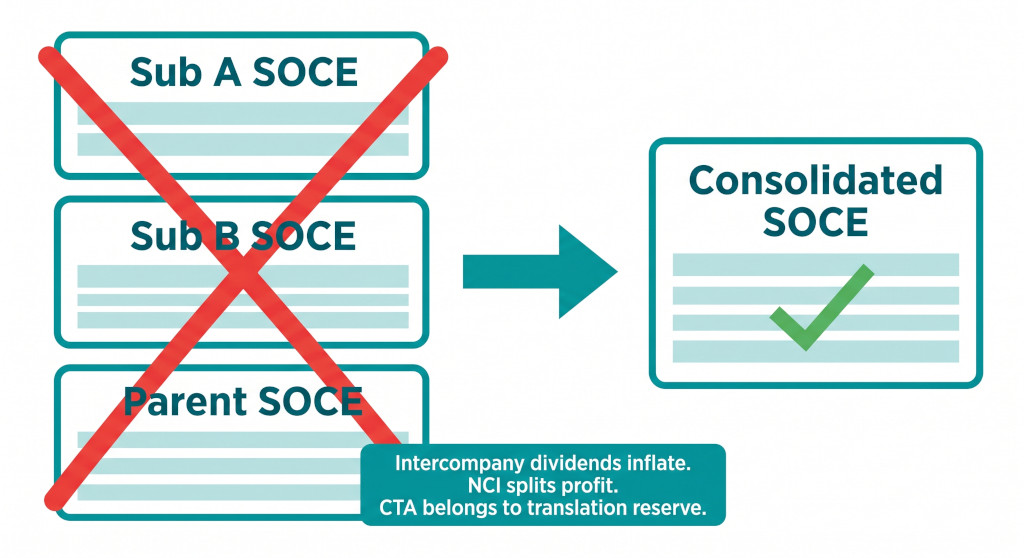
The mistake is tempting because it feels efficient. The entity SOCEs already contain the profit movements, the dividend payments, and the other comprehensive income lines. Surely combining them gives you the consolidated picture?
It does not, for three structural reasons.
First, intercompany dividends distort equity movements in both directions. When a subsidiary pays a dividend to the parent, the parent records dividend income (in profit or retained earnings) and the subsidiary reduces its retained earnings. Both of those movements appear in their respective entity SOCEs. But at consolidation the dividend income is eliminated from the parent’s profit, and the subsidiary’s equity reduction has no effect on the group — it simply moves equity from one part of the group to another. The consolidated SOCE must show neither movement.
Second, profit is attributed differently at group level. The consolidated income statement presents profit split between “attributable to owners of the parent” and “attributable to non-controlling interests.” That split does not exist in any entity SOCE. The entity SOCEs simply show total profit. At consolidation, you need to take the consolidated profit figure and route the NCI share into the NCI column and the parent’s share into retained earnings. No entity document gives you those two numbers pre-split.
Third, the opening balance must be the prior-year consolidated position, not the sum of entity opening positions. Entity retained earnings include the full carrying value of their investment in subsidiaries; the consolidated position has replaced those investments with goodwill and net assets. The two opening figures are irreconcilable unless you go back through the full consolidation.
The consolidated SOCE is not a summary of entity equity movements. It is a new statement built from the consolidated income statement, the OCI schedule, the consolidated balance sheet, and the cash dividend records — with intercompany items stripped out entirely.
The Column Structure: What Belongs Where
Before touching any numbers, establish the columns. For most groups the consolidated SOCE has these columns (amounts in the group’s presentation currency):
| Column | What populates it | Source |
|---|---|---|
| Share capital | Parent’s issued share capital only | Parent entity accounts |
| Share premium | Parent’s share premium only | Parent entity accounts |
| Retained earnings | Parent’s retained earnings + group share of post-acquisition retained earnings of each subsidiary, after consolidation adjustments | Consolidated P&L + consolidation journals |
| Translation reserve (FCTR) | Cumulative CTA on foreign subsidiaries, parent’s share only | CTA schedule, split for NCI |
| Other OCI reserves | Pension remeasurements, hedging reserves, FVOCI gains — parent’s share | OCI schedule |
| NCI | NCI share of net assets at each reporting date, including NCI’s share of profit, OCI, and dividends paid to NCI | NCI calculation schedule |
| Total equity | Sum of all above columns | Cross-checked to consolidated balance sheet |
A key principle: subsidiary share capital and share premium are never shown in the consolidated SOCE. At acquisition, they were eliminated against the investment. After acquisition, any new shares issued by a subsidiary that are bought by the parent are an intragroup transaction. Only the parent’s share capital and premium appear in the equity attributable to owners of the parent.
Step 1 — Opening Balances
The opening balance for every column in the current-year SOCE is the closing balance from last year’s consolidated SOCE. This sounds obvious, but it creates a problem the first time a group prepares a consolidated SOCE: there is no prior-year consolidated SOCE to refer to.
In that situation, the opening balances must be derived by working through the full consolidation at the prior year-end. You need the prior-year consolidated balance sheet equity section and you need to disaggregate it into its component columns. The equity reconciliation and the retained earnings reconciliation are the tools for doing this — they confirm that the opening retained earnings column ties to the consolidation workings, not to any entity’s retained earnings figure.
Step 2 — Profit for the Year and NCI Attribution
The profit figure that moves through the SOCE comes from the consolidated income statement — not from any entity’s P&L. That consolidated profit has already had intercompany transactions eliminated, goodwill amortisation or impairment applied, and fair value adjustments unwound.
From the consolidated profit, you split into two destinations:
- Retained earnings column: profit attributable to owners of the parent
- NCI column: profit attributable to non-controlling interests
The NCI share of profit is calculated on the consolidated profit of each partly-owned subsidiary — not on its entity profit — because any consolidation adjustments relating to that subsidiary (for example, unrealised profit elimination on intragroup stock) affect the profit figure that is split. If you use the entity profit to calculate the NCI share, you will overstate the NCI column. The NCI formula post covers this calculation in detail.
Common mistake: Using the entity P&L profit to calculate NCI rather than the consolidated profit of the subsidiary after adjustments. If the subsidiary sold goods to another group company at a margin and that stock is still held at year-end, the unrealised profit must be eliminated before splitting between parent and NCI.
Step 3 — Other Comprehensive Income
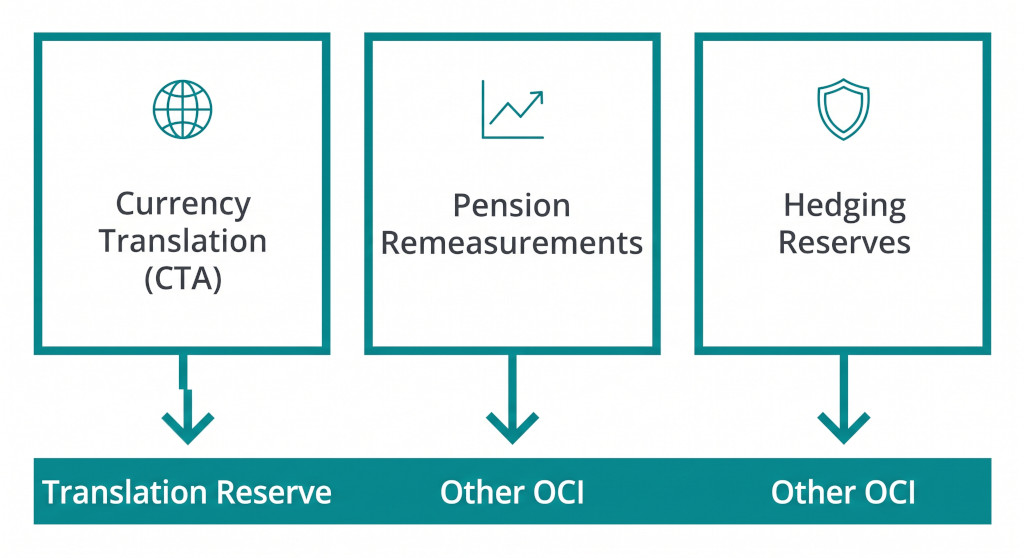
OCI items land in different columns depending on their nature. Getting this right is critical because the wrong routing produces an SOCE that does not cross-check to the balance sheet.
Currency translation adjustments (CTA)
When a foreign subsidiary’s financial statements are retranslated into the group’s presentation currency, the difference goes to the translation reserve — not to profit. This is the cumulative translation adjustment.
If the subsidiary is wholly owned, the entire CTA goes to the translation reserve column. If it is partly owned, the CTA must be split: the parent’s share goes to the translation reserve column, and the NCI’s share goes to the NCI column. The NCI and CTA split post explains the mechanics of this split, which is frequently missed in practice.
Pension remeasurements and FVOCI movements
These go to “other OCI reserves” (or sometimes directly to retained earnings under certain elections, depending on the standard). They are normally wholly attributable to the parent unless the subsidiary generating them is partly owned, in which case the NCI again takes its share.
Hedging reserves
Cash flow hedge gains and losses deferred in OCI go to the hedging reserve column (or within “other OCI reserves”). They are reclassified to profit when the hedged item affects P&L, at which point they leave the OCI column and move through retained earnings.
Step 4 — Dividends: Three Scenarios, Two Treatments
Dividends are where most errors in the consolidated SOCE occur, because there are three types of dividend in a group — and they receive completely different treatments.
Scenario A: Parent pays a dividend to its shareholders
This reduces the parent’s retained earnings. It appears in the consolidated SOCE as a deduction from the retained earnings column and from total equity. It is not eliminated.
Scenario B: Partly-owned subsidiary pays a dividend to its NCI shareholders
This reduces the NCI column. The NCI shareholders are external third parties, so the dividend represents a real cash outflow from the group to outsiders. It appears as a deduction from the NCI column and from total equity. It is not eliminated.
Scenario C: Any subsidiary pays a dividend to the parent (or to another group entity)
This is entirely eliminated. The subsidiary’s retained earnings reduce and the parent records dividend income. Both movements are wiped out in the consolidation. The consolidated SOCE shows nothing. No entry, no column movement, no disclosure. As Priya discovered, the temptation to show it is strong — but the dividend has simply moved equity from one part of the group to another, and at group level nothing has changed.
A practical check: every dividend that appears in the consolidated SOCE should have resulted in cash leaving the group to an external party. If the cash stayed within the group, the dividend eliminates.
Step 5 — Acquisitions During the Year
When a subsidiary is acquired during the year, its net assets and any NCI are recognised in the consolidated balance sheet from the acquisition date. In the SOCE, this appears as a single entry in the NCI column (if the acquisition is partial) reflecting the NCI recognised at acquisition.
The parent’s equity columns (share capital, retained earnings, translation reserve) are unaffected by the acquisition itself — the goodwill and net assets are recognised without flowing through the equity statement. The only equity movement visible in the SOCE is the NCI addition. From that point, the subsidiary’s post-acquisition profit, OCI, and dividends are included in subsequent SOCE movements in the normal way.
Common mistake: Showing the fair value of acquired net assets as a movement in the retained earnings column. It is not. The acquisition is a balance sheet transaction — equity consideration paid by the parent reduces cash or increases liabilities, and the net assets of the subsidiary replace the investment on consolidation. No retained earnings movement occurs on acquisition day itself.
Step 6 — Disposals During the Year
A full disposal of a subsidiary produces multiple SOCE movements. In the consolidated disposal accounting, the gain or loss on disposal flows through the consolidated P&L — and therefore into retained earnings via the profit attribution in Step 2. But beyond that, two additional SOCE entries are needed.
First, the NCI column is reduced by the carrying value of the NCI at the date of disposal. The NCI is derecognised because the group no longer controls the entity.
Second, and frequently missed: if the disposed subsidiary was a foreign operation, any cumulative CTA held in the translation reserve column that relates to that subsidiary must be recycled from the translation reserve to profit. This means the translation reserve column decreases and retained earnings increases — because the CTA has been reclassified into the disposal gain already recognised in P&L. It is a within-equity reclassification, so total equity is unchanged by the recycling entry alone.
Does your consolidation software build the SOCE automatically?
BrizoConsol generates a full columnar statement of changes in equity from your trial balances and consolidation journals — including the NCI column, translation reserve movements, and the balance sheet cross-check. No spreadsheet required. See It In Action
Step 7 — The Cross-Check: Every Column Must Tie to the Balance Sheet
The closing balance in every column of the SOCE must agree to the corresponding balance sheet line. This cross-check is non-negotiable — it is the only way to confirm that no movement has been omitted or double-counted.
| SOCE closing column | Must agree to |
|---|---|
| Share capital | Share capital on consolidated balance sheet |
| Share premium | Share premium on consolidated balance sheet |
| Retained earnings | Retained earnings on consolidated balance sheet (also see the retained earnings reconciliation) |
| Translation reserve | Foreign currency translation reserve (FCTR) on consolidated balance sheet |
| Other OCI reserves | OCI reserve balances on consolidated balance sheet |
| NCI | Non-controlling interests on consolidated balance sheet |
| Total equity | Total equity section of consolidated balance sheet |
If any column does not cross-check, the cause is almost always one of: a dividend that should have been eliminated but was not, an OCI item routed to the wrong column, or a CTA that was not split between parent and NCI. Work backwards from the mismatch — identify which column is wrong, then trace the movements in that column only.
Worked Example: Building the Full SOCE for a Three-Entity Group
The following example uses a group with three entities: Parent Co (GBP, presentation currency), Sub A Ltd (100% owned, GBP functional currency), and Sub B GmbH (75% owned, EUR functional currency). All figures in £’000.
Opening consolidated position (from prior year close)
| Share capital | Share premium | Retained earnings | Translation reserve | NCI | Total equity | |
|---|---|---|---|---|---|---|
| 1 January | 1,000 | 500 | 2,400 | (120) | 380 | 4,160 |
Movements during the year
The following events occurred during the year:
- Consolidated profit for the year: £850k, of which £85k is attributable to the NCI in Sub B GmbH (25% × Sub B’s consolidated profit of £340k)
- CTA on retranslating Sub B GmbH from EUR to GBP: £60k gain in total; split 75% (£45k) to parent’s translation reserve, 25% (£15k) to NCI
- Parent Co paid a dividend to its shareholders: £200k
- Sub B GmbH paid a dividend to its NCI shareholders: £30k (translated at the rate at payment date)
- Sub A Ltd paid a dividend to Parent Co: £150k — this is an intercompany dividend and is eliminated
Before building the SOCE, confirm the intercompany elimination. Sub A’s dividend of £150k reduced Sub A’s retained earnings and created £150k of dividend income in Parent Co’s P&L. In the consolidated P&L, that dividend income was eliminated — so it does not appear in consolidated profit of £850k. Sub A’s retained earnings reduction was also reversed on consolidation (because the subsidiary’s equity is consolidated line by line, and the elimination of dividend income offsets the retained earnings movement). Net effect on the consolidated SOCE: nil.
Building each column
Now apply the movements to each column systematically.
Retained earnings column:
| Opening retained earnings | 2,400 |
| Profit attributable to owners of the parent (850 − 85) | 765 |
| Dividend paid by Parent Co to shareholders | (200) |
| Closing retained earnings | 2,965 |
Translation reserve column:
| Opening translation reserve | (120) |
| CTA for the year — parent’s 75% share | 45 |
| Closing translation reserve | (75) |
NCI column:
| Opening NCI | 380 |
| NCI share of profit for the year | 85 |
| NCI share of CTA (25% × £60k) | 15 |
| Dividend paid by Sub B GmbH to NCI holders | (30) |
| Closing NCI | 450 |
The full consolidated SOCE
| Share capital | Share premium | Retained earnings | Translation reserve | NCI | Total equity | |
|---|---|---|---|---|---|---|
| Opening balance | 1,000 | 500 | 2,400 | (120) | 380 | 4,160 |
| Profit for the year | — | — | 765 | — | 85 | 850 |
| CTA — foreign currency retranslation | — | — | — | 45 | 15 | 60 |
| Dividends paid to owners of parent | — | — | (200) | — | — | (200) |
| Dividends paid to NCI holders | — | — | — | — | (30) | (30) |
| Closing balance | 1,000 | 500 | 2,965 | (75) | 450 | 4,840 |
Total equity movement: £4,840k − £4,160k = £680k. Cross-check: £850k profit + £60k CTA − £200k parent dividend − £30k NCI dividend = £680k. ✓
Each closing column balance now needs to be agreed to the consolidated balance sheet before the SOCE is finalised. If the balance sheet shows retained earnings of £2,965k, translation reserve of (£75k), NCI of £450k, and total equity of £4,840k — the SOCE is clean.
The journal entries behind the SOCE movements
Two of the movements above require explicit consolidation journals. The intercompany dividend elimination is the most important:
| Account | Dr | Cr |
|---|---|---|
| Dividend income (Parent Co P&L) | £150,000 | |
| Dividend payable / retained earnings (Sub A) | £150,000 |
Elimination of intragroup dividend from Sub A Ltd to Parent Co. Reverses dividend income in consolidated P&L and restores Sub A’s retained earnings to pre-distribution position in the consolidation workings.
The CTA journal on Sub B GmbH retranslation credits the translation reserve and NCI (not P&L):
| Account | Dr | Cr |
|---|---|---|
| Net assets of Sub B GmbH (retranslation gain) | £60,000 | |
| Translation reserve (OCI — parent’s 75%) | £45,000 | |
| Non-controlling interests (NCI’s 25%) | £15,000 |
Retranslation of Sub B GmbH net assets at closing rate versus opening rate produces a £60k gain. Split between parent share (translation reserve) and NCI share per IAS 21.
Practical Checklist: Building the Consolidated SOCE
- Start with last year’s closing SOCE as your opening row. If this is the first year, reconstruct the prior-year closing position from the consolidated balance sheet.
- Take profit from the consolidated income statement only. Split into owners’ share (retained earnings) and NCI share using the consolidated profit of each partly-owned subsidiary after adjustments.
- Run your OCI schedule and route each item: CTA to translation reserve (split for NCI if partly owned), pension remeasurements and hedging reserves to other OCI (split for NCI if applicable).
- Identify all dividends paid during the year. Ask for each one: did cash leave the group? If yes, show it in the SOCE (retained earnings for parent distributions, NCI for NCI distributions). If the cash stayed in the group, eliminate it and show nothing.
- If a subsidiary was acquired, add the NCI recognised at acquisition into the NCI column as a single line with no effect on retained earnings.
- If a subsidiary was disposed of, reduce the NCI column by the closing NCI carrying value, and recycle the related CTA from the translation reserve column to retained earnings (with an equal and opposite effect so total equity is unchanged by the recycling alone).
- Cast each column from opening balance to closing balance.
- Cross-check every closing column balance to the consolidated balance sheet. If any column does not agree, find the movement that was omitted or double-counted before proceeding.
- Cross-check total equity movement: consolidated profit + total OCI − dividends paid to external parties = change in total equity.
- Document the source of each movement so the auditors can trace it. The intercompany dividend elimination and the CTA split in particular will be reviewed.
Build your SOCE without a single spreadsheet
BrizoConsol generates the full consolidated statement of changes in equity — all columns, all movements, all cross-checks — directly from your entity trial balances and consolidation journals. Start free and have your first consolidated SOCE live this month. Start Free Trial