Goodwill Impairment Under US GAAP: How ASC 350 Works and What It Means for Multi-Entity Groups
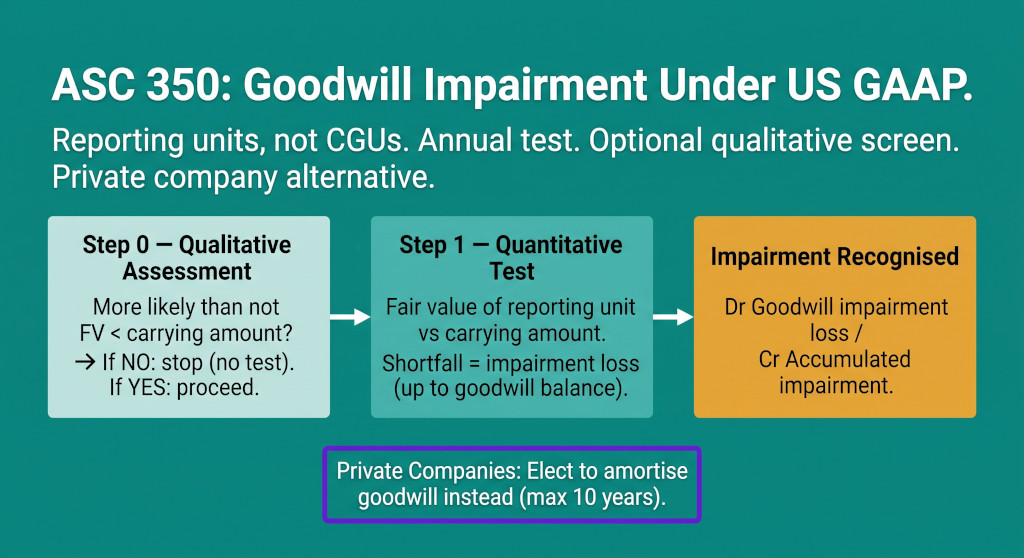
Goodwill impairment testing under US GAAP is governed by ASC 350-20 — a framework that differs from the IFRS approach (IAS 36) in several important ways. The most significant differences are structural: US GAAP tests goodwill at the reporting unit level rather than the cash-generating unit level, provides an optional qualitative screening step before the quantitative test, and — following the 2017 FASB simplification — determines the impairment loss directly from the reporting unit’s fair value shortfall rather than through a separate implied-goodwill calculation. For private companies and not-for-profit entities, a further alternative allows goodwill to be amortised over its useful life, sidestepping much of the annual testing burden.
For multi-entity US GAAP groups — and for non-US groups consolidating US GAAP subsidiaries — understanding how ASC 350 allocates goodwill, defines reporting units, and measures impairment is essential for producing accurate consolidated financial statements. The consequences of getting it wrong range from understated impairment charges to incorrect goodwill allocations when the group restructures.
The ASC 350 Test Structure: Three Stages
The two-stage structure reflects the 2017 FASB simplification (ASU 2017-04), which eliminated the old Step 2 calculation — where preparers had to determine the “implied fair value of goodwill” by performing a hypothetical purchase price allocation to all of the reporting unit’s assets and liabilities. That calculation was burdensome, expensive, and often produced results that differed only marginally from a simpler approach. The current single quantitative step goes directly from the fair value shortfall to the impairment charge, with no implied-goodwill derivation required.
Stop building consolidations in spreadsheets.
BrizoConsol automates multi-entity consolidation — setup in minutes, reports the same day.
What Is a Reporting Unit?
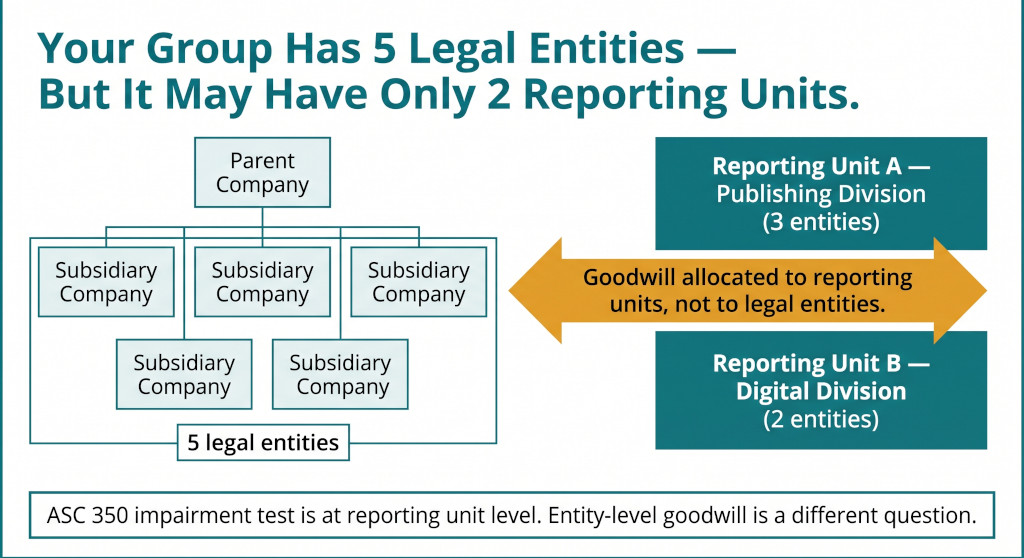
A reporting unit is an operating segment (as defined in ASC 280-10-50-1) or one level below an operating segment, provided the lower-level component constitutes a business and management regularly reviews its operating results. Most multi-entity groups have fewer reporting units than legal entities — a group with ten subsidiaries might have three or four reporting units depending on how management monitors performance.
The reporting unit concept has no direct equivalent in IAS 36. IFRS uses CGUs — the smallest identifiable group of assets that generates cash inflows largely independent of other assets. CGUs are generally more granular than reporting units and are driven by cash flow independence; reporting units are driven by management’s operating segment structure. The practical result is that US GAAP often tests goodwill at a higher level of aggregation than IFRS, which can mean that impairment in one part of a reporting unit is masked by strength elsewhere in the same unit.
Goodwill arising from a business combination is assigned to the reporting units expected to benefit from the combination — which must be done at the time of the acquisition. If the acquired business fits neatly within a single reporting unit, the entire goodwill goes to that unit. If it benefits multiple reporting units, the goodwill is allocated across those units, typically based on relative fair values. This allocation decision matters at every subsequent impairment test date and becomes critical when reporting units are reorganised or when components of a reporting unit are disposed of.
Legal entities ≠ reporting units. A legal entity that has been acquired and carries goodwill in its own statutory accounts is not necessarily the same as a reporting unit for ASC 350 purposes. The consolidated goodwill allocated to a reporting unit may span multiple legal entities, and a single legal entity may sit within a reporting unit alongside other entities. The impairment test is always performed at the reporting unit level — not at the level of the individual legal entity.
Step 0: The Qualitative Assessment
Before performing the quantitative test, a company may (but is not required to) perform a qualitative assessment to determine whether it is more likely than not — a greater than 50% probability — that the fair value of a reporting unit is less than its carrying amount. If the assessment concludes that fair value more likely than not exceeds carrying amount, the quantitative test may be skipped for that year and that reporting unit. No impairment is recorded.
Qualitative factors considered in Step 0 include:
- Macroeconomic conditions — interest rate movements, credit market deterioration, currency volatility, economic slowdown in key markets
- Industry and market conditions — sector-specific deterioration, competitive pressures, product obsolescence, regulatory changes
- Cost factors — significant increases in raw material costs, energy costs, or labour costs not recoverable through pricing
- Financial performance — actual or projected cash flows declining below prior projections; revenue below plan
- Entity-specific events — key management departures, a significant government contract loss, litigation
- Share price — sustained decline in market capitalisation below book value (for listed companies at the consolidated level)
- Result of the prior year’s test — how much headroom existed between fair value and carrying amount
Step 0 is entirely optional. A company may elect to bypass it and proceed directly to the quantitative test for any or all reporting units in any year. Many companies apply Step 0 only to reporting units with strong historical headroom, while going straight to quantitative testing for units that have shown deteriorating performance or where headroom was thin in the prior year.
Step 1: The Quantitative Test
If Step 0 concludes that impairment is more likely than not — or if Step 0 is skipped — the company must perform the quantitative test for the affected reporting unit.
The test has two components:
1. Determine the fair value of the reporting unit. This is the most demanding and judgement-intensive step. US GAAP accepts any reasonable valuation method, but in practice most preparers use one or more of:
- Income approach — discounted cash flow (DCF): project the reporting unit’s free cash flows over a forecast period (typically 5–10 years), apply a terminal value, and discount at the reporting unit’s weighted average cost of capital (WACC). The discount rate and terminal growth rate assumptions are the most consequential and auditor-sensitive inputs.
- Market approach — comparable company multiples: apply EV/EBITDA, EV/Revenue, or P/E multiples from comparable public companies to the reporting unit’s financial metrics. Requires identifying genuinely comparable businesses and making control premium adjustments.
- Relief-from-royalty or other asset-based approaches: used less commonly for reporting units with significant goodwill and intangibles.
2. Compare fair value to carrying amount. The carrying amount of the reporting unit is its equity book value (total assets minus total liabilities) including goodwill. If the fair value exceeds the carrying amount, there is no impairment and the test ends. If the carrying amount exceeds the fair value, an impairment loss is recognised equal to the shortfall — but limited to the goodwill balance of the reporting unit. Goodwill cannot be written below zero; any excess shortfall beyond the goodwill balance is not recognised.
Worked Example: Two Reporting Units, One Fails the Test
MediaCo is a US GAAP group with two reporting units: a Publishing Division and a Digital Division. Annual impairment test date: 31 December.
Quantitative test — Publishing Division only:
Step 1 — Quantitative impairment test: Publishing Division
| Carrying amount of Publishing Division (book value including goodwill) | $1,800,000 |
| Fair value of Publishing Division (DCF analysis) | $1,450,000 |
| Excess of carrying amount over fair value | $350,000 |
| Goodwill balance — Publishing Division | $600,000 |
| Impairment loss recognised (lesser of shortfall and goodwill balance) | $350,000 |
| Remaining goodwill after impairment | $250,000 |
Impairment journal — Publishing Division (31 December)
| Account | Dr ($) | Cr ($) |
|---|---|---|
| Goodwill impairment loss (operating expense — P&L) | 350,000 | |
| Accumulated impairment losses — goodwill (balance sheet) | 350,000 |
The impairment is presented in operating expenses — typically as a separate line item “goodwill impairment loss” — not as a finance cost. The remaining goodwill of $250,000 is not amortised (MediaCo is a public company and has not elected the private company alternative). It will be retested at next year’s annual impairment date. Impairment losses on goodwill are not reversible in future periods — even if the reporting unit’s fair value recovers above carrying amount in a subsequent year, no reversal is permitted.
The Private Company Alternative: Amortise Instead of Test
Private Company Accounting Alternative (ASC 350-20) — Goodwill Amortisation Election
Private companies and not-for-profit organisations under US GAAP may elect to amortise goodwill rather than test it annually. The election is applied by reporting entity and cannot be changed without justification (it is an accounting policy election). Under the alternative:
- Goodwill is amortised on a straight-line basis over its useful life — or over 10 years if the useful life cannot be reliably determined (the same 10-year cap used in IFRS for SMEs and FRS 102)
- Impairment testing is triggered only when a triggering event occurs — not annually
- The impairment test is performed at the entity level (not reporting unit level), further simplifying the analysis
- The triggering event threshold is the same qualitative Step 0 assessment — if events make impairment more likely than not, a quantitative test at entity level is performed
- Goodwill impairment under the alternative = carrying amount minus fair value of the entity, up to the goodwill balance
This alternative substantially reduces the cost and complexity of annual goodwill accounting for private companies, and brings the US GAAP private company treatment into alignment with IFRS for SMEs and FRS 102. A private company that elects the alternative should also apply it consistently to any goodwill arising from future acquisitions.
Goodwill Allocation in Multi-Entity Groups
For a multi-entity US GAAP group, three goodwill allocation scenarios arise frequently and each has specific ASC 350 implications:
1. Acquisition of a new subsidiary. At the acquisition date, the acquirer must identify which reporting unit or units will benefit from the acquisition and allocate goodwill accordingly. If the acquired company fits within an existing reporting unit, the goodwill is allocated entirely to that unit. If the acquisition spans multiple reporting units (for example, the acquired company has two product lines that slot into two different existing reporting units), the goodwill is allocated across those units based on their relative fair values at the acquisition date. This allocation decision is documented as part of the acquisition accounting and becomes the baseline for every future impairment test.
2. Reorganisation of reporting unit structure. When a group reorganises its operating segments — combining, splitting, or redefining divisions — goodwill must be reallocated among the new reporting units. ASC 350-20-35-45 requires reallocation using relative fair values of each portion of the old reporting unit moving to the new units. This is a valuation exercise that requires the same DCF or market approach used in the quantitative impairment test, and it should be performed on the reorganisation date. Failure to reallocate properly can result in a reporting unit holding goodwill that economically belongs elsewhere, producing impairment test results that do not reflect the true allocation of value.
3. Disposal of a component within a reporting unit. When a business is sold from within a reporting unit, a portion of the reporting unit’s goodwill must be attributed to the disposed business and included in the carrying amount for the gain/loss on disposal calculation. The attribution is based on the relative fair value of the disposed business compared to the remaining reporting unit. If the reporting unit was tested for impairment as part of the disposal, that test should be performed before the disposal, not after.
International groups consolidating US GAAP subsidiaries. If a US GAAP subsidiary has goodwill in its own accounts, the parent group’s impairment framework (IFRS, FRS 102, etc.) governs how that goodwill is tested at the consolidated level. The US GAAP subsidiary may have passed its own ASC 350 test, but the consolidated group may apply IAS 36 at a different CGU level and reach a different conclusion. Aligning the impairment assessments between entity-level (ASC 350) and consolidated-level (IAS 36 or equivalent) is one of the most technically demanding aspects of cross-GAAP group accounting. See how to consolidate an IFRS subsidiary into a US GAAP parent and how to consolidate a US GAAP subsidiary into an IFRS parent.
ASC 350 vs IAS 36 vs FRS 102: Cross-Standard Comparison
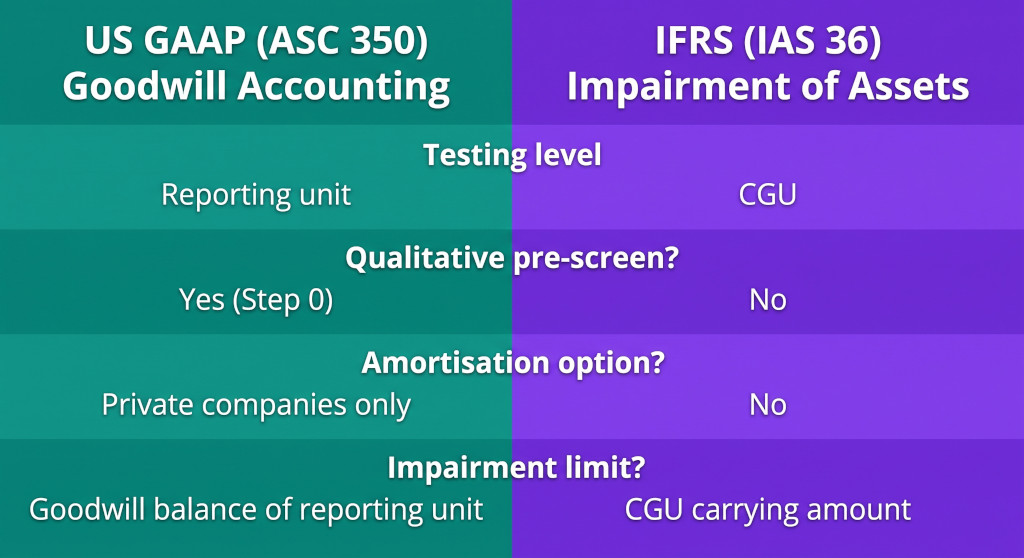
| Area | ASC 350 — US GAAP | IAS 36 — IFRS | FRS 102 — UK GAAP |
|---|---|---|---|
| Testing level | Reporting unit (operating segment or one level below) | Cash-generating unit (CGU) — smallest group generating independent cash inflows | Income-generating unit — similar concept to CGU but under simplified FRS 102 framework |
| Annual test required? | Yes — public companies (regardless of indicators) | Yes — regardless of indicators | No — indicators-based trigger only (unless useful life >20 years) |
| Qualitative pre-screen? | Yes — Step 0 optional | No equivalent | No formal pre-screen, but indicators assessment is similar in practice |
| Goodwill amortisation? | Private companies only — max 10 years | Not permitted | Required — useful life or 10-year default |
| Impairment calculation | Reporting unit FV vs carrying amount — shortfall = impairment (up to goodwill balance) | CGU recoverable amount (higher of VIU and FVLCD) vs carrying amount — shortfall allocated to goodwill first | Simplified recoverable amount vs carrying amount — shortfall reduces goodwill |
| Impairment reversal? | Not permitted | Not permitted | Not permitted |
| Old two-step test? | Eliminated — ASU 2017-04 effective for public companies from 2020 | N/A — IAS 36 never had a two-step structure | N/A |
| Annual test date | Any date chosen by entity — must be consistent year to year | Year-end (or other consistent date) | Reporting date (indicators only) |
For the goodwill calculation mechanics that produce the initial goodwill balance tested under ASC 350 — including purchase price allocation and NCI at acquisition — see goodwill in group consolidation: how to calculate and account for it and goodwill in group consolidation: calculation, impairment, and common errors. For the US GAAP consolidation framework governing how multi-entity groups are structured, see US GAAP consolidation: a practical guide to ASC 810 for multi-entity groups. For a side-by-side treatment of where US GAAP and IFRS diverge more broadly, see US GAAP vs IFRS: key differences in financial reporting.
Goodwill impairment workpapers managed at the reporting unit level
BrizoConsol tracks goodwill by reporting unit across the consolidated group — maintaining acquisition-date allocations, recording period-end impairment charges, and flagging when triggering events arise that require an unscheduled test. See It in Action Start Free