FRS 102 Goodwill Amortisation: How UK GAAP Groups Account for Goodwill Differently From IFRS
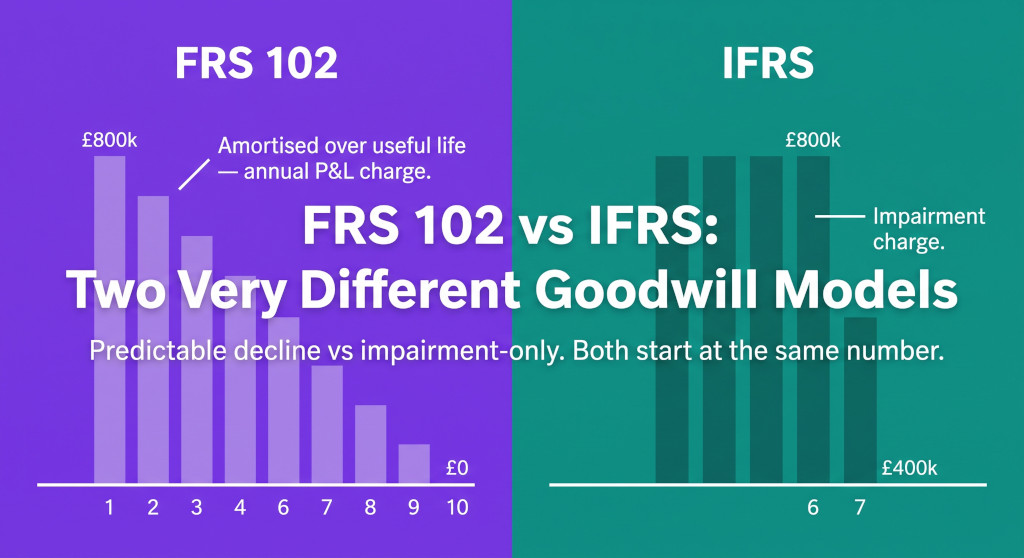
Goodwill is one of the most significant balance sheet items in any acquisitive group, and the accounting treatment depends entirely on the framework the group uses. Under IFRS — specifically IFRS 3 combined with IAS 36 — goodwill is not amortised. It sits on the balance sheet indefinitely, tested for impairment each year at the cash-generating unit level, and written down only if the recoverable amount falls below the carrying value. In good years, the goodwill charge in the income statement is zero.
Under FRS 102, the treatment is fundamentally different. Section 19 requires goodwill to be amortised on a systematic basis over its useful economic life. Where a reliable estimate of useful life cannot be made, the maximum permitted amortisation period is 10 years. The result is a predictable annual charge to profit — year after year, until the goodwill balance reaches zero — regardless of whether the acquired business is performing well or poorly.
These two approaches produce different P&L profiles, different balance sheet trajectories, and — when a UK group converts to IFRS — a significant conversion adjustment that reverses all accumulated amortisation. This guide covers the FRS 102 treatment in full: useful life determination, the amortisation schedule, the impairment review trigger, negative goodwill as a deferred credit, and the practical implications for UK group management accounts and covenant reporting.
Stop building consolidations in spreadsheets.
BrizoConsol automates multi-entity consolidation — setup in minutes, reports the same day.
The Core Difference: Amortise vs Test
- Goodwill is amortised over its useful economic life on a systematic basis
- If useful life cannot be reliably estimated: maximum 10 years (FRS 102 para 19.24)
- Impairment review only when indicators of impairment exist — not required annually
- Annual P&L charge = goodwill ÷ useful life (straight-line in most cases)
- Goodwill balance declines to zero at the end of the amortisation period
- Negative goodwill: recognised as a deferred credit, released to P&L over the period expected to benefit
- Goodwill is not amortised (IFRS 3 para 54)
- Annual impairment test required at CGU level — regardless of whether indicators exist
- Goodwill impairment is recognised in P&L when carrying value exceeds recoverable amount
- No annual P&L charge in periods without impairment — the charge can be zero for many years
- Goodwill balance maintained indefinitely unless impaired; no scheduled decline to zero
- Negative goodwill (bargain purchase): recognised immediately in P&L on the acquisition date
Determining the Useful Life Under FRS 102
FRS 102 paragraph 19.23 requires the amortisation period to reflect the useful economic life of the goodwill — the period over which the group expects to derive economic benefits from the acquired business. The standard acknowledges that this is a difficult estimate, and paragraph 19.24 sets a practical default: where a reliable estimate cannot be made, amortise over a maximum of 10 years.
In practice, most UK groups face this choice:
- Use the 10-year default. Where the acquired business has a strong brand, durable customer relationships, or long-term market position but the duration of those advantages is genuinely uncertain, 10 years is defensible and simple. Most SME groups and their auditors accept 10 years without detailed life analysis.
- Estimate a specific useful life. Where the goodwill relates to identifiable advantages with a clear time horizon — a customer contract of defined length, a franchise arrangement with a fixed term, a technology platform with an expected obsolescence date — a specific useful life (shorter or longer than 10 years) may be more appropriate. FRS 102 does not cap the useful life at 10 years; 10 years is the default when estimation is not possible, not an absolute maximum.
Where the estimated useful life exceeds 20 years, FRS 102 requires an annual impairment review (in addition to the normal indicators-based review) — similar to the IFRS approach but less formal in its CGU methodology.
The 10-year default is not a ceiling — it is a safe harbour. If you can make a reliable estimate of a shorter useful life (e.g., 5 years because the acquired customer relationships have short renewal cycles), you should use the shorter life. Overstating the useful life keeps goodwill on the balance sheet longer than warranted and understates the annual P&L charge, which may flatter the group’s reported profit but create a larger impairment risk later.
The Amortisation Journal and Schedule
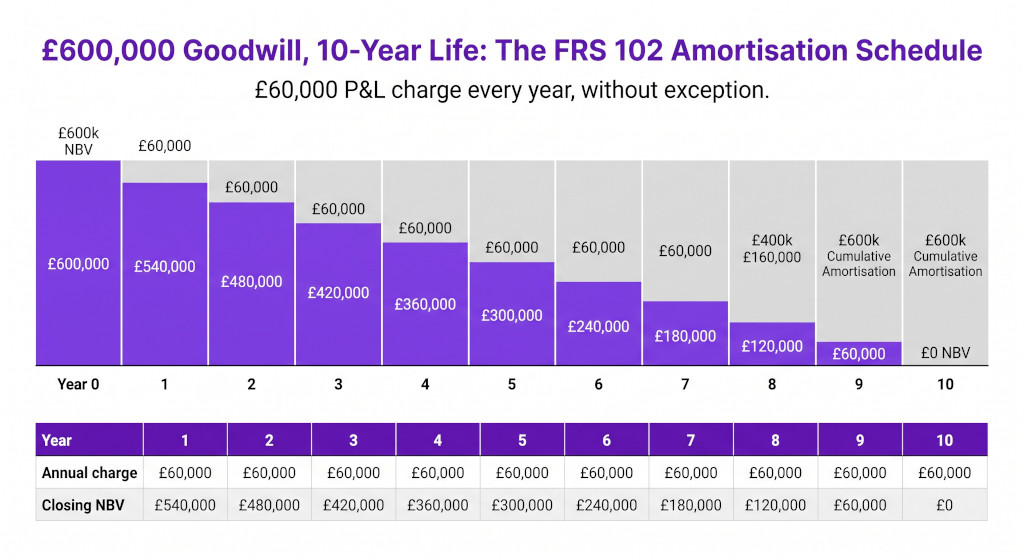
Suppose a UK group acquires a business on 1 January 2026 and recognises goodwill of £600,000. The group determines that the useful life of the goodwill cannot be reliably estimated and applies the 10-year default under FRS 102 paragraph 19.24.
Journal — Annual goodwill amortisation charge (straight-line, 10 years)
| Account | Dr (£) | Cr (£) |
|---|---|---|
| Amortisation of goodwill (administrative expenses — P&L) | 60,000 | |
| Goodwill — accumulated amortisation (balance sheet) | 60,000 |
The annual charge of £60,000 = £600,000 ÷ 10 years. It is charged to P&L in administrative expenses (or separately disclosed as “amortisation of goodwill” if material). The credit reduces the goodwill balance on the balance sheet.
| Year ended | Opening NBV (£) | Annual charge (£) | Closing NBV (£) |
|---|---|---|---|
| 31 Dec 2026 | 600,000 | (60,000) | 540,000 |
| 31 Dec 2027 | 540,000 | (60,000) | 480,000 |
| 31 Dec 2028 | 480,000 | (60,000) | 420,000 |
| 31 Dec 2029 | 420,000 | (60,000) | 360,000 |
| 31 Dec 2030 | 360,000 | (60,000) | 300,000 |
| 31 Dec 2031 | 300,000 | (60,000) | 240,000 |
| 31 Dec 2032 | 240,000 | (60,000) | 180,000 |
| 31 Dec 2033 | 180,000 | (60,000) | 120,000 |
| 31 Dec 2034 | 120,000 | (60,000) | 60,000 |
| 31 Dec 2035 | 60,000 | (60,000) | — |
| Total | (600,000) | — |
For a mid-year acquisition, the first year’s amortisation is pro-rated from the acquisition date. In the example above, if the acquisition completed on 1 July 2026, the 2026 charge would be £30,000 (6 months), and the final charge would be £30,000 in the second half of 2035.
The Impairment Review: Indicators, Not Annual Testing
FRS 102 Section 27 governs asset impairment. For goodwill, the standard requires a review at each reporting date for indicators of impairment. Where indicators exist, the group must calculate the recoverable amount of the goodwill (or of the cash-generating unit to which the goodwill is allocated) and recognise an impairment loss if the carrying value exceeds it. Where no indicators exist, no impairment calculation is required and no charge is recognised.
Indicators of impairment that would trigger a review include:
- Significant deterioration in the performance of the acquired business — revenue decline, margin compression, or cash flow shortfall against acquisition projections
- Loss of key customers, key staff, or key supplier relationships that were part of the acquisition rationale
- Increased competitive pressure in the acquired business’s market segment
- Regulatory or legal changes that adversely affect the business
- Evidence from market data that the business’s fair value has fallen below its carrying value
- The business is being restructured, wound down, or significantly reorganised
This indicators-based approach is simpler than IAS 36’s mandatory annual CGU-level impairment test. It means that in years where the acquired business is performing well, no impairment calculation is performed and no impairment charge is recognised — but the amortisation charge continues regardless. Under IFRS, the equivalent years require a full impairment test even when performance is strong.
The absence of an annual impairment test does not mean goodwill is free from scrutiny. Auditors will still review the trading performance of acquired businesses against acquisition projections and will challenge management if there are indicators of impairment that have not been acknowledged. Where there is a significant gap between actual performance and the cash flows that justified the original goodwill, the auditor may conclude that an impairment indicator exists even if management does not believe one has arisen.
The P&L Trajectory: FRS 102 vs IFRS in Practice
Neither framework is inherently “better” for reporting quality. FRS 102’s amortisation produces a more predictable, lower-volatility P&L — the annual charge is known from acquisition date and can be built into profit forecasts. IFRS’s impairment-only approach produces zero goodwill charge in good years but can produce a large, sudden impairment charge in a year where performance deteriorates, which is harder to forecast and can surprise analysts and lenders.
The Cross-Standard Comparison
| Area | FRS 102 | IFRS (IFRS 3 + IAS 36) |
|---|---|---|
| Amortisation | Required — over useful life or 10-year default | Prohibited |
| Annual impairment test | Not required unless indicators exist (or useful life >20 years) | Required annually at CGU level, regardless of indicators |
| Impairment test basis | Simplified — recoverable amount of goodwill or CGU | Full IAS 36 CGU test — value in use with detailed cash flow modelling |
| Goodwill balance trajectory | Scheduled decline to zero over amortisation period | Maintained indefinitely unless impaired; no scheduled decline |
| P&L charge pattern | Predictable annual charge | Zero in good years; large one-off in impairment year |
| Negative goodwill | Deferred credit — released to P&L over periods expected to benefit | Bargain purchase gain — recognised immediately in P&L at acquisition |
| EBITDA treatment | Amortisation excluded from EBITDA — goodwill charge does not affect EBITDA | Impairment typically excluded from EBITDA — no regular charge to affect EBITDA |
| Complexity | Lower — straightforward amortisation schedule | Higher — annual CGU identification, cash flow modelling, discount rate selection |
Negative Goodwill Under FRS 102
When the consideration paid for an acquisition is less than the fair value of the acquired net identifiable assets — a bargain purchase — negative goodwill arises. Under FRS 102 Section 19, negative goodwill is not recognised immediately in P&L as it is under IFRS. Instead:
- It is presented on the balance sheet as a deferred credit — a separate negative asset immediately below the goodwill line, or within provisions/deferred income.
- It is then released to P&L over the periods in which the non-monetary assets of the acquired entity are recovered (depreciated, amortised, or sold). Where the negative goodwill exceeds the fair value of non-monetary assets, the excess is recognised in P&L in the period of acquisition.
This deferred release approach means a bargain purchase does not produce an immediate profit spike under FRS 102 — the benefit is spread over time. For groups that have made acquisitions at below-market prices (distressed acquisitions, friendly transactions with motivated sellers), the FRS 102 treatment is more conservative and less volatile than IFRS. For the IFRS treatment, see why negative goodwill must hit your consolidated P&L.
The Goodwill Reversal: What Happens When a FRS 102 Group Converts to IFRS
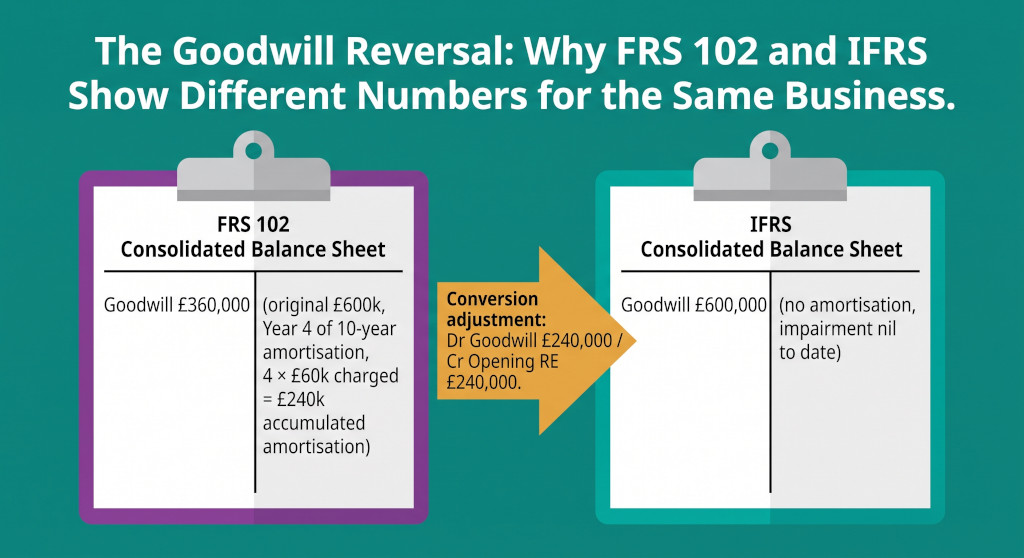
When a group that has been reporting under FRS 102 converts to IFRS for its consolidated accounts — or when an IFRS parent acquires a UK subsidiary that has been amortising goodwill under FRS 102 at the entity level — the accumulated goodwill amortisation must be reversed. IFRS does not permit amortisation; therefore, any amortisation previously charged under FRS 102 must be added back to the goodwill balance and to opening retained earnings at the conversion date.
Journal — Goodwill reversal at IFRS conversion (after 4 years of FRS 102 amortisation)
| Account | Dr (£) | Cr (£) |
|---|---|---|
| Goodwill — accumulated amortisation (reinstate 4 × £60,000) | 240,000 | |
| Opening retained earnings (IFRS transition adjustment) | 240,000 |
After this entry, goodwill is reinstated to £600,000 — the original acquisition value — and opening equity increases by £240,000 (the cumulative amortisation that was expensed under FRS 102 but is not permitted under IFRS). From the IFRS transition date, no further amortisation is charged; instead, the full IAS 36 annual impairment test applies. This is the “goodwill reversal” referenced in the cross-GAAP consolidation guides. See how to consolidate an FRS 102 subsidiary into an IFRS parent for the full context.
Practical Implications for UK Groups
Profit drag in acquisitive groups. Each acquisition adds a new annual amortisation charge. A group that has made three acquisitions with aggregate goodwill of £3m and uses the 10-year default will carry an annual amortisation charge of £300,000 indefinitely until each goodwill balance reaches zero. For a group with an operating profit of £1.5m, this represents a 20% reduction in reported profit — every year. Many SME group owners do not model this into their acquisition economics at the outset, and the cumulative charge can become a persistent drag on distributable profits.
EBITDA vs profit metrics. Goodwill amortisation is excluded from EBITDA (it is a non-cash amortisation charge). Where management accounts, bonus targets, or bank covenants are set on an EBITDA basis, the amortisation charge does not affect the relevant metric. Groups should confirm with their lenders how goodwill amortisation is treated in covenant definitions — whether it is added back as an amortisation item or left in as an expense. Different facilities treat this differently.
Disposal gain calculations. When a group sells a subsidiary, the gain is calculated as proceeds minus the consolidated carrying value of the subsidiary’s net assets (including goodwill net book value). Under FRS 102, goodwill NBV declines over time through amortisation. A subsidiary sold after 8 years of a 10-year amortisation life will have a goodwill NBV of only 20% of the original balance — increasing the calculated disposal gain compared to what the same calculation would show under IFRS (where goodwill is unamortised and potentially still at close to full original value).
Tax treatment of goodwill amortisation. UK tax law distinguishes between pre-April 2002 goodwill (no tax relief on amortisation, creating a permanent difference) and post-2002 goodwill (where the Corporate Intangibles regime may allow relief at the amortisation rate, creating temporary difference alignment). The tax treatment should be confirmed with the group’s tax adviser; the accounting amortisation charge and the tax deductibility of that charge are separate questions. Note that FRS 102 paragraph 29.15 prohibits recognising deferred tax on the initial recognition of goodwill — consistent with IAS 12’s equivalent prohibition.
For the goodwill calculation mechanics that are common to both FRS 102 and IFRS — consideration, NCI, and the fair value of net identifiable assets at acquisition — see goodwill in group consolidation: calculation, impairment, and common errors and goodwill in group consolidation: how to calculate and account for it. For the acquisition accounting framework under IFRS 3 that produces the initial goodwill figure, see acquisition accounting in group consolidation: a step-by-step guide to IFRS 3. For the differences between UK GAAP and IFRS across all major areas, see currency translation under IAS 21, ASC 830 and FRS 102.
Goodwill amortisation tracked and posted automatically at close
BrizoConsol maintains the goodwill amortisation schedule for each acquisition in each entity — posting the annual charge, tracking the NBV, and flagging when indicators of impairment are present based on the entity’s underlying trading performance. See It in Action