How to Build a Journal Template Library That Automatically Generates Every Consolidation Adjustment Your Group Runs Each Period
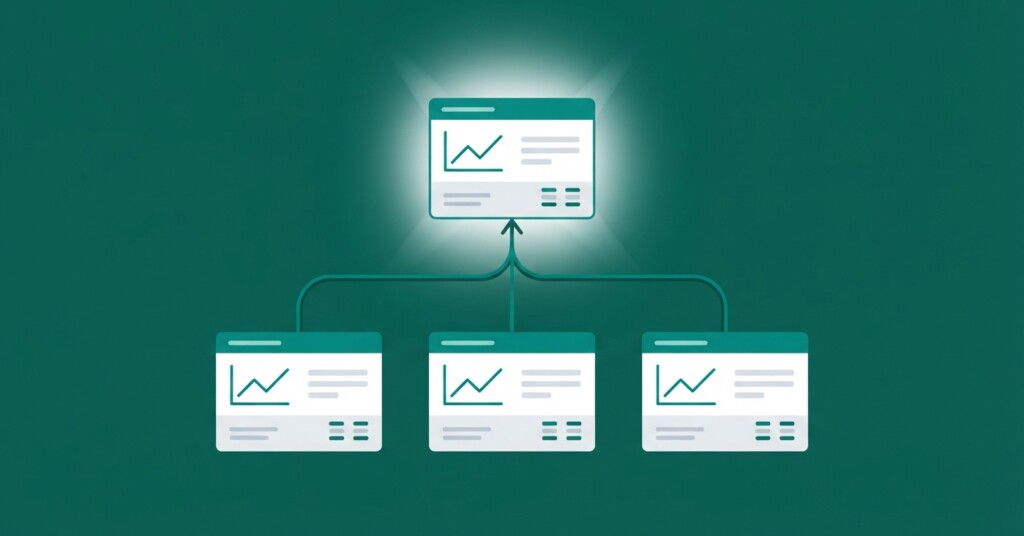
If your finance team spends the first week of every month-end hunting through last period’s workpapers to remember which intercompany eliminations to post, you already know the problem. Consolidation adjustments are not random — they follow patterns. The same eliminations fire every single period, adjusted only for current balances and exchange rates. Yet most SME finance teams recreate them from scratch, or half-recreate them and hope nothing was missed. A journal template library changes that. It encodes every repeating consolidation adjustment your group runs, parameterises the variables, and lets you generate the full set of period-end journals in minutes rather than hours. This article explains how to build one, what it must cover, and why it pays dividends far beyond just saving time.
Why Consolidation Adjustments Are Template-Ready
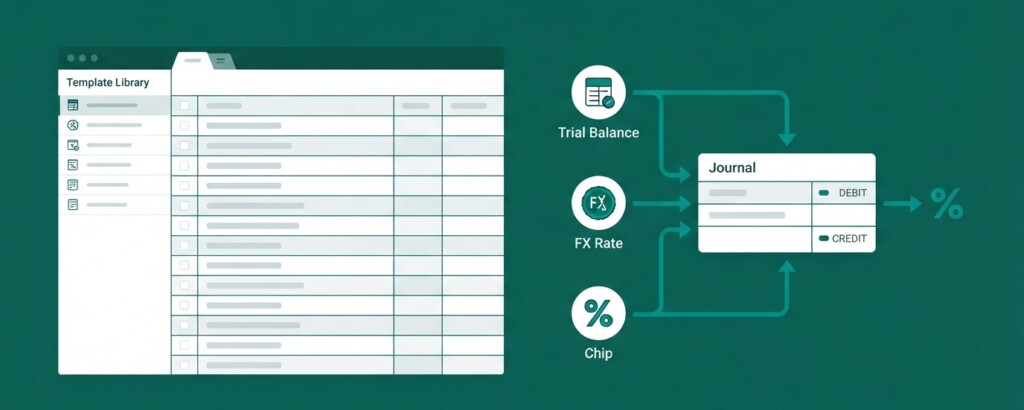
Every consolidation adjustment falls into one of a small number of structural categories. The accounts involved are fixed. The direction of each debit and credit is fixed. What changes period to period is the amount, driven by updated balances, new FX rates, or changes in intercompany activity. That structure makes these adjustments almost perfectly suited to templating. A template library does not need to be a sophisticated software feature — it can start in a well-organised spreadsheet. But once you understand the logic, you will quickly see why a purpose-built consolidation tool handles it more reliably, because the variables feed automatically from trial balances rather than being keyed manually.
A consolidation journal template library is simply a catalogue of every repeating adjustment your group runs, each defined by: the accounts involved, the debit/credit structure, the variable inputs that change each period, and the entity or entities the adjustment belongs to. Once built, it becomes your consolidation playbook.
Stop building consolidations in spreadsheets.
BrizoConsol automates multi-entity consolidation — setup in minutes, reports the same day.
Step One: Catalogue Every Adjustment Type Your Group Runs
Before writing a single template, spend time listing every class of consolidation adjustment your group currently makes. Most SME groups, once they sit down and document honestly, find they run a shorter list than they feared — but that they have been running it inconsistently. The major categories to cover are intercompany revenue and cost eliminations, intercompany loan balance eliminations, intercompany interest eliminations, unrealised profit in inventory or fixed assets, investment in subsidiary elimination at acquisition, goodwill amortisation or impairment (where applicable under local GAAP), NCI share of profit and equity, and FX translation adjustments including the currency translation reserve movement. For each category, note which entities are involved, what the source data is (trial balance accounts, loan schedules, trading summaries), and how often the balance changes.
Step Two: Design the Template Structure
Each template in your library should follow a consistent structure. Define a template header that captures the template name, the adjustment category, the applicable entities, the frequency (monthly, quarterly, or at acquisition), and a short description of what it eliminates and why. Below the header, define the journal lines — each account, its normal debit or credit position, and the variable that drives the amount. Variables should be named clearly. For example, an intercompany sales elimination template would reference ‘IC_Sales_Parent_to_Sub_AUD’ as a named variable, rather than a hard-coded number. This means that when you run the template next month, you update the variable from the trial balance and the journal populates itself.
| Template Name | Category | Variable Input | Entities Involved | Frequency |
|---|---|---|---|---|
| IC Sales Elimination — Parent to Sub A | Intercompany Revenue | Intercompany sales per TB | Parent, Sub A | Monthly |
| IC Loan Elimination — Sub B / Parent | Intercompany Balance | Loan balance per schedules | Parent, Sub B | Monthly |
| IC Interest Elimination | Intercompany P&L | Interest charged per period | Parent, Sub B | Monthly |
| Unrealised Profit — Inventory | Profit Elimination | Closing stock × markup % | Parent, Sub A | Monthly |
| Investment Elimination — Sub C | Investment / Equity | Cost of investment, share capital | Parent, Sub C | Acquisition only |
| NCI Share of Profit | NCI | Sub profit × NCI % | Sub A, Sub B | Monthly |
| FX Translation Reserve Movement | FX Translation | TB translated at closing rate vs average | All foreign subsidiaries | Monthly |
Step Three: Write the Core Journal Templates
With your catalogue in hand, write out the debit and credit structure for each template. The following example shows an intercompany sales and cost of sales elimination, which is the most commonly recurring adjustment in any trading group. Parent sells goods to Sub A at a markup. At consolidation, both the intercompany revenue in Parent and the corresponding intercompany purchase in Sub A must be eliminated, so that only third-party sales appear in the group income statement.
| Account | Dr | Cr |
|---|---|---|
| Intercompany Sales Revenue (Parent) | 120,000 | |
| Intercompany Cost of Sales (Sub A) | 120,000 |
Elimination of intercompany sales from Parent to Sub A for the period. Both entities recorded £120,000 of IC revenue and IC cost respectively. The debit removes the revenue line in Parent; the credit removes the cost line in Sub A. Net group profit is unaffected, while group revenue and group cost of sales are both reduced by £120,000. Amount sourced from IC trading summary reconciled between entities before posting.
| Account | Dr | Cr |
|---|---|---|
| Intercompany Loan — Sub B (Asset in Parent) | 500,000 | |
| Intercompany Loan — Parent (Liability in Sub B) | 500,000 |
Elimination of intercompany loan balance. Parent holds a £500,000 loan receivable from Sub B; Sub B holds the corresponding payable. Both are eliminated on consolidation so the group balance sheet shows only third-party debt. Amount confirmed from loan schedule agreed between both entities.
| Account | Dr | Cr |
|---|---|---|
| Intercompany Interest Income (Parent) | 4,167 | |
| Intercompany Interest Expense (Sub B) | 4,167 |
Elimination of intercompany interest. Parent charges Sub B 10% per annum on the £500,000 loan, producing £4,167 per month. Debit removes income in Parent; credit removes the expense in Sub B. From the group perspective, no interest has been earned or paid — it is an internal transfer.
Handling FX Translation in Your Templates
FX translation adjustments are the part of the template library that confuses finance teams most, because the amounts are derived rather than sourced directly from any single ledger account. Under the closing rate method (standard for autonomous foreign subsidiaries), P&L is translated at the average rate for the period and the balance sheet at the closing rate. The difference that arises — between equity translated at historical rates and the rest of the balance sheet at closing — goes to the Currency Translation Reserve (CTR) in group equity. Your template needs to calculate this difference and journal it correctly.
| Sub C (EUR) net assets at closing rate (€800,000 × 0.87) | £696,000 |
| Sub C net assets at historical/average rate (opening equity + avg-rate P&L) | £681,500 |
| Movement in Currency Translation Reserve this period | £14,500 |
The £14,500 movement credits the CTR in group equity and is balanced by the net effect of retranslating the foreign subsidiary’s assets and liabilities. Your FX translation template should have named variables for the closing rate, the average rate, and the opening equity balance, so that updating those three figures regenerates the adjustment automatically each period. This is precisely where connected consolidation tools earn their keep — they pull live rates and translated trial balance figures rather than requiring manual rate entry.
FX translation adjustments will not balance if your entity trial balances are not themselves balanced in local currency before translation begins. Always confirm each subsidiary TB balances to zero before running translation templates. A small rounding difference in local currency becomes a large and confusing FX mismatch at group level.
Non-Controlling Interests: The Template Most Groups Get Wrong
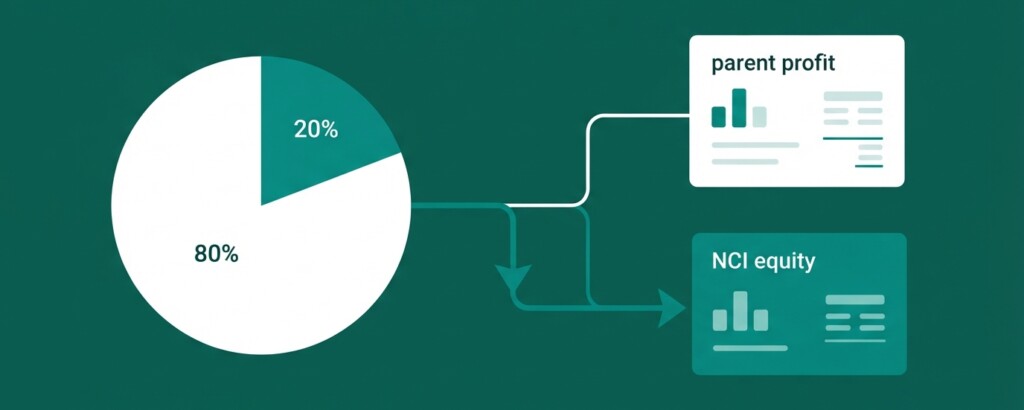
If your group does not own 100% of every subsidiary, you need NCI templates. These are often the last thing SME finance teams document properly, because NCI seems complex — but the journal logic is straightforward once you understand what it represents. NCI is simply the portion of a subsidiary’s net assets and profit that belongs to minority shareholders, not to the parent. Each period, you allocate a share of the subsidiary’s profit to NCI in the income statement, and carry the cumulative NCI share of net assets on the consolidated balance sheet.
| Account | Dr | Cr |
|---|---|---|
| NCI Share of Profit (Income Statement — Group) | 18,000 | |
| NCI Equity (Balance Sheet — Group) | 18,000 |
Sub A earned £90,000 profit this period. The group owns 80%, so NCI holds 20%. The debit of £18,000 reduces group profit attributable to parent shareholders; the credit increases NCI equity on the consolidated balance sheet. Template variable: Sub A net profit × 20% NCI percentage.
Organising the Library for Fast Period-End Use
A library that exists but cannot be found quickly is almost as bad as no library at all. Structure your template library with a master index as the first page or file, listing every template, its category, its entities, and its status (active, retired, or pending). Group templates by category — intercompany, FX, NCI, investment eliminations — rather than by entity, because the same category logic often applies across multiple subsidiary pairs. Version-control the library. When a subsidiary is disposed of or a new one acquired, retire old templates and add new ones with an effective date. This prevents stale templates being applied in error.
- Create a master index tab listing every template, its category, applicable entities, and current status.
- Group templates by adjustment category, not by entity, to make the library easier to scan.
- Name every variable input consistently across templates — for example, always use ‘IC_Revenue’ not a mix of ‘Interco Sales’ and ‘Related Party Revenue’.
- Add an effective date and retirement date to each template so the library reflects the current group structure.
- Run a template completeness check at each period-end: for every active IC relationship, confirm there is an elimination template.
- Document the data source for each variable input — TB account code, loan schedule, FX rate feed — so any team member can populate it without relying on institutional memory.
- Review the library quarterly and whenever the group structure changes: acquisitions, disposals, new intercompany agreements, or changes in ownership percentage all require template updates.
Where Automation Takes This Further
A well-built template library in Excel will dramatically reduce your month-end effort and the risk of missed adjustments. But it still requires someone to pull the trial balance figures, update the variable inputs in each template, and post the resulting journals manually. The natural next step is a consolidation tool where the trial balances from each entity feed directly into the adjustment engine, the variables populate automatically, and the journals are generated and applied to the consolidated workbook without manual keying. This eliminates an entire category of data-entry error — not the logic errors that come from a wrong template, but the transposition and omission errors that come from copying numbers between spreadsheets under time pressure at month-end. Finance teams that move from a manual template library to an automated consolidation workflow typically find that the consolidation itself compresses from three or four days to under a day, because the data population and journal generation steps are removed from the human workload.
The template library is the intellectual work — understanding what your group needs to eliminate and why. Automation is the mechanical work — populating the numbers and generating the journals. You need to do the intellectual work regardless of what tools you use. But once you have done it, automation means you only do the mechanical work once.
Maintaining Quality: Reconciliation Before Posting
No template library removes the need for intercompany reconciliation before journals are posted. If Parent records £120,000 of intercompany sales to Sub A, but Sub A records £118,500 of intercompany purchases from Parent, your elimination template will not balance the group — it will leave a £1,500 unexplained difference in cost of sales. The template library and the intercompany reconciliation process are complementary, not alternatives. The reconciliation confirms the inputs; the template generates the journal. Both need to be in place for the process to work. Build your intercompany reconciliation into the period-end timetable as a prerequisite step before consolidation journals are generated, and make it a policy that no IC elimination template is populated until the corresponding IC reconciliation is signed off.
The Business Case for Investing the Time
Building a proper journal template library typically takes a finance team one to two weeks of focused effort — documenting all existing adjustments, writing the templates, agreeing the variable definitions, and testing against a prior period. That is a meaningful investment. The return comes every subsequent period-end, where what previously took three or four days of manual consolidation work compresses to a fraction of that time, with fewer errors, clearer audit trails, and better visibility for the CFO into exactly what adjustments have been applied and why. For accounting firms managing consolidations for multiple SME clients, a template library that can be adapted per client group is a particularly strong efficiency multiplier — the structural logic is the same across clients, only the entities, accounts, and amounts differ.
See How BrizoConsol Handles Your Consolidation Adjustments
BrizoConsol is built for SME finance teams managing multi-entity consolidation. See how it connects entity trial balances, generates consolidation journals, handles FX translation, and produces group reports — without the manual Excel work.