How to Consolidate a Multi-Entity SaaS Group When One Subsidiary Sells White-Label Access to the Group Platform and Charges a Usage-Based Licence Fee to Sibling Entities
For many SaaS groups that have grown through geographic expansion or product specialisation, the platform itself becomes an internal cost centre — and then, almost inevitably, a profit centre for the entity that owns it. When a subsidiary holds the intellectual property or infrastructure rights and charges sibling entities a usage-based licence fee for white-label access to the group platform, the consolidation gets genuinely complicated. Revenue appears on one entity’s books, an expense appears on another’s, and the amounts rarely match cleanly at month-end because the licence fee is usage-based and therefore variable. This article walks through how to handle the consolidation correctly, including the intercompany elimination, FX translation where entities operate in different currencies, non-controlling interest (NCI) implications, and the reporting structure that makes sense for the group.
Understanding the Structure Before You Consolidate
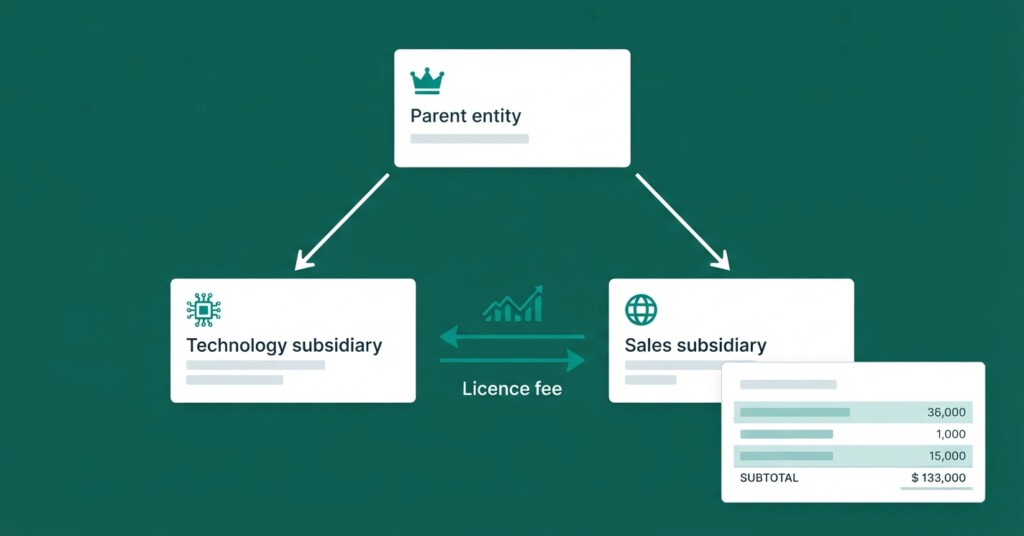
Suppose the group looks like this: a UK-based parent (GroupCo) owns 100% of a technology subsidiary (TechSub, registered in Ireland) and 80% of a sales subsidiary (SalesCo, registered in Australia). TechSub owns the platform IP and infrastructure. It licences white-label access to SalesCo, charging a monthly fee based on the number of active end-users on the platform during the period. SalesCo rebrands the platform and sells subscriptions to its own customers in the Australian market.
Each month, TechSub invoices SalesCo for the usage-based licence. SalesCo records a cost of sales or operating expense. TechSub records revenue. From a statutory reporting perspective both entities look commercially active. From a group perspective, all of that activity is internal and must be eliminated entirely before you can present a true picture of group performance.
Stop building consolidations in spreadsheets.
BrizoConsol automates multi-entity consolidation — setup in minutes, reports the same day.
Why Usage-Based Fees Create Reconciliation Friction
Fixed intercompany fees are annoying to eliminate but relatively straightforward — the same number sits on both sides of the ledger every month. Usage-based fees introduce two layers of complexity. First, the amount varies, so you cannot simply roll forward a prior month figure. Second, there is almost always a timing mismatch: TechSub calculates usage and raises the invoice on, say, the 5th of the following month, while SalesCo accrues the estimated cost at month-end. The two numbers will not match until the invoice is issued and agreed.
The elimination must be based on the amount recorded across both entities, not the invoice. If SalesCo has accrued AUD 85,000 and TechSub has recognised EUR 52,000 of revenue from the same transaction, the starting point for reconciliation is translating both to the presentation currency and understanding why they differ — timing, FX rate differences, or a genuine disagreement about usage volumes.
In practice, finance teams often discover a three-way mismatch: the accrual on SalesCo’s books, the invoice issued by TechSub, and the amount TechSub has actually recognised in its accounts. Getting an intercompany agreement (ICA) in place that specifies the calculation methodology, the reporting cut-off, and who raises the invoice and when is essential groundwork before worrying about the consolidation mechanics.
The Intercompany Elimination Entry
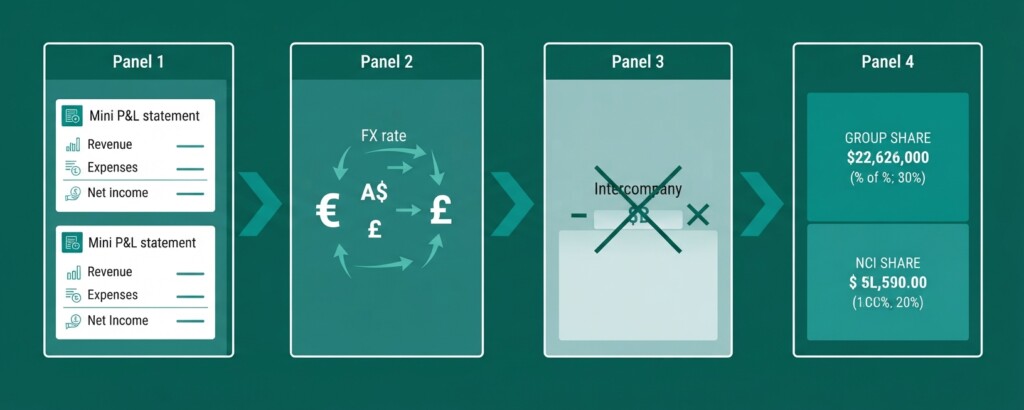
Once you have agreed numbers, the group consolidation journal eliminates TechSub’s intercompany revenue and SalesCo’s corresponding cost. Everything flows through the consolidation working papers, not the individual entity ledgers. Below is an illustrative example, translated into the group presentation currency of GBP.
| Account | Dr | Cr |
|---|---|---|
| TechSub — Intercompany licence revenue (GBP equivalent) | 62,400 | |
| SalesCo — Intercompany licence expense (GBP equivalent) | 62,400 |
Elimination of intragroup licence fee for the month ended 31 March 2025. TechSub EUR revenue translated at average rate; SalesCo AUD expense translated at average rate; residual FX difference dealt with separately in the consolidation FX reserve.
Notice that the note references a residual FX difference. This is normal and expected whenever the paying and receiving entities operate in different functional currencies. The mismatch after translation is not an error — it is a foreign exchange difference arising on the elimination itself, and it goes to the consolidated foreign currency translation reserve (FCTR), not to P&L.
FX Translation: Which Rates to Use and Where Differences Go
Each entity prepares its local accounts in its functional currency. For consolidation, everything must be expressed in the group presentation currency (GBP in this example). The standard approach under IFRS and most national GAAP equivalents is to translate P&L items at the average rate for the period and balance sheet items at the closing rate. The resulting difference goes to other comprehensive income as part of the FCTR.
| Item | Rate to Use | Where the Difference Goes |
|---|---|---|
| TechSub EUR revenue (P&L) | Average rate for the period | N/A — rate is applied directly |
| SalesCo AUD expense (P&L) | Average rate for the period | N/A — rate is applied directly |
| Intercompany balance (receivable/payable on balance sheet) | Closing rate | FCTR on elimination |
| SalesCo net assets for NCI calculation | Closing rate | FCTR |
| SalesCo goodwill (from original acquisition) | Closing rate | FCTR |
The practical implication: when you eliminate the intercompany revenue and expense using each entity’s average rate, the two GBP amounts will almost certainly differ slightly because EUR/GBP and AUD/GBP move independently throughout the month. Record the residual as an FCTR movement rather than forcing a P&L adjustment.
Non-Controlling Interest Complications
GroupCo owns only 80% of SalesCo. The 20% NCI holders have an economic interest in SalesCo’s results, including the intercompany licence cost. This matters for how you present the elimination in the consolidated P&L and balance sheet.
A common misconception is that eliminating SalesCo’s licence expense creates an ‘elimination gain’ that boosts SalesCo’s profit for NCI attribution. In reality, because the platform access is fully consumed in the period to deliver subscriptions to external customers, the licence fee is a genuine, realised operating cost for SalesCo. Furthermore, because the seller (TechSub) is 100% owned by GroupCo, this lateral transaction is treated similarly to a downstream transaction from the group’s perspective. No unrealised profit remains capitalised in an asset on SalesCo’s balance sheet, so the elimination does not alter SalesCo’s profit attributable to NCI.
| SalesCo standalone profit (GBP) | £210,000 |
| Intragroup licence expense eliminated against TechSub revenue | £62,400 |
| SalesCo net profit subject to NCI allocation | £210,000 |
| NCI share (20% of £210,000) | £42,000 |
| Group share (80% of £210,000) | £168,000 |
The NCI line in the consolidated statement of comprehensive income reflects £42,000, which is exactly 20% of SalesCo’s net profit. If a consolidation tool or spreadsheet incorrectly adds back the eliminated licence fee before calculating NCI, it will allocate £54,480 (20% of £272,400) to NCI. That would systematically overstate the amount attributable to NCI by £12,480 and understate group profit attributable to parent shareholders.
Accrual Matching: Keeping Both Sides in Sync
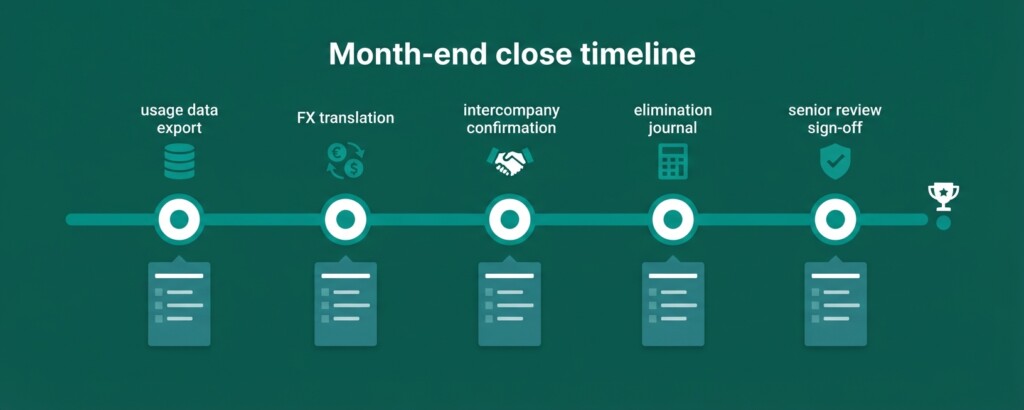
Because the licence fee is usage-based and invoiced in arrears, SalesCo should accrue the estimated cost at each month-end based on usage data it has access to. TechSub should accrue the matching revenue. In practice, TechSub’s finance team controls the usage data and therefore has better information. A simple intercompany reporting process — TechSub sends a preliminary usage report to SalesCo by, say, the 3rd business day after month-end — allows both entities to book the same number before close.
If SalesCo and TechSub book different amounts at month-end, you will have a consolidation difference that is not an FX difference — it is a genuine mismatch in the recorded intercompany balances. This cannot be resolved by adjusting the FCTR. It needs an intercompany reconciliation before close, an agreed adjustment to one entity’s books, and a documented reason for any residual. Leaving unreconciled intercompany differences in the consolidation and labelling them as ‘FX’ is a common source of audit findings.
Group Reporting: What Management Actually Wants to See
Once the consolidation is mechanically correct, the question becomes what management reporting structure makes sense for a group like this. GroupCo’s CFO probably wants to see three views: the group consolidated P&L (eliminations applied, NCI split out), segment reporting by entity or geography, and a contribution analysis that shows how much of TechSub’s revenue is external versus intercompany.
The intercompany licence fee is real economic activity — it reflects the cost of platform usage and should influence SalesCo’s pricing decisions and TechSub’s investment case. Eliminating it at the group level does not mean it should disappear from management reporting. Many groups maintain a ‘management basis’ view alongside the statutory consolidation, keeping the intercompany fee visible as a transfer price so business unit managers can be held accountable for the full economics of their operations.
- Agree intercompany pricing methodology and document it in an ICA, including how usage is measured, who provides the data, and when the invoice is raised.
- Establish a month-end close calendar that requires TechSub to send usage data to SalesCo before both entities finalise their books.
- Translate each entity to GBP using consistent rates (average for P&L, closing for balance sheet) before attempting any eliminations.
- Run the intercompany elimination at the group consolidation level, not in the individual entity ledgers.
- Calculate NCI on SalesCo’s standalone profit without adding back consumed intragroup service expenses.
- Record any residual FX difference on elimination in the FCTR, with documentation explaining the source.
- Maintain a management reporting view that retains transfer pricing visibility for business unit performance management.
Financial Close: Where the Process Breaks Down in Practice
Most of the pain in this type of consolidation comes not from the accounting theory but from the process. TechSub’s close depends on finalising usage data that it effectively controls but that SalesCo needs. SalesCo’s close depends on receiving that data. GroupCo’s consolidation close depends on both entities being closed, translated, and reconciled. Stack three time zones on top of this — Ireland, Australia, and the UK — and a five-day close target becomes genuinely difficult.
The manual version of this process typically involves: exporting trial balances from three different accounting systems, translating them manually in Excel using rates sourced from a third-party feed, identifying intercompany balances through a combination of account coding and email, reconciling differences, posting eliminations in a consolidation spreadsheet, and then rebuilding the group P&L and balance sheet from scratch. Each step introduces the risk of formula errors, rate errors, and missed eliminations.
Automated consolidation tools address this by pulling trial balances directly from the source systems, applying FX translation consistently, flagging intercompany mismatches before close, and running eliminations as configured rules rather than manual journal entries. The result is not just a faster close — it is a more auditable one, because every elimination and translation is traceable back to a configured rule rather than a cell reference in a spreadsheet.
Transfer Pricing and Tax Considerations
A usage-based intercompany licence fee between entities in different tax jurisdictions is a transfer pricing matter as well as a consolidation matter. The arm’s-length principle requires that the fee be set at a price that unrelated parties would agree to. For a SaaS platform, this typically means benchmarking against comparable third-party SaaS licence fees or using a cost-plus methodology applied to TechSub’s platform costs.
From a consolidation perspective the transfer price does not affect the eliminated group result — whatever the number is, it cancels out. But it absolutely affects the split of profit between jurisdictions, the tax charge in each entity, and therefore the effective group tax rate. A fee set too high benefits TechSub’s jurisdiction (Ireland, in this example, with a relatively low corporation tax rate) and reduces SalesCo’s Australian taxable profit. Tax authorities in both jurisdictions will scrutinise this, and the group should have contemporaneous documentation supporting the methodology.
Making the Consolidation Repeatable
The goal is a consolidation process that can be run consistently every month without heroic effort from the finance team. The building blocks are: clean intercompany account coding in each entity’s chart of accounts; a shared intercompany confirmation process run before close; documented FX rate sources and translation rules; a consolidation model (whether tool or spreadsheet) with the elimination logic built in rather than re-entered each month; and a review checklist that someone senior signs off before the numbers are released.
For a three-entity group like this one, a well-structured Excel consolidation model can work — but it becomes fragile as the group grows, as the number of intercompany relationships increases, and as audit and investor scrutiny intensifies. The transition point is usually when the finance team is spending more time maintaining the model than using it. Dedicated consolidation software removes the model-maintenance burden and makes it straightforward to add new entities, currencies, or intercompany relationships without rebuilding from scratch.
How BrizoConsol handles this
BrizoConsol connects directly to the accounting systems each entity uses — if TechSub is on Xero and SalesCo is on QuickBooks Online, trial balances pull in without manual exports. Rates for EUR/GBP and AUD/GBP are imported and applied automatically: average rates to P&L lines, closing rates to balance sheet items, with the residual translation difference posted to the FCTR rather than left as an unexplained variance. You can read more about how that works on the currency translation page.
The usage-based licence elimination is set up once as a configured intercompany rule under the relevant intercompany type. Each month, BrizoConsol flags any mismatch between TechSub’s recognised revenue and SalesCo’s accrued expense before you run the elimination, so the reconciliation happens before close rather than after. NCI for SalesCo is calculated on SalesCo’s standalone profit without incorrectly adding back the consumed licence cost, and the 20% attribution flows through to the consolidated statements automatically. The intercompany eliminations page covers how elimination types and difference treatment are configured. Every elimination and translation step is recorded in a searchable audit trail, so there is nothing to reconstruct at year-end.
Stop building consolidations in spreadsheets.
BrizoConsol automates multi-entity consolidation — setup in minutes, reports the same day.