How to Consolidate a Multi-Entity SaaS Group When Subsidiaries Recognise Deferred Revenue on Different Schedules Across Xero and QuickBooks
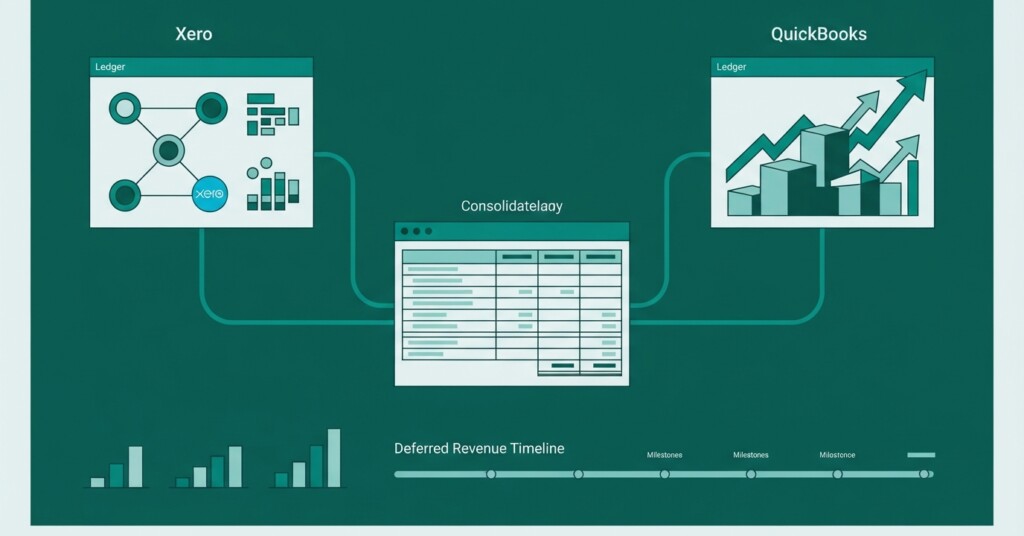
If you run a SaaS group with two or more subsidiaries, you have almost certainly encountered this problem: one entity books a twelve-month subscription upfront and releases it monthly through Xero, while another entity recognises the same type of contract over the delivery milestone in QuickBooks. At month-end, your consolidation spreadsheet starts fighting itself. Intercompany invoices hit deferred revenue on one side and recognised revenue on the other. Exchange rates move between the invoice date and the reporting date. And your minority shareholder wants to see their share of earnings calculated on a consistent basis. This article walks through the real accounting issues and practical steps to consolidate a multi-entity SaaS group where deferred revenue schedules differ across platforms.
Why Deferred Revenue Timing Creates a Consolidation Problem
IFRS 15 and ASC 606 both require revenue to be recognised when — or as — performance obligations are satisfied. In practice, SaaS businesses satisfy obligations either over time (access to a platform) or at a point in time (onboarding, implementation, or a discrete feature unlock). When two subsidiaries in the same group apply different recognition schedules, even for contracts with identical commercial terms, the group consolidated P&L will be distorted unless you normalise the timing at consolidation. The problem deepens when those subsidiaries sit in different accounting platforms. Xero and QuickBooks both handle deferred revenue, but they store it differently, report it differently, and export it in formats that do not map to each other without manual effort.
The core issue is not which platform is ‘right.’ It is that consolidation requires the group to apply a single accounting policy. If Sub A releases deferred revenue daily on a straight-line basis and Sub B releases it monthly on the first of each month, the group must pick one method and restate or adjust accordingly before eliminations.
Consolidate your Xero entities — automatically.
BrizoConsol pulls from all your Xero organisations and delivers group reports in minutes.
Setting a Consistent Group Revenue Recognition Policy
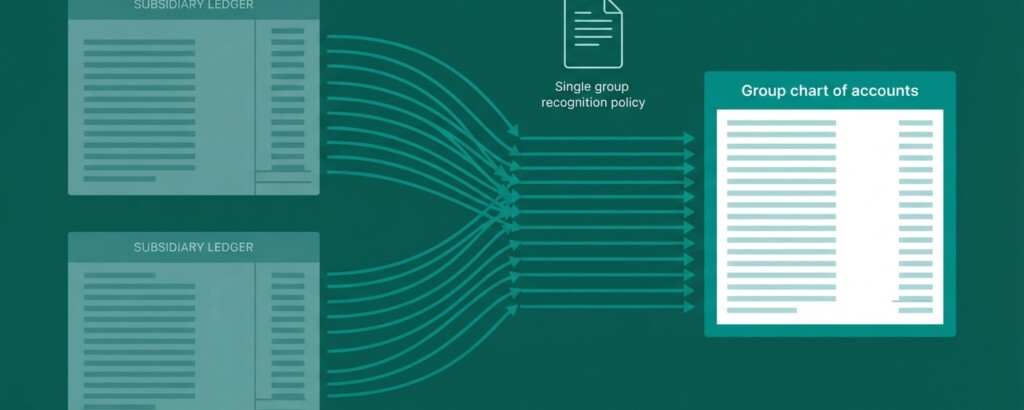
Before you touch a spreadsheet, the group finance policy needs to be explicit. Define whether subscription revenue is recognised daily straight-line or monthly. Define how implementation fees are treated — are they distinct performance obligations or bundled with access? Define the cutoff rule: does ‘month-end’ mean the last calendar day or the last business day? Once policy is clear, each subsidiary’s ledger balances become inputs that may need adjustment at consolidation level, even if you cannot — or do not want to — change the underlying subsidiary books.
In many SME groups, the subsidiary controllers are not willing or able to reopen and rebook entries mid-month. The practical answer is to apply top-side consolidation adjustments that bring both entities onto the group policy without touching the subsidiary general ledgers. These adjustments live in the consolidation working paper and are reversed at the start of the next period.
Mapping Deferred Revenue Accounts Across Xero and QuickBooks
Xero stores deferred revenue as a liability account, typically under ‘Revenue in Advance’ or a custom account the user has created. QuickBooks Online uses ‘Deferred Revenue’ as a liability line, but the chart of accounts code will differ, and the balance sheet classification can vary depending on whether the user has separated current and non-current portions. Before any elimination or policy adjustment, you need a group chart of accounts that each subsidiary account maps to. This is the account mapping layer.
| Subsidiary | Platform | Local Account Name | Local Account Code | Group COA Mapping | Group Code |
|---|---|---|---|---|---|
| Sub A (UK) | Xero | Revenue in Advance | 2300 | Deferred Revenue — Current | L4010 |
| Sub A (UK) | Xero | Deferred Revenue — LT | 2310 | Deferred Revenue — Non-Current | L4020 |
| Sub B (US) | QuickBooks | Deferred Revenue | 2500 | Deferred Revenue — Current | L4010 |
| Sub B (US) | QuickBooks | Deferred Revenue LT | 2510 | Deferred Revenue — Non-Current | L4020 |
| Sub B (US) | QuickBooks | Unearned Revenue | 2520 | Deferred Revenue — Current | L4010 |
The mapping exercise also reveals misclassifications. Sub B in this example has ‘Unearned Revenue’ sitting separately from ‘Deferred Revenue’ — in the group view, they are the same thing. Collapsing them at the mapping stage prevents double-counting in the consolidated balance sheet.
Intercompany Deferred Revenue: The Elimination You Cannot Skip
SaaS groups frequently have intercompany arrangements — a parent entity sells licences or IP to a subsidiary, which in turn sells to external customers. If the parent recognises revenue from the intercompany sale while the subsidiary still holds the licence cost in prepayments or has not yet delivered to third-party customers, the group is counting income that has not yet been earned from a third-party perspective. This is one of the most common errors in SaaS consolidations produced in Excel.
Consider this example: Parent Co (UK) invoices Sub B (US) £60,000 for a twelve-month platform licence on 1 January. Over Q1 (through 31 March), Parent Co recognises £15,000 (£5,000 per month) in intercompany revenue and carries £45,000 in intercompany deferred revenue. Sub B recognises £15,000 in intercompany cost of sales and carries £45,000 in intercompany prepayments. At group level, this intercompany revenue and intercompany cost of sales, as well as the remaining intercompany deferred revenue and prepayments, must both be eliminated.
| Account | Dr | Cr |
|---|---|---|
| Intercompany Revenue (Parent Co) | 15,000 | |
| Intercompany Deferred Revenue Liability (Parent Co) | 45,000 | |
| Intercompany Cost of Sales (Sub B) | 15,000 | |
| Intercompany Prepayments (Sub B) | 45,000 |
Q1 consolidation elimination of intercompany SaaS licence revenue recognised by Parent Co against matching intercompany cost of sales in Sub B, alongside the unearned intercompany deferred revenue and prepayments. Intercompany P&L and balance sheet positions are fully removed at the group level. Entry is prepared in the consolidation workpaper and does not touch subsidiary ledgers.
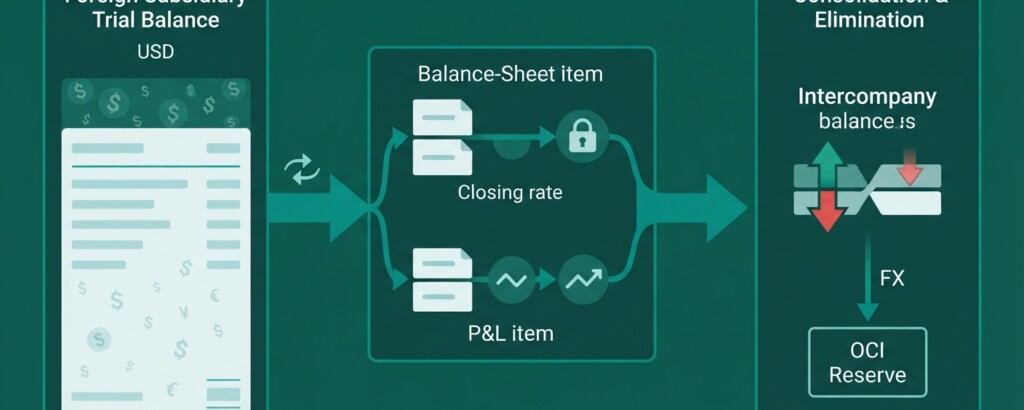
When Sub B holds intercompany balances in USD and Parent Co invoiced in GBP, the elimination must use consistent exchange rates on both sides. If you eliminate Sub B’s costs or balances translated at one rate against Parent Co’s revenue or balances recorded at another, you will create a spurious FX imbalance in your consolidated statements. Document the rate used for each intercompany elimination explicitly.
FX Translation of Deferred Revenue Balances
Under IAS 21 (and US GAAP ASC 830), deferred revenue is classified as a non-monetary liability because it represents an obligation to deliver software or services rather than cash. However, when translating a foreign operation (such as USD-functional Sub B into GBP presentation currency), IAS 21.39 requires all assets and liabilities on the balance sheet — both monetary and non-monetary — to be translated at the closing exchange rate at the reporting date, with P&L items translated at average rates. The resulting exchange differences from translating the net assets of the subsidiary are recognized in other comprehensive income (OCI) in the foreign currency translation reserve. This is where SME consolidations often go wrong, such as when finance teams mistakenly translate the entire trial balance at the average rate for simplicity, which misrepresents the closing balance sheet.
| Sub B deferred revenue balance at 31 March (USD) | $180,000 |
| Closing rate GBP/USD at 31 March | 1.27 |
| Translated deferred revenue liability (GBP) | £141,732 |
| Deferred revenue at 1 January translated at opening rate (1.22) | £147,541 |
| FX translation difference on deferred revenue liability (OCI) | £5,809 |
The £5,809 difference reflects the fact that sterling strengthened against the dollar (from 1.22 to 1.27) — meaning fewer pounds are required to translate the USD liability. In group consolidation, this translation movement forms part of the foreign currency translation reserve in OCI, not the group P&L. If your consolidated revenue looks unusually high or low, check whether FX differences on deferred revenue are being incorrectly routed through revenue rather than OCI.
Non-Controlling Interests and Deferred Revenue
If the group owns 75% of Sub B, the 25% non-controlling interest (NCI) has a claim on Sub B’s net assets — including the future earnings embedded in deferred revenue balances. NCI is measured at acquisition on either the full goodwill or proportionate share basis. But at each reporting date, the NCI share of post-acquisition net assets moves with retained earnings and OCI. The deferred revenue balance itself is not split between the group and NCI on the face of the balance sheet — 100% of the third-party liability is recognised in full on the consolidated balance sheet (only intercompany balances are eliminated). What the NCI does share is the profit recognised when that deferred revenue is released to the P&L.
In practical terms, when Sub B releases $15,000 of deferred revenue in Q1, the group P&L includes that $15,000 (after intercompany elimination of any intra-group portion). Of the profit attributable to that release, 25% flows to NCI in the profit attribution schedule. The NCI balance on the consolidated balance sheet increases accordingly.
Running the Month-End Close Across Two Platforms
The sequencing of month-end matters when deferred revenue schedules are on different platforms. A practical close checklist for a two-entity SaaS group running Xero and QuickBooks might look like this:
- Lock the Sub A (Xero) period on the last calendar day. Export trial balance as at that date in GBP.
- Lock the Sub B (QuickBooks) period. Export trial balance in USD. Confirm no entries have been posted after the cutoff.
- Confirm the deferred revenue schedule for each entity: how much was released this month, what remains on the balance sheet, and whether any new contracts were invoiced and deferred.
- Map both trial balances to the group chart of accounts using the account mapping table.
- Apply FX translation to Sub B using the month-end closing rate for balance sheet items and the average rate for P&L items.
- Calculate and post the FX translation reserve adjustment to OCI.
- Identify all intercompany balances: receivables, payables, intercompany revenue, and intercompany deferred balances.
- Prepare and post the intercompany elimination journals in the consolidation workpaper.
- Apply any policy normalisation top-side adjustments for differences in deferred revenue recognition methodology.
- Calculate NCI share of Sub B net profit for the period.
- Produce the consolidated trial balance and draft financial statements.
When this process runs through a spreadsheet, each step is a manual data pull, a paste, a formula, and a reconciliation check. A single missed mapping or a wrong exchange rate cascades through every downstream calculation. Finance teams in growing SaaS groups frequently describe spending three to five days per month on this process, with a significant portion of that time on reconciling intercompany deferred revenue differences rather than analysing the business.
Where Automated Consolidation Changes the Workflow
Consolidation software that connects directly to both Xero and QuickBooks can pull trial balances automatically at period-end, apply a pre-configured account mapping, run FX translation using a live or manually entered rate, and surface intercompany mismatches for resolution rather than asking the finance team to find them. The eliminations and policy adjustments still require human judgement — the system cannot decide whether your deferred revenue policy is daily or monthly straight-line — but once the policy is configured, the mechanical application of it across multiple periods becomes repeatable and auditable without rebuilding the spreadsheet each month.
The audit trail is particularly important for SaaS groups approaching external audit or investor due diligence. When an auditor asks why the Sub B deferred revenue balance moved the way it did, being able to show a structured elimination schedule with rates, dates, and policy notes is significantly more defensible than a colour-coded Excel file with a note saying ‘see old version in the shared drive.’
A Practical Summary for SaaS Finance Teams
Consolidating a multi-entity SaaS group where subsidiaries recognise deferred revenue on different schedules across different platforms is not primarily a technology problem. It is a policy problem, an account mapping problem, and a process sequencing problem. Get the group revenue recognition policy documented and agreed first. Build the account mapping table so that both Xero and QuickBooks outputs speak the same language. Handle FX translation by translating foreign subsidiary balance sheet balances at closing rates with differences routed to OCI. Eliminate intercompany revenue, costs, and deferred balances at the group level, using consistent exchange rates on both sides of the entry. Calculate NCI on the profit recognised, while consolidating 100% of third-party deferred revenue liabilities. And run month-end in a defined sequence so that no adjustment is applied before the data it depends on is finalised. Done consistently, this process produces a defensible, auditable consolidation — whether it runs through a well-structured spreadsheet or a purpose-built consolidation platform.
See Multi-Entity Consolidation Without the Spreadsheet Marathon
BrizoConsol connects to Xero and QuickBooks, maps your chart of accounts, handles FX translation, and surfaces intercompany mismatches automatically — so your month-end close focuses on judgement, not data wrangling.