How to Consolidate a Manufacturing Group Where a Central Procurement Entity Buys Raw Materials and On-Sells to Production Subsidiaries at a Mark-Up
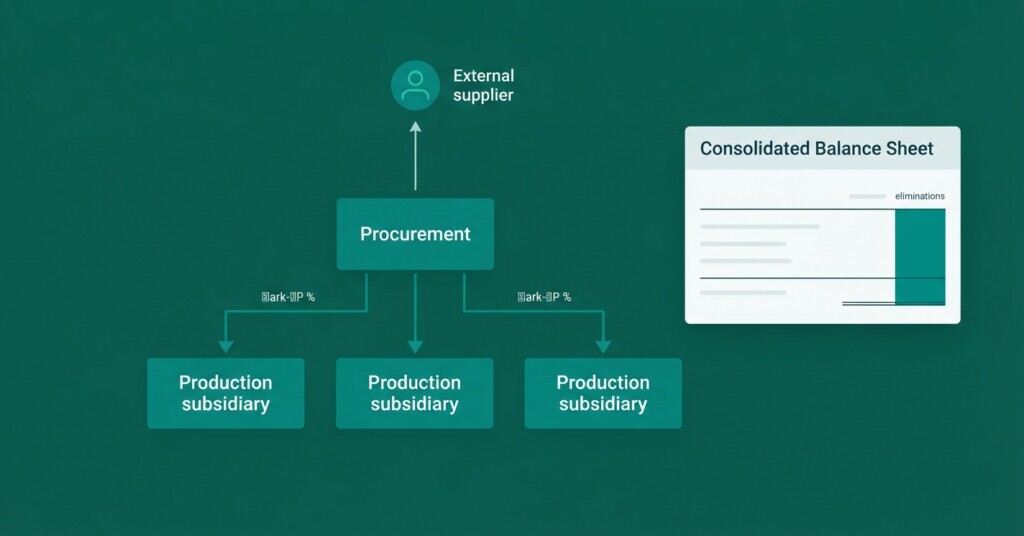
Many manufacturing groups operate with a centralised procurement model: one legal entity negotiates with suppliers, purchases raw materials in bulk, and then on-sells those materials to the operating production subsidiaries at a mark-up. The arrangement makes commercial sense — bulk purchasing lowers unit costs, and the procurement entity can recover its overhead and earn a margin — but it creates a series of intercompany accounting challenges that can turn month-end consolidation into a painful manual exercise. This article walks through the key problems, the correct accounting treatment, and practical guidance for finance teams managing this type of group structure.
Why the Central Procurement Model Creates Consolidation Complexity
In a straightforward group, intercompany eliminations tend to be clean: a parent lends money to a subsidiary, or one entity provides a management fee to another. The transactions are often one-directional and easy to trace. A central procurement entity changes the picture in several ways. First, the procurement entity carries inventory that has been purchased from third-party suppliers but not yet on-sold. Second, when it sells to production subsidiaries, it books revenue and a profit margin. Third, the production subsidiaries carry that purchased inventory at cost to them — which includes the mark-up. When those subsidiaries then consume the materials in production and sell finished goods to external customers, the cost of goods sold recorded in the consolidated accounts is overstated by the amount of the intercompany mark-up that has not yet been eliminated. Finally, if any raw material inventory transferred to a production subsidiary remains unconsumed or unsold at period end, that inventory is carried at an inflated value on a gross basis across the group.
Mapping the Intercompany Flows Before You Start
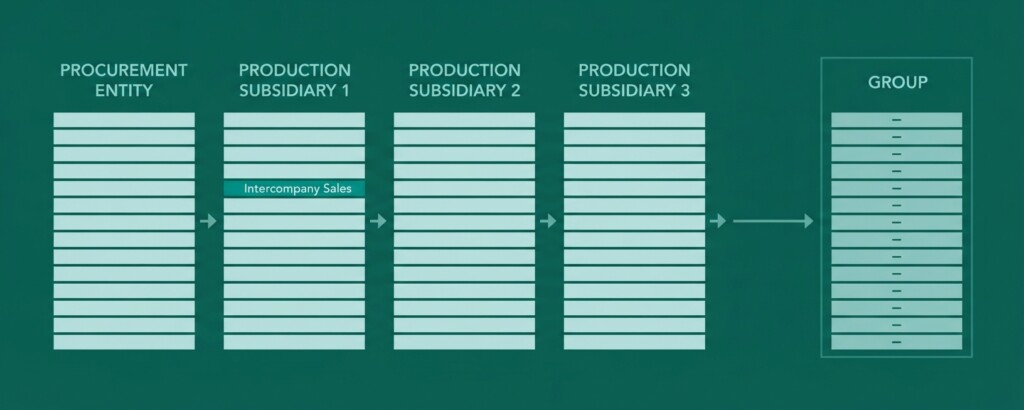
Before attempting any elimination journal, it is worth mapping exactly what flows exist and at what point in the process inventory sits. For a typical month you will need to identify: the total purchases made by the procurement entity from external suppliers; the total on-sales from the procurement entity to each production subsidiary and the mark-up percentage applied; the closing inventory held by the procurement entity (materials not yet on-sold); the closing inventory held by each production subsidiary (materials purchased from the procurement entity but not yet consumed); and the cost of goods sold in each production subsidiary that includes the intercompany mark-up. This mapping exercise is the foundation for every elimination entry you will need to make.
Stop building consolidations in spreadsheets.
BrizoConsol automates multi-entity consolidation — setup in minutes, reports the same day.
Practical tip: Agree a fixed, documented transfer price policy for the procurement entity at the start of the year. A consistent mark-up percentage — say 15% on cost — makes reconciliation far simpler than a mark-up that varies by material category or negotiation each month. Transfer pricing documentation also becomes important for tax purposes if the entities are in different jurisdictions.
Step One — Eliminate Intercompany Sales and Purchases
The first elimination removes the revenue recorded by the procurement entity against the corresponding purchases recorded by the production subsidiaries. This entry has no net effect on group profit or inventory value on its own — it simply removes the gross-up from both the income statement and the cost line. Suppose the procurement entity sold £2,000,000 of raw materials to production subsidiaries during the period at a 15% mark-up on its own cost of £1,739,130.
| Account | Dr | Cr |
|---|---|---|
| Intercompany Sales Revenue — Procurement Entity | 2000000 | |
| Intercompany Purchases — Production Subsidiaries | 2000000 |
Eliminate intercompany sales of raw materials from procurement entity to production subsidiaries. The gross revenue and corresponding purchase cost recorded in each subsidiary are removed on consolidation. This entry is made at the transfer price (£2,000,000), not at the procurement entity’s cost.
Step Two — Eliminate the Unrealised Profit in Closing Inventory
Eliminating the top-line intercompany sale is not enough. Any inventory that has been transferred to a production subsidiary and remains unconsumed or unsold at period end contains an element of profit that has not yet been realised through a sale to an external third party. Until those materials are sold to an outside customer, the group profit embedded in the transfer price must be deferred. The adjustment reduces the carrying value of inventory to what it cost the group as a whole — i.e. the original third-party supplier cost — and reduces consolidated retained earnings or cost of goods sold accordingly.
Assume that at month end, production subsidiaries collectively hold £600,000 of raw material inventory purchased from the procurement entity. At a 15% mark-up on the procurement entity’s cost, the procurement entity’s original cost for that inventory was £521,739, meaning £78,261 of unrealised intercompany profit is embedded in that closing inventory balance.
| Closing inventory held by production subsidiaries (at transfer price) | £600,000 |
| Divide by 1.15 to arrive at procurement entity original cost | £521,739 |
| Unrealised intercompany profit to be eliminated | £78,261 |
| Account | Dr | Cr |
|---|---|---|
| Cost of Goods Sold (Group) | 78261 | |
| Inventories — Production Subsidiaries | 78261 |
Eliminate unrealised profit embedded in raw material inventory held by production subsidiaries at period end. The inventory is restated to the procurement entity’s original third-party purchase cost. This reduces consolidated inventory and increases consolidated cost of goods sold by £78,261.
Step Three — The Procurement Entity’s Own Closing Inventory
Do not overlook the inventory still sitting with the procurement entity itself. If the procurement entity purchased materials from external suppliers but had not yet on-sold them to production subsidiaries at period end, that inventory is already recorded at external cost — so no intercompany elimination is needed for those materials from a profit perspective. However, you do need to ensure that no intercompany receivable or payable has been incorrectly booked in relation to goods that have not yet been transferred. In practice this means confirming that the procurement entity’s inventory ledger and the intercompany payables in the production subsidiaries are properly reconciled to actual goods movements, not just invoice dates.
Watch for timing differences between when the procurement entity raises an intercompany invoice and when the production subsidiary receives and receipts the goods. If an invoice is raised at month end but goods are still in transit, the procurement entity may have derecognised inventory and booked an intercompany receivable, while the production subsidiary has not yet booked the inventory. On consolidation, this creates a mismatch that inflates the group’s intercompany eliminations. Establish a clear cut-off policy — goods in transit should be carried in a single entity’s books at period end.
Intercompany Balances — Receivables and Payables
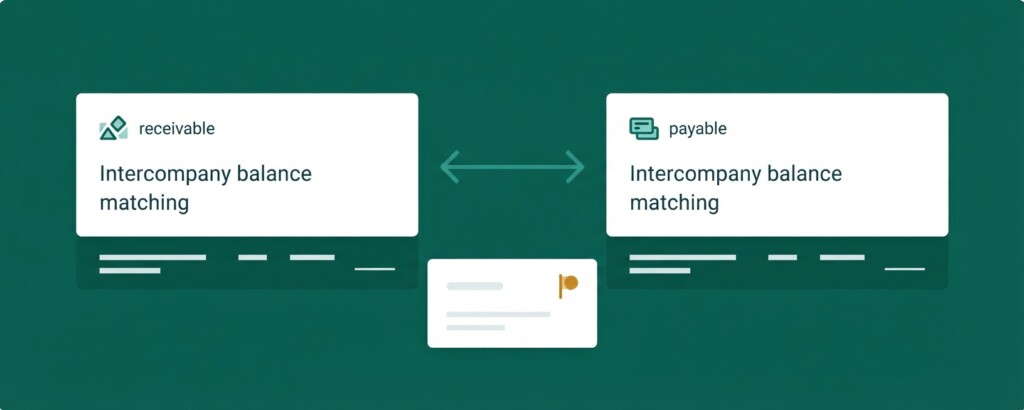
The procurement entity will carry an intercompany receivable for amounts owed by production subsidiaries for materials supplied. Each production subsidiary will carry a corresponding intercompany payable. On consolidation these must eliminate against each other in full. Differences are a common source of consolidation errors and usually arise from timing differences, unapplied payments, or currency differences where entities are in different functional currencies. Building a formal intercompany matching schedule — comparing the procurement entity’s receivables ledger with each subsidiary’s payables ledger before consolidation — is a basic control that saves significant time at close.
FX Translation When Procurement and Production Are in Different Currencies
The complexity increases materially when the procurement entity operates in one functional currency and production subsidiaries operate in others. Suppose the procurement entity is a UK entity with a GBP functional currency, and one production subsidiary is a Polish entity with a PLN functional currency. The intercompany transaction is denominated in GBP. In its standalone accounts, the Polish subsidiary records its purchase in PLN at the spot rate on the transaction date and remeasures its intercompany payable at the closing rate at period end under IAS 21, recognising a foreign exchange gain or loss in profit or loss. When the Polish subsidiary’s balance sheet is translated into GBP at the closing rate on consolidation, the intercompany payable translates to exactly £2,000,000 and eliminates in full against the procurement entity’s receivable. Crucially, under IAS 21 paragraph 45, the foreign exchange difference recognised on an intragroup trade balance cannot be eliminated on consolidation; it remains recognised in consolidated profit or loss because the group as a whole is exposed to currency fluctuations. Only monetary items that form part of a net investment in a foreign operation have their exchange differences recognised in other comprehensive income (OCI).
| Intercompany Item | Procurement Entity (GBP) | Production Subsidiary (PLN translated to GBP) | Consolidation Treatment |
|---|---|---|---|
| Intercompany receivable / payable — raw material supply | £2,000,000 | £2,000,000 (at closing rate) | Eliminated in full against each other on the consolidated balance sheet |
| Foreign exchange difference on intercompany payable | — | £32,000 (remeasurement in P&L) | Retained in consolidated profit or loss under IAS 21.45 (not OCI) |
| Unrealised profit in closing inventory | £78,261 | £78,261 (at closing rate) | Eliminated against consolidated inventory and COGS |
Non-Controlling Interests and the Profit Elimination
If any of the production subsidiaries are not wholly owned — say the group owns 80% of a production subsidiary and an external party holds the remaining 20% — accounting for the unrealised profit requires careful analysis of who recorded the profit. Under IFRS 10, 100% of the unrealised profit is eliminated against consolidated inventory regardless of ownership percentage. However, the attribution of that elimination depends on whether the transaction is downstream or upstream. In this central procurement model, the sale is downstream (the parent or wholly owned procurement entity sells to the partially owned production subsidiary). Because the unrealised profit was recorded entirely by the selling procurement entity, the elimination is allocated 100% to the controlling interest; the NCI is unaffected because it has no interest in the procurement entity’s profit. The NCI’s share of profit and equity is only adjusted when the sale is upstream (a partially owned subsidiary sells to the parent or fellow subsidiary) or lateral from an entity in which an NCI exists.
Building a Repeatable Consolidation Workbook
Finance teams that handle this type of group structure entirely in Excel often find that the workbook grows in complexity over time to the point where it becomes fragile: a single wrong cell reference can cascade errors through multiple elimination schedules. A more robust approach — whether in a dedicated consolidation tool or a well-governed Excel model — separates the process into distinct stages: (1) trial balance upload for each entity in local currency; (2) FX translation to presentation currency at the appropriate rates; (3) intercompany matching and agreement; (4) elimination journals for intercompany sales, purchases, and balances; (5) unrealised profit adjustments for inventory; (6) NCI calculations; and (7) consolidated financial statement output. Each stage should be independently reviewable and auditable. The elimination journals should reference source documentation — intercompany invoices, goods receipts, and transfer price calculations — so that an auditor or a new team member can trace every adjustment.
A common efficiency gain comes from requiring the procurement entity to code intercompany sales transactions with a specific intercompany revenue account and a subsidiary identifier at the point of posting — rather than trying to extract and analyse them from a general revenue account at month end. The same discipline applied in each production subsidiary’s purchases ledger means intercompany matching can be automated or semi-automated rather than performed manually each period.
Period-End Checklist for This Type of Group
- Reconcile the procurement entity’s intercompany sales ledger against each production subsidiary’s intercompany purchases ledger before posting any consolidation journals.
- Confirm the cut-off position for goods in transit and agree which entity carries the inventory at period end.
- Calculate the unrealised profit in closing inventory for each production subsidiary using the consistent mark-up formula.
- Confirm that exchange differences arising on intercompany trade balances are recognised in profit or loss in accordance with IAS 21.45, while translation differences from converting foreign operations’ net assets are routed to the translation reserve in OCI.
- Post elimination journals: intercompany sales and purchases, intercompany receivables and payables, and unrealised profit in inventory.
- Verify whether any unrealised profit eliminations affect NCI — noting that downstream sales from a parent or wholly owned procurement entity do not affect NCI.
- Reconcile consolidated retained earnings back to the sum of entity retained earnings adjusted for all eliminations.
- Review the consolidated cost of goods sold margin — an unexpected margin improvement relative to prior periods often signals that an unrealised profit elimination has been missed.
Where Automation Makes a Meaningful Difference
The manual effort in this consolidation model concentrates in two places: intercompany matching and the unrealised profit calculation. When the procurement entity sells to three or four production subsidiaries across multiple currencies every month, with different volumes and different product categories each period, recalculating the unrealised profit in closing inventory in Excel becomes a significant and error-prone task. Tools that connect directly to each entity’s accounting data — reading the inventory sub-ledger, identifying intercompany-coded transactions, and applying the documented transfer price formula — can reduce the time spent on these calculations and create a documented, repeatable audit trail. The same connection to live data eliminates the manual trial balance collection step that often adds days to the consolidation timeline. The goal is not to remove accountant judgement from the process — the transfer price policy, cut-off decisions, and NCI adjustments still require professional assessment — but to remove the mechanical re-keying and reconciliation that consumes time without adding insight.
See How Consolidation Works for Multi-Entity Manufacturing Groups
BrizoConsol is built for finance teams managing complex group structures with intercompany trading, FX translation, and NCI. Connect your entities, automate eliminations, and close faster each month.